

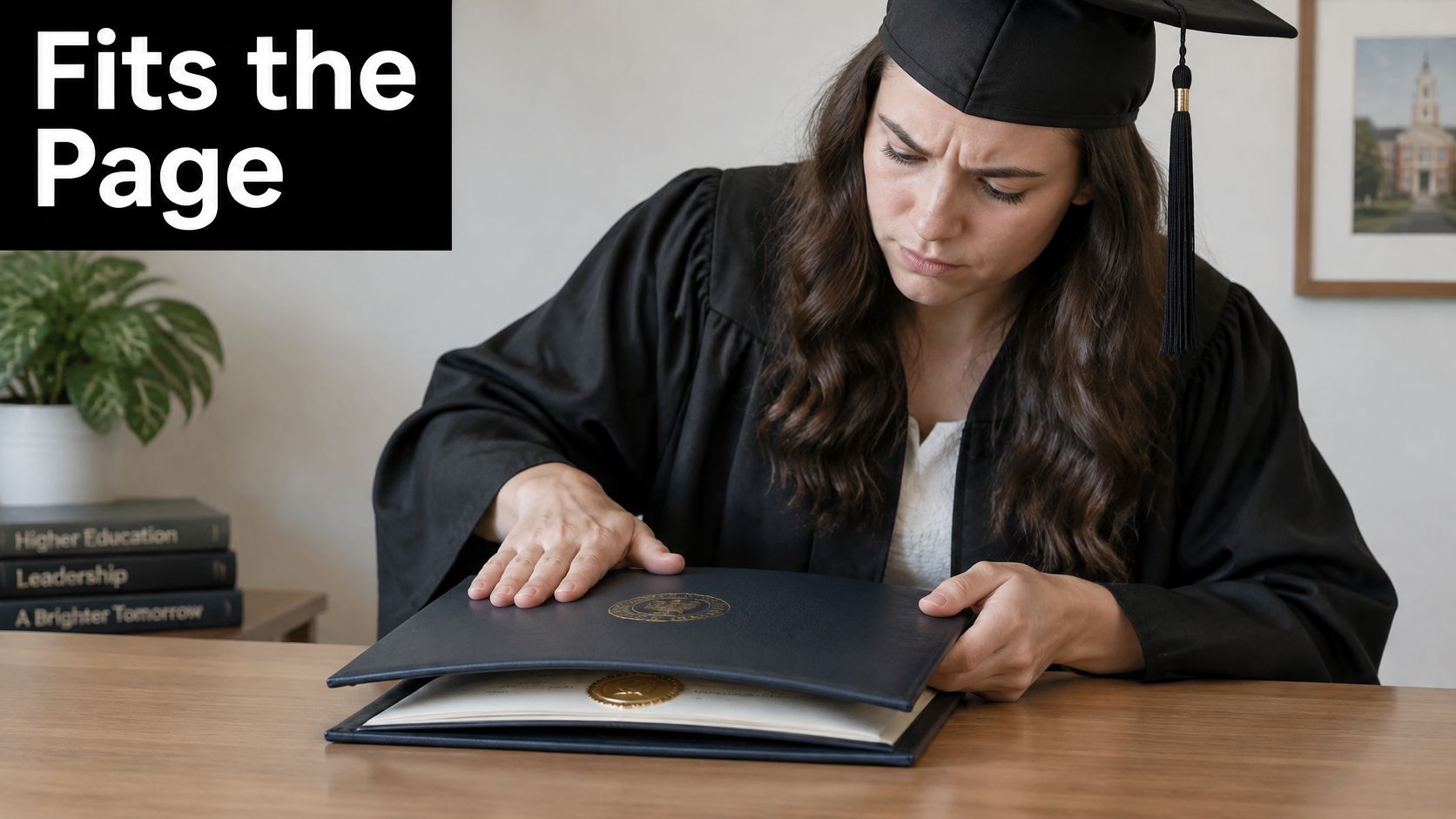
You set the diploma on the desk, tuck its corners into a new cover, and try to close it. The folder bows over the raised seal. Nothing looks wrong in the product photo, but the document in your hands clearly needs something different.
A good diploma cover guide starts with that moment, not with colors or gold lettering. The right purchase should work for commencement photos, the trip home, and the day you need to retrieve the original years later.
Why the Cover Has to Fit the Page
A diploma cover is a rigid, flat-opening enclosure that presents your credential and protects it from bending during handling. It isn't a picture frame, and it isn't a backup of your school records. Think of it as a passport wallet for an academic document: the enclosure must suit what goes inside.
Say your diploma has an embossed seal near the bottom corner. The page fits between the cover's edges, but the corner ribbon crosses the seal and the opposite panel presses against it. That's a poor fit, even though the advertised paper size seems correct.
Buy in the Order That Prevents Rework
Use this buying sequence before choosing a finish:
- Establish the document size. Measure the page or obtain the school's published dimensions, including orientation.
- Choose the supporting materials. Check the board, lining, retaining corners, and any clear insert.
- Select color and imprint. Decoration comes after fit and construction.
- Plan the presentation. Decide whether you're buying for yourself, giving a gift, or coordinating a group order.
The purchase rule: Buy a cover for the actual diploma, never a diploma-sized guess based on the degree name.
Institutional documents haven't always followed uniform formats: Harvard's diploma history describes Thomas Kast's 1769 A.B. diploma as an unusually large 24 inches wide. The practical lesson isn't to buy an oversized folder. It's to stop assuming that academic credentials share a universal shape.
Before opening a product listing, gather the diploma or the school's dimensions. Include a note about any raised seal, photograph, ribbon, or unusually thick paper.
Match the Cover to Your Diploma
A diploma may go through moves, airport trips, and years of storage before it reaches a frame. Start with the document's exact width and height: the cover should support the page without bending it or pressing on raised details.
Diploma sizes and cover interiors
| Credential example | Document size | Orientation | Cover interior | Fit note |
|---|---|---|---|---|
| Purdue undergraduate | 9 5/8 × 7 5/8 in | Horizontal | Larger than 9 5/8 × 7 5/8 in | Leave room for a raised seal |
| Purdue graduate or professional | 11 × 8 1/2 in | Horizontal | Larger than 11 × 8 1/2 in | Don't assume letter size |
| Common US letter certificate | 8 1/2 × 11 in | Vertical | Letter-size interior with clearance | Use only after measuring the actual page |
| Historical wide diploma | About 24 in wide | Confirm the original's layout | Custom rigid cover | Harvard 1769 example; not a modern default |
Purdue University's diploma dimensions provide useful examples for undergraduate and graduate or professional documents. Treat the table as a starting point, then check the current specification for the school that issued the diploma.
Measure the Page, Then Examine Its Shape
- Measure width and height. Lay the diploma on a clean, dry surface. Hold a ruler beside the page and record width before height.
- Confirm orientation. Read the document upright. Its shape determines how it sits in the cover and where retainers should hold it.
- Check raised features. Look across the seal, photograph, or ribbon from the side. The closed cover needs clearance above these details as well as around the page.
- Compare the measurements. Use the closest table row as a reference, then confirm the dimensions with the issuing institution before ordering.
Degree level alone doesn't determine size. A bachelor's diploma at one school may differ in shape from one issued elsewhere.
Check Usable Space, Not Outside Measurements
A cover's outside dimensions include its binding and board, so they don't show how much room the page has inside. Ask for the usable interior dimensions, supported document size, and retainer placement.
For an oversized diploma, the board should support every edge. If the paper extends beyond it, an unsupported edge can crease when someone lifts or carries the cover.
For a diploma you need to carry or store flat, explore Graduation Attire's diploma covers and compare each cover's usable interior with your document's measurements. If you plan to display it instead, the wood diploma frame guide explains framing; a frame's opening measurement is not the same as a cover's usable interior.
Finish by checking that the page lies naturally, the seal isn't compressed, and the cover closes without bending the diploma or pulling at its corners.
Choose Board and Sleeves That Stay Neutral
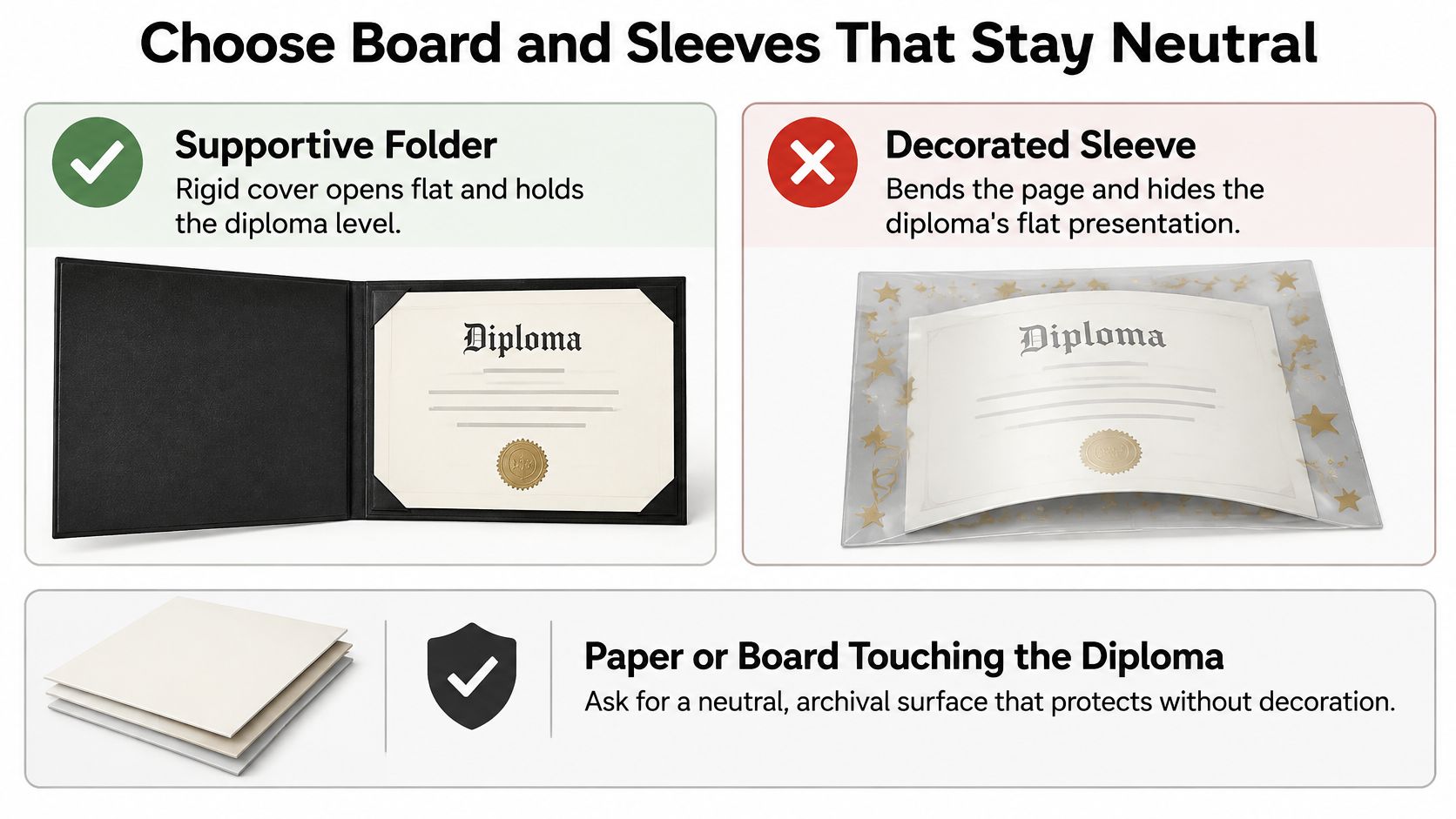
Archival is an unregulated label, not a complete material specification. A handsome diploma folder can still contain unsuitable board or an unidentified plastic sleeve. Ask what touches the document and what supports it.
A rigid cover that opens flat works like a supportive folder. A flexible decorated sleeve may look impressive when empty but bend with the page inside.
Specify the Contact Materials
Cover materials and what they do to a diploma
| Material | Best use | Main risk | What to require |
|---|---|---|---|
| Acid-free, lignin-free board | Long-term folder | Acidic substitute board can yellow paper | Named acid-free and lignin-free stock |
| Alkaline-buffered board | Aging paper | Not a cure for damp storage | Buffer plus a cool, stable room |
| Polyester film | Clear viewing insert | Static can lift friable ink | Support the sheet; avoid powdery media |
| Polypropylene or polyethylene | Protective sleeve | Still needs stable climate | Use these instead of unknown plastic |
| PVC | Not for long-term storage | Can release damaging acids | Don't choose it for the original |
Acid-free and lignin-free paper or board reduces exposure to acidic degradation products. Alkaline-buffered board can help neutralize acids as paper ages, but it doesn't repair existing damage.
A clear insert also requires judgment. Polyester can provide visibility without adhesive, yet its static charge can lift loose graphite, powdery pigment, or flaking media. Don't slide a fragile inscription into film just because the plastic itself is stable.
For packing around a protective enclosure, Storage & Removal Boxes Ltd's Acid Free White Packing Paper is a useful resource to evaluate. Packing paper isn't a replacement for rigid support, and anything placed directly against the diploma still needs suitable material specifications.
If the material list is vague, don't trust the cover with the only original.
Control What the Cover Can't
The Library of Congress preservation guidance recommends flat storage in a cool, stable environment at approximately 35–50% relative humidity, away from intense light, radiators, vents, attics, and basements.
The National Archives of India gives a paper-preservation range of approximately 22–25°C with 45–55% relative humidity, identifies polyester, polypropylene, and polyethylene as safer plastics, and warns against chemically unstable plastics including PVC. These are institutional recommendations, not a reason to chase changing settings every day; avoid dampness and large fluctuations.
For documented purchasing specifications, ISO's standards guidance identifies ISO 9706 as a permanent-paper benchmark and ISO 11798 as a benchmark for durable writing, printing, and copying. Neither a standard nor an expensive enclosure can compensate for heat, water, pollutants, or prolonged bright light.
Choose an interior cupboard or drawer in a regularly occupied room. Don't leave the cover on a sunny windowsill after the celebration.
Use Color and Imprint Without Hiding the Seal
Use color to signal the occasion; the diploma's own content does the protecting. Black and deep neutrals suit commencement photographs and an office setting without competing with the credential. Remember that this cover will appear in ceremony photos and then ride in carry-ons and moving boxes for years, so pick a shade you will still like long after the celebration ends.
A restrained school-color detail can connect the cover to the ceremony. This example shows how a coordinated presentation can work without putting decoration over the document.
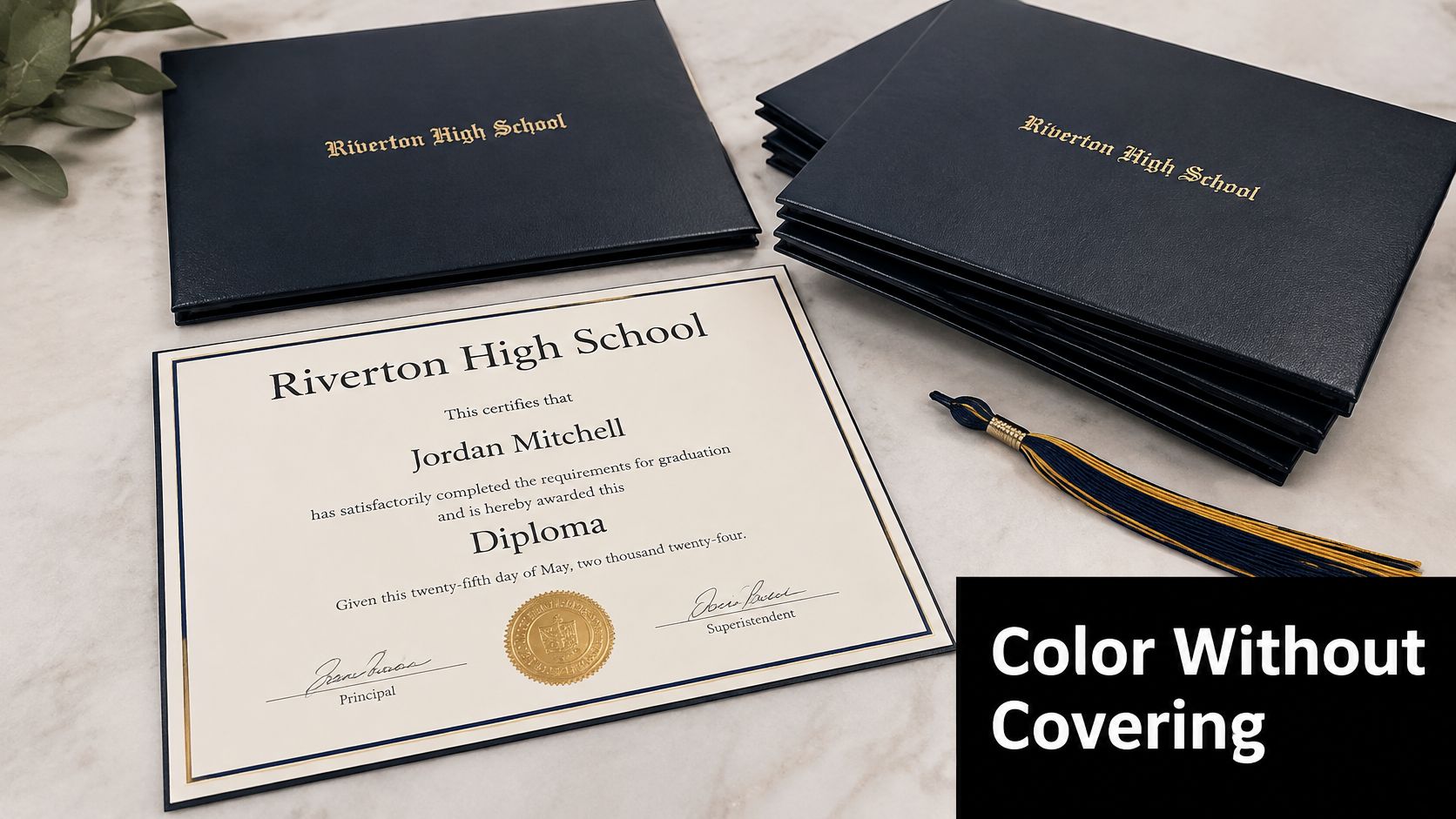
The diploma is the picture and the cover is the frame: decorate the frame, never the picture.
Put Personalization Outside the Reading Area
School colors work well as an exterior border, cord, foil line, or small imprint. Before approving any colored insert pressed against the diploma, ask the maker for the board and lining specification, so you know exactly what will rest against the paper through the next several moves.
Foil stamping usually sits on the outside, keeping the decorative treatment away from the diploma's ink. An inside printed panel needs a dry, non-smearing surface, with no adhesive crossing the document.
Before approving an imprint, check:
- Graduate name. Match spelling, accents, initials, and name order to the diploma exactly as printed. A cover that misspells the name keeps showing the error at every display.
- Degree and school. Use the wording you intend to preserve, rather than an informal abbreviation added in haste.
- Graduation year. Check the actual award information, especially when the celebration and degree conferral don't coincide.
- Reading direction. Confirm that the imprint is upright when the cover opens left to right and when the graduate holds it for a photograph.
The arrangement matters as much as the text. A large central emblem can look balanced on the outside but become distracting if repeated beside the signatures inside.
Choose a Detail That Means Something
For a nursing graduate, a small lamp symbol or program name on the exterior can be enough. Keep the diploma's own seal and professional wording unobstructed.
A first-generation graduate might prefer a short personal phrase to a busy pattern. Have that phrase printed or foil-stamped into the cover material itself; an adhesive label placed on the credential can peel, lift ink, or leave residue over time.
For a doctoral graduate, black with a restrained metallic line often works well because the large document already provides the visual focus. None of these choices requires filling every available surface.
Seeing a finished cover in motion helps you judge how it opens and how the document reads from across a room.
Open the proposed layout and look at it from across the desk. The diploma should be what you read first, with its seal, signatures, and photograph visible rather than tucked behind a decorative panel. If your eye lands on the decoration first, scale the imprint back.
Keep the Diploma Flat Through Moves and Damage
The ceremony is only the first stop. Your diploma may later travel through airports, sit in temporary accommodation, cross a border, or need replacement after a leak.
Create a Recoverable Record
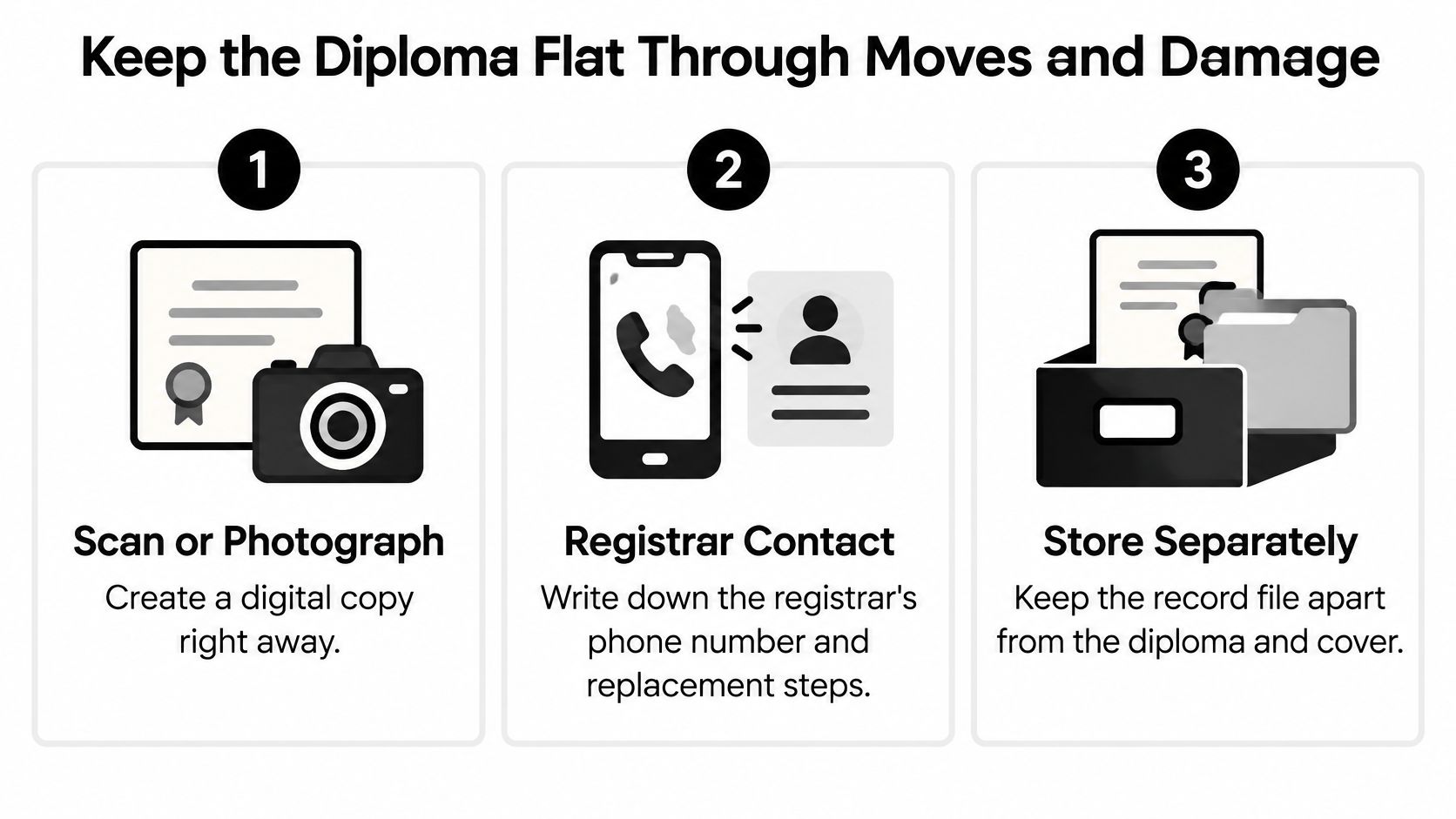
- Scan or photograph the document. Capture the entire page clearly, including its edges and seal. Store the file securely, with a separate backup rather than only on the phone you used.
- Record the replacement route. Save the registrar's contact details, application process, and any identity or name-change documents the institution says it needs.
- Separate the records from the original. Keep the contact information and digital copy accessible even if the cover disappears during a move.
Retention schedules deserve careful reading: a university confidentiality statement provides examples of student records retained for seven years after last enrollment and accessibility-related records retained for ten years after last formal contact. These concern different record categories and aren't universal deadlines for replacing diplomas.
Don't assume replacement ends when a particular retention period expires. Ask the registrar which award records support reissue and whether the replacement will differ from the original.
Pack for the Journey, Not Just the Shelf
- Prepare the original for storage. Keep adhesive away from the print, avoid tight binding, and don't place a heavy stack over an embossed seal. Leave enough room to remove the cover without scraping its edges.
- Carry it deliberately. For airport travel, place the rigid cover flat inside a suitably sized briefcase or carry-on rather than checked luggage. Confirm that the bag fits the airline's rules before leaving.
- Pack shipments against bending and moisture. Use a rigid mailer or box larger than the cover, prevent movement inside, and add an outer moisture barrier without trapping a damp document.
Mark a shipment not to bend, but don't rely on the marking instead of strong packaging. For an oversized original, the U.S. National Archives recommends flat storage without rolling or folding whenever possible, in a container large enough to prevent bending.
Decide What Belongs on Display
A frame suits regular viewing but is awkward to transport and less convenient to open for inspection. A cover with occasional display is easier to relocate.
The conservation questions behind Famous Movie Posters' guide to displaying original posters safely also help explain why mounting methods matter for paper originals. For wearable keepsakes, our cap and gown shadow box guide offers a separate display approach without requiring the diploma to share that enclosure.
- Respond cautiously to damage. For a wet sheet, support it flat and allow gentle air-drying away from direct heat if it's safe to handle. Don't rub soot, brush mold indoors, iron the page, or close damp paper inside a replacement cover.
After water, smoke, or mold damage, seek a paper conservator's advice before cleaning, pressing, or re-enclosing the original.
Display sometimes. Store flat always.
Match the Gift to the Person and the Date
Start with the calendar. A cover bought for commencement photographs often has to exist before the diploma itself does, so the purchase rests on the school's published document dimensions rather than a guess borrowed from another graduate's folder. Order early enough that the delivery estimate clears the photo session, and leave the name imprint off unless the spelling can be checked against the document itself.
That timing matters because a diploma is easier to measure than to replace. Reissuing one can be slow, and some schools limit how many replacements they will provide. The cover chosen for one afternoon of photographs may be the same one that rides in a carry-on or a moving box years later.
Buy for the Recipient's Actual Use
A graduate choosing their own cover has an advantage: the document may already be on the desk. They can inspect the page, pick an understated finish for professional appointments, and decide whether personalization adds anything useful.
A new-job or housewarming gift allows a slower approach. Let the measured original set the purchase instead of treating the party date as an emergency.
Departments honoring a faculty member face a different constraint. The presentation may involve a certificate rather than the person's original degree, and that certificate may not match the covers sitting in the office supply cupboard. Settle the document's design, dimensions, and orientation before approving the enclosure.
Replace the Folder Without Repeating Its Problems
Measure the document, not the old folder. A worn cover works like a stretched sweater: it shows the size of the damage, not the size of what belongs inside. Families replacing a cover after years of moves may remember the degree title but not the institution's paper format, and the original folder may have fit poorly from the start.
Copying a stretched corner pocket or compressed binding repeats the mistake. A replacement given at a housewarming can wait until the document is in hand, and the new cover should hold the page flat without squeezing it.
Never guess the size. A diploma is easier to measure than to replace.
For a thoughtful presentation:
- Show the achievement. Hand the cover over open, with the seal visible, rather than taping the diploma beneath gift packaging.
- Include care advice. A short note reminding the recipient to store it flat and out of sunlight travels with the gift.
- Separate career support from preservation. For a graduate starting a job search, StoryCV's advice on how to frame your college experience with StoryCV pairs well with the gift without changing how the original is stored.
Our graduation gift ideas for her can help with a companion keepsake. The most useful diploma cover gift, though, is the one the recipient never has to exchange for size.
Confirm Size Then Place the Order
A diploma gets framed, moved, packed, and carried through airports over its life. The cover you order now has to handle all of that, so treat the purchase the way a registrar treats the document itself: the paper leads, the enclosure follows.
Lay your measurements beside the product specification before paying. A name like graduation folder or certificate holder describes a style, not a fit.
Make the Final Checks
The fit, board, sleeves, and imprint were settled in the earlier sections. What remains are the checks about what happens after checkout.
- Reject forced closure. If the cover needs the sheet curled, folded, or compressed to shut, it will keep bending that sheet through every move.
- Set the purpose and deadline. A cover for photographs next month, a gift due before a fixed date, and protection for long-term storage are three different orders.
- Plan the trip home. A diploma that flies in a suitcase or ships in a household move needs a cover rigid enough to keep it flat inside luggage, not just on a shelf.
The one rule that prevents a bad purchase: measure the page, then buy the cover that lets that exact page lie flat. A diploma is far harder to replace than the cover around it.
Order Only After the Specification Is Clear
Graduation Attire sells diploma covers and diploma frames alongside caps, gowns, and commencement accessories. For an individual purchase, finish the size and material checks before choosing a decorative finish.
For school or group orders, our custom diploma covers require a minimum order of 8 pieces. Email the details of what you want to order to receive a quote and estimated delivery date. We can also create a mockup from your emailed design information, so you can approve the look before production.
Put the document dimensions, opening direction, intended imprint, quantity, and event date in that message. A complete brief keeps the approval about the cover you need, not a round of follow-up questions.
Measure the page today, then order the cover that lets it lie flat.
Graduation Attire offers diploma covers, frames, and academic regalia to help you prepare the document and the graduate for commencement. Visit Graduation Attire with your confirmed dimensions, or email your group-order details for a custom-cover quote and mockup.