

You're standing in the living room with your cap and gown nearby, checking the ceremony schedule while your family asks what each piece of regalia means. The gown marks your graduation, the cap completes the traditional look, and the first generation graduation stole tells a deeper story. It identifies a student who has reached a degree milestone without a parent holding the same kind of degree before them.
For many families, that small piece of fabric becomes the center of commencement photos. Choosing one involves more than picking a color. You'll want to understand eligibility, school rules, placement, materials, customization, sizing, care, and ordering time so the stole feels as meaningful on stage as it does in your family's hands.
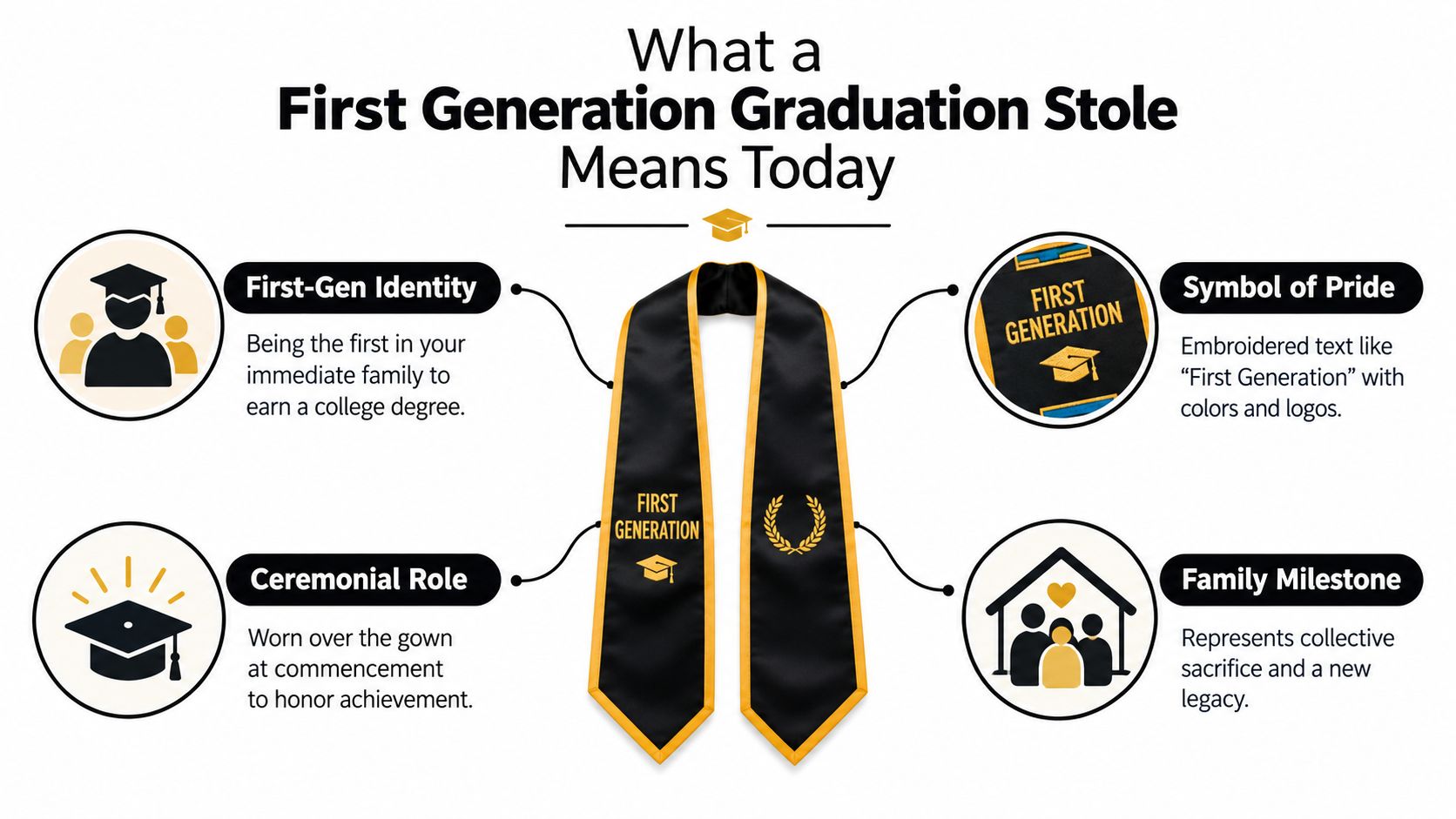
What a First Generation Graduation Stole Means Today
A graduate walks toward the stage wearing a black gown, a cap tilted carefully into place, and a stole that reads First Generation. The audience may see an embroidered phrase. The graduate's family sees years of persistence, unfamiliar forms, difficult decisions, and a new path opening for younger relatives.
A first generation graduation stole is a ceremonial marker for a student who is the first in their immediate family to earn a college degree under the school or organization's definition. The most widely used U.S. federal-style definition focuses on whether the student's parent or parents completed a baccalaureate degree. It also includes a student raised by only one parent when that parent didn't complete a baccalaureate degree, as explained in this policy overview of the first-generation college student definition.
The easiest analogy is a banner. Your diploma proves that you completed the academic requirement, while the stole makes a less visible family milestone recognizable from across the ceremony space. It's different from honor cords, which usually identify academic, leadership, or organizational recognition. It's also different from a decorative sash, because a first-gen stole communicates a specific identity and achievement category.
Core idea: “I am the first, but I won't be the last.”
Eligibility isn't universal. Some campuses define first generation as having parents who didn't complete a bachelor's degree. Others use a stricter standard in which neither parent attended college, as described in this discussion of first-generation student definitions. A sibling's education may not change eligibility under a parental-degree definition. The University of Mary Washington, for example, says eligible students have parents or legal guardians who haven't completed a bachelor's degree, even if a sibling has earned one, according to its commencement regalia information.
If you're curious about how other graduation accessories communicate achievement, read this guide to graduation stole meaning. The distinction matters when you're shopping, because the right first-gen stole should reflect your school's recognition language rather than suggesting a different honor.
Why This Symbol Matters for First Generation Graduates
At commencement, a first-generation stole can turn a private family milestone into a visible part of the ceremony. A parent, grandparent, sibling, guardian, mentor, or friend may have helped the graduate persist, even without knowing every academic process or campus requirement. The stole gives that support a place in the family photograph and on the stage.
The recognition reaches far beyond a small group. One fact sheet reports that 25.8% of undergraduates were first-generation during the 2019–2020 academic year, while another summary identifies 8.2 million first-generation undergraduate students, representing 54% of U.S. undergraduates. These figures appear in FirstGen Forward's higher education insights. They show why colleges increasingly make first-generation achievement visible.
Completion data explains why the moment can carry such emotional weight. Six years after starting college, 24% of first-generation students had earned a bachelor's degree, compared with 59% of continuing-generation students, according to FirstGen Forward's analysis. A national Canadian analysis found first-generation postsecondary students graduating at 69% versus 74% for non-first-generation students. The stole cannot remove those barriers. It marks the determination required to reach commencement despite them.

A family milestone in public view
Schools may provide stoles through receptions, dedicated ceremonies, or student-success programs. Elon University described a first-generation stole ceremony with more than sixty participants, including a lapel pin connected with alumni belonging, in its coverage of the first-generation stole ceremony. Standing with peers who share this experience can make the recognition feel personal rather than merely decorative.
The symbol continues beyond campus. Graduates often share cap-and-stole photos with relatives, making the garment both a keepsake and a public statement. That dual purpose should guide shopping decisions. Choose clear lettering, secure placement, and colors that work with the gown, so the stole reads well from the stage and in close-up photographs. When the design communicates without explanation, the purchase supports both the ceremony and the family milestone.
How to Wear and Style Your First Generation Stole
Start with the gown, not the stole. Put on the gown and close the zipper, then place the stole around the back of your neck so both ends fall evenly over the front. The center should sit at the middle of your neck, and the stole should remain outside the gown rather than disappearing beneath the collar.
Use this quick ceremony checklist
- Center evenly: Find the middle of the stole and line it up with the back of your neck. Equal front lengths create a balanced appearance while you're walking, sitting, and posing.
- Lay it flat: Smooth the fabric across your shoulders. If the stole has an emblem, embroidered wording, or school-color trim, turn that design toward the audience.
- Keep the front clear: Let the stole sit outside the gown zipper. A centered front gives photographers a clean view of the wording and keeps the fabric from bunching.
- Adjust for photos: Check that the text isn't twisted and that both ends hang naturally. A quick mirror check before the processional can prevent awkward corrections on stage.
- Pair wisely: If you're wearing honor cords, medals, or another approved stole, arrange the widest piece first and keep the layers visible. Avoid piling several pieces over the same shoulder area.
Photo check: Ask a family member to take one standing photo before the ceremony. If the lettering is readable and the ends look even, your stage photos should be easier to manage.
Your cap and tassel should complement the stole rather than compete with it. If the stole uses bold black and gold, for example, a simple cap design may keep the first-generation wording as the focal point. Avoid twisting the stole around the neck or pinning it so tightly that the fabric folds.
For additional placement guidance, see this practical article on how to wear a stole. If you enjoy sewing or want to understand how a cape-like garment is constructed, make your own cape in UK offers a useful craft reference, although a graduation stole follows different proportions and ceremonial conventions.
The following video can help you visualize how regalia layers move on the body:
Customization Options Materials and Design Choices
Customization should begin with one practical question: will people be able to read the stole from a distance? Michigan State University's inaugural first-gen stole used a white body, Spartan green edging, and vertical FIRST GENERATION text down one side. That design shows why contrast, school-color alignment, and vertical placement work well at commencement, as described in Michigan State University's first-generation stoling ceremony coverage.
Compare the main choices
| Option | Best For | Visibility and Durability | Consideration |
|---|---|---|---|
| White or neutral base | Strong contrast with dark gowns | Clear lettering in ceremony lighting | May show marks more easily |
| School-color edging | Matching institutional regalia | Helps connect the stole to the campus | Confirm approved school colors |
| Embroidery | Bold first-gen wording, names, or a graduation year | Raised texture and a formal keepsake feel | Complex artwork may require more design planning |
| Printed lettering | Detailed graphics, flags, or multi-color artwork | Smooth surface with flexible visual detail | Review the proof carefully for readability |
| Vertical text | Keeping wording visible while the stole hangs naturally | Works well in front-facing photographs | Placement should account for the shoulder curve |
| Horizontal text | A shorter phrase or centered emblem | Easy to read in close-up images | May be less visible when the stole shifts |
| Satin finish | A polished, light-catching appearance | Photographs with noticeable sheen | Can emphasize folds |
| Matte finish | A quieter, understated appearance | Reduces glare under strong lighting | Colors may look less reflective |
A custom first generation stole can include the phrase “First Generation,” “First Gen,” a family name, a graduation year, a school logo, or another approved symbol. Keep the main message dominant. Adding too many elements can make the design difficult to read, especially when the stole is layered with cords or medals.
Embroidery suits clean lettering because the thread creates dimension. Printing offers more flexibility for intricate graphics and color transitions. Some designs combine methods, but every additional element should earn its place by honoring the graduate's identity, family, institution, or field of study.
If you want to compare layouts, wording, and personalization ideas, use this guide to a custom graduation stole. Graduation Attire is one retailer offering first-generation stole options, including white “First Generation” designs and first-gen proud styles. Check the product details, school requirements, and proofing information before placing a personalized order.
Sizing Pricing and Ordering Tips for a Perfect Fit
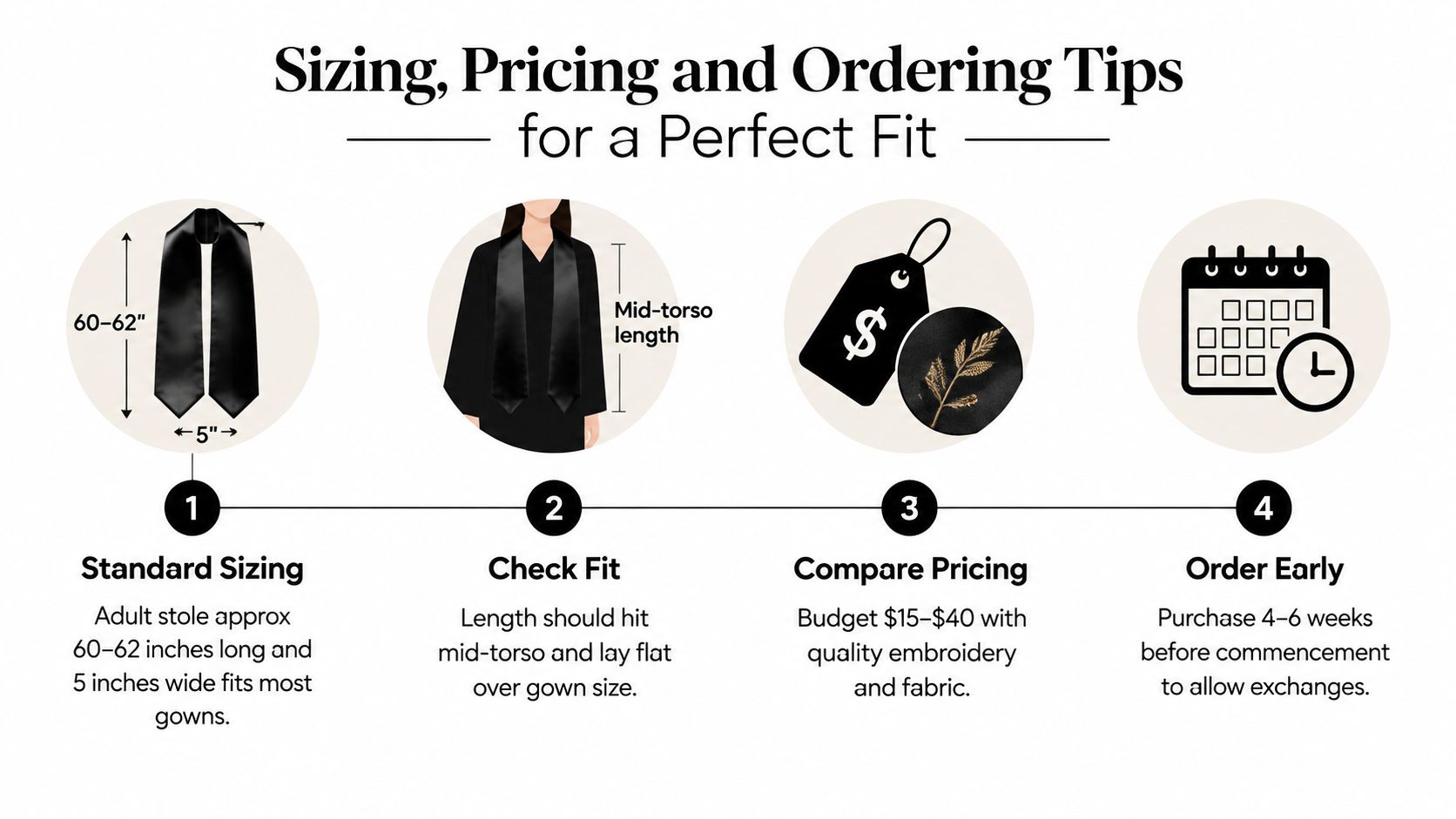
A stole can be listed as one size, but that doesn't mean you should skip the fit check. The adult stole dimensions described in the provided product guidance are approximately 60 to 62 inches long and 5 inches wide, a range intended to suit most gowns. The right result is a stole that reaches around mid-torso, lies flat, and doesn't cover important gown details.
Use this sequence before ordering:
- Confirm the gown first. Gown size, height, and front styling affect how the stole hangs. A shorter graduate may need to check that the ends don't fall too low, while a taller graduate should make sure the stole provides enough front coverage.
- Measure the expected drop. Place a soft measuring tape around the back of your neck and let both sides fall toward mid-torso. This gives you a visual reference rather than relying only on the product label.
- Compare materials and decoration. Fabric choice, embroidery complexity, printing, trim, and personalization can all affect the final price. Use the product page to check what's included, especially if you're adding a name, year, logo, or multiple colors.
- Allow time for changes. The supplied infographic recommends ordering 4 to 6 weeks before commencement so you have time to review the fit and handle an exchange if needed. That timing is especially important for customized items, which may involve design approval before production.
Build a practical order check
Before checkout, verify the spelling of every embroidered word, the graduation year, color selections, shipping address, and ceremony date. If your school distributes an official stole, determine whether you're buying an additional keepsake or replacing an institution-issued item.
Look for shipping choices that match your deadline, including fast or overnight delivery where available. A lowest-price guarantee may also be relevant when you're comparing similar products, but read the terms rather than assuming every customized design qualifies. A school finder can help you match cap, gown, hood, and accessory requirements when your institution specifies particular colors or styles.
Ordering rule: A custom design needs a proofing window, a production window, and a delivery window. Treat all three as part of the purchase.
Caring for Your Stole and Navigating School Policies
Your stole should look polished during commencement and remain meaningful afterward. Use a simple routine: confirm the school's rules, prepare the fabric carefully, then store it properly after the ceremony.
Check the policy before you buy
Contact the commencement office, first-generation student center, or student affairs department. Ask these questions before placing an order:
- Eligibility definition: Does the campus use parental bachelor's completion, or a stricter definition involving college attendance?
- Distribution method: Is the stole supplied by the school, available through an application, limited on a first-come basis, or purchased independently?
- Timing: When does the school check eligibility, open applications, and distribute the item?
- Ceremony requirements: Is the stole permitted at the main commencement, a college ceremony, a reception, or more than one event?
- Pickup support: Can a proxy collect it if you cannot attend the distribution window?
- Accessibility: Are alternate pickup arrangements or ceremony accommodations available?
Policies can differ even among schools with similar first-generation programs. The University of North Texas describes applications and first-come, first-served distribution in its first-generation graduation stole information. Texas Woman's University connects its stole with a first-generation reception and describes it as representing the student's journey, challenges, and achievements in its first-generation recognition information.
Treat the school's rule like a fitting guide. It tells you whether an independently purchased stole complements an official item, or whether the campus expects graduates to use a specific version.
Prepare and preserve the fabric
Steam the stole gently from a safe distance. Do not press directly over embroidery or printed areas. For a small mark, follow the fabric's care label and use careful spot cleaning. Avoid aggressive rubbing, high heat, and improvised washing when the stole includes stitched lettering, metallic thread, or contrasting trim.
After commencement, let the stole dry completely. Fold it loosely with clean tissue paper, then place it in a breathable garment bag or storage box away from moisture and direct sunlight. Store the ceremony program or a family photograph with it. The fabric then becomes a record of the day, not an accessory forgotten in a drawer.
Celebrate Your Achievement and Wear It With Pride
A first-generation graduation stole carries a clear message, but its meaning is personal. For one graduate, it honors parents who encouraged college without having attended themselves. For another, it recognizes a guardian, sibling, mentor, or community that helped make an unfamiliar path possible.
Choose the design with the ceremony in mind. Select readable wording, colors that work with your gown, and materials that feel comfortable over the shoulders. Confirm your school's definition and regalia policy, then check the length, decoration, delivery timing, and care instructions before ordering. Those practical decisions protect the emotional value of the moment.
The stole can also become part of the family story. Wear it for the formal ceremony, include it in photographs with the people who supported you, and store it with your diploma or other keepsakes. Years later, the fabric can still point back to the moment when one graduate opened a new chapter for the family.
If you're ready to choose yours, browse first-generation designs, compare customization options, and verify your school's requirements before the ceremony calendar becomes crowded.
Graduation Attire offers graduation stoles, custom first-generation designs, caps, gowns, and other regalia for students and families preparing for commencement. Visit Graduation Attire to compare first-generation stole options, review sizing and school requirements, and place your order with time for delivery and fit checks.