

Your graduation cap and gown are so much more than an outfit. They're a powerful symbol of your academic journey and every bit of hard work that got you across the finish line. The whole ensemble is known as academic regalia, and it includes the gown, cap, tassel, and sometimes a hood or stole—each piece loaded with tradition and meaning. When you're looking for the right graduation cap and gown, understanding these components will ensure you wear them with the pride and confidence they deserve on your big day.
Understanding Your Academic Regalia
Think of your academic regalia as a uniform that tells a story. Every single element of your graduation cap and gown package—from the shape of your gown's sleeves to the color of your tassel—communicates your level of education, your field of study, and the institution that’s handing you that diploma. This tradition goes back centuries, but it remains the proud centerpiece of modern commencement ceremonies.
And these symbolic garments are a bigger deal than ever. The demand for graduation attire reflects a growing global appreciation for academic milestones. In fact, the market was valued at around $2.6 billion in 2025 and is expected to hit nearly $5.1 billion by 2033. This boom is driven by rising enrollment and online retailers making regalia more accessible than ever. You can discover more insights about this growing market and its trends.
The Core Components of Your Regalia
Your graduation package will look different depending on your degree level. A high school graduate's outfit is pretty straightforward, but a doctoral candidate's regalia is far more elaborate. These differences aren't random; they follow a specific code designed to distinguish each academic achievement.
Here are the main pieces you'll come across when buying your graduation cap and gown:
- The Gown: This is the main body of your regalia, and its style changes significantly with each degree you earn.
- The Headwear: This is usually a mortarboard cap for high school, bachelor's, and master's degrees, or a soft, velvety tam for doctoral degrees.
- The Tassel: A simple cord attached to your cap, but its color and even its placement are both significant.
- The Academic Hood: Worn by master's and doctoral graduates, this is the most colorful and descriptive part of the entire outfit.
A common mistake is thinking all black gowns are the same. Look closely at the sleeves and fabric—a bachelor's gown has pointed sleeves, a master's gown has oblong sleeves, and a doctoral gown often features velvet panels and full bell sleeves.
To help you visualize these differences, here’s a quick overview of what to expect for your specific degree level.
Graduation Regalia at a Glance by Degree Level
This table breaks down the standard cap and gown components you'll find at different academic stages. It’s a simple reference to help you see how the regalia evolves as you climb the academic ladder.
| Degree Level | Typical Gown Style | Sleeve Shape | Typical Headwear | Academic Hood |
|---|---|---|---|---|
| High School | Simple, lightweight design; often in school colors. | Pointed and open. | Mortarboard Cap | Not Applicable |
| Bachelor's | Plain black gown with a simple, unadorned front. | Pointed sleeves. | Mortarboard Cap | Not Applicable |
| Master's | More detailed gown, often with unique sleeve design. | Oblong sleeves with an arc cut in the front. | Mortarboard Cap | Yes, worn |
| Doctoral | Most elaborate gown with velvet panels and chevrons. | Full, bell-shaped sleeves. | Soft Tam or Mortarboard | Yes, worn |
Getting these distinctions down is the first step toward appreciating the rich history woven into every thread of your cap and gown. Each piece celebrates a specific chapter of your academic life, making that walk across the stage even more meaningful.
A Closer Look at Gowns, Hoods, and Tams
While every graduate wears a gown, the subtle details of each piece tell a specific story about their academic journey. Diving deeper into these components reveals a rich, visual language of tradition, distinguishing a bachelor's accomplishment from a master's or a doctorate. Understanding these differences is the key to appreciating the full meaning behind your cap and gown.
This visual guide breaks down the core elements of academic regalia into its three main parts.
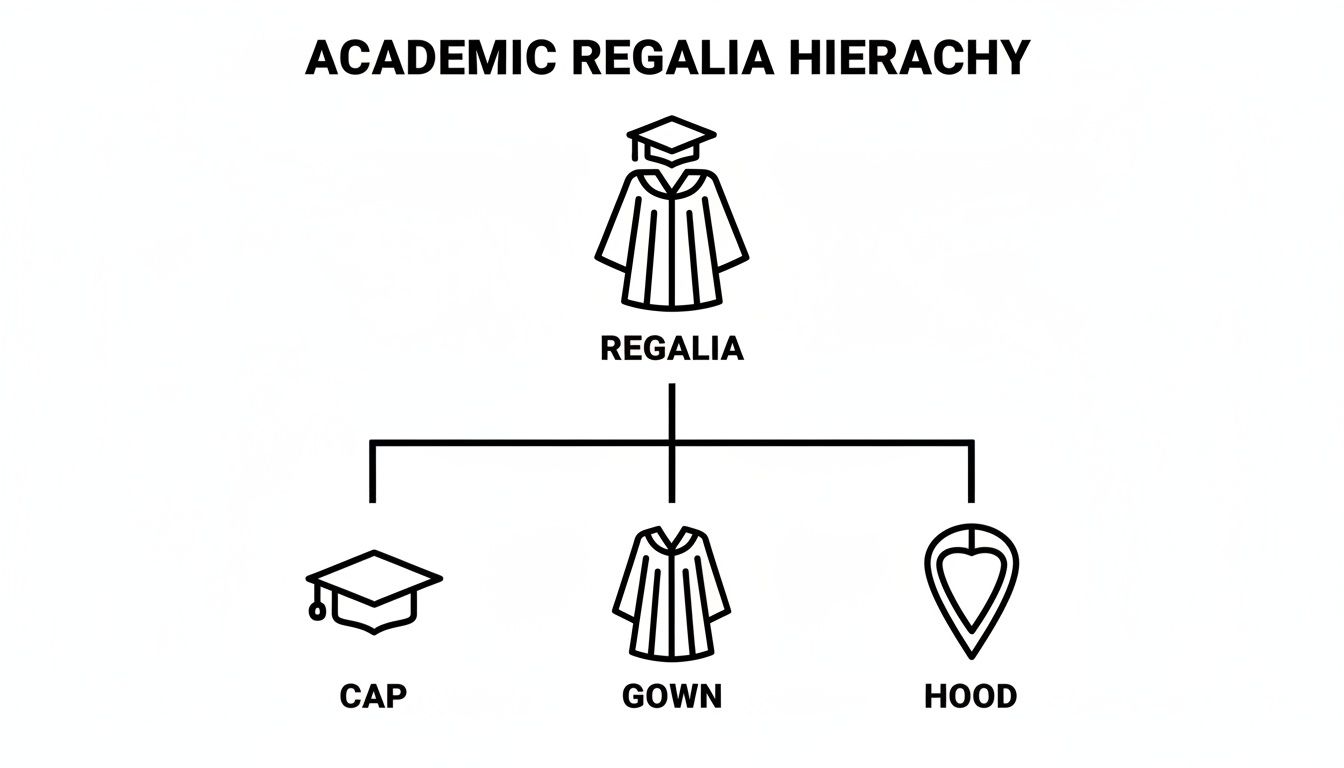
This hierarchy shows how the cap, gown, and hood combine to form the complete regalia. Each piece carries its own distinct symbolism, with design variations that signal your specific academic level.
The Evolution of the Graduation Gown
The gown is the foundation of your academic attire, and its design evolves dramatically as you advance in your studies. Think of it like a uniform that earns its stripes with each new degree.
A bachelor's gown is the most straightforward. It's typically black, unadorned, and features long, pointed sleeves. Its clean simplicity signifies the foundational nature of an undergraduate degree.
Moving up the ladder, the master's gown adds a layer of distinction. The most noticeable feature is its unique sleeve—an oblong shape with an arc cut into the front. This design sets it apart and marks a clear step up from the bachelor's gown.
Finally, the doctoral gown is the most ornate of all. It boasts full, bell-shaped sleeves and is adorned with plush velvet panels down the front. Three velvet bars, known as chevrons, decorate each sleeve, symbolizing the highest level of academic achievement. While the velvet is often black, it can also be a specific color representing the field of study.
Mortarboards and Tams: The Headwear Explained
The headwear you receive is another clear indicator of your academic standing. Most graduates will wear the iconic mortarboard cap. This flat, square cap with its familiar tassel is the standard for high school, bachelor's, and master's degree candidates.
For doctoral graduates, however, the traditional headwear is often a tam. This soft, rounded cap is typically made of velvet and may have four, six, or eight sides. A bullion or silky tassel is permanently affixed to it. The tam is a symbol of advanced scholarship, reserved for those who have earned a terminal degree like a Ph.D. or Ed.D.
The academic tam is not just a different style; it's a mark of distinction. Its velvet material and softer structure signify a departure from the rigid mortarboard, representing the culmination of years of dedicated research and expertise.
Cracking the Code of the Academic Hood
The academic hood is arguably the most descriptive and colorful part of any graduation ensemble. Reserved for master's and doctoral graduates, it’s a wearable guide to the graduate’s entire academic history.
Each part of the hood tells a piece of the story:
- Shell Fabric: The material of the hood itself matches the fabric of the gown, creating a unified look from top to bottom.
- Velvet Trim: The color of the velvet trim is determined by the graduate's specific field of study. Light blue, for example, signifies education, while gold represents sciences and royal blue is for philosophy (Ph.D.).
- Satin Lining: This is where it gets personal. The brightly colored satin lining showcases the official colors of the institution granting the degree. When worn correctly, the lining is turned out on the back to display these school colors with pride.
This intricate system of colors allows anyone to identify a graduate's degree and alma mater at a glance. You can see these traditions brought to life by exploring a deluxe doctoral graduation hood, which showcases the high-quality velvet and satin that make the regalia so special. The hood truly completes the look, transforming a simple gown into a personalized testament to academic success.
How to Find Your Perfect Fit and Fabric
Your graduation photos are going to be around forever, so let's make sure your cap and gown look and feel amazing. An ill-fitting gown can bunch up, feel restrictive, and just be a distraction on your big day. The good news is, getting the right size is a surprisingly simple process—no complex measurements needed.
The whole goal is to have the gown drape nicely, giving you enough room to move comfortably without looking like you’re swimming in it. It's all about finding that sweet spot, which is why it helps in understanding garment fit principles like ease. This just means the gown is designed to give you plenty of room to walk, sit, and wave to your family during a long ceremony.
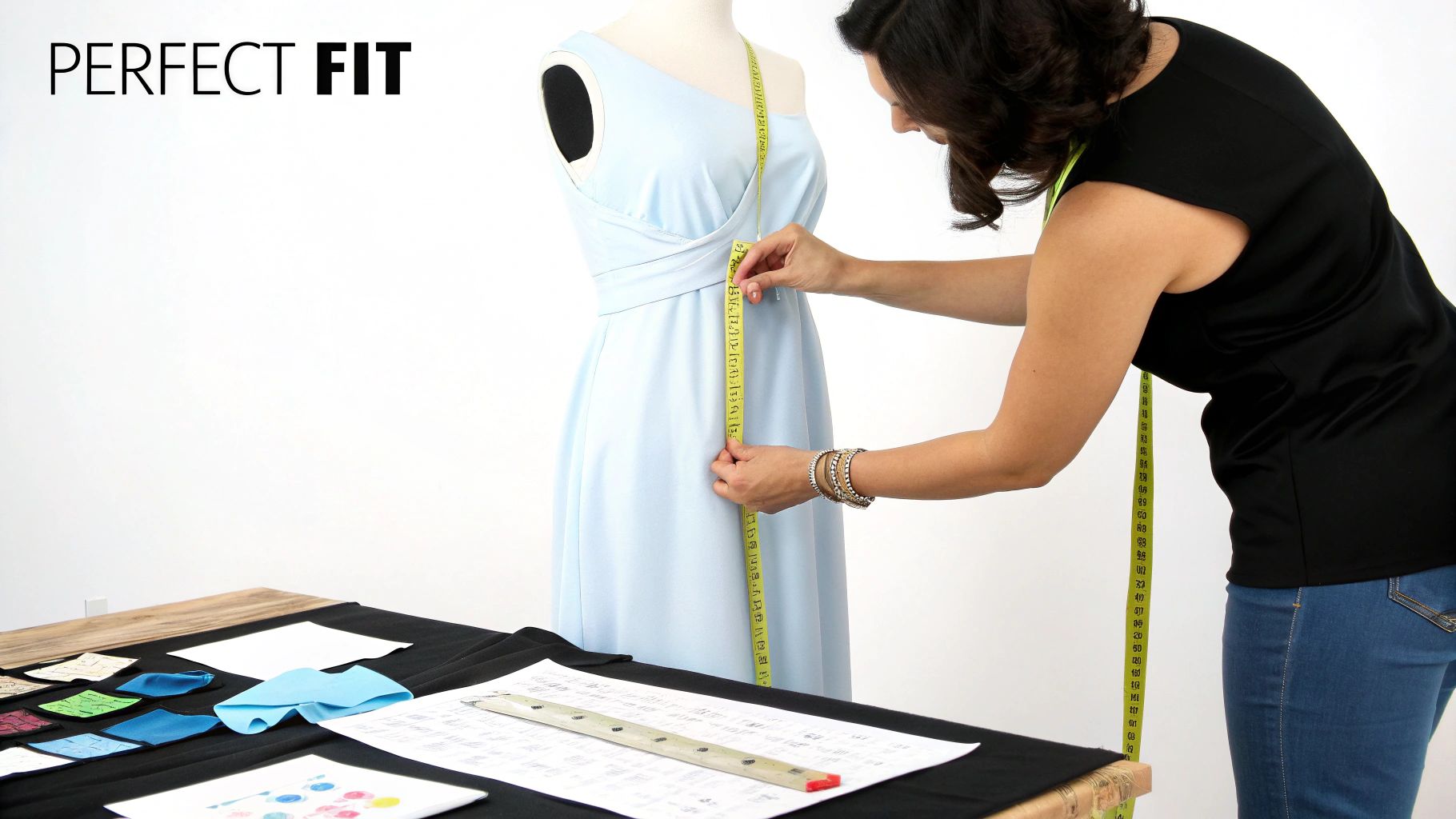
Measuring for Your Gown Made Easy
Forget about breaking out the tailor’s tape for a dozen different measurements. Graduation gown sizing is refreshingly straightforward and hinges on just two things: your height and weight. This smart approach ensures a comfortable, flattering fit for a huge range of body types.
The process couldn't be easier:
- Measure Your Height: Stand straight against a wall (no shoes!) and have someone mark where the top of your head is. Then just measure from the floor to the mark in feet and inches.
- Note Your Weight: All we need is your current weight in pounds.
- Check Our Size Chart: With those two numbers, our sizing guide will point you to the perfect fit.
We've designed our charts to take all the guesswork out of it. For example, if you're 5'6", you'll fall into a specific size range. Your weight then helps determine if you'd be more comfortable in a "full fit" gown, which offers a little extra room through the chest and shoulders.
Choosing the Right Fabric for Your Big Day
Beyond the fit, the fabric of your gown makes a huge difference in how you look and feel. The two main options create totally different visual effects, and each one has its perks, especially when it comes to photos.
Matte vs. Shiny Finish
| Fabric Finish | Best For | Key Benefits |
|---|---|---|
| Matte Finish | Photography | A matte finish is a photographer's dream. It absorbs light, which means no harsh glare in photos. It creates a smooth, modern, and classic look that's perfect for outdoor ceremonies or professional portraits. |
| Shiny Finish | Traditional Look | A shiny, satin-like finish reflects light, giving your gown a more formal and traditional vibe. It looks especially sharp during indoor ceremonies under bright stage lighting. |
Ultimately, this choice comes down to your personal preference and where your ceremony is held. That being said, more than 70% of graduates are now choosing a matte finish. Why? They want to make absolutely sure their photos turn out perfectly, without any distracting glare.
A Sustainable Choice for a Modern Graduate
Think about it: with millions of students graduating every year, the environmental footprint of single-use regalia can be huge. In the U.S. alone, an estimated 3.7 million high school students (plus millions more from college) cross the stage each year. That's a massive amount of textile waste from old-school polyester gowns. In response, sustainable options have become a popular and really responsible choice for today's grads.
Our eco-friendly gowns are made from 100% recycled PET plastic, offering the same high-quality look and feel as traditional polyester but with a much smaller environmental footprint. Every single gown keeps dozens of plastic bottles out of our landfills.
By choosing a sustainable gown, you're not just celebrating your own achievement—you're making a positive choice for the future of our planet. And with our lowest-price guarantee, you don’t have to choose between making an environmentally conscious decision and getting a great value.
Make It Your Own: Personalizing Your Look with Stoles and Cords
Your graduation cap and gown are a huge symbol of your academic achievement, but let's be real—the journey to that stage was entirely your own. Personalizing your regalia with stoles, cords, and medals is the perfect way to celebrate your unique story, your heritage, and the specific accomplishments that defined your time at school. Think of these accessories as turning a standard uniform into a personal statement of pride.

This isn’t just about style; it's a real reflection of how modern graduates celebrate their identities. The trend is so big that by 2025, retailers saw huge sales increases for personalized gowns and accessories. Custom stoles—representing cultural identity, veteran status, or first-generation honors—now routinely add 10–30% to the average order value.
Stoles That Tell Your Story
A graduation stole, sometimes called a sash, is that long, scarf-like piece of cloth worn over your shoulders. It’s basically a blank canvas for you to display your affiliations, heritage, and achievements. Unlike the academic hood, which is governed by strict, old-school rules, stoles give you a ton of freedom to express yourself.
Here are some of the most popular and meaningful ways to use a stole:
- First-Generation Stoles: Worn with immense pride by students who are the first in their families to graduate from college. They’re a beautiful way to honor the sacrifices of previous generations and symbolize a monumental family achievement.
- Kente Stoles for Cultural Pride: The vibrant, hand-woven patterns of Kente cloth originate from Ghana and represent a deep connection to African heritage. Wearing a Kente stole is a powerful and stunning way to celebrate Black identity and ancestry.
- Veteran and Military Stoles: Graduates who have served in the armed forces often wear stoles displaying the seal of their military branch. It’s a powerful tribute to their service, sacrifice, and dedication to their country.
Your stole is a visual narrative of your journey. Whether it represents your fraternity, your major, or your cultural background, it’s an opportunity to share a piece of your identity with everyone celebrating your success.
Understanding Honor Cords and Medals
Alongside stoles, honor cords and academic medals are the other key accessories used to recognize outstanding performance. These items are typically awarded by the university or an academic society, and they signify specific levels of achievement.
Honor Cords are those colored ropes with tassels on each end, draped around the neck. Different colors are used to represent all sorts of honors:
- Academic Honors: The most common cords are for Latin honors like cum laude (with honor), magna cum laude (with great honor), and summa cum laude (with highest honor). The exact colors vary by school, but gold, silver, and white are frequently used.
- Honor Societies: Got into a prestigious national honor society like Phi Beta Kappa or Sigma Xi? You'll often get specific colored cords to show off your membership.
- University-Specific Awards: Schools also award cords for things like leadership roles, community service, or completing a specific academic program.
Academic Medals, or medallions, are another distinguished honor. You'll see these worn on a ribbon around the neck, and they’re usually reserved for the highest achievements—think valedictorian, salutatorian, or receiving a major university-wide award for research or leadership. While they're less common than cords, they carry a lot of weight and are a prominent mark of distinction.
To help you decode all the options, here's a quick look at some of the most popular graduation accessories and what they usually mean.
Popular Graduation Accessories and Their Meanings
This table is a simple guide to common graduation accessories and what they typically represent, helping you choose the right items to celebrate your achievements.
| Accessory Type | Common Meaning or Use | Who Wears It |
|---|---|---|
| Honor Cords | Academic excellence (high GPA), honor society membership, or leadership roles. | Students who meet specific criteria set by the university or an organization. |
| Stoles/Sashes | Cultural heritage (Kente cloth), first-generation status, Greek life, or field of study. | Any graduate wishing to display a personal affiliation or identity. |
| Medallions | Top academic honors like valedictorian, salutatorian, or major university awards. | The highest-achieving students, as designated by the institution. |
| Pins | Membership in a specific club, society, or completion of a special program. | Members of specific campus groups or academic programs. |
Choosing the right accessories is all about telling your story. Whether it's a simple gold graduation stole for your academic standing or a custom stole celebrating your roots, each piece adds another layer to your accomplishment.
Your Stress-Free Ordering Checklist and Timeline
With graduation just around the corner, the last thing you need to worry about is your cap and gown. Ordering your regalia should be one of the fun parts—an exciting step toward the big day. This simple checklist and timeline will walk you through it, making sure everything shows up perfectly and on time so you can focus on celebrating.
The absolute key to a smooth process is giving yourself enough time. We recommend getting started 6 to 8 weeks before your ceremony. That might sound early, but it builds in a comfortable buffer for choosing your options, getting sized up, and shipping, especially if you’re thinking about adding custom accessories.
The Ideal Ordering Timeline
Don't leave this for the last minute! Graduation season is our busiest time of year, and ordering early means you get the best selection while avoiding those heart-stopping rush shipping fees. Think of this as your roadmap to a stress-free commencement.
Here’s a simple, step-by-step plan:
- 6-8 Weeks Out (The Research Phase): Now is the perfect time to start. First, use our school finder tool to confirm your school’s specific regalia requirements. Then, just browse our collections to see what gown styles, fabrics, and accessories catch your eye.
- 4-6 Weeks Out (The Measurement and Selection Phase): Time to get your measurements. Don't worry, it's easy—all we need is your height and weight. This is also when you'll pick your fabric finish (matte or shiny) and select any personalized items like custom stoles or honor cords.
- 3-4 Weeks Out (The Ordering Phase): Go ahead and place your final order. This is the sweet spot. It ensures all your items are in stock and gives you a comfortable cushion before the ceremony. It’s also a great time to triple-check your shipping address.
Your Step-by-Step Ordering Checklist
Let’s break this down into a few simple steps. This checklist makes sure you cover all the bases, from finding your school's exact requirements to placing your final order with total confidence.
- Step 1: Confirm Your School's Requirements: Use our school finder tool to instantly see the specific gown, cap, hood, and tassel colors for your institution. This takes all the guesswork out of the equation.
- Step 2: Take Your Measurements: All you need is your height (without shoes) and your current weight. Our sizing charts are designed to give you a comfortable, flattering fit based on just those two numbers.
- Step 3: Select Your Gown and Cap: Choose between our popular matte finish and the more traditional shiny fabric. Quick tip: a matte finish is fantastic for minimizing glare in photos.
- Step 4: Add Your Hood and Accessories: If you’re getting an advanced degree, make sure you add the correct academic hood. This is also the time to add meaningful extras like first-generation stoles, veteran cords, or honor society tassels that celebrate your unique journey.
- Step 5: Place Your Order: Add everything to your cart, pick your shipping option, and check out. With over 10,000+ positive reviews, you can order knowing you're getting quality attire backed by people who care.
Pro Tip: When your graduation package arrives, take the gown out of the packaging right away. Hang it up to let any wrinkles from shipping fall out naturally. A light steaming is the safest and most effective way to get a crisp, photo-ready look.
What to Do When It Arrives
Once that box lands on your doorstep, the final prep begins. Don't just leave your gown folded up until the morning of the ceremony. The moment it arrives, hang it up somewhere with good air circulation.
For any stubborn creases, a gentle steam is your best friend. A garment steamer is ideal, but even hanging the gown in the bathroom during a hot shower can work wonders. Whatever you do, avoid direct ironing—the heat can easily damage the fabric. Taking just a few minutes to care for your gown ensures you’ll look polished and ready for every photo op on your big day.
Getting your order in is a huge milestone. For those of you continuing your education, you can learn more about our complete regalia bundles, like the Classic Masters Graduation Cap Gown Tassel Hood Package, which pulls together everything you need for a distinguished look.
Answering Your Top Graduation Regalia Questions
As commencement gets closer, the practical questions about your cap, gown, and accessories start to pile up. This is where we answer the most common things we hear from grads. We want to give you clear, simple answers so you can navigate every tradition with confidence and keep your focus on what really matters—celebrating this incredible moment.
Which Side Does the Tassel Go On?
This is easily the number one question, and it’s tied to the most symbolic moment of the whole ceremony. Before your degree is officially conferred, your tassel should be on the right side of your mortarboard. Think of this as its "candidate" position—you're almost there, but not quite yet.
The "turning of the tassel" is the main event. Once your name is called and your degree is awarded, you'll be instructed to move the tassel from the right side over to the left side. That simple gesture is the official, non-verbal announcement that you've gone from a candidate to a graduate.
It's worth noting that Master's and Doctoral candidates sometimes keep their tassel on the left for the entire ceremony. Always double-check your university's specific commencement guidelines to be sure you're following their tradition.
How Do I Wear My Academic Hood Correctly?
Putting on an academic hood can feel awkward at first, but it’s actually pretty simple once you know the trick. This colorful piece of regalia is reserved for Master's and Doctoral graduates and is designed to tell the story of your academic journey.
Here’s the right way to put it on:
- Drape the hood over your shoulders so the velvet trim is facing up. The V-shaped part should rest at the front of your neck, like a scarf.
- Find the small cord on the front and use it to secure the hood to a shirt button or the zipper of your gown. This is the secret to keeping it from sliding off your shoulders.
- Now for the most important part: flip the colorful satin lining out so it’s visible on your back. This is what shows off your university's colors.
Most of the time, a faculty member or ceremony marshal will help you with this final flip as you're lining up or on stage, but having it on correctly beforehand makes the whole process go much more smoothly.
Can I Decorate My Graduation Cap?
Decorating your mortarboard is a huge trend and an amazing way to show off your personality. Whether you're celebrating your future plans, thanking your family, or just getting creative with paint and 3D designs, the results can be incredible.
However, school policies on this tradition are all over the place. Some universities fully embrace it as a form of self-expression, while others have strict rules that require all regalia to be kept completely plain.
Before you get out the glitter and glue gun, it is absolutely essential to check your school's official commencement guidelines. A quick search on your university's website or an email to an administrator can save you from the disappointment of being asked to remove your hard work on graduation day.
What Should I Do with My Cap and Gown After the Ceremony?
Your cap and gown are more than just an outfit—they're a tangible reminder of a massive achievement. Once all the photos have been taken and the parties are over, you have a few great options for what to do with your regalia.
- Preserve It as a Keepsake: The best way to keep your gown in perfect condition is to store it in a garment bag away from direct sunlight, which prevents fading and dust.
- Create a Display: Many graduates choose to frame their tassel right alongside their diploma. Our custom diploma frames are designed to create a beautiful, lasting tribute to your hard work.
- Donate It: Consider passing your gown on to an organization that helps students who can't afford their own regalia. Programs like "Gowns for Grads" are a great way to ensure another student gets to feel that same sense of pride.
- Repurpose It: Your gown can always find a second life as a perfect costume for Halloween or other themed parties.
Beyond the regalia, families often look for a special memento to mark the occasion. If you're searching for inspiration, you can explore these unique graduation gifts for daughters to find a meaningful way to honor this milestone.
Here at Graduation Attire, our mission is to help you celebrate this monumental day with confidence and style. From getting the perfect fit to personalizing your look, we have everything you need to make your commencement unforgettable. Explore our complete collection of high-quality caps, gowns, and accessories today.