

You're standing near the stage with a cap in one hand and a diploma cover in the other. The graduate's name is about to be called, family members have their phones ready, and that cover will appear in nearly every photograph. It may look like a simple folder, but the right graduation diploma cover has to handle a public ceremony, quick handoffs, repeated gripping, and the first trip home with the graduate's achievement.
The decision also involves more than color. You need the correct interior size, orientation, opening style, material, branding, and storage plan. A cover that looks polished under bright stage lights may still be a poor long-term container if its interior materials encourage sticking or discoloration. This guide treats the cover as both a ceremonial presentation accessory and a document-preservation product, because that's how graduates and institutions use it.
Walking Across the Stage With the Right Cover
The graduate takes the diploma cover from the presenter, turns toward the audience, and holds it at the angle practiced backstage. For a few seconds, the cover becomes the visual focus. School colors, a seal, a foil crest, or a clean unbranded finish all communicate something before anyone sees the diploma inside.

The cover also has to work physically. A graduate may open it with one hand, hold it tightly during the photo line, or pass it briefly to a family member. A weak hinge can fight the handoff. A loose interior can let the diploma slump. A glossy finish can reflect stage lighting directly into photographs, while a poorly chosen color can compete with the gown and hood.
Ceremony rule: The best cover looks intentional without distracting from the graduate.
That standard helps separate useful customization from decoration for its own sake. A school seal placed cleanly on a firm cover usually supports the moment. Excessive text, trendy graphics, or an oversized personal design can make a keepsake harder to frame or reuse later. For a class order, administrators also need consistency. Every graduate should receive a cover that opens the same way, fits the same diploma format, and reflects the institution's visual identity.
The diploma itself may not be handed over on stage. Many institutions present a cover during commencement because the final credential is issued after grades and degree requirements are finalized. The graduate may receive the actual document later by mail, while the cover serves as the ceremony's presentation holder, as described in this overview of graduation traditions.
That timing makes the cover important even before the diploma arrives. It frames the stage moment, protects the document temporarily, and becomes the first physical reminder taken home. Buy for the handshake, the photograph, and the years of storage that follow.
What a Graduation Diploma Cover Actually Does
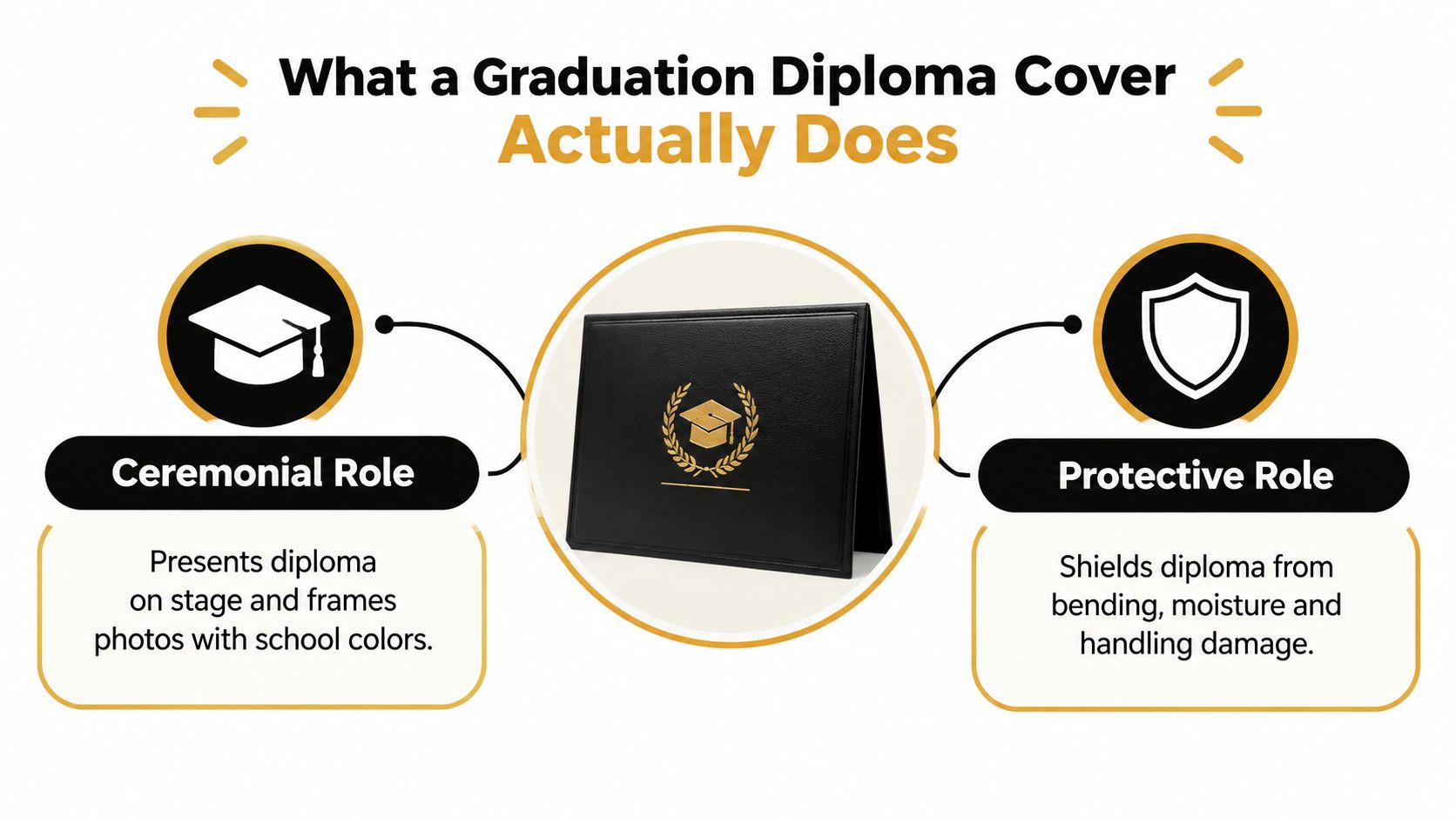
A graduation diploma cover has two jobs that should be judged together. On stage, it presents the credential with dignity and gives the graduate something substantial to hold. At home, it provides an initial barrier against handling, bending, dust, moisture, and ordinary wear.
The ceremonial side is visible first. The cover frames the diploma during the walk, supports school colors and official branding, and gives photographers a recognizable object to capture. Institutions often customize covers with official seals and colors because the item forms part of the ceremony's visual language.
The protective side matters after the applause. A cover can reduce contact with the paper and help prevent bending during the journey from the stage to the graduate's home. It shouldn't be confused with a fully archival enclosure, however. Preservation guidance emphasizes acid-free mats and backing, rigid enclosures, flat storage, and reduced exposure to light, acids, and humidity. A decorative cover alone may not provide that level of protection, particularly when its plastic or acetate components aren't acid-free, as explained by this diploma preservation guide.
A useful mental test is simple:
A good cover should look right when it opens on stage and still feel solid decades later in a closet, frame, or shadow box.
That test exposes the usual compromises. The cheapest folder may protect the paper briefly but feel flimsy in photographs. A highly decorative cover may perform well as a stage prop but offer poor storage characteristics. A practical buyer chooses a balanced construction, confirms the fit, and selects personalization that won't make later framing awkward.
The cover also doesn't normally contain the final diploma at the ceremony. Graduates often receive the cover on stage and the actual diploma afterward, a practice described in this explanation of commencement diploma covers. Treat the cover as a presentation holder first, then decide whether it will remain part of the long-term display or be replaced by an archival frame.
The best purchase therefore combines appearance, handling, fit, and preservation compatibility. Don't approve a cover based on the front panel alone.
How to Match the Cover Size to the Diploma
Size is where many otherwise careful orders go wrong. A cover that's too tight forces the diploma into the pocket or hinge. One that's too loose lets the document shift during the ceremony. A mismatched orientation can make a correctly sized paper look awkward every time the graduate opens the cover.
Start with the actual diploma, or obtain a confirmed specification from the registrar.
- Measure the paper itself. Record the width and height, not the size of an envelope, folder, or frame. A guide to diploma framing warns that assuming 8.5 x 11 inches can create a poor fit because institutions use different formats based on tradition, vendors, and design choices. The same guide recommends measuring first, as explained in this resource on evaluating local frame shops.
- Confirm orientation. Portrait and cover formats aren't interchangeable in practice. A diploma in a horizontal format needs a hinge and opening that support the wider presentation, while a portrait document usually benefits from a conventional vertical layout.
- Check the interior dimensions. Match the cover's usable interior, not just its exterior measurement. The document should slide in without force and lie flat without sagging.
- Ask about the opening and binding. A two-fold cover, a three-panel hinged cover, and a sleeve can all hold paper differently. Confirm where the diploma enters and whether the school expects a particular format.
United States institutions don't follow one universal diploma-cover size. Common formats include 8.5 x 11 inches, while larger institutional documents can measure 11 x 14 inches or 15 3/4 x 22 inches, including formats used for medical degrees, according to this diploma size guide.
| Diploma Size | Typical Use | Recommended Cover Interior |
|---|---|---|
| 8.5 x 11 inches | Common school and college diploma format | Match the measured paper with enough interior clearance for easy insertion |
| 9 x 12 inches | Institutional diploma formats and presentation documents | Choose a cover made for the confirmed document size and orientation |
| 11 x 14 inches | Larger academic or professional credentials | Use an oversize interior, then verify the hinge and support |
| 15 3/4 x 22 inches | Large medical-degree formats | Confirm a specialty cover or presentation system before ordering |
Suppliers offer several additional formats, including 6 x 8, 7 x 9, 8 x 10, 8.5 x 11, and 11 x 14 inches, with different hinge and opening configurations, as shown in this diploma-cover size listing. If you can't measure, ask the school for the exact paper dimensions. Never choose a cover merely because it fits a ceremony folder.
Materials and Opening Styles Compared
Material determines how the cover feels in the graduate's hand, how it photographs, and how it ages on a shelf. Opening style determines whether the diploma stays aligned and whether the cover feels natural during the stage handoff.
Leatherette is the dependable institutional choice. It offers a formal appearance, accepts embossing and foil stamping well, and handles repeated ceremony use without the price or maintenance associated with genuine leather. Genuine leather adds tactile depth and a premium feel, but it demands a larger budget and can be excessive for a large class order.
Bonded leather sits between those options. It can look refined at first and often supports traditional decoration, but the surface may not age like full-grain leather. Velvet-touch poly creates a soft, contemporary finish that photographs warmly, although textured surfaces can show handling and may be harder to clean.
Soft-touch cardstock works for short-term presentation or highly budget-conscious events. It's light and easy to print, but it isn't the choice I'd make for a cover expected to sit in a family archive for years. Recycled PU can support sustainability goals while maintaining a leather-like appearance, but administrators should verify the specific construction and interior materials rather than assuming the outer finish defines archival performance.
Institutional procurement often specifies a laminated, multi-layer construction rather than a simple folder. One university bid called for a .080 warp-resistant premium-grade diploma board, laminated to 3/32-inch foam, with a .018 top liner and reinforced hinge. That structure is designed to keep the cover taut and prevent foam exposure at the edges, according to the University of Central Arkansas diploma-cover bid.
| Material or Style | Best For | Trade-Off to Watch |
|---|---|---|
| Leatherette | School ceremonies and embossed class sets | Verify interior composition before treating it as archival |
| Genuine leather | Formal individual keepsakes and professional hoodings | Higher cost and more maintenance |
| Bonded leather | Traditional appearance with moderate budget pressure | Surface aging can vary |
| Velvet-touch poly | Soft, modern presentation | Texture may show handling |
| Soft-touch cardstock | Short-term events and printed designs | Less substantial for long-term storage |
| Recycled PU | Institutions seeking a leather-like recycled-material option | Confirm construction and decoration compatibility |
| Single-folder sleeve | Fast stage presentation and compact storage | Limited support for loose or oversized diplomas |
| Two-fold presentation | Traditional portrait or landscape diplomas | Hinge direction must match the document |
| Three-panel hinged | More formal display and stronger presentation structure | Takes more room when open |
| Box-style slipcase | Protected transport and shelf storage | Less convenient for a quick one-handed handoff |
A clear plastic document wallet, such as the type shown among custom printed clear wallets, may suit temporary organization, but it doesn't automatically replace a formal diploma cover. Choose the format based on the ceremony, not just the cheapest enclosure.
Personalization and Custom Branding That Looks Right
Personalization should make the cover feel official, not trapped in a particular trend. My strongest recommendation is to begin with the school seal or crest, then add only the information that will still look appropriate when the graduate frames the diploma later.
An embossed school seal is the safest traditional choice. It adds texture, reads clearly in photographs, and doesn't compete with the gown. Blind stamping creates a quieter result, while foil stamping gives the crest or school name stronger contrast. Gold and silver can look formal, but the foil should complement the institution's colors rather than fight them under stage lighting.
A full-color printed lining can add identity inside the cover, especially for a school or program with a strong visual system. It's less universal than a simple crest, though. A graduate may later prefer a neutral frame, and a busy interior can become visible in photographs or display cases.
Personal and institutional marks
Name and year stamping on the spine creates a keepsake, but monograms and individual names can limit future gifting, resale, or reuse. A class set with the institution's name and graduation year is more flexible than a cover customized for one person. Program ribbons can identify nursing, law, or other groups, but they should follow the school's established ceremony protocol.
Use the artwork the way a printer will use it, not the way it appears on a phone screen. Send clean vector artwork when available, confirm the school name and degree wording, and request a proof before production. Institutional buyers should also confirm their approved color references, including PMS matching when the vendor supports it. Traditional schools generally suit serif fonts and restrained placement, while modern programs can use cleaner sans-serif typography.
The more decoration steps you add, the more coordination the order requires. Approve the design, spelling, placement, and color before the production window becomes tight. This guide to personalized diploma covers can help buyers compare customization approaches before requesting a quote.
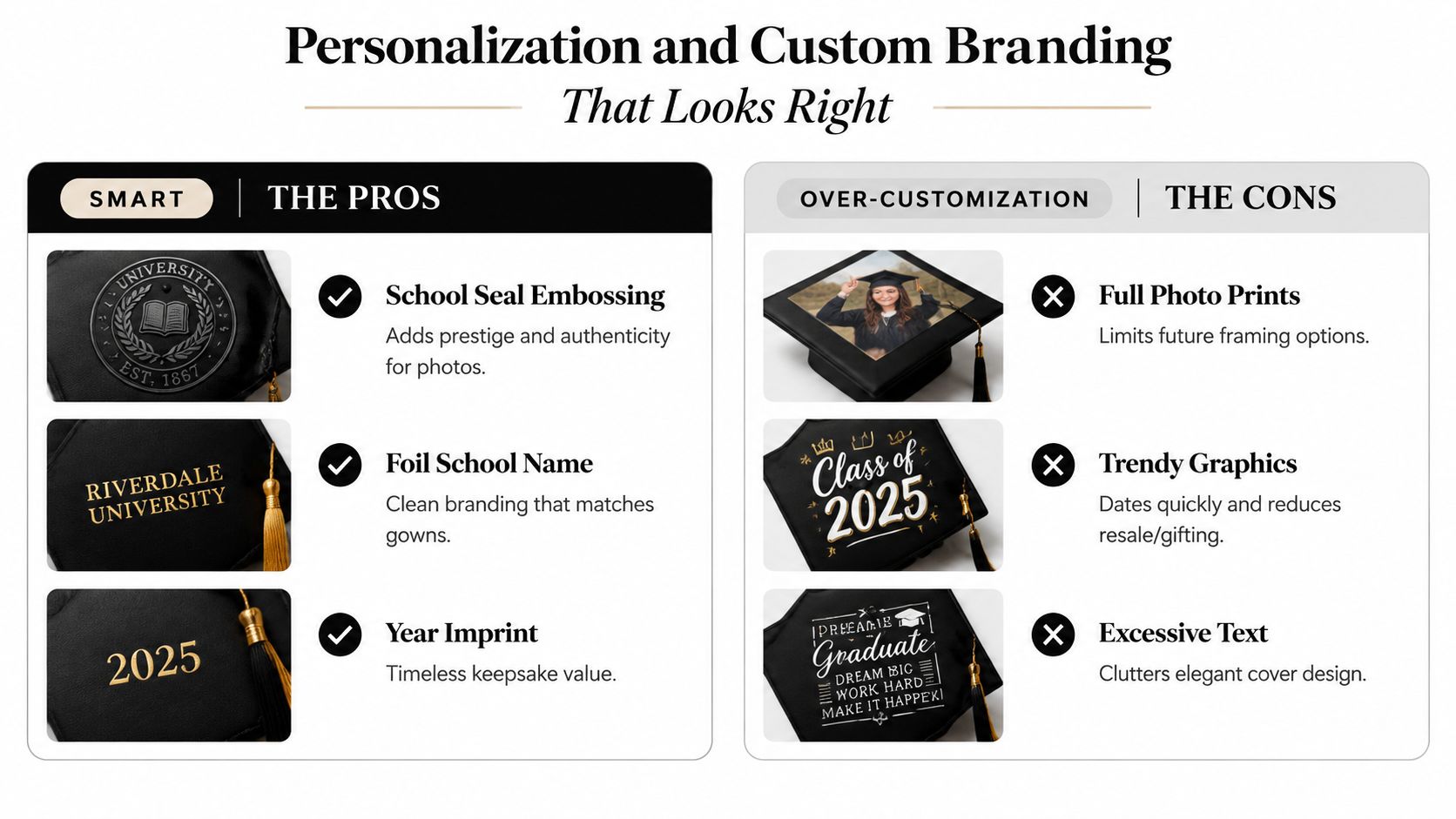
A timeless cover earns its place in a frame. A heavily personalized cover often ends up in a drawer because the graduate's display plan changes. For most orders, choose one official mark, one compatible color treatment, and restrained text.
Bulk Ordering, Pricing, and Shipping for Schools
School administrators shouldn't begin with a catalog image. Begin with a verified count, a confirmed diploma format, and a delivery date that leaves room for correction.
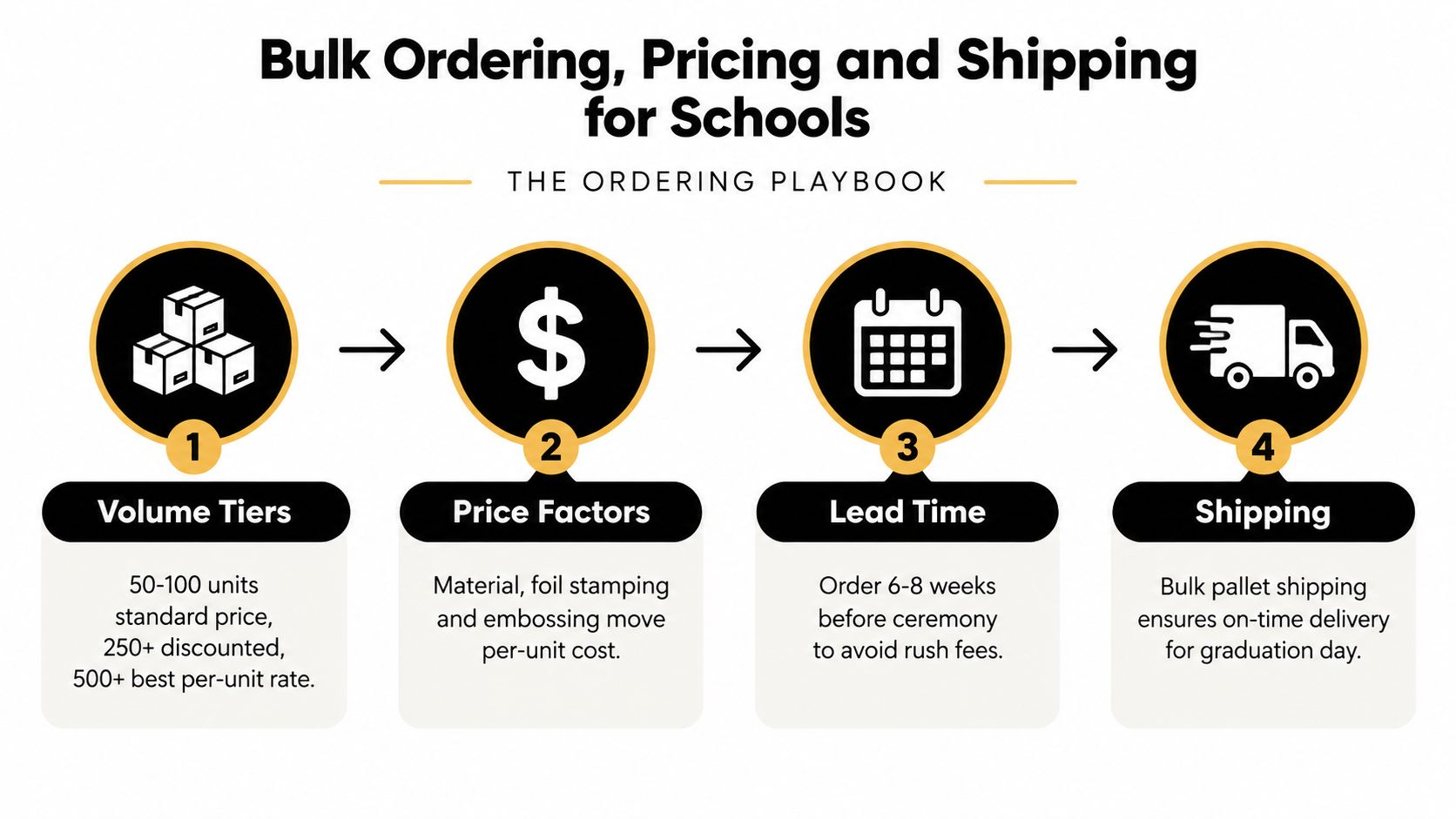
The per-unit price usually moves with the material, decoration method, order quantity, and construction. Foil stamping and embossing add production work. A reinforced laminated cover costs more to produce than a lightweight paper folder. Ordering the wrong size creates the most expensive kind of waste because the school may need a replacement order close to commencement.
A practical ordering sequence
- Confirm the population: Count expected graduates, honors recipients, faculty presenters, and approved replacements separately. Don't rely on an old class list.
- Lock the specification: Record diploma width, height, orientation, opening style, cover color, material, and branding.
- Request a physical sample: Review the hinge, pocket, finish, foil, and logo placement before approving the full run.
- Approve written artwork: Check every spelling detail, degree title, year, seal, and color treatment.
- Set the ship-to plan: Use a staffed campus address and name the person responsible for inspection.
- Build a reorder plan: Decide how misprints, damaged units, and late enrollment changes will be handled before production starts.
The University of Central Arkansas bid illustrates why administrators should ask about construction details. Its specification called for warp resistance, layered board and foam, a top liner, and a reinforced hinge, not merely a decorative exterior. Those details affect whether a class set remains presentable through storage and handoffs.
Use the diploma covers collection as one place to compare available formats and then ask for a quote based on your exact quantity and decoration. Don't compare prices until every vendor is quoting the same size, material, opening, and imprint.
Timeline checklist
Work backward from the ceremony. At the earliest planning stage, confirm counts and diploma specifications. After that, approve the sample and artwork, place the order with a shipping buffer, inspect the delivery immediately, and keep a short window available for replacements. Never schedule final approval so close to commencement that a misprint forces emergency freight.
Care, Display, and Long-Term Storage Tips
A presentation cover and an archival system aren't automatically the same thing. The cover handles the ceremony and short-term protection. Long-term preservation depends on the materials touching the diploma, the storage environment, and the way the document is supported.
During commencement, keep hands clean and dry. Hold the cover by its edges or exterior panels, avoid pressing through the opening onto the diploma, and don't tape, glue, or staple decorations to the surface. Those quick fixes can leave residue, create pressure points, or damage a finish that was meant to remain intact.
Choose the display method first
A shadow box gives the diploma, cover, and selected ceremony items a defined display environment, but the framing package should use appropriate archival materials. A shelf display leaves the cover accessible for handling, yet leaning it upright can place stress on the spine and allow the paper to slump. Flat storage is the safer default for an unframed diploma.
Light, humidity, and temperature changes deserve attention. Warm or humid conditions can make non-archival acetate or plastic components stick to the diploma and can accelerate discoloration. Avoid basements and attics, where environmental swings can affect both paper and binding. Acid-free, lignin-free materials are preferable for long-term storage, and acid-free tissue can separate the diploma from the cover when the cover's interior composition is uncertain.
| Material | Best For | Avoid |
|---|---|---|
| Leatherette | Frequent ceremony handling and formal class presentation | Assuming the outer finish guarantees archival protection |
| Genuine leather | Carefully handled personal keepsakes | Prolonged exposure to direct light or unstable humidity |
| Bonded leather | Traditional display with moderate handling | Storing under pressure if the surface is beginning to peel |
| Velvet-touch poly | Photo-friendly presentation and gentle handling | Rough stacking or frequent contact with dirt |
| Soft-touch cardstock | Short-term ceremony use | Treating it as a permanent archival enclosure |
| Recycled PU | Institutional presentation with a leather-like finish | Sealing the diploma inside without checking interior materials |
For framed display, this guide to wood diploma frames offers a useful reference point for choosing a frame style that complements the cover. The frame should support the diploma without forcing it against unsuitable plastic or acidic backing.
The central rule is straightforward: store the diploma flat, reduce exposure to light and humidity, and use archival materials when the document is meant to last for decades. A beautiful cover can begin the preservation process, but it doesn't finish it.
Your Final Checklist Before You Buy
Before you click buy, turn the product page into a specification sheet. A graduation diploma cover is easy to order badly because several details can look correct in a thumbnail while failing in actual use.
Document and fit
- Measure the diploma: Confirm the paper's exact width and height.
- Verify orientation: Choose portrait or landscape based on the diploma, not the ceremony folder.
- Check the interior: Compare usable pocket dimensions with the measured document.
- Confirm the binding: Make sure the hinge or opening style supports the way the diploma will be presented.
- Ask about samples: For an institutional order, inspect a physical sample before approving production.
Appearance and personalization
Check the school name, seal, degree wording, graduation year, and any program designation letter by letter. Decide whether the cover is for one graduate, a class set, or a reusable institutional supply. Match the material and color to the ceremony's formality and the place where the cover will live afterward.
A cover intended for repeated stage handling needs a sturdy hinge and finish. One intended for a display case may justify more refined decoration and a material that looks best untouched. Don't select personalization that will make the cover difficult to frame later unless that trade-off is deliberate.
Bulk-order controls
For schools, record the final quantity, ship-to address, date needed, proof-approval deadline, replacement policy, and process for reporting misprints. Set a budget per unit that includes the selected construction and decoration. Consider whether a small number of blank replacement covers makes operational sense for damaged or lost units, but don't order extras until the school confirms its policy and actual diploma format.
The most important buying rule: Order a sample before committing to a full run.
That sample should be opened with one hand, photographed under realistic lighting, checked for logo placement, and tested with the actual diploma or a paper mockup cut to its exact size. If the cover fails any of those checks, change the specification before placing the larger order. A polished ceremony starts with a cover that fits the document, suits the institution, and remains useful after graduation day.
Graduation Attire offers diploma covers for preschool, high school, college, and university ceremonies, with options for individual purchases and custom cover orders. Review the available formats and customization choices at Graduation Attire, then confirm your diploma size and ceremony requirements before ordering.