

You're standing in front of a graduation gown with a tape measure in one hand and a size chart in the other. The chart gives you a number, but your height is in centimeters, your weight is in kilograms, and you're not sure whether the gown should fit over a shirt, dress, stole, or academic hood. That uncertainty is exactly what causes many sizing mistakes.
A reliable graduation gown size chart becomes much easier to use when you follow the right order: measure your full height first, check your chest and other body measurements second, then resolve any boundary between sizes. The guide below walks through that process for individual shoppers, families, graduates, and school coordinators.
Why Graduation Gown Sizing Works Differently
A graduation gown isn't cut like a T-shirt or fashion dress. If you order your usual clothing size, the shoulders may feel acceptable while the sleeves or hem fall in the wrong place. Academic regalia uses measurement-based labels because the gown must hang vertically over clothing and create a consistent ceremonial silhouette.
Most charts organize gowns around height bands, often in roughly 3-inch steps. One widely used chart runs from size 21, intended for children around 2'6" to 2'9", through size 63, intended for adults around 6'6" to 6'8". Adult examples include size 39 for 4'6" to 4'8", size 45 for 5'0" to 5'2", size 51 for 5'6" to 5'8", and size 57 for 6'0" to 6'2". The same chart pairs gown sizes with weight thresholds for regular and plus-size fits, including thresholds such as 180 pounds, 270 pounds, and 330 pounds. See the graduation gown size chart from GraduationSource for the complete retail pattern.
Why clothing size isn't enough
A small T-shirt can fit your torso but say nothing about the distance from your shoulder to the floor. A gown needs enough vertical length to reach the intended hem position without dragging, while its roomy body must accommodate the clothing worn underneath.
Ease also matters. If you're unfamiliar with the space built into a garment for movement and layering, this explanation of understanding ease for fit provides useful sewing context. Graduation gowns need planned room, but extra room doesn't fix a gown that's too short.
Academic suppliers continue to use discrete numbers such as 39, 42, 45, 48, 51, 54, 57, 60, and 63, matched to height bands from approximately 4'6" to 6'8". Independent regalia guidance also confirms that gown size is selected using height and weight rather than generic S/M/L labels, as shown in this master's graduation gown size guide.
Practical rule: Start with barefoot height. Use chest and weight to check whether the standard fit will accommodate your proportions.
If your chest falls inside the chart's range for your height, stay with that height-based gown number. If your chest or weight exceeds the listed range, compare the next size or a plus-size option without choosing a shorter gown to compensate.
How to Measure Yourself the Right Way
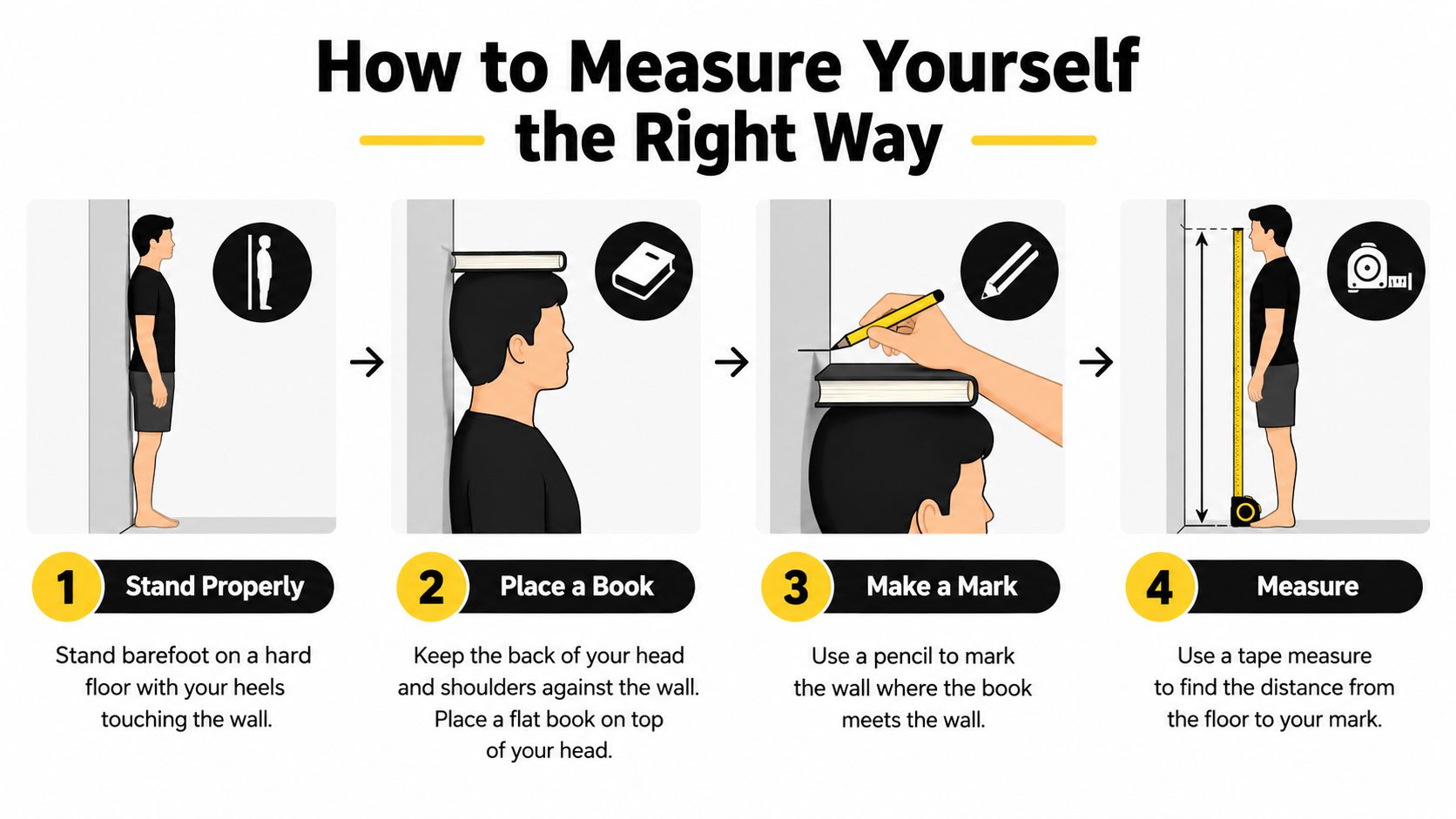
Use a soft fabric tape measure, not a metal construction tape. A second person can read the tape more accurately, but you can measure alone with a wall, a flat book, a pencil, and a firm floor.
Begin with height because it controls the gown number.
- Remove your shoes. Stand on a hard, level floor with your heels against a wall. Keep your feet flat and your posture natural.
- Align your upper body. Let your heels, shoulders, and the back of your head touch the wall if your posture allows it. Don't stretch upward or stand on your toes.
- Set a book on your head. Use a flat book and hold it level so one edge touches the wall.
- Mark the wall. Make a small pencil mark where the bottom of the book meets the wall. Measure from the floor straight up to that mark. This is your full standing height, from the top of your head to the floor, as described in this academic regalia measuring guide.
Take the remaining measurements
Wear a light shirt and close-fitting trousers, leggings, or a similarly thin layer. A graduation gown usually goes over ceremony clothing, so measuring over bulky layers can create unnecessary extra room.
- Chest: Wrap the soft tape around the fullest part of your chest. Keep it parallel to the floor, untwisted, and comfortably against the body. Exhale gently and record the measurement without pulling tight.
- Waist: Measure around the natural waist, generally the narrowest area above the navel. Stand normally instead of holding your stomach in.
- Hips: Measure around the widest part of the hips and seat. Keep the tape level all the way around.
Write every result on one sheet in inches and centimeters. A clean record prevents you from repeatedly converting numbers while comparing charts. For additional height assessment best practices, focus on a level head position and a straight measurement line.
If you want a visual walkthrough specific to regalia, use this guide to measuring graduation gown size. Your final measurement set should include height, chest, waist, and hip. The height selects the starting gown number, while the other measurements reveal whether you need a wider fit.
The Core Graduation Gown Size Chart by Height
A standard graduation gown size chart uses numbered sizes instead of apparel labels. The numbers move upward as the height band increases, commonly in roughly 3-inch increments. This arrangement helps suppliers keep the hem, sleeve position, and overall drape consistent across large orders.
The chart below presents the height-led structure supported by common academic regalia charts. Chest information must be treated as a secondary check because suppliers may define the allowance differently. Always compare the seller's own chart before placing an order.
Graduation Gown Size Chart by Height and Chest
| Gown Size | Height Range | Chest Range | Typical Length |
|---|---|---|---|
| 39 | 4'6" to 4'8" | Check supplier chart | Short adult gown |
| 42 | 4'9" to 4'11" | Check supplier chart | Short adult gown |
| 45 | 5'0" to 5'2" | Check supplier chart | Standard short gown |
| 48 | 5'3" to 5'5" | Check supplier chart | Standard gown |
| 51 | 5'6" to 5'8" | Check supplier chart | Standard gown |
| 54 | 5'9" to 5'11" | Check supplier chart | Longer standard gown |
| 57 | 6'0" to 6'2" | Check supplier chart | Long adult gown |
| 60 | 6'3" to 6'5" | Check supplier chart | Extra-long adult gown |
| 63 | 6'6" to 6'8" | Check supplier chart | Tall adult gown |
The height bands above reflect the discrete numbering shown by independent regalia suppliers, including 39, 42, 45, 48, 51, 54, 57, 60, and 63. A separate institutional chart pairs height with weight ceilings, which is why you shouldn't treat the gown number as a direct equivalent of a clothing size.
How to read the table
Measure barefoot, locate your height band, and write down the corresponding number. Then compare your chest, waist, and hip measurements with the product-specific chart. If those measurements fit comfortably, the height-based number is usually the correct starting point.
Don't assume every supplier uses identical chest limits or sleeve construction. Even when the numbered ladder looks familiar, fabric, degree level, and loose-fit design can change the final recommendation. Buyers comparing a gown with another type of custom apparel may also benefit from this custom sublimated size guide, especially when learning how different product categories present measurements.
International Conversions and Borderline Sizes
Metric shoppers often face a chart that lists feet and inches first, then adds centimeters as a secondary reference. That layout can create trouble when your measurement falls between two displayed ranges. The safest approach is to convert the measurement accurately, preserve the original result, and avoid rounding to a convenient ten.
For example, a height band of 5'0" to 5'3" corresponds approximately to 152 to 160 centimeters. A regalia chart may show neighboring bands with overlapping-looking metric values because the imperial endpoints don't always translate neatly into rounded centimeter labels. Use the chart's actual boundaries rather than choosing a size based on a rounded figure.
Metric conversion reference
| Gown Size | Height (ft/in) | Height (cm) | Recommended Action |
|---|---|---|---|
| 45 | 5'0" to 5'2" | Approximately 152 to 157 cm | Match the exact chart band |
| 48 | 5'3" to 5'5" | Approximately 160 to 165 cm | Compare the next band at the boundary |
| 51 | 5'6" to 5'8" | Approximately 168 to 173 cm | Recheck barefoot height |
| 54 | 5'9" to 5'11" | Approximately 175 to 180 cm | Use the supplier's stated endpoints |
| 57 | 6'0" to 6'2" | Approximately 183 to 188 cm | Confirm long-gown fit |
| 60 | 6'3" to 6'5" | Approximately 191 to 196 cm | Check tall sizing availability |
| 63 | 6'6" to 6'8" | Approximately 198 to 203 cm | Confirm the provider's maximum band |
A student measuring 159 cm shouldn't automatically select a size from a rounded “160 cm” line. Compare the exact chart boundary and ask the supplier whether the upper band is intended for that measurement. Someone measuring 170 cm should also avoid guessing from a rounded chart label, because the next imperial band may not begin until a taller threshold.
For weight conversions, use kilograms = pounds × 0.4536. Keep the original pound figure beside the converted result when comparing a chart that lists both systems. The Camosun conversion chart illustrates why mixed imperial and metric ranges need careful boundary handling.
When a converted height sits within 1 centimeter of the next band, measure barefoot twice. Order the larger size only when the second reading repeats the same result.
Gown Length and Fit by Degree Level
Degree level changes more than the color and accessories. It can change the gown's sleeve shape, hem target, front detailing, and the amount of material layered over your clothing. Use the degree-specific requirements from your school before relying on a general gown chart.
| Degree Level | Hem Position | Sleeve Style | Fit Note |
|---|---|---|---|
| High school | Around four inches below the knee | Shorter body and simpler sleeve | A narrow chest range may apply |
| Associate | Knee to mid-calf | Bell sleeve | Shoulder drop affects the appearance |
| Bachelor | Knee to mid-calf | Bell sleeve | Check the vertical fit before chest allowance |
| Master's | About seven to eight inches below the knee | Longer sleeve with arc-shaped cuff | Extra sleeve material can change shoulder feel |
| Doctoral | Mid-calf to ankle | Detailed sleeve with velvet bars | Velvet panels add front weight and length |
High school gowns usually have a shorter body and a hem approximately 4 inches below the knee. Associate and bachelor gowns commonly fall between the knee and mid-calf, so a correct shoulder position helps the bell sleeves hang properly.
Master's gowns use a longer sleeve with an arc-shaped cuff and extend approximately 7 to 8 inches below the knee. Doctoral gowns are longer still, often reaching from mid-calf toward the ankle, with velvet panels down the front and three velvet bars on each sleeve. Those details add visual weight and can make front length feel different from a plain gown.
If your ceremony requires shoes with a noticeable heel or raised sole, ask whether the supplier wants height measured barefoot or with ceremony footwear. Use the degree-specific guidance in this resource on the length of a graduation gown before selecting between adjacent sizes.
Plus Size and Weight-Based Fit Decisions
Weight alone shouldn't decide your gown size. A taller graduate and a shorter graduate can have the same weight but need different robe lengths, so height remains the primary control variable. Weight and chest measurements then determine whether the standard body width will be comfortable.
Some regalia charts pair sizes with weight ceilings such as 180 pounds, 270 pounds, and 330 pounds, as shown in the GraduationSource sizing chart. Treat those figures as a fit check, not as a substitute for measuring your chest.
Use chest as the deciding measurement
If your chest is within the standard range for your height, retain the height-based gown number. If your chest exceeds the listed range, compare the next size or a plus-size fit while keeping the same height logic.
A wider gown adds room through the chest and hip, but it doesn't shorten the shoulder-to-hem distance. Choosing a smaller gown to avoid extra width can leave the sleeves and hem too short. For a procurement team, the chart should therefore record height first and weight or chest second.
| Height Band | Standard Chest | Plus Threshold | Action |
|---|---|---|---|
| Short adult band | Supplier-specific | Supplier-specific | Compare chest before ordering |
| Mid-height band | Supplier-specific | Supplier-specific | Use height size, then check width |
| Tall adult band | Supplier-specific | Supplier-specific | Confirm long length with plus fit |
| Extended-size band | Supplier-specific | Supplier-specific | Ask about dedicated full-fit options |
The published charts don't provide one universal chest threshold for every supplier, so don't transfer a threshold from one retailer to another. Send the exact height, chest, waist, and hip measurements when requesting a recommendation.
What to Order When You Sit Between Sizes
A gown that's slightly long offers more practical options than one that's too short. A tailor can hem excess length, take in a shoulder, or adjust a loose area. Added length can also remain less noticeable beneath the front drape, while missing length at the wrist or knee can't be created after delivery.
Use a simple decision rule:
- At the top of a height band: Choose the larger size when your second barefoot measurement confirms the result.
- Near the next band: Compare the supplier's exact endpoints instead of rounding your height.
- With ceremony layers: Account for a stole, hood, honor cord, shirt, dress, or jacket when checking shoulder comfort.
- Above the weight guidance: Choose added width rather than shortening the gown to force a standard fit.
Measure in the morning if possible, when you're likely to stand at your natural full height. Keep your posture relaxed, repeat the wall measurement, and record both results before ordering.
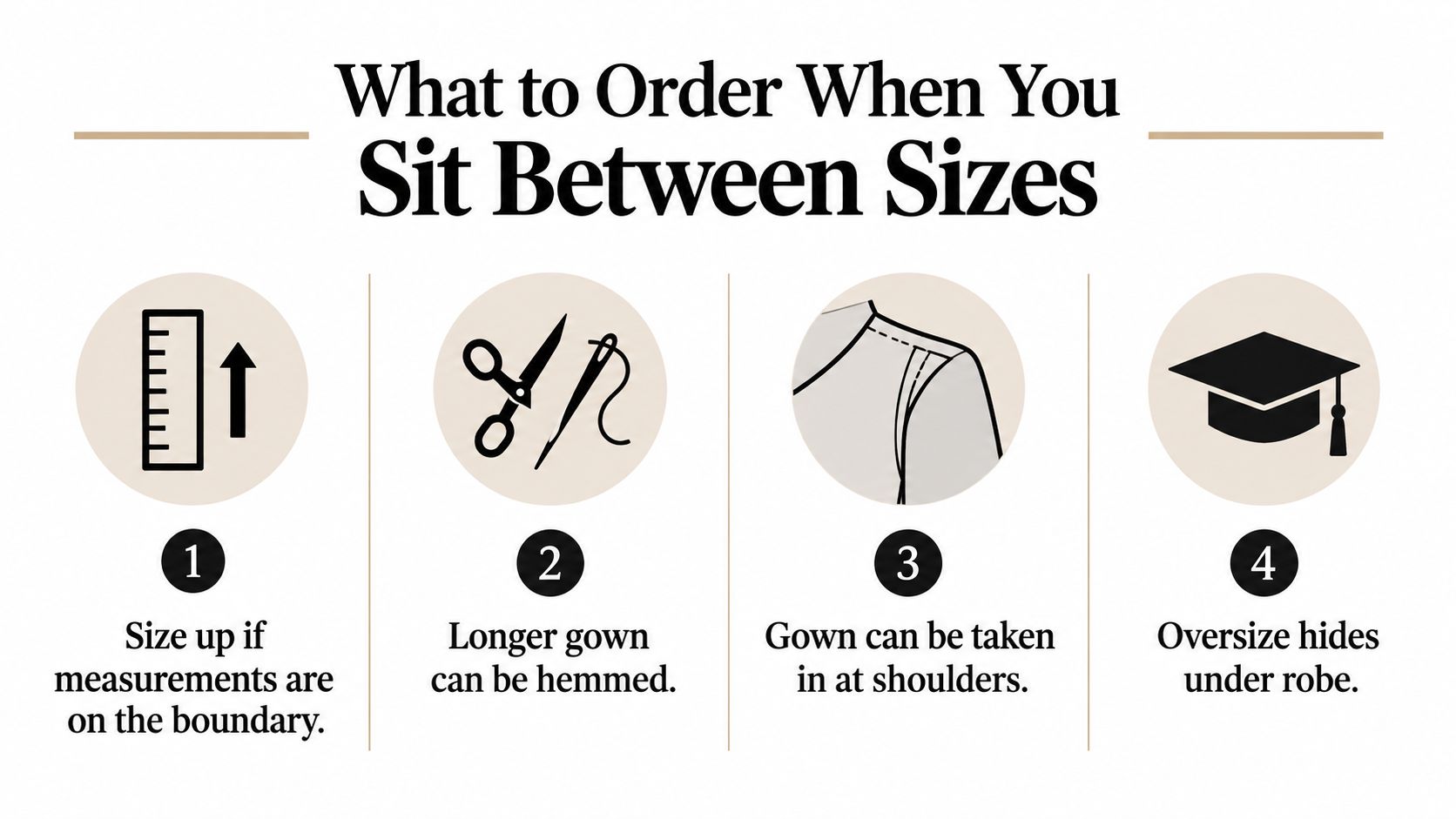
Boundary decision: If height and chest point to different sizes, protect the vertical fit first, then choose the wider option that keeps the sleeve and hem appropriate.
Shoes need a separate decision. If your school expects a particular ceremony shoe, ask the vendor whether that footwear should affect the selected gown size. Don't add shoe height to your measurement if the chart specifically requires barefoot height.
The following video can help shoppers visualize the decision process before submitting measurements.
Bulk Ordering and School Procurement Tips
A school order succeeds when the coordinator treats sizing as a data-collection task rather than a last-minute apparel survey. Ask each graduate for barefoot height, chest, and any relevant weight information, then keep those responses in a single roster that can be reviewed before the order is released.
Color and material require the same attention as size. Request fabric swatches before approving the full order, confirm that the finish and weight match the school's expectations, and ask the supplier to document color consistency across the shipment.
Coordinator checklist
| Milestone | Lead Time | Owner |
|---|---|---|
| Confirm school requirements and degree levels | Before ordering | Commencement coordinator |
| Collect height and body measurements | Before size allocation | Students or families |
| Review size distribution | Before purchase approval | Coordinator and registrar |
| Request swatches and confirm color | Before full order | Procurement lead |
| Record exchange terms and cutoff | Before purchase order | Purchasing office |
| Prepare day-of distribution plan | Before ceremony | Staff team |
The roster should show the number of graduates assigned to each gown size, the students who need a wider fit, and any unresolved boundary measurements. Keep a small reserve plan for likely changes, but don't assign exact quantities without checking the seller's exchange and return rules.
A school comparing available regalia options can review graduation regalia for sale alongside its ceremony requirements. The most useful vendor comparison includes size-chart clarity, color consistency, shipment timing, replacement procedures, and support for individual exceptions.
Return and Exchange Considerations
A correct measurement doesn't protect you from every ordering problem. Sellers set their own conditions for returns, exchanges, rentals, custom decoration, and bulk purchases, so read the policy before paying.
Check four details in writing:
- Condition: Confirm whether the gown must remain unworn, unsoiled, tagged, and in its original packaging.
- Timing: Find the final date for an exchange and allow time for the replacement to arrive.
- Exceptions: Ask whether custom embroidery, doctoral robes, faculty regalia, or other specialized items are excluded.
- Documentation: Keep the receipt, order confirmation, tracking information, and packaging until after the ceremony.
Photograph the gown as soon as it arrives, while it's still packaged. If the wrong size or a visible defect appears, contact the seller before wearing, steaming, altering, or decorating the garment.
For bulk orders, confirm whether unused stock can be returned and whether the school or individual graduate must initiate the request. Rental programs may use a different process from retail purchases, so don't assume a rental exchange follows the same rules as a purchased gown.
Quick Reference Card for Shoppers
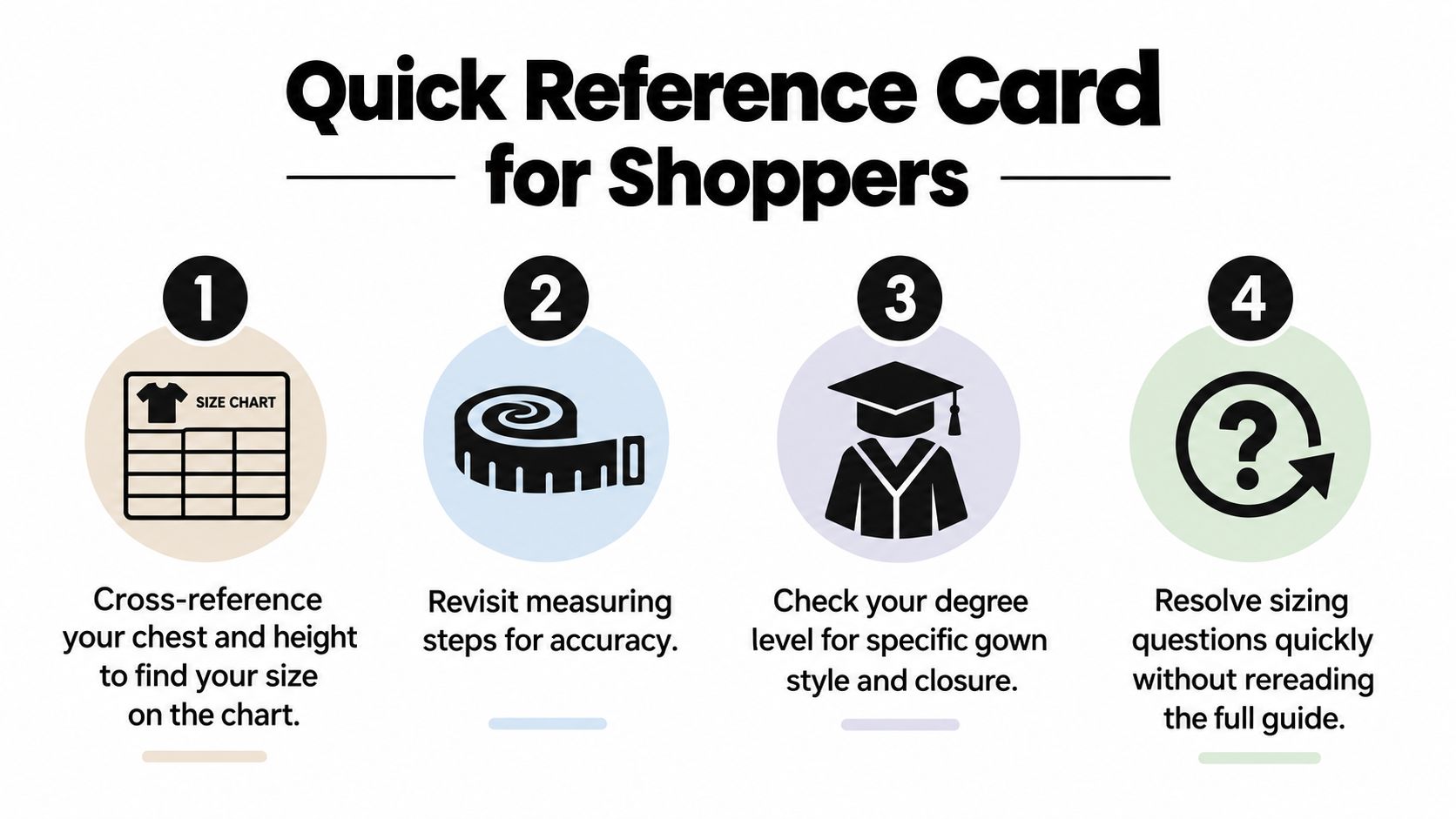
Use this compact sequence when you're ready to place the order:
- Measure barefoot height: Start at the floor and measure to the top-of-head mark. Use the wall method from How to Measure Yourself the Right Way.
- Record chest, waist, and hips: Measure over light clothing with the tape level and relaxed.
- Match the height band: Find the numbered gown size in The Core Graduation Gown Size Chart by Height.
- Check degree-level length: Confirm the expected hem and sleeve style in Gown Length and Fit by Degree Level.
- Resolve the boundary: If measurements disagree, favor the correct vertical length, then add body width where needed.
Keep these common errors off your checklist:
- Wrong tape posture: Don't measure height in shoes or with your chin lifted.
- Over-rounding centimeters: Preserve the measured result and compare exact chart boundaries.
- Ignoring ceremony footwear: Ask whether shoe height belongs in the supplier's calculation.
- Skipping the breathing step: Exhale gently for the chest measurement without tightening the tape.
- Using clothing size alone: Use apparel size only as background context, never as the primary gown number.
For school distribution, print a small card with the student's gown number, height range in inches, height range in centimeters, chest check, and degree-level hem target. That gives staff a consistent reference during pickup and makes day-of exchanges easier to manage.
Graduation Attire offers graduation caps, gowns, hoods, tams, stoles, tassels, cords, and other regalia with sizing and color guidance for school and individual orders. Review your measurements against the available graduation gown options, then visit Graduation Attire to choose the ceremony pieces that match your degree level and school requirements.