

You're checking the gown, sorting ceremony details, and deciding whether a graduation medal belongs on the order. Perhaps your graduate has received an award notification, or you're an administrator comparing medals for an honors presentation. Before choosing a ribbon or approving an engraving, settle the question that matters most: are you buying an authorized academic insignia or a personal keepsake?
Why Graduation Medals Matter on Commencement Day
A graduate settles a medal ribbon around their neck, straightens the pendant against the gown, and joins the procession. From a distance, the medal catches the light. Up close, its emblem and inscription help explain why the graduate is wearing it.
Graduation medals communicate recognition. They can identify academic achievement, completion of an honors program, or membership in a recognized honor society. Unlike caps and gowns, which are generally worn by all graduates, honor medals are selective rather than universal components of academic dress, as outlined in the history and purpose of honor medals.
The broader American academic-regalia tradition was standardized through the Intercollegiate Code of Academic Costume in 1895, creating a shared framework for ceremonial dress, according to that same historical account. That date isn't the beginning of every medal program, nor does it mean every institution follows identical medal rules.
Recognition with an institutional history
Berkeley's University Medal illustrates how an award can be connected to academic evaluation. The university established its medal in April 1871, initially using optional senior-class examinations before moving to faculty recommendations after 1874, according to the University of California's historical account of the University Medal.
The useful distinction is between the object and the decision behind it. A medal may be beautifully made, but an academic award gets its meaning from the institution's selection process.
Practical rule: Choose the recognition category before choosing the metal color.
For a family, the medal can become a reminder of effort and celebration. For a school, it must also communicate the right distinction accurately. A retailer can help with appearance, personalization, and ordering, but the registrar or awarding organization must resolve questions about eligibility and authorized ceremony wear.
The Anatomy of a Graduation Medal
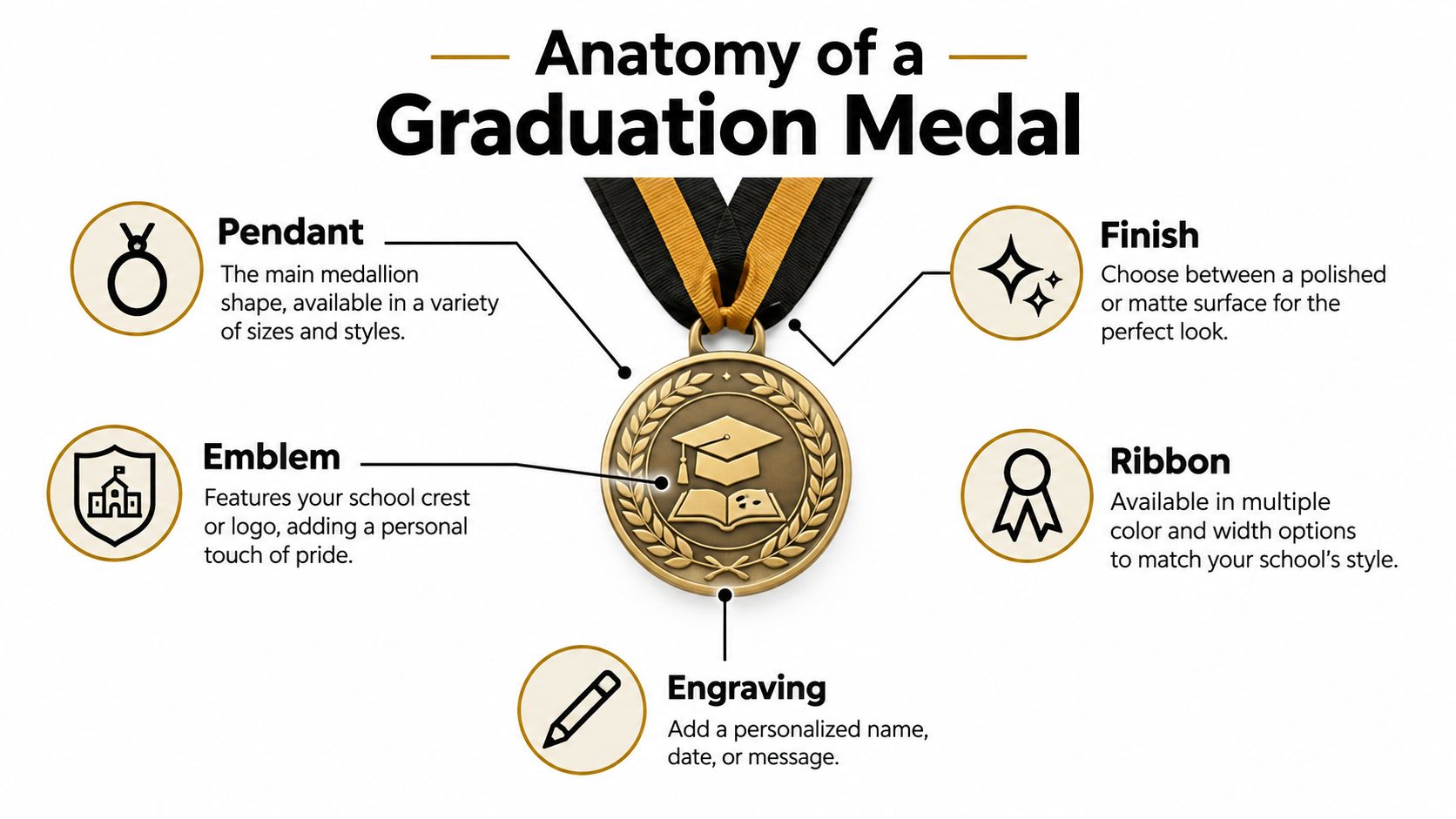
Read a medal listing as an assembly of parts, not a photograph of a gold-colored circle. The pendant, emblem, finish, attachment, and engraving each answer a different question about what you're buying.
Read from the pendant outward
The pendant is the main medallion. Its shape and dimensions determine how much room the designer has for an emblem and lettering. If a listing describes it as die-cast, ask the supplier to identify the underlying alloy rather than assuming the finish tells you the material.
The emblem identifies the organization or occasion. A school crest and a graduation-year inscription do different jobs: the crest identifies an affiliation, while the year records a milestone. Treat permission to use an emblem as a separate approval task, especially for chapter or department orders.
The finish describes the visible surface, not necessarily the metal beneath it. A gold-colored medal isn't automatically solid gold, and a photograph alone won't tell you how its surface was produced.
- Ribbon or chain: Confirm what's included, how it attaches, and whether the awarding organization specifies its appearance.
- Engraving area: Ask which surface can be personalized and request a layout showing the actual inscription.
- Attachment hardware: Examine the connection between the pendant and its ribbon or chain rather than evaluating them separately.
Match the parts to the purpose
Think of the medal as a compact identification badge, but don't assume every viewer will understand its symbols. Clear wording helps distinguish an academic award from a general graduation celebration.
For example, a parent might prioritize a personal message on the reverse. A society advisor might need an approved emblem on the front and consistent ribbons throughout the order. Before comparing listings, write down what the medal must communicate, who must approve it, and which components are included in the quoted product.
Official Academic Medals vs Honor Society Medals vs Decorative Medals
Buying a medal doesn't create an academic honor. The issuing authority and its eligibility rules determine what the award means. A decorative keepsake can be meaningful without being equivalent to a university distinction.
Choosing the Right Type of Graduation Medal
| Medal Type | Issuing Authority | Eligibility | Typical Buyer | Presentation Setting |
|---|---|---|---|---|
| Official university or department medal | University, faculty, college, or authorized department | Published institutional award criteria | Authorized administrator or confirmed recipient following institutional directions | Approved commencement or academic-awards event |
| Honor society medal | Recognized society or chapter | Society membership and applicable recognition rules | Chapter advisor or eligible member | Society presentation or commencement when permitted |
| Decorative or keepsake medal | Retailer or personal gift giver | No academic status created by purchase | Family, graduate, or celebration organizer | Private celebration, photographs, or an authorized ceremony |
The differences become clearer when you examine actual university policies. Under the UTS medal guidelines, selection normally considers the highest WAM or GPA within a program, typically requiring a WAM above 85 alongside applicable honors or research criteria.
LSU applies a different formula. Its University Medal eligibility rules require an undergraduate GPA of at least 4.0, all A-level grades, and more than 50% of degree credits completed at LSU A&M; the university uses the lower of its overall and institutional GPA calculations and awards no medal when nobody qualifies.
Verify the authority before ordering
Ask for the award's exact title, the office responsible for selection, and written confirmation of eligibility. Also clarify how transfer credits are treated, whether the institution supplies the medal, and whether presentation occurs during commencement or elsewhere.
- For society purchases: Confirm chapter authorization, emblem permission, and the institution's ceremony requirements.
- For personal gifts: Choose wording that celebrates graduation without suggesting an unearned award.
- For ceremony wear: Ask the organizer which insignia are permitted rather than treating a retailer's availability as permission.
If you're comparing medals with other recognition accessories, the guide to graduation honor cords can help organize that discussion. Don't assume approval for a cord automatically extends to a medal.
For professional profiles, preserve the issuing organization's terminology. A society recognition belongs under that society's name, not under an invented university-award title.
Materials, Finishes, Engraving, and Sizing That Actually Matter
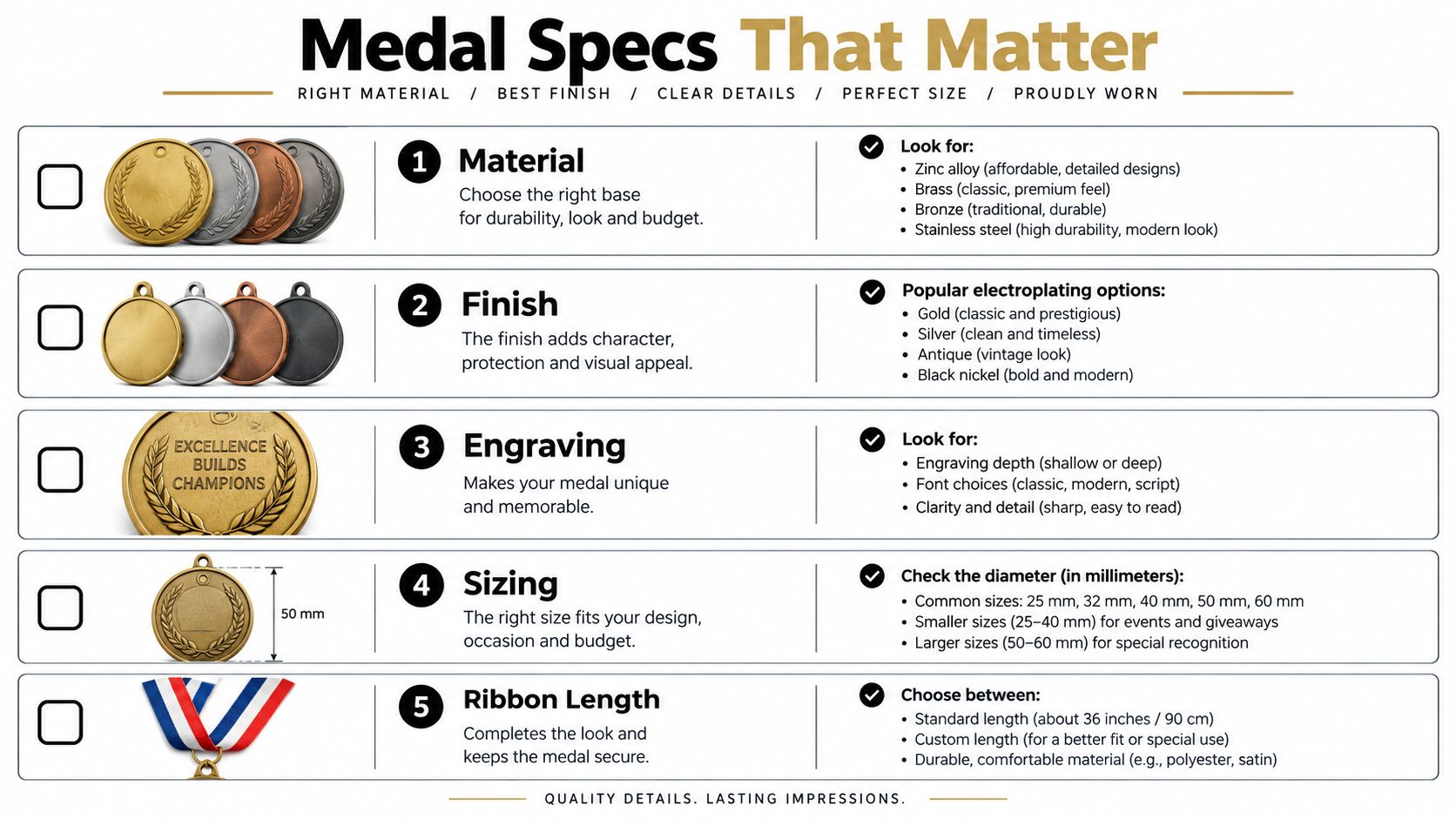
A specification sheet is more useful than a description such as premium gold medal. Ask what the medal is made from, how its surface is finished, and how the supplier will reproduce your approved design.
Choose the base metal and dimensions together
Zinc alloy suits die-cast medals with detailed relief and lettering at relatively low cost; brass and bronze offer a traditional appearance and greater perceived weight, while stainless steel provides stronger resistance to tarnishing and corrosion, according to this student award-medal materials and sizing guide. The same guide gives a practical diameter range of 60–80 mm and thickness range of 3–5 mm, identifying approximately 75 mm by 3.5 mm as a balance of presence, durability, and wearability.
Treat those dimensions as a starting point, not a universal requirement. Ask to evaluate a sample with the intended attire, particularly if the design is unusually heavy or the wearer needs a less prominent pendant.
Specify the surface and personalization
Electroplated finishes can provide gold-, silver-, nickel-, or rhodium-colored surfaces and help reduce tarnishing, while antique finishes darken recesses to emphasize raised detail. Laser engraving produces precise, repeatable marks; on anodized aluminum, it removes the oxide layer to expose contrasting metal, while anodizing itself forms a bonded oxide layer rather than conventional plating, as explained in this school-medal finishing and engraving guide.
That distinction matters when comparing apparently similar products. Ask the supplier to name the process, not just the color, and request a sample of the proposed lettering on the proposed surface.
- Base material: Record the alloy and finished dimensions in the quote.
- Surface protection: Specify plating, any clear coating, and care requirements. Ask whether protective lacquer is included rather than assuming it is.
- Personalization: Confirm the method, placement, font, and supplier's legible minimum text size. Don't impose an unsupported universal minimum.
- Color artwork: If you need a printed logo, ask about the proposed printing method, its durability, and how it differs from engraving.
- Ribbon assembly: Confirm color, length, width, attachment security, tensile-strength testing, and colorfastness.
Approve the medal you can read and comfortably wear, not just the enlarged artwork on a screen.
A useful quote request combines these decisions in writing. Include the emblem file, exact inscription, finish description, and proof-approval requirement so the vendor isn't left to interpret your preferences.
Pricing, Bulk Discounts, and Lead Times for Medal Orders
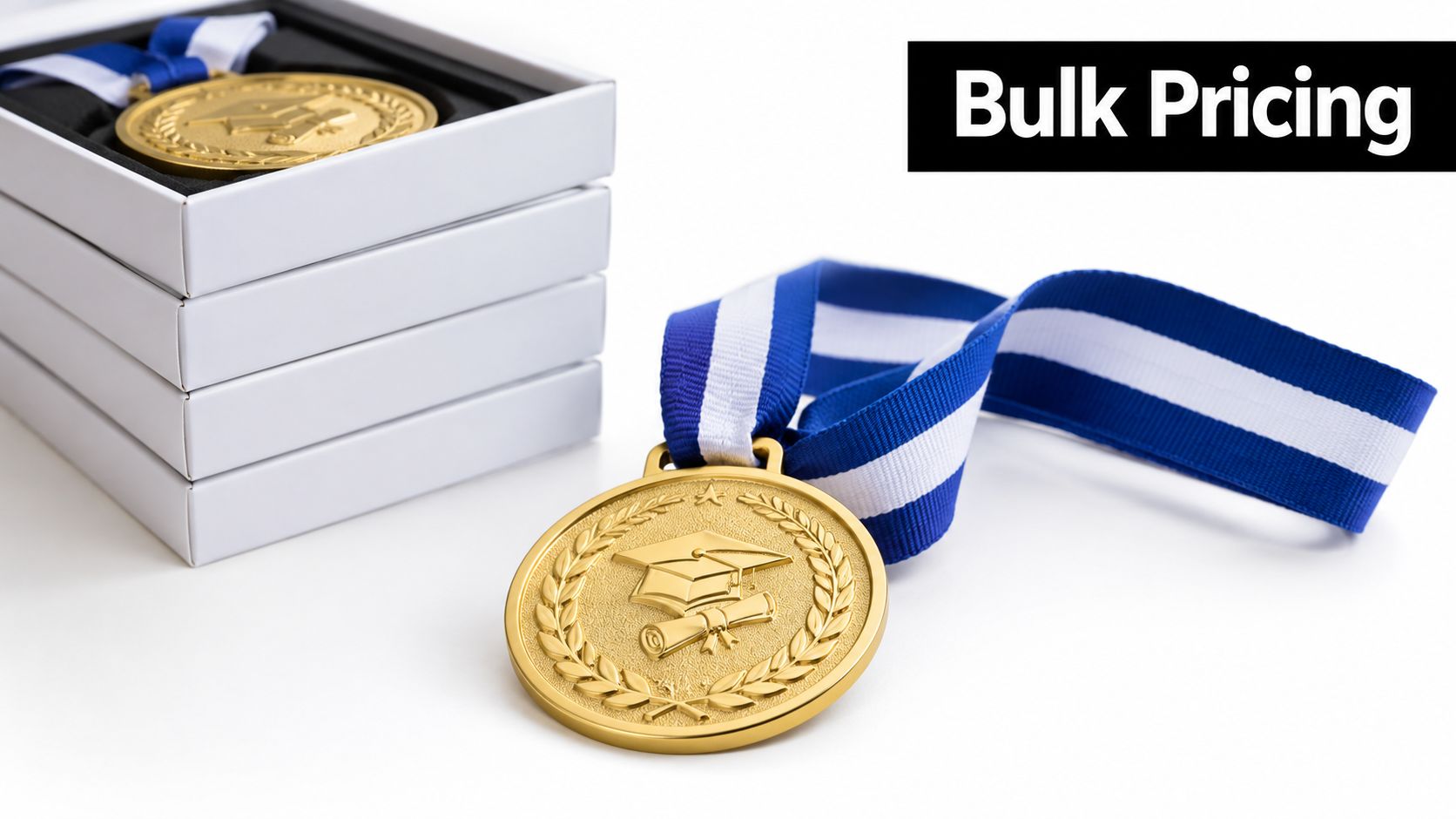
The most useful price comparison is between equivalent finished orders, not attractive starting prices. A quote for an unpersonalized pendant doesn't answer the same question as a quote that includes ribbons, individual names, presentation packaging, and delivery.
Ask for an itemized total
Send each supplier the same specification and ask them to separate the costs. Material, design complexity, finish, personalization, ribbon requirements, and packaging should be explicit quote fields rather than assumptions.
- Quantity pricing: Request the supplier's actual bulk-discount thresholds and ask whether personalized names affect those terms.
- Setup and artwork: Confirm whether design preparation, tooling, or proof revisions carry separate charges.
- Delivered total: Ask about shipping, applicable taxes, and any destination-related charges.
- Order flexibility: Clarify the cost and process for additions, corrections, or replacements.
Don't assume that a particular quantity automatically qualifies for a discount. Compare stock graduation medals with custom-manufactured options and ask what changes when you select an existing design.
For a broader custom-order comparison, T-Shirt Envy's custom clothing pricing guide 2026 is a related resource. Use it as context for preparing vendor questions, not as evidence of medal prices or production schedules.
Work backward from the required arrival date
Ask the vendor to distinguish artwork preparation, proof approval, production, dispatch, and delivery. Get the expected arrival date in writing, along with any conditions that could change it.
A family ordering a keepsake may only need to confirm the inscription and ribbon. An administrator coordinating a personalized bulk medal order also needs an approved recipient list and a named person authorized to sign off on the proof.
Expedited production and expedited shipping are different requests. Ask which stage the vendor can shorten, what approval deadline applies, and what happens if the parcel is delayed. If eligibility is still provisional, explore reserving an unpersonalized option instead of committing uncertain award details to metal.
How to Wear, Present, and Display Graduation Medals
Start with your ceremony organizer's directions, not a photograph from another university. Don't assume there's a universal left-side, right-side, or layering rule that applies to every medal and every combination of hood, stole, and gown.
Rehearse with the complete outfit
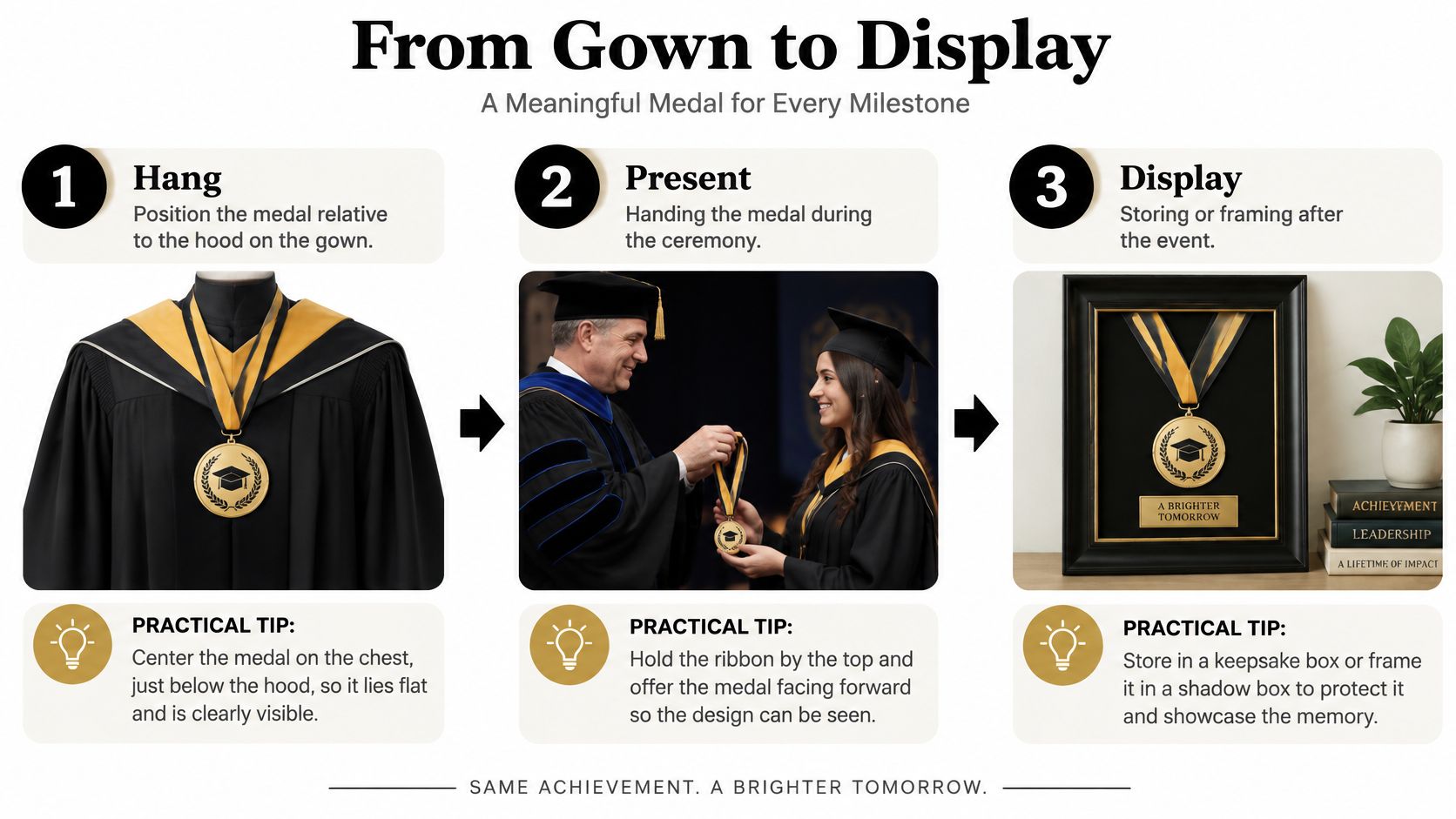
Try the medal on with the clothing and regalia you'll wear. Check its position while standing, sitting, and walking, and ask whether any adjustment is needed to keep the emblem visible.
- Positioning: Follow the organizer's directions for placement relative to the hood and stole.
- Ribbon adjustments: Don't cut or permanently alter an issued ribbon without approval. Ask about an authorized adjustment or replacement.
- Multiple medals: Confirm whether they may be worn together and whether an order of precedence applies.
Use the guide to how to wear academic regalia alongside the institution's medal-specific instructions. A rehearsal is also a good opportunity to check that the attachment is secure.
Arrange the presentation and the return home
Ask who will present the medal and whether the graduate should arrive wearing it. For a family keepsake, consider a private presentation rather than adding an unscheduled moment to the official ceremony.
Institutional arrangements can be quite specific. Under Flinders University's academic-excellence policy, the governing Council approves the medal's material, design, and inscription, and recipients who don't attend graduation have their medals sent to them.
Afterward, choose a protective box or display frame that keeps the pendant from rubbing against other objects. Follow the supplier's cleaning instructions, avoid prolonged moisture exposure, and don't assume household polish is suitable for the finish.
Before packing: Keep the award notification and presentation details with the medal's records, even if you display them separately.
For an overseas recipient, confirm the address, available tracking, destination requirements, and responsibility for a lost parcel with the issuing office before dispatch.
Eligibility Timing, Late Grades, and Using Medals After Graduation
The ceremony date isn't always the award-decision date. A graduate can finish a degree, attend commencement, and still be waiting for the institution to complete its medal process.
Texas A&M–Kingsville bases its medal calculation on GPA and completed hours from the semester before graduation and presents medals at a separate Academic Achievement Ceremony, according to its graduating-with-honors guidance. That's why families shouldn't substitute their own final-grade calculation for an official decision.
Ask which decision is final
At the University of Newcastle, University Medals are limited to 0.75% of the annual graduating cohort; when nomination decisions follow a student's graduation attendance, the university permits later presentation or delivery of the medal and updated academic documents by registered post, under its University Medal policy. A delayed presentation therefore doesn't necessarily mean an award has been overlooked.
If grades change or an appeal is pending, ask the awarding office these questions:
- Decision status: Is the recognition provisional, confirmed, or still awaiting nomination?
- Academic cut-off: Which results and completed credits count?
- Changed results: Can corrected grades trigger reconsideration, and who handles that process?
- Purchase authorization: Should the recipient order anything, or will the institution arrange it?
Keep personalization aligned with official records
The University of New England connects recipient selection with notifying its Graduation Officer so medals can be engraved and recipients included in the program, according to its University Medals policy. Use the approved award record, not an informal message, when checking an inscription.
For a résumé, LinkedIn profile, or professional biography, use the confirmed award title and issuer. Don't list anticipated recognition as already awarded, and ask the institution about replacement procedures before buying a substitute for a lost official medal.
Families can prepare a card or plan a display while confirmation is pending. The shadow-box display guide offers a starting point for arranging the eventual keepsake without rushing an uncertain inscription.
Your Medal Buying Checklist and Final Recommendations
An administrator may begin with a recipient spreadsheet, a society advisor with chapter artwork, and a parent with a gift idea. Each needs a different purchasing route, but all benefit from recording decisions before placing the order.
For schools and society advisors
Use a compact approval sheet that assigns responsibility rather than leaving every detail with the vendor.
- Award authorization: Name the office or society officer who approves the order and recipient list.
- Artwork ownership: Identify who approves the emblem, colors, and inscription.
- Specification sign-off: Attach the agreed material, dimensions, finish, ribbon, and personalization layout.
- Fulfillment responsibility: Name the contact who checks delivery, reports defects, and distributes the medals.
A school's vendor inquiry might read:
Please quote the attached medal specification and approved artwork. Separate personalization, packaging, and delivery charges, identify the proof-approval deadline, and explain how you handle incorrect inscriptions or damaged items.
That wording asks for actionable information without presuming the supplier's prices or policies. Society advisors should also retain the chapter's artwork approval and confirm whether matching ribbons can be sourced for later additions.
For families and graduates
Start by deciding whether you want an official replacement, authorized society insignia, or a personal gift. Then check the proposed wording with the graduate, compare complete delivered quotes, and review the final proof together.
Don't pay for customization that doesn't serve the occasion. A clear, well-chosen inscription may be more appropriate than a crowded design, and a private gift doesn't need to imitate an institutional award.
Before submitting payment, save the approved proof, written delivery expectations, and seller's correction policy. Those records give you something concrete to refer to if the delivered medal differs from the agreement.
The right graduation medal should suit the recognition, the wearer, and the occasion. Make those decisions deliberately, then choose a product whose specifications and ordering terms support them.
Graduation Attire offers graduation medals alongside caps, gowns, and academic accessories for assembling a ceremony outfit. Visit Graduation Attire to explore the available options, then compare your preferred medal with your approved wording, ribbon requirements, and ceremony plans before ordering.