

Let's get right to it and settle the biggest question on every graduate's mind: your graduation tassel starts on the right side of your cap. After your degree is officially conferred, you’ll ceremoniously move it over to the left side, marking your official transition from candidate to graduate.
Understanding Graduation Tassel Placement
The journey of your graduation tassel from one side of your cap to the other is a small but incredibly powerful symbol of your academic achievement. Think of it as crossing a finish line. Starting on the right signifies you are a candidate for graduation, poised and ready. The moment it's moved to the left, you've officially done it—you've completed your degree.
This simple "right-to-left" tradition is a rite of passage shared by millions of graduates, connecting you to a long history of academic celebration. It’s a physical gesture that represents the culmination of years of hard work, late-night study sessions, and pure dedication. Knowing this little detail ensures you can fully participate in one of the most memorable moments of the entire ceremony.

Tassel Placement At a Glance
To make sure there's zero confusion on the big day, we've put together a simple cheat sheet. This table breaks down the standard placement for all academic levels, so you know exactly where your tassel should be before and after your name is called.
| Academic Level | Before Degree Conferral | After Degree Conferral |
|---|---|---|
| High School | Right Side | Left Side |
| Associate's Degree | Right Side | Left Side |
| Bachelor's Degree | Right Side | Left Side |
| Master's Degree | Right Side | Left Side |
| Doctoral Degree | Right Side | Left Side |
This quick guide should clear up any last-minute jitters about where your tassel belongs. Now, you can just focus on the moment.
Having the right regalia is the first step to a flawless ceremony. Explore our complete collection of high-quality graduation caps and tassels at Graduation Attire to make sure you're perfectly prepared. Our tassels are designed to move smoothly, making your symbolic switch from right to left a seamless and unforgettable experience.
The Story Behind the Tassel Turning Tradition
Moving your tassel from one side to the other is so much more than a box to check on graduation day—it’s a powerful, personal moment. This is a rite of passage, the physical gesture that marks the end of years of hard work and the beginning of a whole new chapter. With one simple flick of the wrist, you’re joining millions of graduates who came before you, all sharing in the same symbolic transition.
Think of it like turning the page on your academic story. With the tassel on the right, you’re still a candidate, standing on the edge of completion. The second it swings over to the left, you’ve officially arrived. This small but profound action gives you a tangible way to mark your achievement, making it feel both final and incredibly celebratory.
The Origins of a Modern Custom
Believe it or not, this iconic tradition is a relatively new kid on the block. The practice of moving the graduation tassel from right to left only really caught on about 50 years ago, but it quickly became one of the most recognizable symbols of academic success in the world. This simple ceremony, which took hold around the 1970s, is now a universal benchmark for accomplishment. You can dig a little deeper into this tradition's history and its significance on National Today.
The tassel starts on the right side of the mortarboard to show you're still a student candidate. The deliberate move to the left signifies that your degree has officially been conferred. It’s a moment of pure transformation, all in one smooth motion.
This simple act transforms a piece of academic regalia into a storyteller's tool. It silently communicates a graduate's journey from diligent student to accomplished degree-holder, all with one smooth motion.
Why the Direction Matters
The right-to-left direction isn’t random; it’s symbolic of progress, of moving forward into the next stage of your life. It’s a unified motion that the entire graduating class shares, creating a powerful sense of community and a feeling of "we did this together." Whether you move it on your own as your name is called or all at once with your classmates, the feeling is the same: pride, relief, and a whole lot of excitement for what’s next.
Participating in this tradition feels even more special when your regalia is just right. At Graduation Attire, our classic tassels are designed to make your moment perfect. They’re crafted for a smooth, easy swing, ensuring your symbolic gesture is as flawless as your academic record. After all, the last thing you want to be thinking about in that moment is a tangled or stubborn tassel. It’s a small detail that helps you stay focused on the incredible milestone you’ve just achieved.
Tassel Rules for Every Degree Level
While the ‘right-to-left’ rule is pretty much a universal constant at graduation ceremonies, the path to that big moment can feel a little different depending on what milestone you've reached. Knowing the specific customs for your degree helps you feel confident and ready when the day arrives. The good news is that the core tradition holds true across the board, from high school auditoriums to university stadiums.
Whether you're finishing up high school or earning an associate's degree, the rule couldn't be simpler. Your tassel starts on the right side of your mortarboard. This placement shows you’re a candidate, eagerly waiting for that diploma to be officially conferred.
The infographic below really helps visualize this symbolic journey from student to graduate.
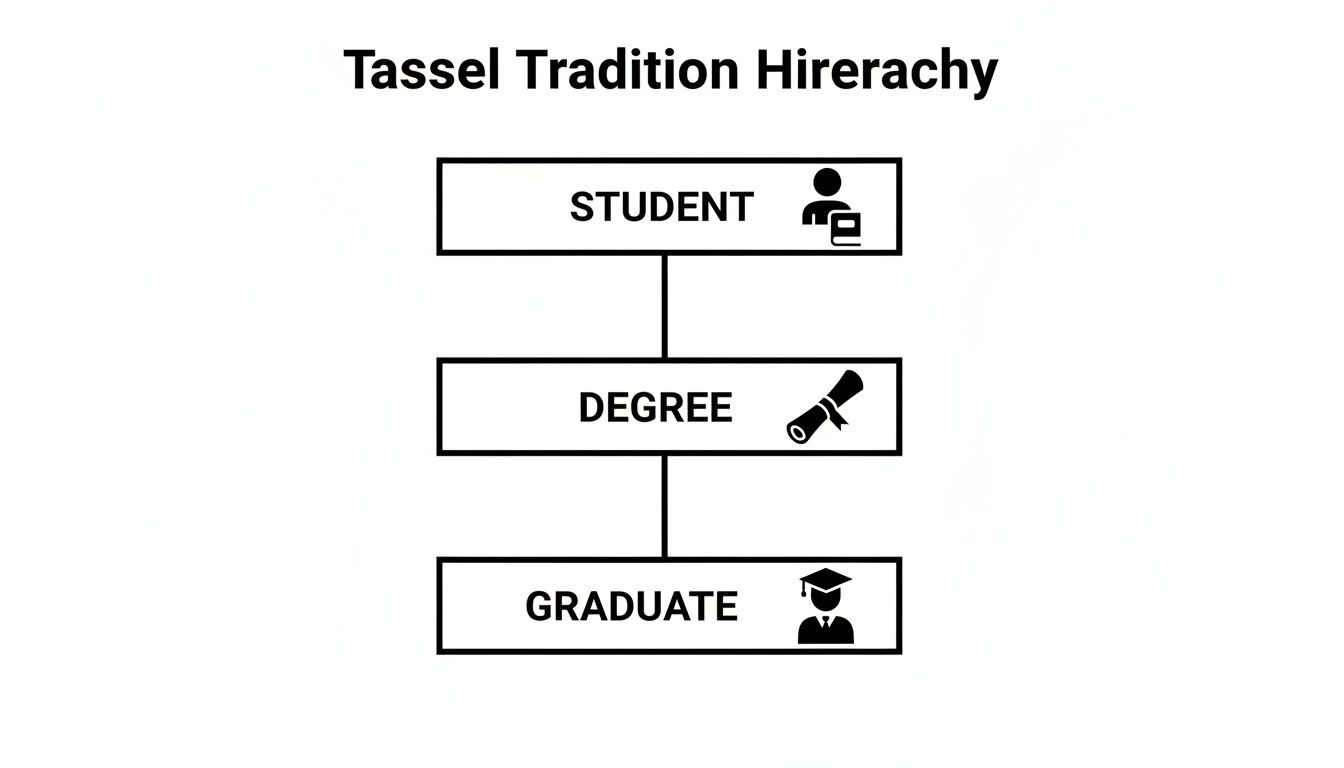
This simple chart shows that the tassel's movement is the final, official step that marks your transition from student to graduate after your degree is awarded.
Collegiate and Advanced Degree Tassel Traditions
As you move into higher education, the fundamental tradition stays the same. At the collegiate level—for everyone from bachelor's to master's and doctoral degree holders—the practice mirrors high school. Tassels start on the right and make their way to the left once degrees are formally conferred.
The only real variation you’ll see is how the tassel gets turned. Some ceremonies have graduates flip their tassels one by one as their names are called. Others coordinate a single, simultaneous tassel turn across the entire graduating class for a big, dramatic finish.
For master's and bachelor's degree candidates, the experience is almost identical. You’ll sit through the ceremony with your tassel hanging out on the right. When the big moment finally arrives, you'll join your classmates in that collective switch to the left, a shared symbol of your incredible achievement.
The consistency of the tassel turn across all degree levels is what makes it such a powerful, unifying symbol. It connects every single graduate, from high school seniors to doctoral candidates, through a shared rite of passage that celebrates perseverance and success.
Special Considerations for Doctoral Candidates
Reaching the very pinnacle of academic achievement—the doctoral degree—comes with its own unique regalia. Doctoral candidates often get to trade the traditional mortarboard for a soft, velvet tam, a more distinguished cap that signifies their advanced academic standing.
But even with this different headwear, the tassel tradition lives on.
- Starting Position: The doctoral tassel is still placed on the right side of the tam before the degree is conferred.
- The Switch: After being "hooded"—another key part of the doctoral ceremony—the graduate moves the tassel to the left side.
- The Symbolism: The meaning is completely unchanged, representing the final step in a long and demanding academic journey.
No matter your degree level, Graduation Attire has the perfect regalia for you. We offer everything you need to look and feel your best for this once-in-a-lifetime moment. You can also explore our guide on how to properly wear your full graduation regalia for more detailed tips.
When and How to Move Your Tassel
It’s the grand finale, the single most anticipated moment of any graduation ceremony: the symbolic turning of the tassel. This is that final, triumphant gesture that officially seals your new status as a graduate. Knowing exactly when and how this happens lets you stay present and fully soak in the experience without any last-minute confusion.

The timing for this big moment isn't universal; it typically follows one of two common procedures. Your school will decide which approach fits the flow of its ceremony best, so it helps to know what to expect.
Individual Versus Simultaneous Turning
The method your school chooses for the tassel turn really shapes the climax of the ceremony. Each approach creates a totally different vibe—either a quiet, personal moment of recognition or a powerful, collective celebration.
-
The Individual Turn: At many ceremonies, you’ll be instructed to move your tassel from right to left as your name is called and you walk across the stage. This approach creates a deeply personal moment of achievement, tying your tassel turn directly to the act of receiving your diploma.
-
The Simultaneous Turn: Other schools prefer a more dramatic, unified moment. In this scenario, a university official—often the president or chancellor—will instruct the entire graduating class to move their tassels at the same time, right after all the degrees have been conferred. This creates a powerful, communal feeling of shared success.
Regardless of the method, the feeling is the same—a rush of pride and accomplishment. The key is to listen for the specific instructions during your ceremony so you can participate in this cherished tradition flawlessly.
A Step-by-Step Guide to the Perfect Tassel Flip
When your moment arrives, the last thing you want is to accidentally send your cap flying. A smooth, confident tassel flip makes for a great photo and a stress-free experience. A secure fit is absolutely essential for this moment, and the durable caps from Graduation Attire are designed to stay firmly in place.
Here’s a simple guide to nail the move:
- Stabilize Your Cap: Before the moment arrives, subtly check that your cap is sitting securely. If you need to, gently press down on the center of the mortarboard with one hand to hold it steady.
- Grasp the Tassel: With your other hand, take hold of the tassel itself, right near the metal charm or the knot at the top. Grabbing it by the bottom strands can make the flip feel awkward.
- Perform the Flip: In one smooth, deliberate motion, guide the tassel from the right side of your cap over to the left. You don't need a dramatic, forceful flick; a gentle and controlled movement is all it takes.
- Pause and Smile: Once the tassel is on the left, take a moment to smile. You did it!
For more detailed advice on getting your cap and tassel perfectly positioned before the ceremony even starts, check out our helpful article on how to put the tassel on your graduation cap. Following these simple steps will ensure your big moment is as seamless as it is memorable.
What Tassel Colors and Charms Mean
That little tassel dangling from your cap does more than just mark the symbolic flip from student to graduate. Its color and any charms you add tell a story about your unique academic path. It’s not just an accessory; it’s a tiny, colorful banner celebrating what you’ve accomplished.
Just like the careful selection of charms for jewelry making, the color of your tassel isn’t random. It’s part of a standardized system used by most universities to visually represent your field of study, instantly connecting you with peers who followed a similar path.
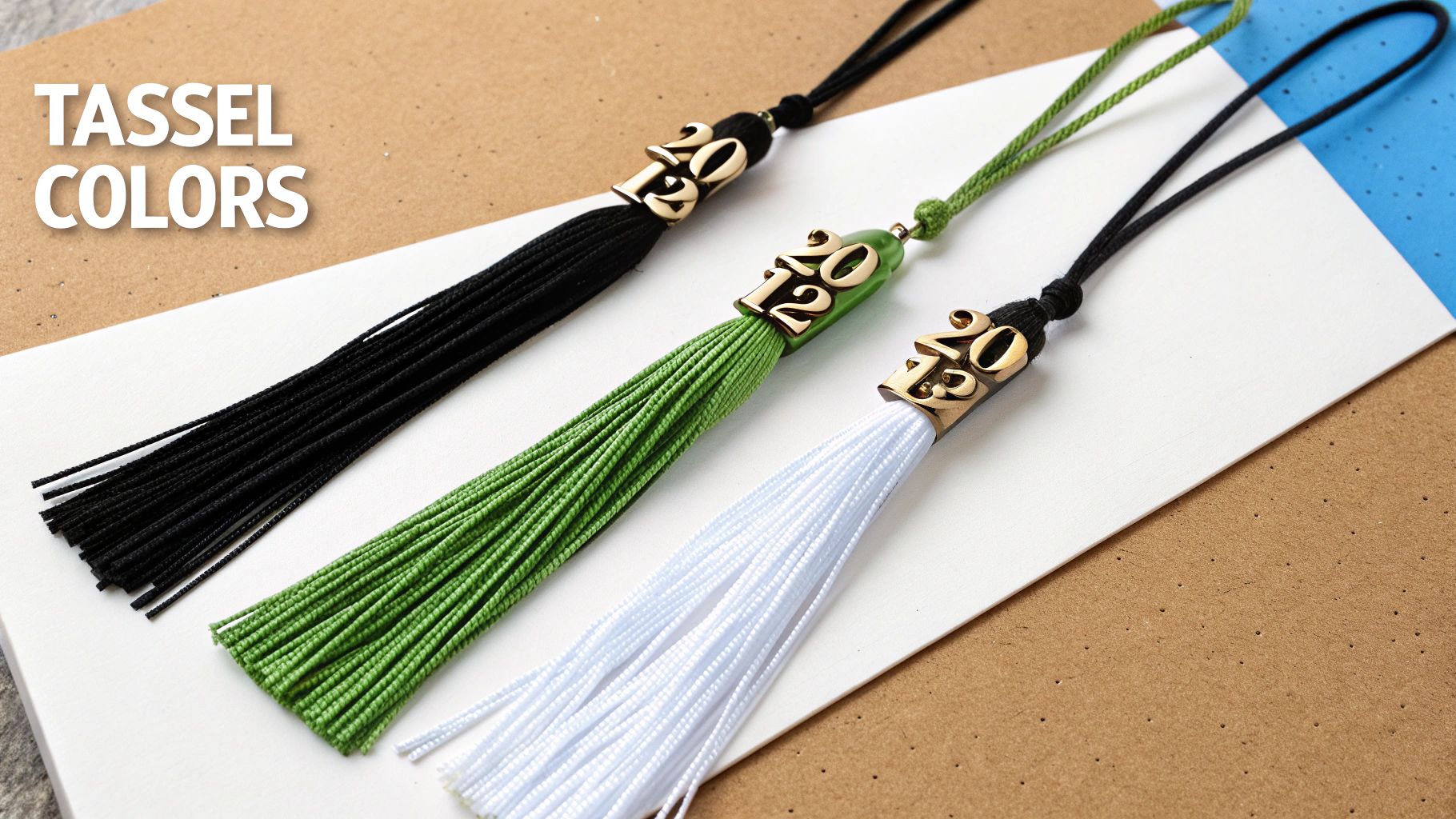
Decoding Common Tassel Colors
While some high schools keep it simple by using school colors, universities usually follow a specific code that assigns a color to each academic discipline. This system is a practical way to tell graduates from different colleges apart during the ceremony.
Here are a few of the most common examples you'll see:
- Gold or Golden Yellow often signifies graduates in the sciences, including mathematics and physics.
- Light Blue is traditionally reserved for the field of education.
- Drab (a light brown) represents degrees in business, accounting, and commerce.
- White is used for the arts and humanities, like English, history, and sociology.
This color-coding turns the graduating class into a living mosaic of academic achievement, showcasing all the different kinds of knowledge cultivated on campus.
Your tassel color is an immediate visual cue of your academic home. It’s a silent announcement of your hard-earned expertise, whether in science, the arts, or education, and connects you to a legacy of scholars in your field.
To make it easier to decode the colors you'll see on graduation day, here’s a quick reference guide to some of the standardized tassel colors and the fields they represent.
Common Tassel Colors and Fields of Study
| Tassel Color | Field of Study | Associated Degrees |
|---|---|---|
| White | Arts, Letters, Humanities | English, History, Foreign Languages |
| Golden Yellow | Science | Biology, Chemistry, Physics, Math |
| Drab | Business | Accounting, Finance, Management |
| Light Blue | Education | Elementary Education, Administration |
| Orange | Engineering | Civil, Mechanical, Electrical Engineering |
| Brown | Fine Arts | Art, Dance, Theatre, Music |
| Purple | Law | Juris Doctor (J.D.) |
| Green | Medicine | Medicine, Pharmacy, Veterinary Science |
| Apricot | Nursing | Bachelor of Science in Nursing (BSN) |
| Peacock Blue | Public Administration | Public Policy, Non-Profit Management |
This system is a time-honored tradition that adds another layer of meaning to your graduation day regalia.
Personalizing Your Regalia with Charms and Stoles
Your tassel and regalia are also the perfect canvas for celebrating your individual story. Many graduates add a custom year-date charm to their tassel—a classic touch that locks in their graduation year. But you can go even further, using other pieces of regalia to highlight special honors and your personal identity.
At Graduation Attire, we believe in celebrating every part of your journey. That’s why we offer a wide range of accessories to help you personalize your look:
- Honor Cords: These braided cords, often in gold or other specific colors, signify academic honors like graduating summa cum laude, magna cum laude, or cum laude.
- Specialty Stoles: Celebrate your heritage and identity with our custom stoles, including options for First-Generation students, Kente cloth for representing African heritage, and Serape stoles for Latinx graduates.
These elements transform your academic attire into a meaningful expression of who you are and what you’ve accomplished. You can explore more ideas on how to personalize your look by reading our guide on charms for graduation tassels. It's the perfect way to make your graduation day truly your own.
Tips for Wearing and Preserving Your Tassel
Getting the tassel right is a huge part of graduation day, but there are a few other practical tricks that make all the difference. Knowing how to keep your cap from flying away and how to turn your tassel into a genuine keepsake will help you feel confident and prepared for the big day.
Let’s be honest, the biggest worry for most grads is that mortarboard cap taking flight during an outdoor ceremony. The fix is simple: bobby pins. Just slide a couple over the base of the cap and into your hair on each side for a firm hold that can handle a gust of wind or a celebratory jump.
Securing Your Tassel and Keeping the Memory Alive
When it's time for pre-ceremony photos, that tassel can have a mind of its own, usually swinging right in front of your face. Feel free to temporarily pin it back or hold it in place to get that perfect shot. Just remember to let it hang freely on the right side before the ceremony starts—it’s a small detail that honors the tradition.
After you’ve moved it to the left, your tassel officially transforms from a piece of your outfit into a cherished memento of everything you’ve accomplished. A little care goes a long way in making it last.
- Avoid the Crush: Don't just toss it in a box. Store your tassel somewhere its strands can hang straight, like in a shadow box or memory frame.
- Keep it Dry: Moisture is the enemy of both the tassel fibers and the little metal year-date charm. Keep it in a cool, dry spot away from direct sunlight to prevent fading.
Your tassel is a real, tangible reminder of all that hard work. Preserving it next to your diploma is a fantastic way to honor your journey and create a display of your success that you can be proud of for years.
To really complete your graduation collection, think about protecting your entire outfit. At Graduation Attire, we offer premium diploma frames to perfectly showcase your degree and protective garment bags to keep your gown safe. It’s the perfect way to thoughtfully preserve every piece of your graduation story.
Your Tassel Questions, Answered
To make sure you feel totally ready for the big day, we’ve put together some quick answers to the most common questions graduates have about the whole graduation tassels left or right tradition and other ceremony details.
What If My School Has Different Tassel Rules?
While the right-to-left flip is the standard across the country, some schools love to do things their own way. The most important rule of graduation day is simple: follow your school's official commencement guide.
If you’re not sure what the plan is, just ask a faculty member or someone at the registrar’s office. The goal is to feel confident and be part of your school's unique ceremony. Our regalia at Graduation Attire is made to universal standards, so you'll look the part no matter the local custom.
Is My Master's or Doctoral Tassel Different?
Yep, the regalia for advanced degrees definitely gets an upgrade. While the tassel-turning tradition is exactly the same, master's and doctoral graduates also wear specific academic hoods that show off their field of study.
Doctoral candidates often trade the mortarboard for a velvet tam, which feels a bit more distinguished. The tassel itself might even be made from a higher-quality material to signify the advanced degree.
The core symbolism is the same—moving that tassel from right to left is the moment you mark your achievement. The extra regalia simply reflects a higher level of academic work.
Can I Personalize My Graduation Tassel?
Absolutely! Adding a personal touch is a great way to make the day your own. The most common and accepted customization is a year-date charm—it’s a classic for a reason.
Some students also add small charms related to their major or a club they were in. It’s a fantastic way to celebrate your unique journey, but always check your school’s rules first to make sure personal flair is allowed.
Once the ceremony is over, the real celebration begins. For anyone wondering how to keep the good times rolling, these tips for planning a graduation party will help you create a memorable event that honors all your hard work.
At Graduation Attire, we offer a huge variety of year-date charms, honor cords, and custom stoles to help you celebrate your unique path. Find everything you need to personalize your look at https://www.graduationattire.com.