

Maya stood at the side of the stage, smoothing the edge of her sash before her name was called. Her mother adjusted the stole one last time, then pointed to the family in the front row, already wearing matching shirts they'd picked to make the photos feel like one shared moment. That small strip of fabric carried more than color, it carried the whole room.
The Hispanic graduation stole turns a standard commencement outfit into a visible statement of heritage, family, and hard-won achievement. It's worn over the cap and gown, but it isn't just decoration, it tells the audience that the graduate's story belongs to a larger community. For families who've never managed graduation traditions before, that can feel both meaningful and confusing, especially when the rules, styles, and labels vary from campus to campus.
What a Hispanic Graduation Stole Represents on Stage
A graduate in a black gown can look identical to everyone else from the back row, until the stole appears. That's when the moment changes. The sash signals that this walk across the stage is also a public recognition of culture, ancestry, language, and family effort.
A symbol that speaks before the name is called
A Hispanic graduation stole is usually worn over the shoulders and draped down the front of the gown. It can carry national colors, bilingual text, embroidered names, or symbols that point to family roots. In many ceremonies, that visual cue matters because commencement leaves graduates with very few ways to express identity in a standardized setting.
The tradition also helps families read the occasion differently. A parent or grandparent may not know the language of university regalia, but they can understand a stole instantly as a sign of pride. If you're comparing ways relatives show up for the day, matching family shirt designs can help create that same sense of unity in photos without competing with the stole itself.
Practical rule: the stole should look intentional, not improvised, because its job is to be visible from the stage and meaningful up close.
A university stole or honor cord may recognize academic standing, affiliation, or achievement. A Hispanic stole, by contrast, usually centers heritage and community identity. For a plain-language overview of that distinction, the meaning of a graduation stole is useful background before you choose one.
Families often treat the stole as a keepsake after the ceremony, but its real power is immediate. It says, “This graduate did not get here alone.” That's why the most effective designs feel personal rather than generic.
The History Behind Hispanic Graduation Celebrations
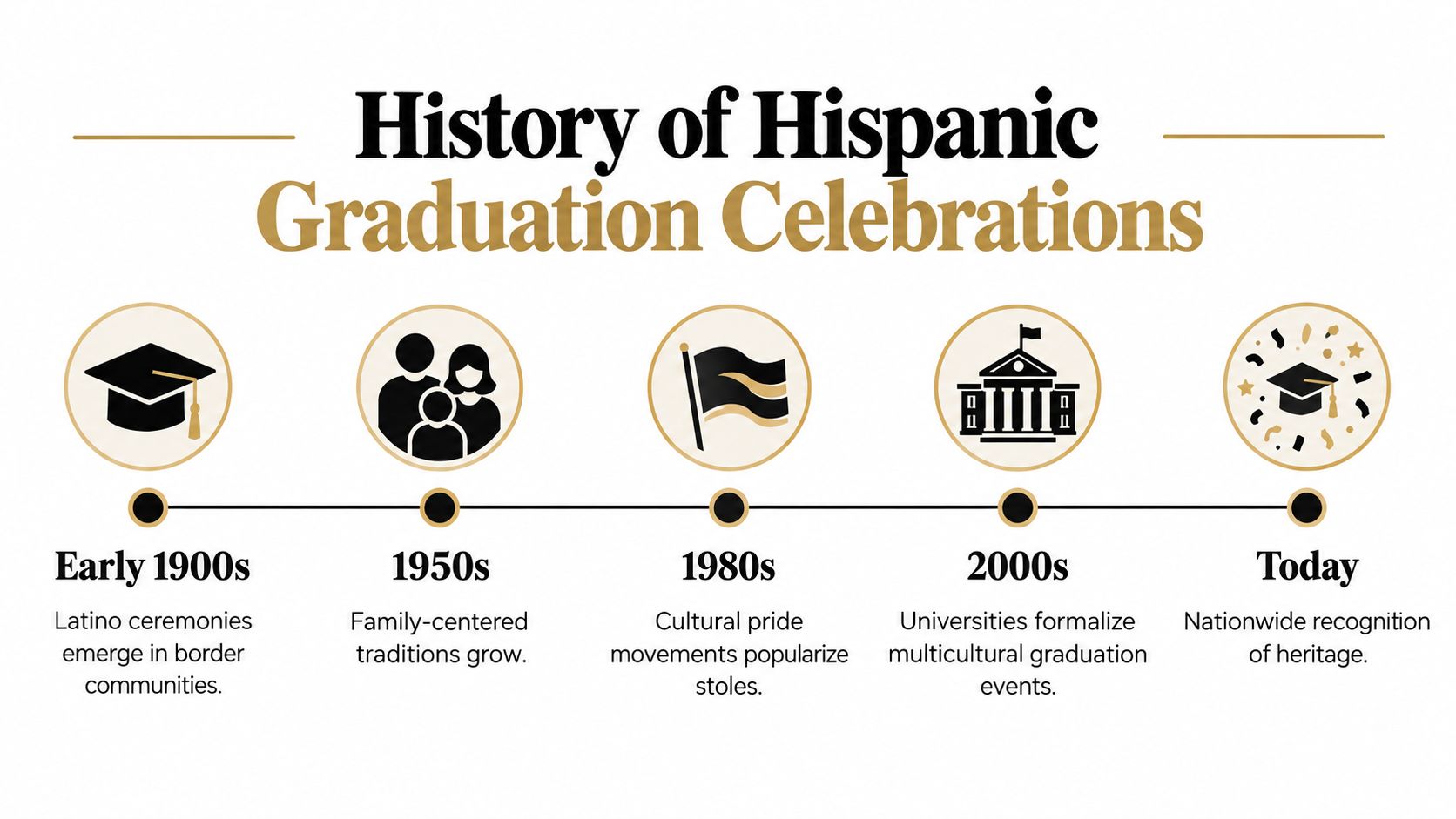
A family may see the first stole at a ceremony and feel that it has always belonged there. The tradition has older roots. Coverage of Hispanic and Latino commencement customs shows that some celebrations go back 50 years or more, and many campuses now hold separate Hispanic or Latino convocations alongside the official cap-and-gown ceremony Borderzine. That history explains why the stole became part of a campus ritual of recognition.
Why the tradition took root
These celebrations grew beside formal university graduations, especially where Hispanic-serving campus organizations and cultural centers made heritage visible. At institutions such as Arizona State University, Hispanic convocation traditions used a traditional sash to distinguish participating graduates. Arizona State University's own convocation page describes these ceremonies as spaces for cultural recognition and family celebration Arizona State University. The stole works inside the standard ceremony as a cultural marker, not as a replacement for the degree itself.
The scale of participation also helps explain why the tradition stays relevant. Hispanic students earned 15.9% of all bachelor's degrees in 2021, up from 9.2% in 2011, and 25.4% of associate degrees, according to the Hispanic Association of Colleges and Universities HACU toolkit. These are mainstream numbers, and they show a growing body of graduates who want identity-specific regalia at multiple degree levels.
Census data points in the same direction. The share of Hispanic people ages 25 to 29 who completed high school rose from 58.2% in 1996 to 88.5% in 2021, while Hispanic college enrollment reached 2.4 million in 2021 U.S. Census Bureau. For families, the stole reads less like a trend and more like a sign of progress.
Popular Styles, Fabrics, and Visual Systems
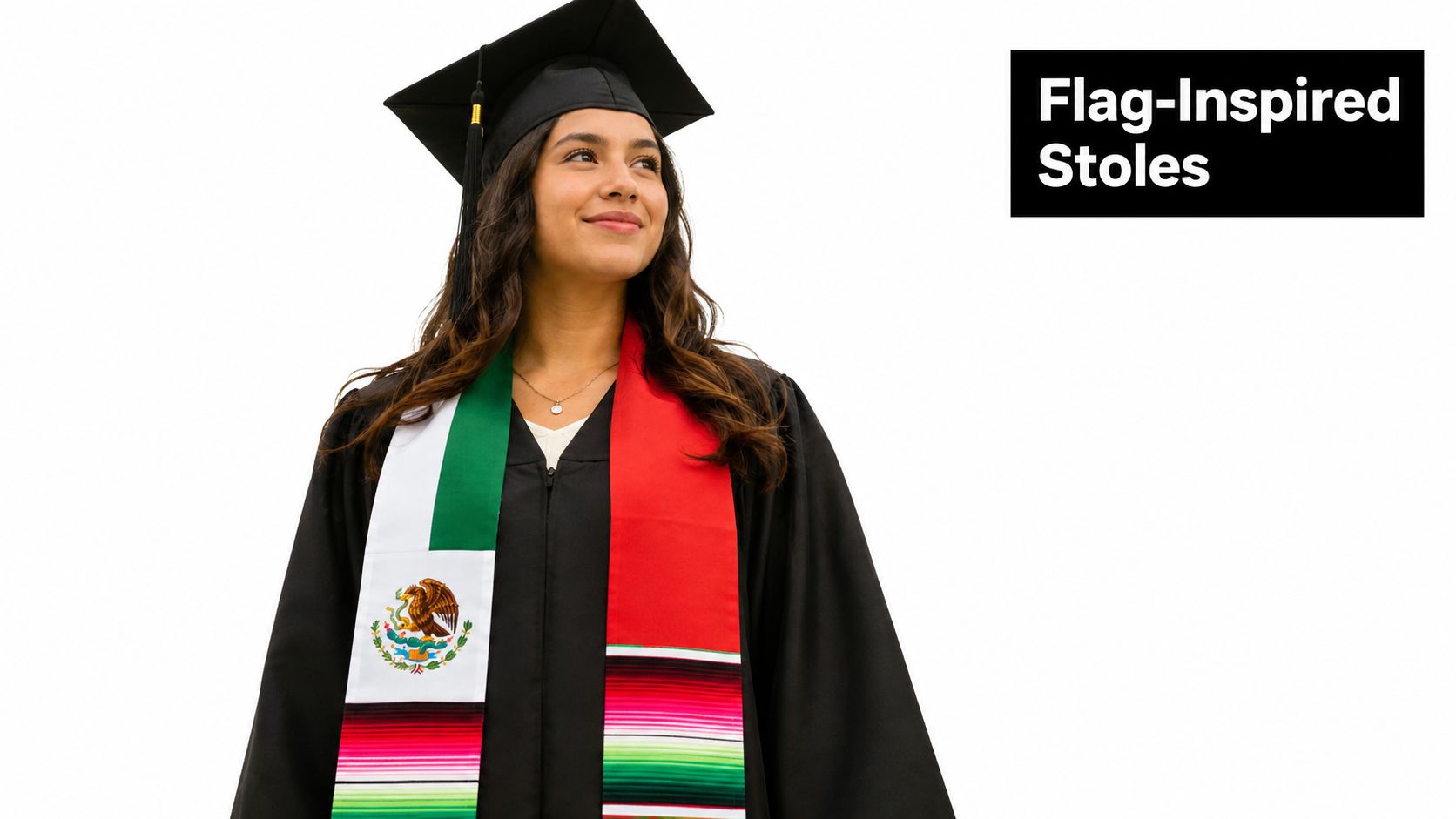
A stole can do more than match a gown. It can tell a family story at a glance, or it can reveal that story slowly in embroidery, texture, and color.
Common design families
Flag-inspired stoles use color blocks, stripes, and familiar national motifs to signal heritage quickly from the stage. Textile-driven designs draw on patterns associated with Mexican, serape, or broader Latin American aesthetics, which gives the stole a richer surface without relying on text. Bilingual word-art stoles often include terms like Familia or Orgullo Latino, so the message stays clear even for guests who do not know the visual references.
Custom embroidery is usually the most personal route. A name, class year, initials, or a short phrase can turn the stole into a keepsake that still belongs in the ceremony. If the design includes stitching, a stabilizer guide for sewing projects helps explain why clean support matters for crisp lines and durable embroidery.
Design tip: contrast matters more than busy detail. A strong base fabric and high-contrast thread usually read better in the auditorium and in family photos.
Fabric changes how the stole sits on the body and how it photographs. Satin reflects light and can give a polished finish, while polyester and graduation-weight blends are often easier to care for and less likely to wrinkle during travel. For families comparing the main options, types of graduation stoles offers a clear overview of the common categories before you narrow the look.
Families also have practical questions that style guides often skip. Will the stole be approved by the school? Can it layer cleanly over a hood, cord, or medallion? Is it affordable enough to buy without stress? Those concerns shape the final choice just as much as color or symbolism.
A good design has to be legible from the auditorium, comfortable for a two-hour ceremony, and specific to the graduate wearing it.
Choosing a Design That Honors Your Specific Heritage
“Hispanic” is a broad label, not a single culture. A graduate may identify as Mexican, Puerto Rican, Cuban, Central American, South American, Spanish, Afro-Latino, Indigenous, multiracial, or some mix of these, and each of those identities can call for a different visual language. Treating every stole as interchangeable is where a lot of guides get it wrong.
Start with identity, not assumptions
The safest question is direct: what does the graduate want the stole to represent? If the answer is family heritage, a national flag or regional reference may fit best. If the answer is community pride more than a single country, a pan-Hispanic design or bilingual wording may make more sense.
Avoid guessing based on a surname, skin tone, or accent. Those shortcuts flatten real differences, and they can turn a celebration into a mismatch. A custom message can be more respectful than a generalized motif when the graduate's heritage is mixed or specific.
Pew Research found that 46% of U.S. Hispanics had at least some college experience in 2024, up from 36% in 2010, and 21% held a bachelor's degree or higher Pew Research. That broader educational profile means the people choosing stoles are increasingly diverse, not only in degree level but in how they describe themselves.
A simple decision framework
- Pan-Hispanic symbolism: use this when the graduate wants a shared Latino identity without narrowing to one nationality.
- National-flag design: choose this when family roots in one country are central.
- Regional or textile reference: use this when the design should echo a broader cultural style without naming a country.
- Personalized message: pick this when the stole should reflect a first name, family phrase, or an identity that crosses categories.
If you're comparing visual references, the Mexican serape graduation stole collection is a useful example of how one heritage-specific style can differ from a generic Latin-inspired look. The point isn't to make the design louder. It's to make it truer.
Sizing, Layering, and Matching Your Cap and Gown
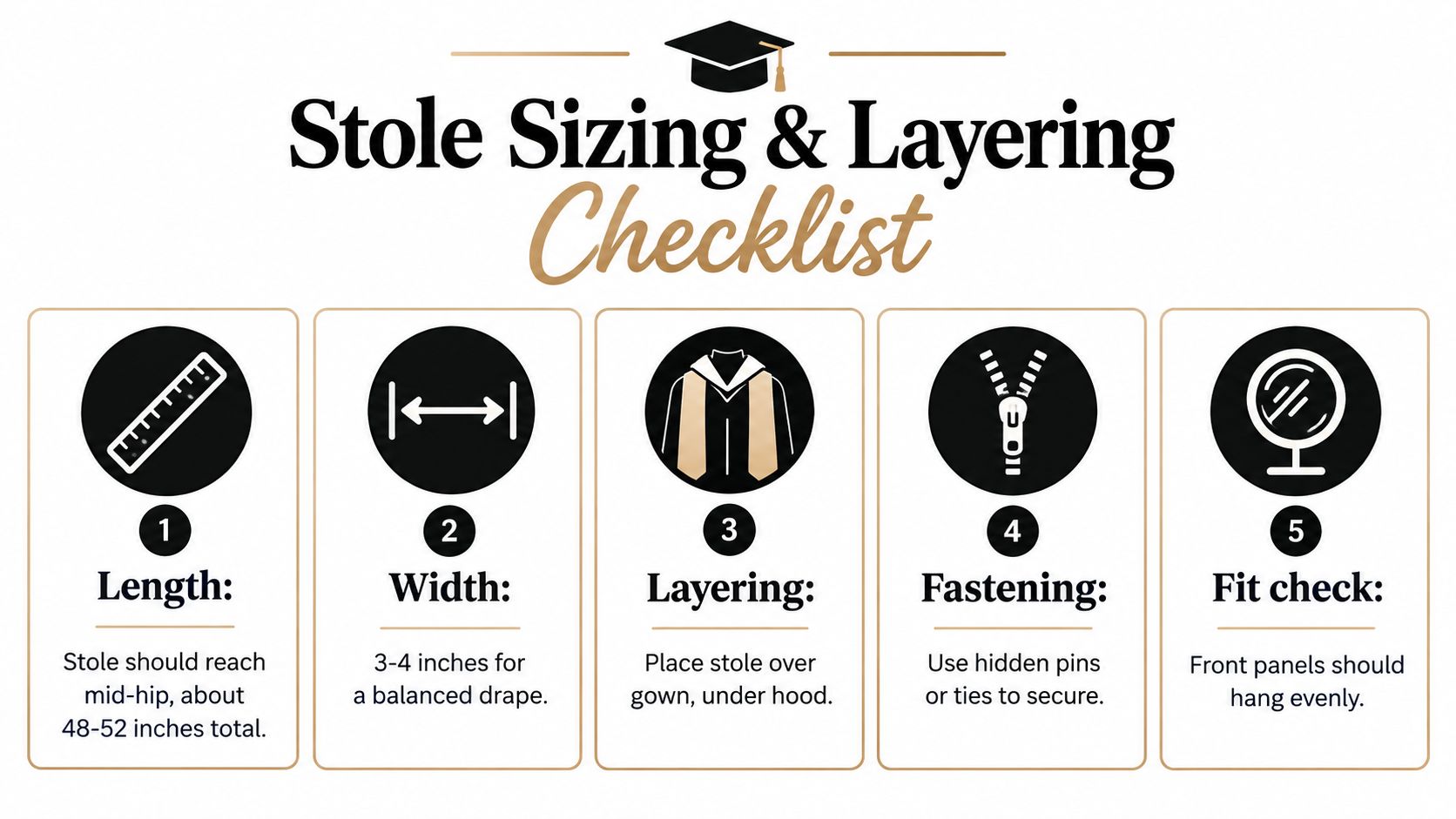
A beautiful stole can still look wrong if it hangs unevenly or fights with the rest of the regalia. The fix is mostly practical. Once the graduate understands length, layering, and placement, the whole outfit looks calmer and more polished.
Fit comes first
A stole should sit flat on the shoulders and fall evenly down the front. If it's too long, it can swallow smaller frames. If it's too short, it may look pinched or accidental.
The easiest way to check is in a mirror before leaving for the ceremony. The front panels should hang at the same length, the fabric should lie smoothly over the gown, and the edges should stay visible from the audience. If the stole has embroidery or a printed design, make sure the main element sits high enough to be seen in photos.
Layering without confusion
Wear the stole over the gown, and let the campus-required items stay visible if your school allows them to show. Honor cords usually need to rest cleanly in front, while a university-issued stole may be worn according to that school's instructions. If the ceremony has a hood, follow the hood's placement first, then arrange the stole so it doesn't bunch underneath.
Practical rule: if two items compete for the same space, the school's written commencement policy wins.
Matching the stole to the gown is easier than people expect. Black gowns usually make bright colors stand out, while school-specific regalia may need more careful contrast. Taller graduates sometimes need a slightly longer drape to keep the proportions balanced, and shorter graduates often look best with a slimmer fall that avoids crowding the torso.
NPR reported that 73% of Hispanic undergraduates are the first in their families to attend college NPR. That makes clear sizing guidance especially useful, because many families are learning commencement rules for the first time together.
Ceremony Etiquette, School Approval, and Stole Care
Campus rules can decide more than people expect. Some schools permit cultural stoles freely, some require approval, and some limit who can wear a particular design. Before buying anything, check the registrar, ceremony coordinator, or commencement office so the stole matches the school's written policy.
What permission can look like
Andrews University offers a concrete example. The university states that its AULA Latino Association stole is for participants who identify with Latin American cultural heritage, uses red and white symbolism, and carries a $10 fee handled by the Office of International Languages & Global Studies Andrews University. That kind of campus-specific rule is exactly why one school's custom is not automatically another school's custom.
Ceremony etiquette is straightforward once approval is clear. Put the stole on before photos and before lining up for procession, then keep it smooth and centered. If the family wants post-ceremony pictures, check the front and back again after the walk, because movement can twist the fabric.
Keeping it crisp after the event
Steam is usually safer than direct heat when you need to remove wrinkles. If the stole has embroidery, turn it gently and avoid pressing hard on decorated areas. Keep it away from makeup, food, and perfume until after the ceremony, because those marks show up fast on lighter fabrics.
Store the stole flat or rolled loosely after the event, especially if the graduate plans to keep it as a memory piece. A garment bag or acid-free storage option works better than stuffing it into a drawer with the cap and tassel. Clean handling matters because this isn't just fabric, it's part of the graduation record the family will look back on.
Where to Buy, What to Pay, and Smart Buying Tips

The easiest way to buy a stole is to start with the ceremony, not the product photo. A specialist graduation retailer usually makes it simpler to sort by regalia type, heritage theme, and degree level. Generic marketplaces can still work, but quality, shipping reliability, and school-friendly styling are harder to judge.
Custom work needs extra lead time. Simple stock stoles may arrive quickly, while embroidered names, dates, or school-specific wording often require longer production and review before shipping. For a student organization ordering several at once, that timing matters as much as the design.
What to compare before you order
Start with the details that affect the fit and the final look. Check whether the seller offers heritage-specific styles, custom embroidery, and clear size information. Then look at shipping speed, return policy, and whether group orders can be handled without mix-ups in color or finish. Graduation Attire, for example, carries custom stoles and identity-focused regalia across degree levels, which can help when a student group wants matching pieces.
Price matters, but the full graduation budget matters more. Because families are already covering cap-and-gown pieces, photos, travel, and a reception, decide deliberately whether the stole earns its place in that budget. If the answer is yes, loaner programs, organization subsidies, or shared purchases through a Latino student group can reduce the pressure.
A short checklist makes the decision clearer:
- Confirm eligibility: make sure the design is allowed by the school or organization.
- Check customization: verify names, wording, and colors before checkout.
- Ask about bulk orders: student groups often need consistency across several stoles.
- Review shipping timing: order early enough to avoid last-minute stress.
- Budget the full day: keep the stole in view, but not at the expense of everything else.
The demand is broad because many Hispanic students are graduating through both two-year and four-year pathways. That is one reason identity-specific regalia has become a familiar part of graduation planning.
Frequently Asked Questions About Hispanic Graduation Stoles
Families usually ask the same few questions right before graduation. The good news is that most of them can be answered with a combination of school policy, honest identity choices, and a little advance planning.
Quick Answers to Common Stole Questions
| Question | Short Answer | What to Do |
|---|---|---|
| Can it be worn with official regalia? | Usually yes, if the school allows it. | Check the commencement policy and ask the ceremony coordinator. |
| Who gives permission? | The school or event organizer does. | Confirm with the registrar, commencement office, or student organization. |
| What if dress must be uniform? | Follow the ceremony rule. | Ask whether the stole can be worn for photos or at a separate recognition event. |
| Is it worth buying if money is tight? | It can be, but it's optional. | Compare the stole's meaning with the full cost of graduation day. |
| How do I know the symbols are right? | Ask what the graduate wants represented. | Match the design to identity, not assumptions. |
A lot of confusion comes from the word Hispanic itself. It can describe a shared cultural space without erasing national, racial, or family differences, which is why the right stole is the one that reflects the graduate's identity. A design that looks “more Hispanic” isn't automatically more respectful.
Best next step: verify the ceremony rules first, then choose the stole that fits both the graduate and the event.
If the graduate is first-generation, keep the decision simple and practical. Talk through whether the stole is for photos, ceremony recognition, or later keepsake value, then decide together whether to buy, borrow, or skip it. That keeps the focus where it belongs, on the degree and the people who helped get there.
Graduation Attire offers custom and identity-focused graduation regalia, including Hispanic-themed stole options that can support school-approved ceremonies and family celebrations. If you're comparing styles, sizing, and regalia for an upcoming commencement, visit Graduation Attire to browse options that fit your graduate's day and their story.