

The most popular advice about graduation cords is also the most misleading. A chart that says gold always means honors, white always means one field, and blue always means another sounds tidy, but it doesn't match how campuses work in practice. For honor cords for master's graduation, your school, not a national chart, decides who earns a cord and what its color means.
Honor Cord Colors and What They Usually Mean
A master's honor cord is an achievement marker worn on top of your gown and hood. It doesn't identify your degree level. The issuing school or organization sets its color, and there's no national standard that makes one color mean the same thing everywhere.
That distinction matters before you buy anything. A gold braided cord, draped around the neck and hanging down the front of the gown, traditionally identifies an honor graduate, as described in the University of South Carolina Aiken history of regalia. Many universities also authorize other colors for honor societies, leadership, service, cultural organizations, or discipline-specific achievements.
Common Honor Cord Colors and What They Usually Signal
Read the table as examples, not rules. The same color can signal different achievements on different campuses, so color alone never proves you're eligible.
| Cord color | Usually signals | Seen at (example) | Confirm with |
|---|---|---|---|
| Gold braided | Honor graduate or Latin honors at many schools | Traditional honor marker across US campuses | Registrar or commencement office |
| Red, white and royal blue | Active-duty, Reserve, National Guard or ROTC service | Seattle University veteran cord; Penn State honor cord | Veterans or military student office |
| White | University Honors Program membership | University of Southern Indiana | Honors program office |
| Solid gold, red or blue | Commencement honors such as cum laude, magna cum laude, summa cum laude | University of Southern Indiana | Commencement office |
| Cultural, ethnic or affinity stole | Identity, culture or affinity group membership | Often bought independently by students | Sponsoring student group and campus policy |
Practical rule: Treat every color chart as a starting point for questions, not as permission to wear a cord.
Start with your school's own cord key. Look for it on the commencement page, in the registrar's regalia policy, or in the message that tells you you've earned an honor. If you can't find a color listed there, don't assume a store description fills the gap. Your next step is simple. Match the cord you want to a named award, society, service category, or affinity group that your campus recognizes, then confirm who issues it.
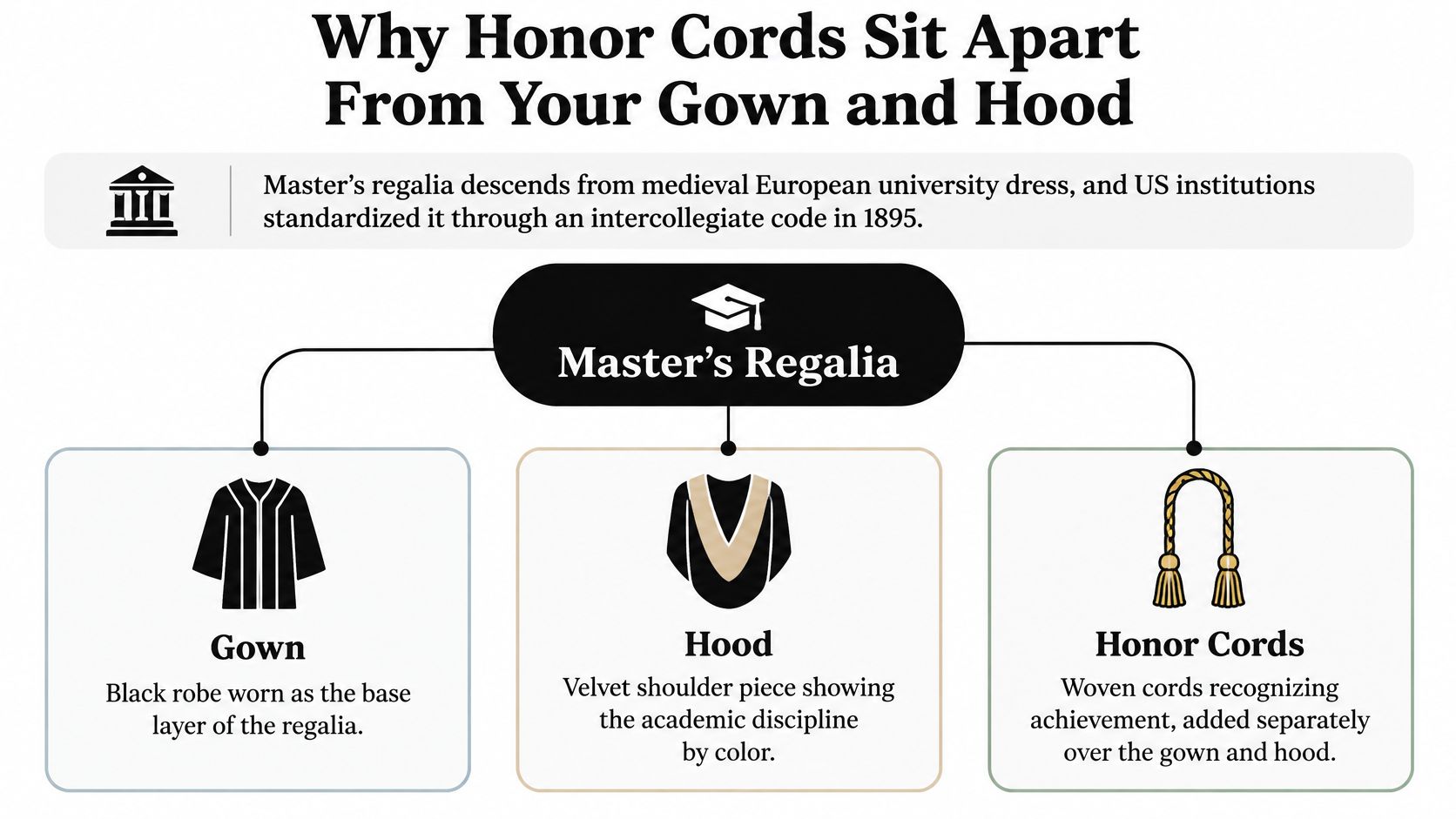
Why Honor Cords Sit Apart From Your Gown and Hood
Master's regalia descends from medieval European university dress, and US institutions later standardized it through a shared intercollegiate code.
That history produced a three-part system where each piece answers a different question. Swapping one piece for another is where the confusion starts.
The Three Roles in Plain Language
The gown works like a uniform that everyone at your level wears. The hood functions as your department's insignia. The cord acts as a merit badge that only some graduates earn.
- The gown shows level: A black master's gown uses full-length closed sleeves that open at the wrist, sometimes described as glove-style sleeves. It generally carries no doctoral velvet trim.
- The hood shows field: Velvet and lining colors signal discipline. A widely used intercollegiate convention assigns drab to business, light blue to education, orange to engineering, sage to public health and related fields, and gold to science, though every school publishes its own color key.
- The cord shows achievement or affiliation: It's added separately, over the gown, only when the school or an approved group has awarded it.
Purdue illustrates the split clearly in its commencement attire guidance: master's candidates wear a black gown and a black tassel, while hood color reflects the academic discipline. The cord sits outside that base package because finishing the degree alone doesn't earn one.
When you're unsure what a piece signals, ask three questions in order. What level is this? That's the gown. What field is this? That's the hood. What honor or affiliation is this? That's the cord. Keeping the questions separate prevents the classic mix-up: treating a gold science hood as an honors cord, or expecting a cord to stand in for a required hood.
Who Qualifies for a Master's Honor Cord
The rule that surprises master's students most is this. Some schools grant no Latin honors to master's candidates at all, even when those same students can wear cords for service, membership, or an earlier degree.
Eligibility comes from each institution's own policy. Degree level alone tells you nothing. A school may tie a cord to GPA, membership in an approved honor society, service, leadership, military status, or an honor earned during an earlier degree, and the catalog entry works like a course prerequisite: only the registrar can confirm you meet it.
Eligibility Rules by Master's Honor Cord Type
| Cord type | Typical rule | Documented example | What to check |
|---|---|---|---|
| Latin honors (cum laude, magna, summa) | Institutional GPA threshold, where the program offers Latin honors at all | North Dakota State publishes tiered GPA bands for the three honors levels; Seattle University grants no academic honors to master's candidates | Whether your program grants Latin honors at all |
| Undergraduate honor cord | Earned during the bachelor's degree | University of Memphis lets graduate students wear cords earned as undergraduates | Registrar confirms the cord carries over |
| Honor society cord | Membership in an approved honor society | Simmons says university funds cannot cover some honor-membership cords | Society must be approved by your school |
| Organization or affinity cord | Active registered group, adviser, member GPA and activity | Missouri Southern sets minimum GPA and semester activity requirements | Group sponsor and written approval |
| Military service cord | Active duty, Reserve, National Guard or ROTC commission | Penn State eligibility for a red, white and blue honor cord | Veterans or military student office |
Where GPA thresholds apply, schools state them precisely. North Dakota State University's published honors policy sets separate GPA bands for cum laude, magna cum laude, and summa cum laude. Don't borrow those cutoffs for your own campus. They're an example of how specific a local rule can be.
Seattle University shows the opposite limit. It states that master's, educational-specialist, and doctoral candidates are not eligible for academic honors, while cords remain optional, in Seattle University's academic attire policy. A cord can still be legitimate there. It just doesn't mean Latin honors.
Earlier honors add another wrinkle. The University of Memphis states that its cords primarily represent undergraduate GPA distinctions but permits graduate students to wear cords earned during their undergraduate careers, as set out in the University of Memphis cord and stole policy. Earning a cord once does not guarantee you may wear it at a second ceremony, so confirm the carryover before you pack your regalia.
Organization cords can carry measurable conditions. Missouri Southern State University requires an active registered group with a faculty or staff adviser, members with at least a 2.5 GPA, and documented leadership or service during the previous two years, with at least two activities per semester or four activities during each academic year, plus at least three years of organization activity, under Missouri Southern State University graduation requirements.
Compare each rule against your own record before you shop. Our overview of the different types of graduation cords can help you name the category, but your registrar decides whether you qualify for it.
Campus Rules That Change What a Cord Means
Two graduates can wear cords that look similar and mean different things. Campus examples show why you should read the local key, not the color.
Three Cases to Learn From
The University of Southern Indiana permits only university-provided or university-approved adornments. It reserves solid gold, red, or blue stoles for commencement honors, white cords for the University Honors Program, and red, white, and blue mixed cords for active-duty or veteran military students, under the University of Southern Indiana regalia, stoles and cords policy. At that school, an unapproved cord isn't a harmless extra. It's outside the policy.

Seattle University draws a different line. Master's candidates wear degree-appropriate hoods and aren't eligible for academic honors, yet qualifying veterans receive a special red, white, and royal-blue cord, and clubs or programs may provide additional cords. The same graduate could therefore be correctly dressed with a service cord and incorrectly dressed with a Latin honors cord.
Consider a fictional master's graduate in a professional program. She sees a gold cord online, assumes it signals honors, and orders it for photos. A week later, she checks her program's approved list and learns it doesn't include that cord. She returns it and wears only the recognition her program approved. The cord wasn't poor quality. It just didn't belong to her school's system.
The meaning belongs to the school's key, not to the color in your shopping cart.
When you read any regalia policy page, search in this order. First find the approved-accessory list, then the honors rule, then the military rule, and then the organization rule. That order prevents the most common error, which is starting with a product and working backward. Our guide to the difference between cords and stoles helps with terminology, but your campus list controls what you can wear.
Approval, Funding and Buying Steps
An honor cord works like a parking permit. Owning one creates no right to use it; the issuing office does. Confirm eligibility and approval before you spend anything, because an inexpensive universal cord can be unusable if its color conflicts with your school's symbolism or the issuing group lacks approval.

A Pre-Order Checklist in Order
- Find the approved list: Locate the commencement office's approved-accessory list and note its deadline. If your cord isn't listed, pause.
- Identify the issuing body: Name the exact issuer, whether that's the university, an honor society, an academic program, or a student organization.
- Ask who pays: Funding rules vary from campus to campus. A sponsoring program or honor society may cover the cost at one school while the student pays at another, so confirm the arrangement with your issuer rather than assuming.
- Submit group requests on time: Use your campus lead time, never a neighboring school's. The University of Southern Indiana, for example, requires student clubs and organizations to submit new cords or stoles for approval at least 60 days in advance, per its approved commencement stoles and cords guidance.
- Wait for eligibility confirmation: Penn State Abington determines honors using cumulative GPA at the end of the previous semester and distributes cords before the ceremony, according to its commencement and regalia policy. Lewis & Clark confirms final honors only after all grades are submitted, so an early cord doesn't guarantee the final designation on your diploma.
- Order after written approval: Keep a copy of the approval, color, and braid configuration. Then match construction details, such as single or double format, to what was approved.
Approval Lead Times by School
| School | Deadline or timing | Applies to |
|---|---|---|
| University of Southern Indiana | At least 60 days in advance | New cords or stoles from student clubs and organizations |
| Penn State Abington | Honors set from cumulative GPA at end of previous semester; cords distributed before ceremony | Honor cord timing |
| Lewis & Clark | Honors calculated before commencement; final only after all grades are submitted | Latin-honor designation on diploma and transcript |
Deadlines count as eligibility. A missed window can't be fixed at lineup, so get your own school's date in writing instead of borrowing another campus's calendar.
Once approval is clear, product details become useful. A double honor cord consists of two individual cords joined together at the center, with the knot positioned at the back of your neck. We sell accessories including stoles, sashes, tassels, academic hoods, diploma covers, honor cords, medals, diplomas, diploma frames, garment bags, and year date drops and charms, and customized honor cords require a minimum of 10 pieces. Browse master's packages only after your school's rules are confirmed, so you order the approved color the first time.
How to Wear Honor Cords With Master's Regalia
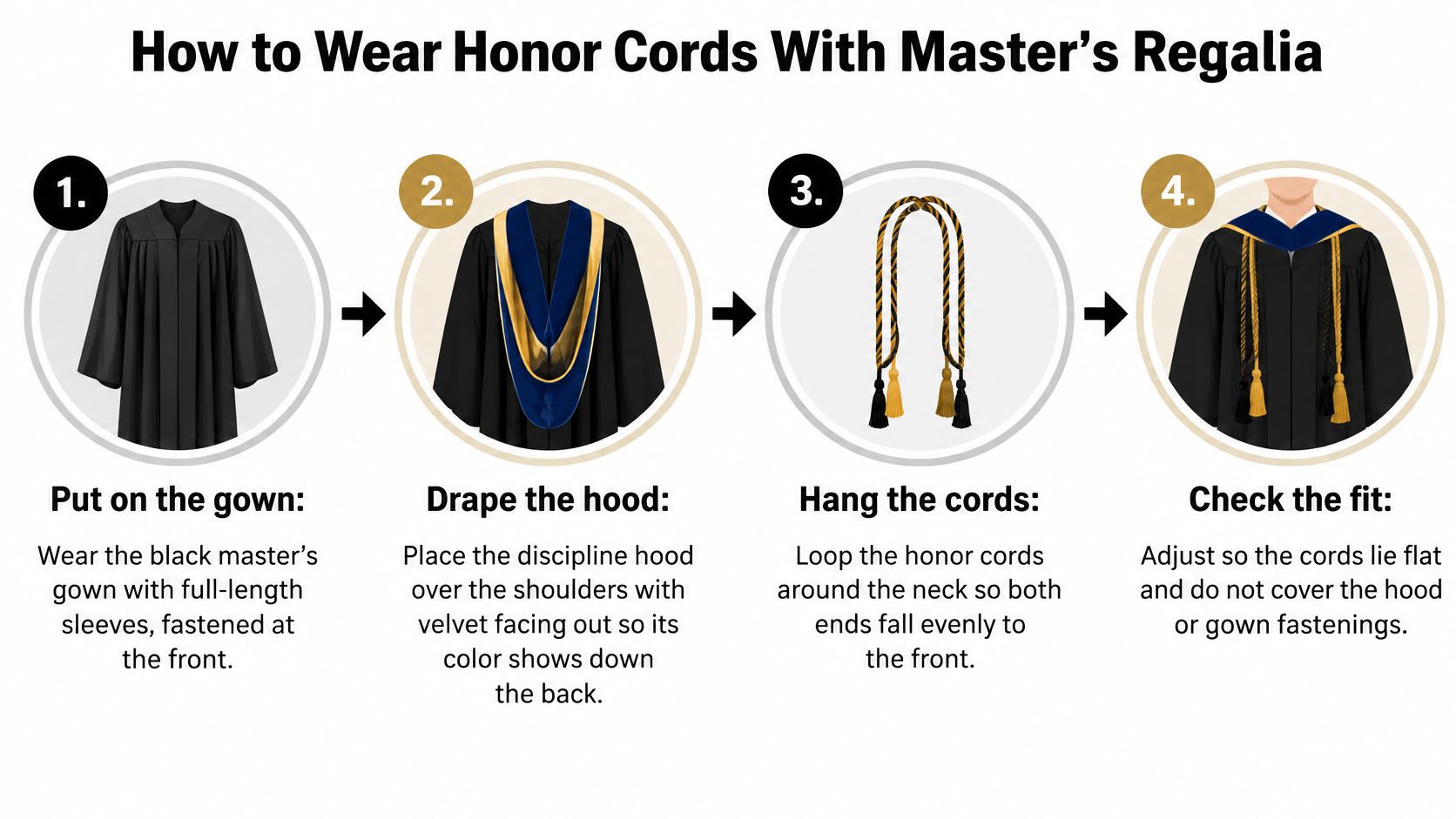
Put the pieces on in the same order they communicate. Gown first, hood second, cord last. That sequence keeps each signal readable.
Seven Steps for a Clean Arrangement
- Put on the gown: Wear the black master's gown with full-length sleeves and fasten it at the front. A closed gown gives the hood and cord a flat surface.
- Drape the hood: Place the discipline hood over your shoulders with the velvet facing out, so its color shows down your back. LSU specifies that master's candidates wear a black gown with a discipline-specific hood, which is why the hood shouldn't be hidden.
- Place the cord around your neck: With a single cord, let both ends hang evenly down the front. With a double cord joined at the center, set the knot at the back of your neck so both halves fall down the front.
- Keep the hood readable: Move cord ends clear of the hood's chevrons and the gown's lapels. The audience should see field and achievement as separate signals.
- Add a second cord only if allowed: Shippensburg University explicitly permits qualifying students to wear more than one cord simultaneously, but that permission isn't universal. Check your approved-accessory list first.
- Set the tassel as directed: Purdue requires a black tassel for master's candidates. Follow your school's instruction for side and movement during the ceremony.
- Check the finished look: Use a mirror or a quick photo. Confirm the gown is closed, the hood is visible, and the cords are even and identifiable.
Watching the sequence once can make the hand movements clearer before you try it with your own hood.
Common slips are easy to fix. Don't wear a cord under the gown, don't tie a double cord at the front, and don't choose a cord so short that it bunches against the hood. Each mistake either hides an approved honor or makes two separate signals look like one.
Our step-by-step guide on how to wear graduation honor cords is useful for a final check. From the front row, a correct arrangement looks calm and legible. The black gown frames everything, the hood color names the field down the back, and the approved cord hangs evenly in front as the one clear note of achievement.
Once your school has confirmed your eligibility, approved color, and issuing group, shop honor cords for master's graduation alongside the correct master's gown, cap, tassel, and discipline hood so every piece matches. Visit Graduation Attire to compare approved cord styles and complete master's regalia packages before your ceremony deadline.