

Most schools allow one to three stoles, and the exact number is set by the institution's commencement policy rather than by any global rule. A second stole is often paperwork, and that paperwork can be due weeks or a full semester before you walk.
So why do stacking guides treat the count like a fashion problem? The registrar isn't judging your photos. That office counts adornments against a written cap, splits university-issued pieces from the ones you choose, and can reject a stole that never got a signature. Etiquette that says "two to four looks fine" skips the checklist. Your handbook doesn't, and the handbook wins.
How Many Stoles Most Schools Allow
There is no worldwide maximum. The only number that matters is the one your commencement office prints, and those numbers don't match from campus to campus.
Published rules show the spread. University of Southern Indiana commencement guidance permits only one approved student-selected stole or cord on top of university-provided items such as honors, commencement-honors, or military stoles. The same policy environment includes Indiana University of Pennsylvania, which permits up to three academic accoutrements, with cords, stoles, sashes, and medallions all counting toward the three when they meet institutional requirements. Kansas State University takes a third path. An organizational adornment request has to cover a single stole, cord, or medallion, not several types at once.
Crowder College commencement guidance draws a harder line between pieces. Students may wear an honor cord and/or a graduation stole, more than one honor cord may traditionally be worn, and no more than one stole will traditionally be worn. A stole there is a scarf-like sash for an approved college program.
How each school counts
Read the limit as a counting rule, not a style tip. "One stole" at a school that already issues honors or military regalia usually means one extra item you pick. Cords sometimes sit outside that cap and sometimes eat a slot in a combined total.
| School | Stole limit | How the count works |
|---|---|---|
| Indiana University of Pennsylvania | Up to three academic accoutrements | Cords, stoles, sashes and medallions all count toward the three |
| University of Southern Indiana | One student-chosen stole or cord | University-provided honors and military stoles are added on top |
| University of Mary Washington | Up to two stoles | Graduate chooses both stoles |
| Crowder College | One stole | Multiple honor cords may traditionally be worn |
| Kansas State University | One stole, cord or medallion | Organizational adornment requests cover a single item |
| University of Nebraska–Lincoln | Official undergraduate stole as standard | Extra recognition limited to cords, ribbons or medallions |
| Tennessee Technological University | No personal stoles | Adornments limited to approved organizational or athletic uses |
| Drury University (graduate ceremonies) | No other adornments, including stoles and badges | Bachelor's ceremonies may allow approved adornments |
Don't assume every honor, identity, and club can show up together. Graduate ceremonies can be stricter than bachelor's ceremonies at the same school, which is why the last row matters before you buy. If you want two or more stoles, open the handbook and count the way that office counts, before you order anything.
Why Schools Cap Stoles and What Approval Requires
The academic hood names your degree field. A stole does a different job. It works like a club pin on a lanyard, marking an approved honor, service society, affiliation, or program. Because it signals membership rather than the degree itself, the registrar counts every stole as a separate item, and each one needs a reason to exist.
The University of South Carolina Aiken regalia history describes an honor stole as a garment draped from the neck down the front of the gown, worn by members of university-authorized honor or service societies. Trinity University treats cords and stoles the same way, as visible signs of affiliation, participation, or membership in a recognized organization, program, or group. That is the whole point of the garment. It is not a substitute for degree regalia.

Why the cap exists
Schools cap the count for three plain reasons. A procession looks uniform when gowns aren't buried under sashes. Wide or layered stoles cover the gown, the hood, and degree details, which breaks ceremony decorum. And recognition stays meaningful only when every stole on the stage was actually approved. A personal sash you designed at home doesn't automatically qualify.
A second stole isn't automatically banned. It may need prior permission, or it may be disallowed entirely. The University of Nebraska–Lincoln academic regalia policy treats the official undergraduate stole as standard regalia and limits special academic-achievement recognition to cords, ribbons, or medallions rather than extra sashes or stoles. Further regalia must be approved at least one semester before commencement. Elon University requires Provost's Office permission for any group-affiliation symbol and allows each group only one form of adornment.
The University of Mary Washington regalia page permits graduates to wear up to two stoles of their choosing. Elsewhere, approval for a new stole or cord can require months of lead time, so treat the deadline as part of the order, not an afterthought. Rowan University says unapproved stoles or cords may be deemed inappropriate and that officials can require graduates to remove them. Crowder College requires the organization, not just the student, to get approval from the Vice President of Student Affairs before a stole or cord is used for recognition.
| School | Who approves | Deadline or condition |
|---|---|---|
| University of Southern Indiana | School approval required for a new stole or cord | Approval must be in place before the stole is worn |
| University of Nebraska–Lincoln | Institution, for further regalia beyond the official stole | At least one semester before commencement |
| Elon University | Provost's Office | Permission required for any group-affiliation symbol, one form of adornment per group |
| Crowder College | Vice President of Student Affairs | The organization seeking to recognize students must obtain approval |
A stole signals an approved achievement or affiliation, so count approved signals, not wishes.
Ask the registrar early and keep the approval in writing. Graduation Attire lets you design and personalize a custom stole online, so hold the order until that confirmation email is in your inbox.
How to Count Your Stoles Before You Order
Count the way the commencement office counts. Do it on paper, before you spend money.
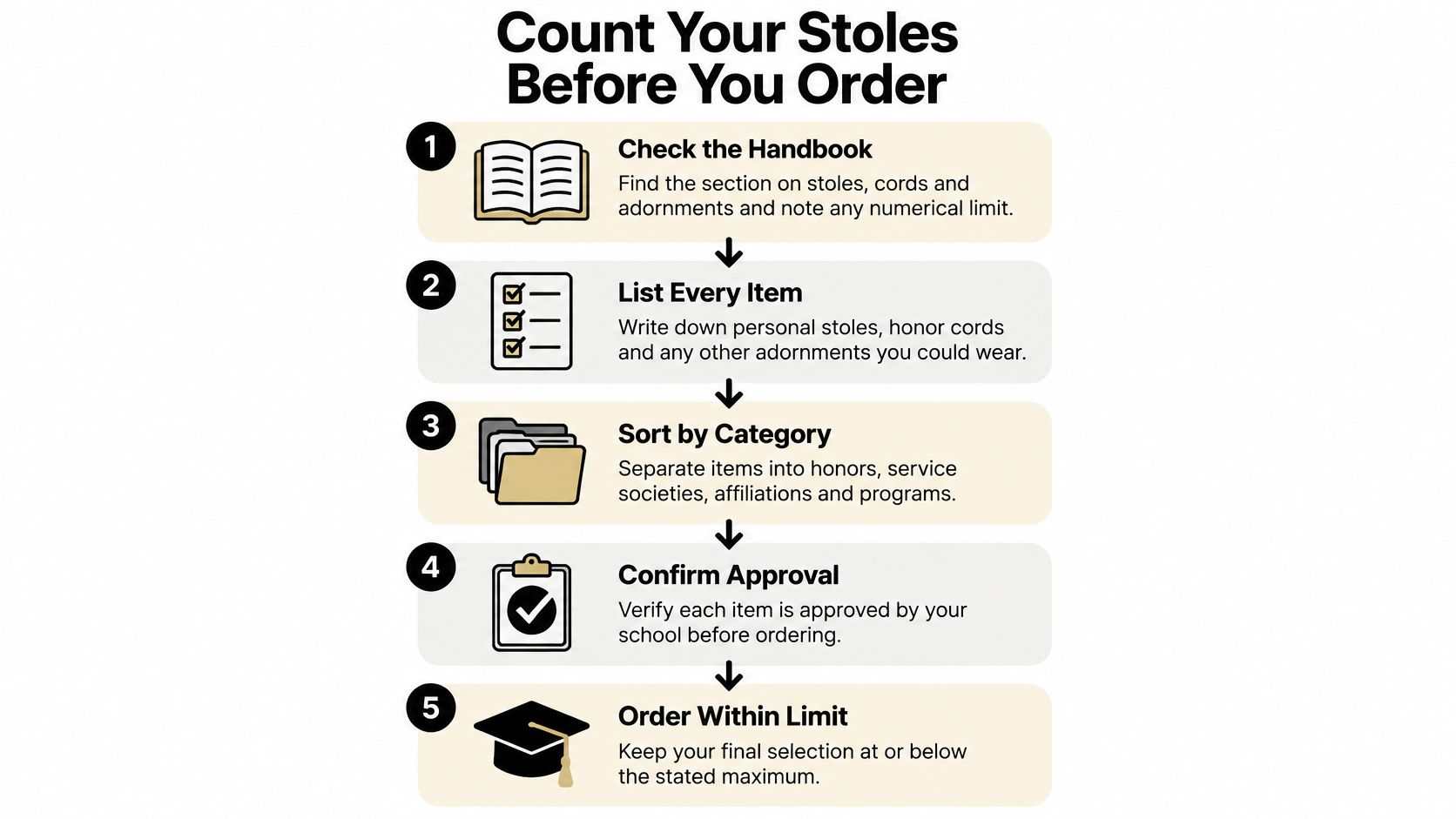
- Pull the handbook. Open the commencement or regalia page and find the section on stoles, cords, and adornments. Write down any numerical limit in the same words the school uses.
- List every piece you could wear. Personal stoles, honor cords, medallions, sashes, and honors you already hold all go on the list, even the ones you're unsure about.
- Mark who supplies each item. Flag pieces the university issues on its own, such as honors, commencement-honors, or military stoles. Everything else is a choice you made.
- Decide how cords are counted. Some schools let cords sit beside the stole cap. Others fold cords, medals, and sashes into one accoutrement total. If you aren't sure, our guide on how to wear graduation honor cords shows how cords differ from stoles, then you still confirm the local rule.
- Check honor exceptions. An honors stole might be automatic and sit outside your personal allotment, or it might burn one of your slots. Don't guess.
- Write the approval deadline. New designs often need a sign-off measured in weeks, not days. Miss it and the stole stays in the bag.
- Measure width and length. Hold the design against the school's size rule before you personalize lettering or insignia.
- Confirm the degree level. A bachelor's ceremony and a graduate ceremony at the same university can use different adornment rules. Read the page for the degree you will be receiving.
A count that fits, and one that doesn't
Say your school issues the honors stole and allows one student-chosen stole or cord on top of that. You already have the honors stole, and you want one Greek stole. That pair fits, because the Greek stole is the one personal item. Add a second personal stole and you've broken the rule, even if both groups are real and both colors are school-approved.
Then email the registrar with your final list and keep the reply. Unapproved stoles can be called inappropriate, and ceremony staff can make you take one off before you cross the stage. A stole you can't wear isn't recognition. It's a return.
Which Stole to Keep When Honors Overlap
Buying more stoles doesn't increase recognition. It can break the policy or bury the one item the institution cares about.
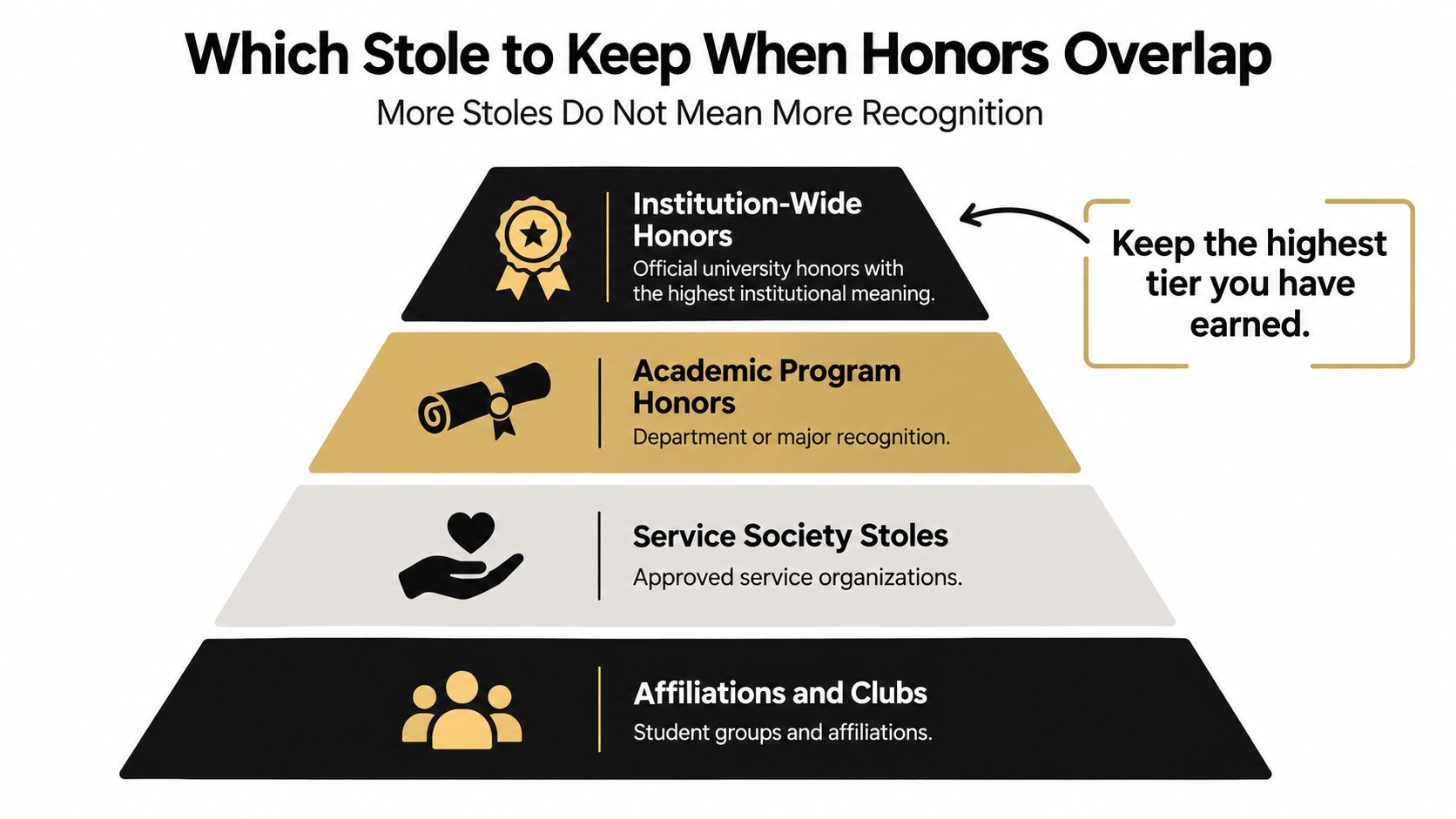
Rank what you keep, and drop from the bottom when the cap is tight.
- First, mandatory university-issued recognition. If the school puts an honors or military stole on you, that piece stays. It isn't competing with a club sash.
- Second, degree or honors-based recognition. This is the academic signal, the one tied to the degree itself.
- Third, approved identity or cultural recognition. First-generation, LGBTQ, veteran, nursing, and Kente stoles belong here when the school recognizes them.
- Fourth, optional organization items. Clubs and chapters are last because they're the easiest to swap for a cord or to save for photos.
Color can show the tier. The University of Arkansas regalia page reserves specific red-and-white colors for university honors while still allowing certain college, honor-society, and registered-organization stoles or cords. The honors colors are the institutional signal. The other pieces are additional, not equal.
Before you cut the list, ask three questions. Can a cord stand in for a second stole? Some schools traditionally allow several honor cords and only one stole, so the cord keeps the honor without spending the stole slot. Can the extra stole be worn at a separate ceremony or a photo session instead of on the procession line? And does this design need approval before you pay for it?
Keep the highest institutional signal. Let a cord or a photo session carry the rest.
Say you hold an honors stole, a first-generation stole, and an organization cord. Keep the honors stole. Add the cord if the handbook allows cords on top. Then ask whether the first-generation stole belongs at a cultural celebration or in portraits rather than on the stage. For a closer look at what each sash is for, see the types of graduation stoles and match the name to the tier, not to how many you can fit on your shoulders.
The clip below walks through how regalia is supposed to read from the audience, which is the same reason a crowded chest loses the honor you most wanted seen.
Three Graduates and How Their Rules Play Out
Rules get clear when you put a real graduate in them.
The undergraduate with one personal slot. She already receives a university honors stole and wants a first-generation stole as well. Her school allows one student-selected stole or cord on top of what the university issues. The first-generation stole is that one choice, so she wears both. A second personal stole, for a club she also led, doesn't fit. She keeps the club for photos.
The student with cords to spare and one stole. He has two honor cords and an organization stole. His college traditionally allows more than one honor cord and only one stole. The cords stay. The organization stole is the single stole he wears. Ordering a second stole for a second club would put him outside the tradition his records office enforces.
The master's candidate under a tighter rule. Drury University commencement regalia rules permit appropriate academic regalia supplied by the university, plus adornments from academic departments or student organizations, including stoles, badges, and cords. The graduate-degree rule then says no other adornments, including stoles and badges, are permitted. A bachelor's ceremony at that school can include approved departmental or organizational pieces. A master's or doctoral ceremony at the same institution can prohibit them entirely.
The person who wore two stoles for a bachelor's degree may wear none for a master's degree a few years later. Check the policy for the exact degree you're receiving. A general "one or two is always fine" assumption is how graduates get stopped at the line.
Match Your Count to a Stole Order
Once the count is settled, order only what that count allows. We sell stoles for Class of 2026, first-generation, LGBTQ, veteran and military, nursing, HBCU, Kente, and Greek organizations, and you can design a custom graduation stole online. If you want to see the design before it ships, email what you want and we can create a mockup for a custom stole.
Measure any custom design against the size rule you already copied, including a cap on width or length. Then check the approval deadline you wrote down. A stole that arrives after the office stops taking requests doesn't get worn, no matter how good it looks. If you're personalizing insignia, start from a clear spec and read how a custom graduation stole is put together so the finished piece matches what you got approved.
Use this order and don't skip ahead.
- Confirm the limit and which items the school issues automatically.
- Choose only the personal stole or stoles the policy allows. Leave the rest off the order.
- Confirm approvals and measurements in writing before you pay.
- Place the order with enough lead time to meet the deadline you were given.
The school's policy always controls. Confirm the final count with the registrar before you buy.
Graduation Attire carries the stoles graduates need once the handbook sets the number, from honors and identity stoles to organization and custom designs you can personalize. Match the order to the count your registrar approved, and don't buy a second stole the ceremony won't allow. Visit Graduation Attire and choose the stole that fits your school's rule.