

The colors on your master's degree hood are a visual language. They instantly tell everyone at the ceremony a story about your academic journey. The velvet trim speaks to your specific field of study, while the satin lining proudly displays the official colors of your university.
Decoding Your Academic Achievement
The academic hood is so much more than a colorful accessory; it’s a symbol steeped in tradition, telling the story of your hard-earned degree. For master's graduates, this piece of regalia is especially important because it distinguishes your advanced level of study. Its design isn't random—it follows a standardized system to create a shared visual language across institutions.
To truly appreciate its meaning, you first have to understand its parts. Every master’s hood has three key components that work together: the shell, the lining, and the velvet trim. While the shell is almost always black, the lining and trim are where the vibrant colors come into play, each holding its own distinct purpose.
The Core Components of a Master's Hood
- The Shell: This is the main black fabric that forms the body of the hood.
- The Satin Lining: This interior fabric shows off your university’s official colors, often arranged in a chevron or split pattern.
- The Velvet Trim: This is the three-inch band of colored velvet on the outer edge that signifies your specific academic discipline. To learn more about how these parts come together, you can explore the structure of the academic hood in our detailed guide.
This color-coding system was established by the Intercollegiate Code of Academic Costume, which has been widely adopted by American universities since 1895. The code ensures that academic disciplines can be recognized at ceremonies around the world, creating a shared visual heritage among scholars.
For graduates, the most important color to get right is the velvet trim, as it directly corresponds to your field of study. From the Light Blue of Education to the Golden Yellow of Science, each color has a designated meaning. This guide will break down those colors, helping you understand and verify the correct regalia for your big day.
The Three Essential Parts of Your Master's Hood
Every master's degree hood might look like a single, elegant garment, but it’s actually made of three distinct components that tell the story of your academic achievement. To really appreciate its meaning, you have to understand each part—the shell, the satin lining, and the velvet trim. Together, they represent your degree level, your university, and your specific field of study.

The foundation of the hood is the shell, which is simply the main black body of the garment. It's almost always made from black fabric to create a seamless look with the traditional black master's gown. The size is also standardized; a master's hood measures exactly 3.5 feet in length. This makes it noticeably longer than a bachelor's hood but shorter than a doctoral one, signifying your status as an advanced degree holder.
The Satin Lining: Your School Spirit
Tucked inside the black shell is the satin lining, and this is where things get personal. This is where your university's official colors are put on full display, proudly identifying your alma mater.
Institutions get creative with the patterns, but the two most common designs you'll see are:
- Chevron: A sharp, V-shaped pattern where two colors meet.
- Division: A clean split where the two colors are divided right down the middle.
This colorful lining is what connects your individual success to the wider academic community of your school. It’s a vibrant flash of school pride woven right into your graduation attire.
The Velvet Trim: Your Field of Study
The most significant color on your master's hood is found on the velvet trim. This is the colored band that runs along the edge of the black shell, and its specific color directly corresponds to your academic discipline as outlined in the Academic Costume Code.
For a master's degree, this velvet band is three inches wide, which distinguishes it from the wider five-inch band you'll find on doctoral hoods. A Master of Business Administration graduate, for example, will have a drab-colored velvet trim, while a Master of Science graduate will sport a golden yellow one. Getting this color right is critical when you order your regalia.
Of course, once you have the perfect hood, knowing how to wear it correctly is just as important for the big day. For a complete walkthrough, be sure to check out our guide on how to wear the academic hood before the ceremony.
Your Guide to Official Master's Hood Colors by Academic Field
The velvet trim on your master's degree hood is more than just decoration—it’s a visual language that instantly communicates your field of expertise. Think of it as a badge of honor. This color-coding system, standardized by the American Council on Education's (ACE) Academic Costume Code, ensures a Master of Arts in History from one university is immediately recognizable next to a Master of Science in Nursing from another.
Nailing down the correct color for your discipline is the first step to making sure your regalia is perfect for commencement. It’s a small detail that honors a long-standing academic tradition and tells the story of your hard work at a single glance.
The Master's Degree Velvet Color Chart by Academic Field
Alright, let's get right to it. This chart is your quick-reference guide for matching your master's degree to its official velvet color. The ACE has assigned a specific hue to just about every major field of study, creating a universal standard you'll see at ceremonies across the country.
We’ve organized this alphabetically to make it easy to find your discipline. Just scan the list to find your field and see the corresponding velvet color you'll be proudly wearing on your hood.
| Academic Field | Official Velvet Color | Common Master's Degrees |
|---|---|---|
| Agriculture | Maize | MS in Agriculture, MS in Agricultural Science |
| Arts, Letters, Humanities | White | MA in History, English, Philosophy; MLitt |
| Business & Commerce | Drab | Master of Business Administration (MBA), MS in Accounting |
| Counseling & Guidance | Light Blue | MS in School Counseling, MA in Clinical Mental Health Counseling |
| Dentistry | Lilac | Master of Science in Dentistry (MSD) |
| Drama / Theater | Brown | MFA in Theater Arts, MA in Drama Therapy |
| Economics | Copper | MA in Economics, MS in Applied Economics |
| Education | Light Blue | Master of Education (MEd), Master of Arts in Teaching (MAT) |
| Engineering | Orange | Master of Engineering (MEng), MS in Civil/Mechanical Engineering |
| Environmental Science | Golden Yellow | Master of Environmental Management (MEM), MS in Environmental Science |
| Fine Arts & Architecture | Brown / Blue-Violet | MFA in Studio Art (Brown), Master of Architecture (MArch) (Blue-Violet) |
| Forestry | Russet | Master of Forestry (MF), MS in Forest Resources |
| Journalism & Communications | Crimson | MS in Journalism, MA in Strategic Communication |
| Law | Purple | Master of Legal Studies (MLS), Juris Master (JM) |
| Library Science | Lemon Yellow | Master of Library and Information Science (MLIS) |
| Medicine | Green | Master of Medical Science (MMSc) |
| Music | Pink | Master of Music (MM), Master of Music Education (MME) |
| Nursing | Apricot | Master of Science in Nursing (MSN) |
| Pharmacy | Olive Green | MS in Pharmaceutical Sciences |
| Physical Therapy | Teal | Doctor of Physical Therapy (DPT)*, Master of Physical Therapy (MPT) |
| Public Administration | Peacock Blue | Master of Public Administration (MPA) |
| Public Health | Salmon Pink | Master of Public Health (MPH) |
| Science (General) | Golden Yellow | MS in Biology, Chemistry, Physics, Mathematics |
| Social Work | Citron | Master of Social Work (MSW) |
| Theology | Scarlet | Master of Divinity (MDiv), Master of Theological Studies (MTS) |
| Veterinary Science | Gray | MS in Veterinary Medical Science |
*While the DPT is a doctorate, its regalia color is often discussed alongside related health master's degrees.
Seeing all the colors laid out like this really drives home how diverse the world of academia is. Each hue tells a story of a different kind of expertise, from the Golden Yellow of scientific discovery to the compassionate Apricot of nursing. It’s a tradition that beautifully visualizes the collective knowledge of the graduating class.
A Closer Look at Key Disciplines
While the chart gives you the quick answer, let's dive into some of the most common fields you'll see at any commencement ceremony.
Arts, Letters, and Humanities
The classic White velvet represents the broad fields of arts, letters, and humanities. It’s a clean, timeless color meant to symbolize the blank page from which new ideas spring and the purity of knowledge itself.
- This covers a huge range of studies, from the creative expression of a Master of Fine Arts (MFA) to the critical analysis of a Master of Arts (MA) in fields like History, English, Philosophy, or a foreign language.
Business and Commerce
For the world of business, accounting, and commerce, the designated color is Drab. It might not have the most exciting name, but this muted, tan-like hue represents the practical, foundational nature of finance and industry in our society.
You’ll see this color everywhere, thanks to the popularity of the Master of Business Administration (MBA). It immediately identifies a graduate with specialized training in management, finance, and strategy.
If you’re ready to get your full regalia set, you can find your complete master's degree graduation attire and customize it with the correct Drab velvet to make sure you’re ready for the big day.
Education and Counseling
The field of education is proudly represented by Light Blue. This bright, hopeful color signifies the clarity, wisdom, and truth that educators bring to the world.
- Graduates wearing Light Blue have earned degrees like the Master of Education (MEd) or Master of Arts in Teaching (MAT). They're the future teachers, principals, and counselors dedicated to shaping the next generation.
Engineering and Technology
Engineers get the bold and energetic color of Orange. It’s a perfect fit, reflecting the innovation, creativity, and bright ideas that drive every engineering discipline, from civil and mechanical to software and cybersecurity.
- This vibrant hue is worn by graduates with a Master of Engineering (MEng) or a Master of Science (MS) in a specialized field like electrical engineering or computer science.
Sciences and Health Professions
The broad world of science—including mathematics, biology, chemistry, and physics—is designated by Golden Yellow. This brilliant color represents the wealth of knowledge and discovery that scientific research brings to humanity.
When it comes to the health professions, the colors get much more specific to identify the different paths of practice.
- Nursing graduates wear Apricot, a warm and compassionate color.
- Public Health is represented by Salmon Pink, a unique shade for those focused on community well-being.
- Social Work is designated by Citron, a bright and hopeful yellow-green.
- Physical Therapy uses Teal, a color that stands for balance and healing.
Each of these distinct colors is a hallmark of academic tradition. They allow for the immediate recognition of a graduate’s specific training, celebrating the unique expertise every master’s degree holder brings to their profession.
Decoding School Colors in the Hood Lining
While the velvet on your master's hood announces your field of study, the satin lining tells a far more personal story: it represents your alma mater. This is where your university’s official colors are showcased, turning a standardized piece of academic regalia into a unique banner of institutional pride.
The lining is the colorful fabric tucked inside the hood's black shell. When you wear it correctly, it drapes down your back, creating a vibrant display of your school’s identity. Getting this part right is absolutely crucial when you order your own graduation attire, as it ensures your hood is a perfect match for the big day.
Common Lining Patterns
Universities use a couple of classic patterns to arrange their colors, adding another layer of distinction to their academic dress. While a few institutions might have their own unique designs, the vast majority stick to one of two traditional styles recognized by the Academic Costume Code.
- The Chevron: This is probably the most common pattern you'll see. It features a V-shaped design, or chevron, of a secondary color layered over the lining's primary color. For example, a university with blue and gold colors might have a gold chevron over a solid blue lining.
- The Division: This style is clean and straightforward. It splits the lining right down the middle into two equal parts, with one color on each side. A school with red and white colors would have one half of the lining in red and the other in white.
The following chart illustrates how the velvet colors for some of the most common master's degree fields create an immediate visual language for academic achievement.
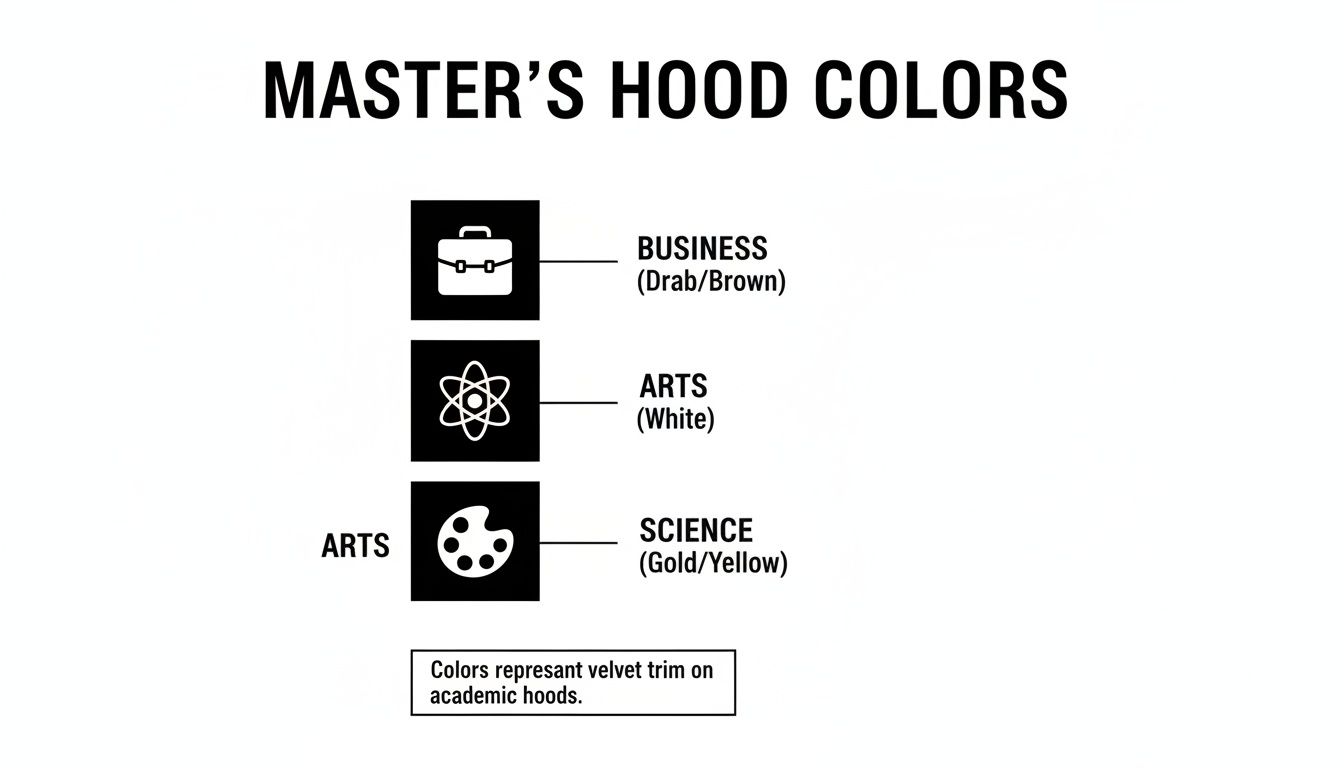
This visual highlights how the distinct velvet colors for Arts (White), Science (Golden Yellow), and Business (Drab) stand apart, clearly communicating the wearer's discipline at a single glance.
Verifying Your University's Colors
Because the lining combination is so specific to each institution, it’s essential to confirm the exact colors and pattern your school uses before ordering. A graduate from the University of Michigan will have a hood lined in maize and blue, while someone from Ohio State University will have one lined in scarlet and gray.
These colors are not just decorative; they are a direct representation of your academic heritage. Getting them right is a crucial part of honoring your institution's tradition on graduation day.
Whether your school uses a single solid color, a chevron, or a division, this combination is what makes your master’s degree hood uniquely yours, connecting you to the legacy of your university for years to come.
How to Order Your Academic Regalia Correctly
Ordering your academic regalia is the final step before commencement, and you want to get every detail right. This isn't just about picking a gown; it's about making sure the specific colors and styles perfectly represent your degree, your field of study, and your university. Getting it right means you'll walk across that stage feeling confident and proud.
The first thing to nail down is your master's degree hood colors. You'll want to refer back to a comprehensive list to find the official velvet color for your specific academic discipline. For example, a Master of Business Administration calls for Drab velvet, while a Master of Science requires Golden Yellow.
Verifying University and Degree Specifics
Once you've identified your velvet color, the next step is to confirm your university's specific satin lining colors and pattern. Most schools use a chevron (a V-shape) or a simple two-color split. You can usually find this information on your university's commencement website or by checking with the registrar's office.
Next up is the gown. You’ll need to select a proper master's gown, which you can spot by its unique oblong sleeves that are open at the wrist—a clear distinction from bachelor's gowns. Finally, choose your cap and tassel. For master's degrees, the tassel is almost always black, but it's worth double-checking, as some institutions have their own traditions.
A common question is whether to buy from the university bookstore or another supplier. Many graduates find that trusted online retailers like Graduation Attire offer high-quality, perfectly matched regalia, often at a more affordable price and with more convenience.
Placing Your Order Step by Step
To keep the process smooth and stress-free, just follow these simple steps. This will ensure your regalia shows up on time and meets every single requirement.
- Confirm Your Details: Before you do anything else, double-check your exact degree (e.g., MA, MS, MBA), your field of study (e.g., Education, Engineering), and your university's full name.
- Find Your School's Regalia: Use a school finder tool to see the specific hood lining and velvet colors required for your institution. This takes all the guesswork out of matching the regalia to your school's precise standards.
- Take Accurate Measurements: Pull out a sizing chart to find the right gown length, which is determined by your height. A proper fit ensures the gown drapes correctly and looks sharp, not sloppy.
- Check Delivery Times: Don't leave this to the last minute! Order well in advance of your ceremony. Be sure to check the estimated delivery timelines and consider expedited shipping if you're on a tight schedule.
By carefully checking each component, you can confidently order the perfect academic attire. For a complete look at what to expect, read our guide on graduation attire for a master's degree, which covers everything from gown styles to accessories.
Completing Your Look with Graduation Accessories
Your master's hood is a huge part of your academic regalia, but it's the other pieces that really pull the whole look together for your big day. Getting each component right ensures your commencement attire is not only accurate but also feels like a true reflection of your unique journey.
The foundation of your outfit is the master’s gown, which you can spot by its traditional black color and distinctive oblong sleeves that are open at the wrist. That’s paired with the classic mortarboard cap and a tassel—typically black for master's grads, though some schools have their own traditions. These items form the dignified, standard base of your graduation uniform.
But graduation ceremonies today are all about celebrating your individual story, and that’s where accessories like stoles and cords come into play. They add layers of personal meaning to the traditional master's degree hood colors and gown.
Personalizing Your Regalia
While the hood shows off your academic discipline, other items can represent your heritage, personal milestones, and affiliations. These accessories are what transform your regalia from a uniform into a powerful personal statement.
You can celebrate your identity and hard work with a few meaningful additions:
- Custom Stoles: These have become incredibly popular for showcasing your background. You can find beautiful stoles that represent your heritage with Kente or serape cloth designs, celebrate your status as a first-generation graduate, or show your affiliation with Greek life.
- Honor Cords: These braided cords, worn around the neck, are the classic way to signify academic honors (like graduating cum laude) or membership in a specific honor society. Their colors vary depending on the organization and the achievement.
- Military and Veteran Cords: Graduates who have served in the armed forces often wear red, white, and blue cords to honor their incredible commitment and service to their country.
By adding a custom stole or a few honor cords, you’re weaving your personal story into the rich fabric of academic tradition. It’s a powerful way to celebrate every single part of the journey that got you to the graduation stage.
Choosing the right accessories helps create a graduation look that feels both cohesive and deeply personal. From the precise master's degree hood colors representing your field to a stole celebrating your family’s roots, each piece tells a part of your success story.
Your Hood Color Questions, Answered
Navigating the details of academic regalia can feel a little confusing, especially when it comes to the master's hood. Let's clear up some of the most common questions to make sure you feel totally confident on your big day.
What Color Hood Is for an Interdisciplinary Degree?
This is a great question, and it comes up a lot. For interdisciplinary or highly specialized degrees, it's the university registrar who makes the final call on the velvet color, usually based on the degree's primary field.
Take a Master of Science in "Business Analytics" as an example. It could reasonably use either Drab (for Business) or Golden Yellow (for Science). Since there isn't a single universal rule, it's always best to confirm with your university's official commencement guidelines or check directly with the registrar's office to be certain.
Can I Wear a Hood from a Different University?
In a word, no. Academic tradition is pretty strict on this one: you must wear the regalia of the institution that is actually granting your degree.
The hood's satin lining is the most important part here—it's designed to specifically represent your university's official colors. Wearing a hood from another school would be like showing up with the wrong diploma. Ordering a hood with the correct lining for your graduating institution is essential.
How Do I Properly Wear My Master's Hood?
Your master's hood drapes over your shoulders so it flows down your back. The velvet trim should frame your neck and shoulders in the front. The real magic is on your back, where the colorful satin lining is turned out to be visible.
Don't stress too much about getting it perfect on your own. Most commencement ceremonies include a "hooding" portion where faculty members will help you wear it correctly—it's a meaningful part of the tradition.
A lot of people wonder if they have to buy their regalia from the university bookstore. The answer is usually no. Many graduates find high-quality, fully compliant regalia from trusted online retailers, which can often be a more affordable and convenient choice.
Just make sure you confirm the exact velvet and lining colors required by your school before you place your order. That way, you're guaranteed a perfect match for your big day.
At Graduation Attire, we make finding your perfect regalia simple. Use our school finder tool to see our huge selection of customizable options and find your complete, high-quality graduation set at https://www.graduationattire.com.