

Luz stood at the edge of the commencement line, smoothing a brightly striped stole over her black gown while her mother fixed the front seam one last time. It wasn't just a finishing touch, it was the part of the outfit that told everyone where her pride came from. For a lot of graduates, a serape graduation stole does that same work, carrying family, region, and ceremony in one visible piece.
A Stole That Carries Centuries of Heritage

A serape graduation stole can feel like a small garment until it's on graduation day, draped over a dark gown, with cameras pointed straight at the chest and shoulders. Then it becomes something else, a statement that's both personal and public. One graduate wears it for style, another for family history, another because the colors make sense of a milestone they've worked years to reach.
The best way to understand the piece is to see it as a bridge. On one side is the historic textile tradition of the Saltillo serape, on the other is the modern commencement stage where identity and achievement meet. If you want a broader primer on symbolic meaning, the overview at graduation stole meaning is a useful companion piece, especially for readers comparing cultural and academic regalia.
That bridge matters because the stole isn't random decoration. It's a portable marker of belonging, and in the right ceremony, that visibility can mean a lot to the graduate and the people cheering for them. A thoughtful choice can also become a keepsake long after the diploma frame goes up on the wall.
A small but practical detail helps too. A personalized graduation touch like a personalized graduation owl card can make the moment feel even more intentional when the stole is part of a larger gift or celebration.
What a Serape Graduation Stole Is
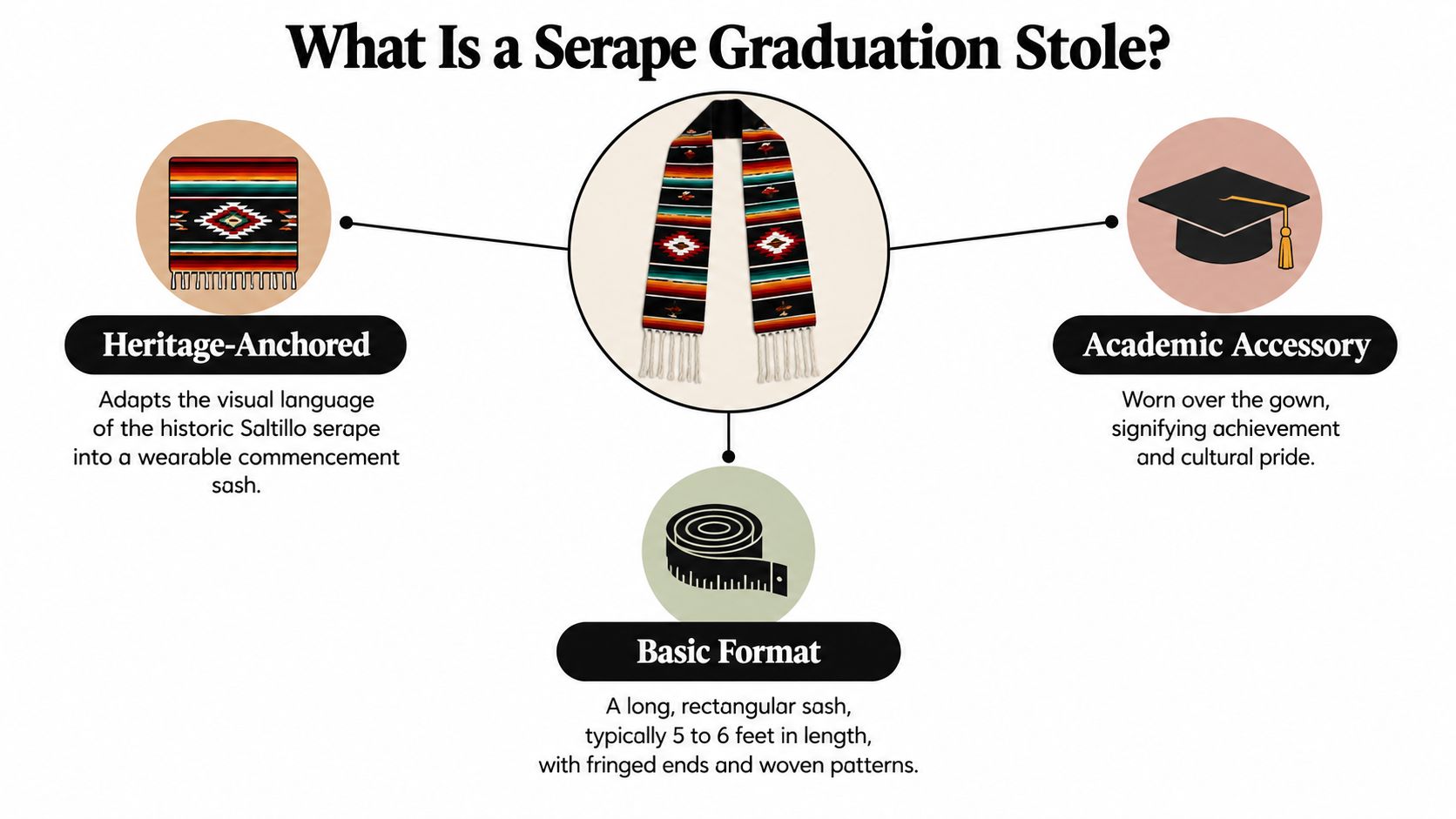
A serape graduation stole is a heritage-anchored academic accessory that adapts the visual language of the historic Mexican serape into a wearable commencement sash. It is usually a long rectangular panel worn over the shoulders, with the patterned face shown on top of the gown so it reads clearly in photos and from the audience.
How it fits into academic regalia
Honor cords sit around the neck and usually signal achievement or membership, while an academic hood points more toward degree level and discipline. The stole sits in its own space as the visible sash-like layer that can carry identity, organization, or heritage.
Schools often treat it as more than an accessory. It works like a banner, something that speaks for the wearer before they even reach the stage. That is one reason graduates, families, and ceremony staff notice it so quickly.
A serape-inspired version is also a design adaptation shaped for graduation, rather than a handwoven Mexican serape sold as textile art. That distinction matters. A commencement stole borrows the visual language, but its purpose is to work with a gown, survive travel, and hold its shape under bright ceremony lights.
Practical rule: if the stole looks good in a hand, on a hanger, and in a photo against a dark gown, it is doing its job.
The form is simple, but the meaning can be layered. For some graduates, it signals Mexican heritage. For others, it reflects Mexican American identity, broader Hispanic belonging, or a family story tied to place and memory. The garment gains its meaning from both the textile it references and the ceremony where it is worn.
The Cultural Roots Behind the Stripes and Diamonds
The serape began as a regional textile, not a graduation item. Museum scholarship identifies northern Mexico as a major center of serape production from the second half of the 18th century through the first half of the 19th century, with Saltillo, Coahuila becoming the best-known manufacturing center. Other respected examples came from San Miguel de Allende and San Luis Potosí, which shows the tradition was broader than one town, even if Saltillo became the name remembered most widely. (The Metropolitan Museum of Art)
A textile language built over time
The serape's look formed through a blend of Indigenous American and European influences during Mexico's colonial period. After Spanish arrival in the 16th century, wool and new weaving technologies entered existing cotton and agave-fiber traditions. Historic Saltillo serapes often used a three-part visual structure, a central diamond or medallion, a patterned field, and a border. The Museo Franz Mayer collection also notes the use of wool, natural dyes such as indigo and cochineal, and the gradual refinement of this style into a recognizable regional form. Museo Franz Mayer
That structure explains why the design stays legible at a distance. The eye lands on the center first, then reads the repeating field and border as a frame. On a graduation stole, the same principle helps, because a narrow garment depends on clear geometry more than dense ornament.
From prestige garment to identity symbol
The serape was also a garment of status. It was associated with affluent horsemen and prosperous mining and ranching communities, and later became tied to Mexican national identity, especially toward the end of the 19th century. The Museo Franz Mayer places a recognized postclassic phase of the Saltillo serape between 1875 and 1900, and describes its growing association with an independent Mexico.
That history explains why the pattern feels at home in commencement settings. A serape-inspired stole can carry heritage, pride, and continuity without reading as costume, because its visual language comes from a long textile tradition rather than a passing trend.
How to Choose an Authentic and Well-Made Stole
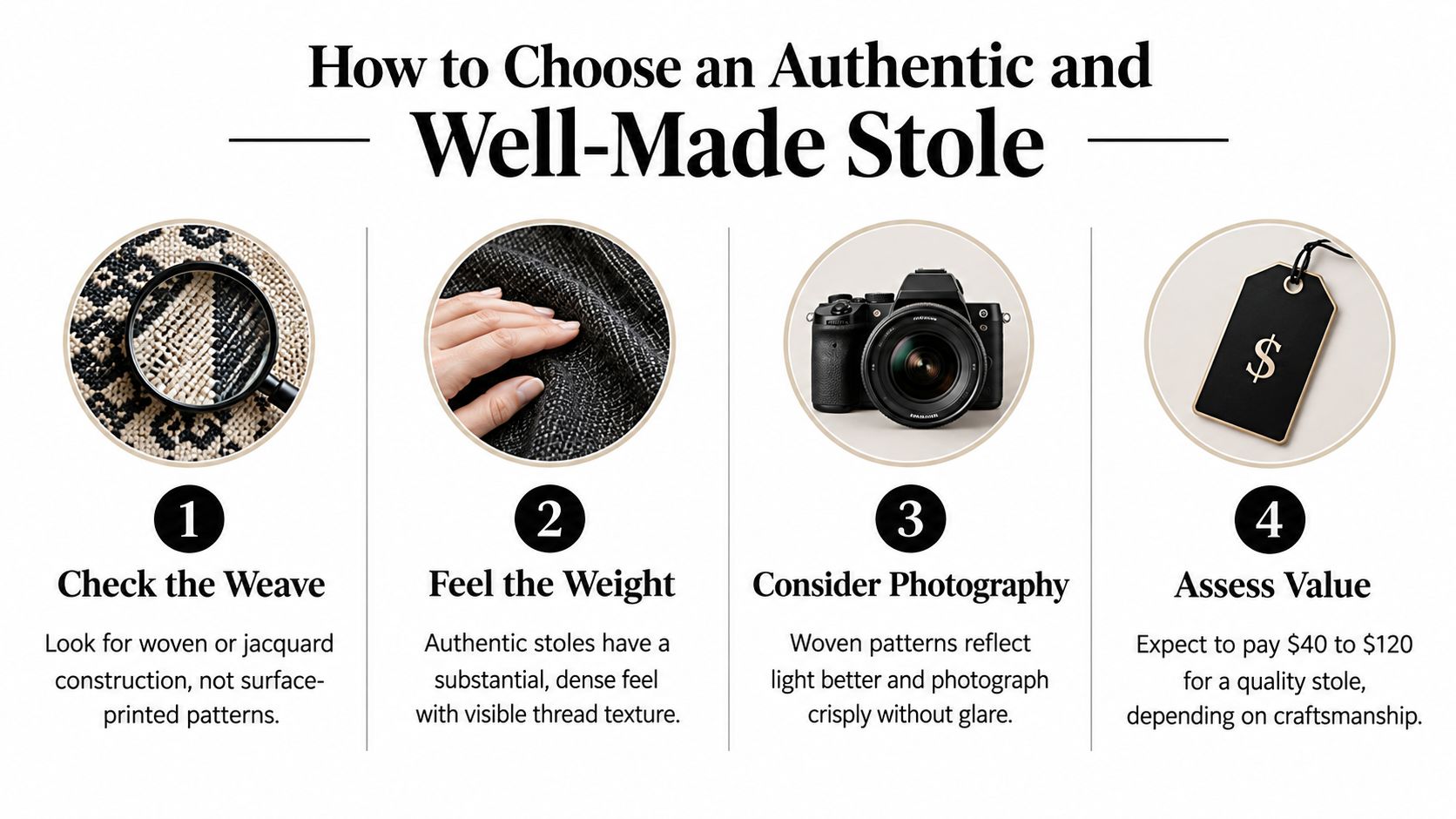
The easiest mistake shoppers make is judging a stole only by color. Color matters, but construction matters more because the ceremony exposes every flaw. A pattern that looks rich online can fall flat in daylight if it's surface-printed, flimsy, or uneven at the edges.
Start with the fabric and surface
Historic Saltillo serapes were woven with tightly spun cotton and wool, and that logic still helps buyers today. A woven or jacquard stole usually gives better pattern definition on both sides than a surface-printed version. Printing can look sharp from the front, but the reverse may look obviously different, and the surface can wear faster at the points where it rubs against a gown. (Arizona State Museum)
Check the edges and the color work
The edge finish matters because commencement day is rough on fabric. Look for reinforced longitudinal edges, clean binding, and yarns that hold their color well under photos, movement, and storage. High-contrast center and border motifs help the stole stay legible over a dark gown, while loose construction can blur the whole design. Museum documentation also notes that the historical palette used natural indigo and cochineal, so modern descriptions should clearly say whether the dyes are natural or synthetic. (Minneapolis Institute of Art)
Buyer's rule: if the seller won't tell you whether the stole is woven, jacquard, or printed, treat that as a warning sign.
Match the material to the ceremony
A polyester or polyester-blend substrate can be a smart choice for repeatable, high-volume commencement use because it handles creases better and is easier to reproduce consistently. That doesn't make it a substitute for a handwoven heritage textile, though. It just means the product is built for ceremony logistics, not museum authenticity. The honest seller will say that plainly.
For readers comparing ready-made options, one place that stocks serape stoles is Graduation Attire's where to buy graduation stoles guide, which can help you sort through available styles without guessing at the basics.
Before checkout, use this short checklist.
- Confirm the weave: Ask whether it's woven, jacquard, or printed.
- Check the finish: Look for bound edges and stable stitching.
- Read the fiber note: Make sure the seller names the actual substrate.
- Verify the pattern: The center motif and border should stay visually balanced when worn.
Wearing and Styling Your Stole on Graduation Day
A serape graduation stole looks best when it sits still. That sounds simple, but a lot can go wrong in the last ten minutes before the procession. If the stole slips, twists, or covers the wrong detail, the whole look loses clarity.
Place the motif where cameras can see it
The central diamond or medallion should sit high enough to read near the chest, not buried under folds. That placement gives the stole its strongest visual line in photos and from the stage. If the ends hang too low or too far apart, the pattern becomes harder to recognize.
If you're wearing a hood for a graduate degree, let the stole sit on top with the hood layered underneath, unless your institution's regalia guide says otherwise. Honor cords can still work with the stole, but they should hang cleanly rather than bunching up across the front. A tam or beefeater changes the overall balance too, so the safest choice is usually the simplest one, with the stole kept flat and secure.
Avoid the small styling errors that distract
Don't let one side slip off the shoulder. Don't pin it in a way that folds the design into a crease. Don't cover an institutional seal if your school requires it to stay visible.
A custom gown can also change how the stole reads, especially if the gown has bold piping or unusual trim. In that case, contrast helps more than matchy-matchy styling. A bright stole over a dark gown usually photographs well, but deliberate contrast also works with school colors if the goal is cohesion instead of separation.
Quick rule: secure placement beats dramatic draping every time.
A 60-second pre-ceremony check
- Flatten the front: Make sure both sides hang evenly.
- Check the center: The main motif should be visible from the chest up.
- Scan the collar area: Nothing should hide a seal, hood, or emblem.
- Move once: Sit, stand, and turn your shoulders to see if the stole shifts.
- Look at the camera angle: A phone photo will show problems faster than a mirror.
For a visual walk-through of positioning and styling, Graduation Attire's how do you wear a stole guide can help you compare placement options before the ceremony.
School Policy: Whether Your Stole Can Cross the Stage
A heritage stole can carry family meaning, cultural memory, and careful craftsmanship, but a commencement stage adds another layer: the school's own rules. A graduate may love the stole and still need to check whether it fits the ceremony code before ceremony day.
The policy range is wider than most shoppers expect
Capitol Technology University allows heritage- or identity-based stoles, yet discourages anything that obscures the university seal and requires approval for items bearing university branding. California Baptist University says approved regalia may not be modified, and noncompliant items can be confiscated. Wesleyan College requires students to remove unapproved tribal, ethnic, or religious identity markers before participating. Those policies point in different directions, which is why the rulebook matters as much as the stole itself. (Capitol Technology University regalia policy)
What approval usually comes down to
Kansas State defines a stole as a cloth, scarf-like garment worn over the shoulders and says cords and stoles may be worn when tied to an officially recognized organization and approved through Student Programs and Involvement. Washington and Lee similarly requires university-sponsored or recognized student organizations to get permission from the University Marshal before graduates wear pins, cords, or stoles. The common thread is straightforward. A stole is usually treated as formal regalia, not ordinary clothing. (Kansas State graduation regalia guidelines)
| University | Policy on Heritage Stoles | Practical Implication |
|---|---|---|
| Capitol Technology University | Heritage or identity-based stoles are acceptable, with limits around seal coverage and branding | Get approval if the stole includes university marks |
| California Baptist University | Approved regalia may not be modified | Do not assume custom changes will be accepted |
| Wesleyan College | Unapproved tribal, ethnic, or religious markers must be removed | Identity stoles may need prior clearance |
| Kansas State | Stoles tied to an officially recognized organization require approval | Recognition status matters before purchase |
Practical takeaway: if the school cannot confirm it in writing, treat the stole as pending, not approved.
A good pre-purchase check keeps the process simple. Read the commencement handbook, confirm approval deadlines, ask whether the stole can cover or alter the seal, and request written confirmation from the registrar or commencement office. If a marshal or staff member questions the stole on ceremony day, stay calm, show the approval email if you have it, and be ready to comply if the school rules differ from what you expected.
For families and organizations trying to match other ceremony materials with the same official tone, Simply Merchandise school supplies can also be a practical reference point.
Ordering for Student Organizations and Bulk Buys
Group orders change the conversation fast. A single graduate is choosing a keepsake, but a student organization is usually trying to keep a visual identity consistent across dozens of people, and that means planning for alignment, timing, and policy.
What bulk buyers need to confirm first
Start with the school rulebook, because a rejected design makes every other decision pointless. Then check whether the group wants the same pattern on every stole or a shared base design with individualized details such as Greek letters, organization names, or the graduation year. Consistent dye lots matter too, because two runs that look slightly different can read as mismatched on stage.
Minimum order quantity and lead time also matter more in group buys than in single purchases. A chapter, cultural club, or administrator handling commencement inventory needs enough time for proofs, production, shipping, and sorting by name or size. If multiple campuses are involved, build in extra time for distribution.
Side by side, the use cases are different
| Order Type | Main Priority | Risk to Watch |
|---|---|---|
| Single graduate purchase | Personal meaning and fit | Buying too late or choosing the wrong width |
| Student organization order | Visual consistency across the group | Uneven color, approval issues, or shipping delays |
For groups wanting coordination with other regalia, it can help to think beyond the stole itself. A matching set of custom embroidered graduation caps may make sense for a chapter or program launch, especially when the cap and stole need to look intentional together.
How to brief a vendor
Use a simple order sheet. Include the pattern direction, preferred colors, text placement, and the exact count needed by deadline. Ask for a sample or proof if alignment matters, since geometric patterns can shift visually when they're reduced to a narrow stole format.
Good group-order habit: approve the sample before you approve the full run.
Graduation Attire offers custom stoles as part of its regalia selection, so a school group can review the design details, check the fit with commencement needs, and line up the order with ceremony timing before the final submission.
Care, Storage, and Questions Graduates Still Ask
After commencement, a shipped stole usually needs a little cleanup. Hang it to release minor wrinkles first, then use steam rather than direct ironing if the fabric seems delicate. Fold it with the central motif visible if you want to frame it later, and store it away from sunlight so the colors stay steady over time.
Quick answers graduates still ask
Can a serape stole be worn at K-12 ceremonies? Sometimes, but only if the school's ceremony rules allow heritage stoles. The same policy questions still apply, even if the age group is younger.
Can it be customized with a name or year? Yes, many stoles can be personalized, but the design should still leave the pattern readable and the lettering balanced.
How is it different from a Mexican flag stole? A Mexican flag stole uses national colors and symbols directly, while a serape stole draws on textile heritage and geometric pattern language. They can both signal identity, but they do it in different ways.
A well-kept stole turns into more than graduation gear. It becomes part of the family archive, and that's worth preserving.
Graduation Attire offers custom serape stoles, caps, gowns, cords, and related regalia for ceremonies at many levels, along with tools like a school finder and sizing guides that help you match the right pieces to your campus rules. If you're ready to compare styles, check policy-friendly options, and plan ahead for commencement, visit Graduation Attire and start with the regalia that fits your ceremony and your heritage.