

In U.S. regalia, white usually marks arts, letters, and humanities on a tassel or hood trim, while a fully white cap is allowed only when that school's dress code says so. That is the opposite of the most popular advice you'll hear, which treats white graduation caps as a clean, universal symbol of purity, new beginnings, or extra formality.
White is not more formal by default. It's a signal with a specific job, and it only reads correctly when it sits in the right place on an approved set. If you start with the cap color and work backwards, you're likely to buy the wrong thing, even if it photographs beautifully on its own.
Think of regalia like a sentence. The gown is the subject, the hood and tassel carry the meaning, and the cap is punctuation. Change the punctuation to white because it looks bright, and you haven't made the sentence fancier. You've changed what it says, or broken the school's grammar altogether.
The fix is simple and a little less romantic. Confirm the approved set first, then decide where white belongs inside it. Sometimes that's the whole cap. More often it's a tassel, a strip of velvet, or a permitted stole.
Where White Shows Up on Regalia
White works as a discipline or campus-color signal. The approved set determines whether it belongs on the whole cap, a tassel, or hood trim. A humanities major alone does not decide the cap color.
The University of New Orleans commencement dress guidelines specify black caps and gowns for undergraduates and master's candidates, with field colors appearing on tassels or hood details. White is designated there for anthropology, English, political science, sociology, and Spanish, among other arts and letters majors.
Read the table below as a guide to what each garment piece communicates. The cap, tassel, and hood answer different questions, much like labels on a uniform: one shows the campus's chosen look, another can identify a field, and another can identify the degree-granting institution.
The Lookup Table to Use First
| Piece | Usual base | Where white appears | What white signals |
|---|---|---|---|
| Mortarboard cap | Black or the school gown color | Whole cap only if the school specifies white | Campus color or ceremony look |
| Tassel | Gown color or class year | White tassel | Arts, letters, and humanities |
| Hood trim | Velvet in the discipline color | White velvet | Arts, letters, and humanities |
| Hood lining | The institution's colors | Rarely a plain white field | The degree-granting school |
| Gown | Black or a school color | Full white gown at some high-school, nursing, or all-white ceremonies | Level or campus tradition |
| Stole or honor cord | Optional add-on | White fabric or a white cord | Honor, culture, or identity, separate from the cap |
A white stole or cord can carry personal meaning while leaving the cap in the approved color. That distinction gives shoppers another way to recognize an achievement or identity without changing the cap.
The hood's two color areas have separate jobs. The lining names the degree-granting school; the velvet trim on the edge names the field. White velvet can indicate arts, letters, and humanities, while the lining displays the institution's colors.
Why White Means Humanities
The University of Portland account of academic dress traditions explains that the Intercollegiate Code of Academic Costume was adopted at a 1895 Columbia University conference, setting shared standards for cut, materials, and colors. In that system, white represents arts, letters, and humanities, and may appear on a tassel, hood edging, gown facings, or other details.
American universities had drawn on medieval European scholars' clerical-style robes, while local customs varied. The 1895 code gave campuses a shared visual language for academic dress.
Campus rules still determine what graduates wear at a particular ceremony. If a school's guide differs from the national color convention, follow the school's guide.
For a clear guide to what academic regalia includes and how its pieces fit together, start with the full outfit rather than shopping by color. That makes it easier to see which piece is meant to carry each signal.
Where a White Cap Fits the Ceremony
High-school and pre-K ceremonies may use white as a school-selected color rather than a discipline marker. A school might choose white for one class, pair it with a contrasting color, or dress the entire group in white.
Nursing pinning-style events, all-white traditions, and special groups may also use white as part of a local ceremony look. Its meaning depends on the school's choice.
A humanities major does not, by itself, call for a white cap. Use the school's approved set to determine where white belongs.
Families can celebrate graduation with Pretty Progress while keeping the outfit details organized. A simple check of the ceremony's color guidance helps make the final look consistent.
When a White Cap Passes the Dress Code
A white cap is permitted only when it belongs to the set your school approves. White may suggest humanities or echo campus colors, but the school's dress code decides where it can appear.
Schools judge whether your outfit matches the approved set. A bright, clean cap can still be out of place if the rules specify another color.
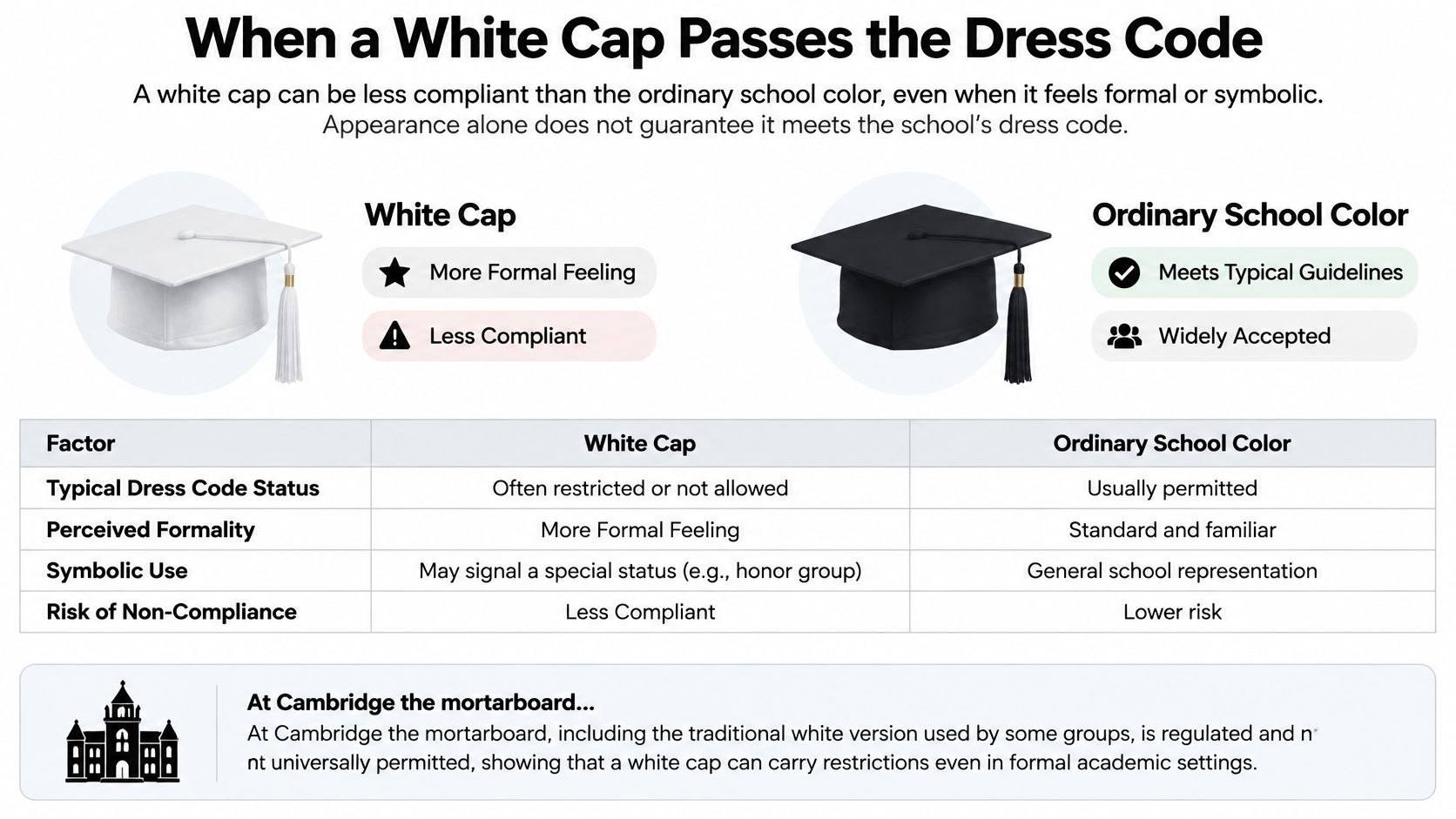
The Daily Bruin's account of changing graduation attire at UCLA describes how white graduation clothing shifted from a historical requirement to an optional tradition. Current undergraduate regalia centers on cap, gown, and tassel rather than mandatory white. The same Daily Bruin report says Metropolitan Community College requires a college-approved black cap and gown with a blue tassel.
These examples show why photos from another campus can mislead. One school may treat white as an optional tradition; another may require a specific black-and-blue set. Check your own ceremony's rules.
What Different Schools Actually Require
| Institution or case | Cap rule | Rest of the outfit | White cap verdict |
|---|---|---|---|
| University of Cambridge | Mortarboard optional; remove and carry it inside the Senate House | Only Cambridge academic dress | Color or style from another university can still be refused |
| University of Oxford | Full academic dress at formal degree ceremonies | Gown and hood included | Follow Oxford's own set, not a general white style |
| Trinity College Dublin | Cap optional | Gown and hood of the degree; senior degree if more than one | Cap color never replaces the required gown and hood |
| UCLA undergraduate tradition | Not a mandatory white cap | Cap, gown, and tassel are the current center | Historical all-white dress is optional, not a requirement |
| Metropolitan Community College | College-approved black cap | Black gown and blue tassel | A white cap conflicts with the approved set |
| University of St Andrews | Cap does not satisfy the code by itself | Gown, hood, dark formal clothes; no jeans or trainers | Wrong full dress can mean exclusion |
Cambridge adds a detail that may surprise American shoppers: the mortarboard is optional, and anyone wearing one must remove it and carry it inside the Senate House, preferably in the left hand. Only Cambridge academic dress may be worn, so a cap from another university can be refused regardless of color.
Trinity College Dublin requires candidates to wear the gown and hood of the degree they are receiving, or the senior degree's set if several are conferred. The cap is optional. Oxford, by contrast, expects full academic dress at formal degree ceremonies. Cap rules vary by campus.
St Andrews makes clear that the cap is only one piece of the dress code. Graduands need a gown and hood, along with specified formal clothing; improper dress can mean exclusion from the ceremony. A white cap cannot make up for a missing hood or other required clothing. For younger students, the high school graduation dress code guide explains how schools set rules for the complete outfit.
Doctoral candidates, faculty, and students attending a college-level ceremony should check with the commencement office. A college within a larger university may have its own requirements.
The rule that trips people up: Cap color, tassel, hood, stole, and decoration each have separate permissions. Approval for one does not automatically cover the others.
Pairing White Caps with Gowns and Tassels
Treat styling as coordination, not decoration for its own sake. A good outfit looks like one decision made by the school, with your permitted additions sitting cleanly on top. A shaky outfit looks like five nice items that met in the parking lot.
Work through the four common looks below. Notice how white moves around depending on level. It rarely stays on the cap.
Four Worked Looks That Hold Together
High school all-white. Pair a matte or shiny white gown with a matching mortarboard in the same finish, then add a tassel in the school color with a current-year charm. Matching the sheen keeps the cap from looking like it floated in from a different set. The colored tassel gives the eye a focal point so the outfit doesn't wash out in photos.
Bachelor's in the humanities. Start with a black or school-color gown and cap, then let a white tassel carry the arts and letters signal. Add a hood only if your campus issues one at this level, since many schools reserve hoods for graduate degrees. This is the look most humanities shoppers need, even though they arrived searching for a white cap.
Master's degree. Buy cap, gown, tassel, and hood as one package so the pieces agree on color and fabric. Keep white limited to the humanities hood trim unless the school color itself is white. At this level the hood does the talking, and a white cap on top of it usually just adds noise.
Doctoral and faculty. Tam or beefeater style headwear and velvet panels follow degree rules that are stricter, not looser. Don't swap in a white mortarboard to look brighter in photos. Faculty regalia signals where you earned your degree and in what field, and a substituted cap erases that information.
Putting Identity on the Stole, Not the Board
If you want the outfit to say something personal, keep the cap plain and add a permitted stole. A white-ground option like the Rainbow LGBTQ Gay Queer Graduation White Sash/Stole reads clearly against a black or white gown without repainting the board. It uses white as a canvas, which is exactly where white does its best work.

A flag stole works the same way for heritage or study abroad recognition. The Spain Graduation Stole belongs with international or study-abroad recognition, not as a substitute for hood lining. The lining already has a job, naming your degree-granting school. Let the stole tell the personal story and let the hood keep its official one.
Skip writing on the cap, glitter, or moving the tassel button if your ceremony bans decoration. Some schools allow decorated boards and some will hand you a plain replacement at check-in. Ask first, decorate second.
The Five-Point Mirror Check
- Cap color: Does it match the approved set exactly, not approximately?
- Fabric sheen: Does a shiny cap sit on a shiny gown, or matte on matte?
- Tassel side: Is it on the side your level and school specify before the ceremony?
- Hood if required: Is it the right lining and trim, worn open as instructed?
- One approved addition: Have you chosen a single stole or cord instead of stacking several?
Run that check in daylight, not bathroom light. If all five pass, you're styled. Anything more is risk without reward.
How to Keep a White Cap from Yellowing
White fabric looks white for a slightly sneaky reason. Optical brighteners absorb ultraviolet light and re-emit it as blue-violet light, which masks the yellow cast that builds up in fibers over time. Your eye reads that extra blue-violet as brightness.
That means whiteness is a performance, not just a color. The CHT textile finishing guidance on optical brighteners reports whiteness values above 150 CIE for cellulosic fabrics with suitable brightener combinations and stresses color fastness after repeated washing. A cap can stay perfectly stiff and still photograph dingy beside a bright gown once that optical effect fades or turns uneven.
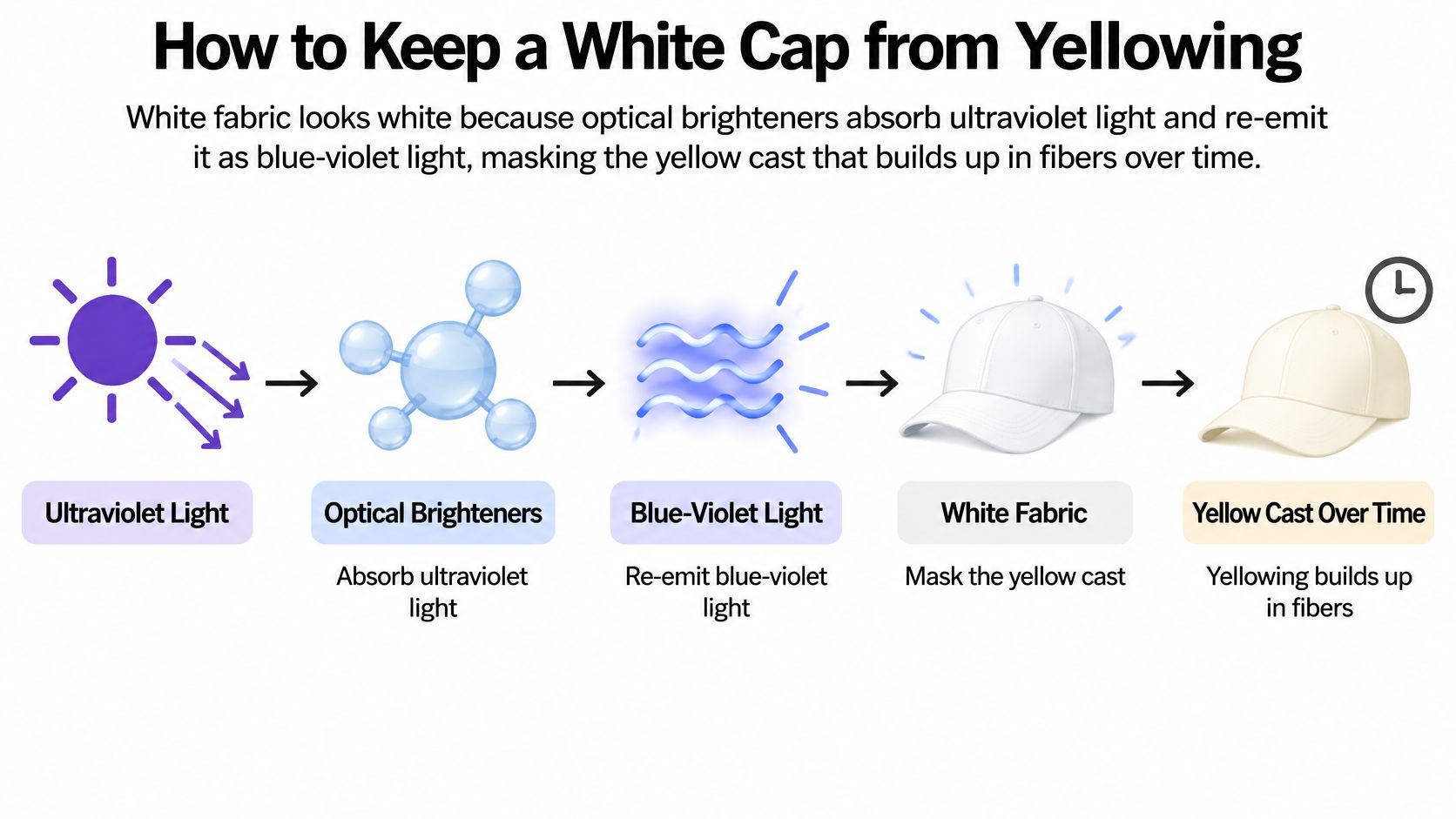
Care matters for the photo as much as for the cap itself. Follow the routine in order, and don't improvise with household whiteners.
The Six-Step Care Routine
- Read the fiber label first. Our caps are 100 percent polyester, so keep them apart from cotton and cotton blends when you clean or store them. Different fibers yellow for different reasons and respond to different products.
- Spot-clean the trouble zones. Use mild detergent and cool water on sweat, makeup, and collar transfer, working from the edge of the mark inward. Scrubbing outward spreads the stain into clean fabric.
- Skip chlorine bleach and harsh whiteners. Don't use them unless the maker validates them for that fabric. On the wrong material, bleach creates the very yellowing you're trying to prevent.
- Don't soak the board. Moisture warps the square insert and can leave the sweatband a different shade from the top panel. A two-tone cap looks dirty even when it's clean.
- Air-dry flat, out of direct sun. Then steam wrinkles on low rather than pressing an iron onto the board. Direct heat and sunlight both work against optical brightness.
- Store it flat in a garment bag. Keep it away from newsprint and colored stoles that can transfer dye onto white fabric in a closet. Most storage stains happen slowly and show up the morning you need the cap.
Edge Cases Worth Knowing
Recycled polyester may wrinkle or hold color a little differently from standard polyester, so test your cleaning method on the underside first. A shiny cap beside a matte gown also looks accidental in photos, even when both are technically white. Sheen mismatch reads as color mismatch on camera.
If you're ordering for a whole class, lot-to-lot whiteness matters more than any single cap's brightness. Ask for matched lots so fifty caps don't arrive in three slightly different whites. Under ceremony lighting your group will notice, and so will every parent's phone camera.
Finish with a daylight photo test a week before the ceremony. Stand near a window in the full set and take one picture. If the cap reads cream against the gown, you still have time to fix it. The morning of graduation, you don't.
Reuse Donation and a Lower Impact Cap
A cap's environmental value depends less on its color than on whether someone can wear it again. White makes marks easier to see, so a cap's reuse depends on its condition and the school's rules. A recycled-material label alone cannot answer either question.
The State News report on Michigan State's recycled graduation gowns describes gowns made from post-consumer plastic bottles. The report says each cap-and-gown set represents roughly 23–27 bottles. The garments can be washed and reused or repurposed, while returns for recycling were less popular.
That difference matters: using recycled material addresses how regalia is made, while reuse depends on what happens after the ceremony. A campus loan program, for example, gives graduates a way to return attire for another wearer. Reuse succeeds when a system makes returns easy.
What the Campus Numbers Suggest
Campus reuse programs can also reduce what students spend on regalia. A borrowed set that fits the dress code can serve another graduate instead of requiring a new purchase.
A separate example of reuse is turning unwanted textiles into graduation accessories. The common thread is practical: loan programs and clear return paths give regalia another use.
Three Checks Before You Call a Cap Reusable
- Fiber content and wash instructions: Can the cap be cleaned without damaging it?
- Next ceremony's rules: Does the school allow reused regalia?
- Donation or resale path: Is there a program or buyer for a cap that remains in good condition?
A cap with visible marks may not be ready for donation. Inspect it in daylight, clean it gently, and consider whether another graduate would feel comfortable wearing it.
For class coordinators, an approved cap that can be worn again is a practical choice. A cap in the wrong color may not meet the dress code, even if it is reusable. Choose an approved set first, then look for a way to pass it along after the ceremony.
If the school permits white and the cap can be reused, borrowing or donating it can extend its use. If white is not approved, choose the school's required color and look for reuse options for that set instead.
Confirm the Cap Before You Order
Close on a decision, not on color history. Before you order anything, confirm four items with the commencement office or a school finder. Write the answers down, because memory blurs once you're comparing product photos.
The Four-Item Check
- Degree level: Pre-K, high school, bachelor's, master's, doctoral, or faculty?
- Required cap shape: Mortarboard, tam, or beefeater?
- Approved cap color: White, black, or a specific school color?
- Included or banned pieces: Are the tassel, hood, and one stole included, permitted, or prohibited?
If white fails that check, order the school color instead and put white only on a permitted tassel, cord, or stole. You keep the meaning and lose the risk. If white passes, buy the cap with the gown so sheen and color match, whether you order pieces individually or in a package.
Our caps are 100% polyester, come in Adult and Child sizes, measure 9"x9", and are not adjustable. An elastic band gives the snug, secure fit, and our cap and gown packages come with a current year charm on the tassel. If you're still deciding where to source the set, this guide on where to buy graduation caps walks through the options by level.
Bulk buyers ordering 100 or more cap, gown, and tassel sets can request a sample set and wait for approval before sizing a class. One sample in hand settles color and sheen arguments that a screen never will.
The last action is simple. Match the written dress code, then order the smallest complete set that already agrees with it.
Once your four-item check confirms white is permitted, shop white graduation caps sold alone or in complete cap, gown, and tassel packages for every level from pre-K through doctoral and faculty. Use the school finder to match your campus colors, hood lining, and tassel before you check out. Visit Graduation Attire to build the approved set in one order and walk into your ceremony already compliant.