

The gown is hanging from the bedroom door, the cap keeps sliding forward, and you're standing in front of the mirror wondering whether your shoes are too casual, your dress is too warm, or your hood is facing the right way. That last-minute uncertainty is common. A college graduation dress code can feel complicated because it combines your own outfit with a formal academic uniform controlled by your institution.
The good news is that commencement clothing follows a readable system. Your degree level, school instructions, regalia pieces, footwear, and personal access needs all have a place in that system. Once you know which details are universal and which ones belong to your university, getting dressed becomes much less stressful.

Introduction to College Graduation Dress Code Expectations
Commencement clothing serves several purposes at once. It creates a shared appearance across a large group, marks the seriousness of the occasion, and helps the audience recognize academic distinctions. The gown also makes the ceremony feel collective. Everyone walks into the venue as an individual, but the regalia places each graduate inside a larger scholarly tradition.
Schools vary in how firmly they enforce those expectations. Some universities provide highly specific rules about gown color, cap style, shoes, decorations, and accessories. Others give broader guidance and leave more room for personal clothing underneath the regalia. The safest approach is to treat the official commencement page, registrar, or commencement office as the final authority.
A mistake usually isn't dramatic, but it can be inconvenient. A cap that doesn't fit may distract you during the processional. Unstable shoes can make stairs or a stage crossing uncomfortable. A decorated mortarboard may need to be covered or removed if the institution prohibits decoration. A stole, cord, or hood worn incorrectly can also require a quick correction before you enter.
The simple rule: Your university decides what the ceremony requires. Your personal outfit should make those requirements easy to follow.
Think of the dress code as a visual language rather than a fashion test. The gown identifies the event. The cut, fabric, hood, and trim can communicate degree level. Institutional colors may identify the school or academic field. Your clothing underneath should support that language, not compete with it.
The most reliable plan is straightforward:
- Start with the official policy: Check the ceremony instructions before buying shoes, accessories, or decoration.
- Separate regalia from personal clothing: The school may control the cap, gown, hood, tassel, and approved accessories, while you choose what sits underneath.
- Plan for movement: You may stand, walk, wait, climb stairs, and sit for an extended ceremony, so comfort and stability matter.
- Ask early about accommodations: Religious headwear, adaptive clothing, mobility equipment, sensory needs, and other access requirements deserve a practical solution before ceremony day.
That preparation changes the morning from a guessing game into a short checklist. You won't need to wonder whether your outfit looks “graduation appropriate” in the abstract. You'll be checking whether each part fits the occasion, follows the policy, and lets you participate comfortably.
How Academic Dress Became the Modern Standard
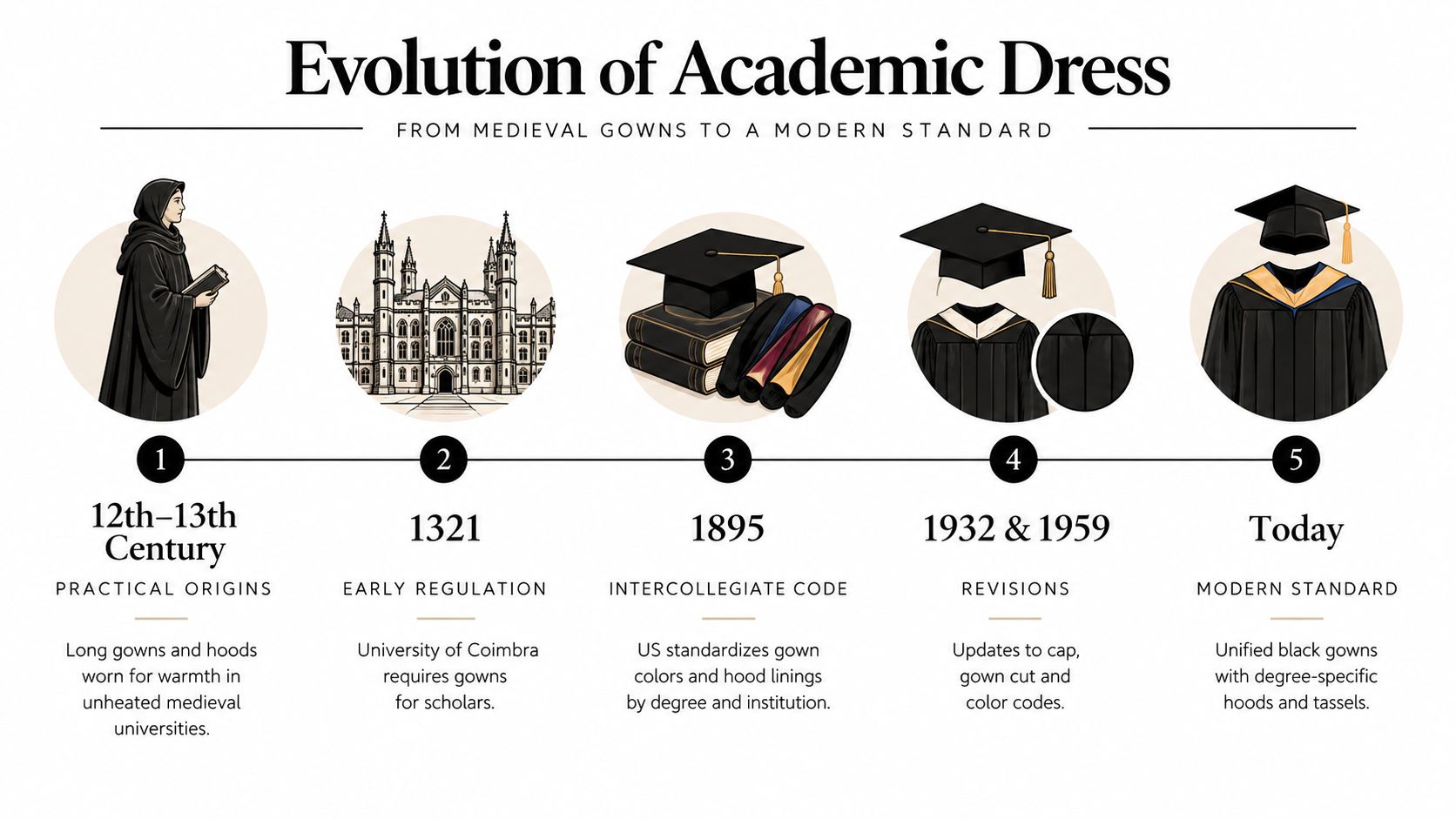
Academic dress began as practical clothing, not as a costume designed only for photographs. Universities that emerged in the 11th and 12th centuries used robes and hoods as everyday scholarly clothing, when warmth and protection mattered in unheated buildings. The clothing later became ceremonial, but its original purpose helps explain why gowns are long, layered, and deliberately distinctive. The University of Toledo's history of academic regalia describes this medieval foundation and the later development of formal graduation standards.
The University of Coimbra in Portugal was the first school known to formally require robes, in 1321. That rule represents an early move from common scholarly clothing toward an institutional dress expectation. Over time, academic communities used clothing to distinguish scholars and to establish a recognizable setting for formal university occasions.
From everyday robes to ceremony language
The modern gown works like a uniform that tells a story. It can show that the wearer belongs to a particular institution, has completed a particular degree level, or has entered a ceremony governed by shared rules. The clothing doesn't replace the graduate's individual identity, but it gives the entire group a common visual frame.
In the United States, institutions began codifying graduation attire by the late 19th century. An intercollegiate commission adopted a standardized code for academic costume in 1895, helping schools use more consistent conventions for gowns, hoods, colors, and academic distinctions. The University of Pennsylvania says its regularized “Pennsylvania System” was published from the 1887 commencement onward before the system was replaced by the Intercollegiate System in 1896. These developments explain why American regalia often looks familiar across different campuses while still retaining institutional variations.
Why schools protect the tradition
Standardization makes a large ceremony easier to read. Faculty, staff, families, photographers, and graduates can identify the basic structure without needing a separate explanation for every person in the procession. The tradition also gives institutions a way to preserve continuity between graduating classes.
That doesn't mean every campus uses identical regalia. A university may authorize a particular color, hood lining, doctoral trim, stole, or cap style. It may also issue stricter rules about accessories and decorations. The historical system provides the vocabulary, but each institution still decides how that vocabulary appears at its ceremony.
Academic dress is less like a party outfit and more like a visual sentence. The gown establishes the occasion, while the details add information about degree and institution.
Understanding that history makes modern rules feel less arbitrary. The cap, gown, hood, and tassel aren't random pieces selected for appearance alone. They evolved into a compact system that helps a community recognize academic achievement.
Understanding Caps Gowns Hoods and Degree Level Differences
Regalia becomes easier to choose when you separate its components. The gown creates the main silhouette, the mortarboard or tam covers the head, the tassel provides a visible ceremony detail, and the hood adds degree and field information where the institution uses one. Stoles, cords, medals, and other accessories may recognize identity, honors, organizations, or service, but their approval depends on the school.
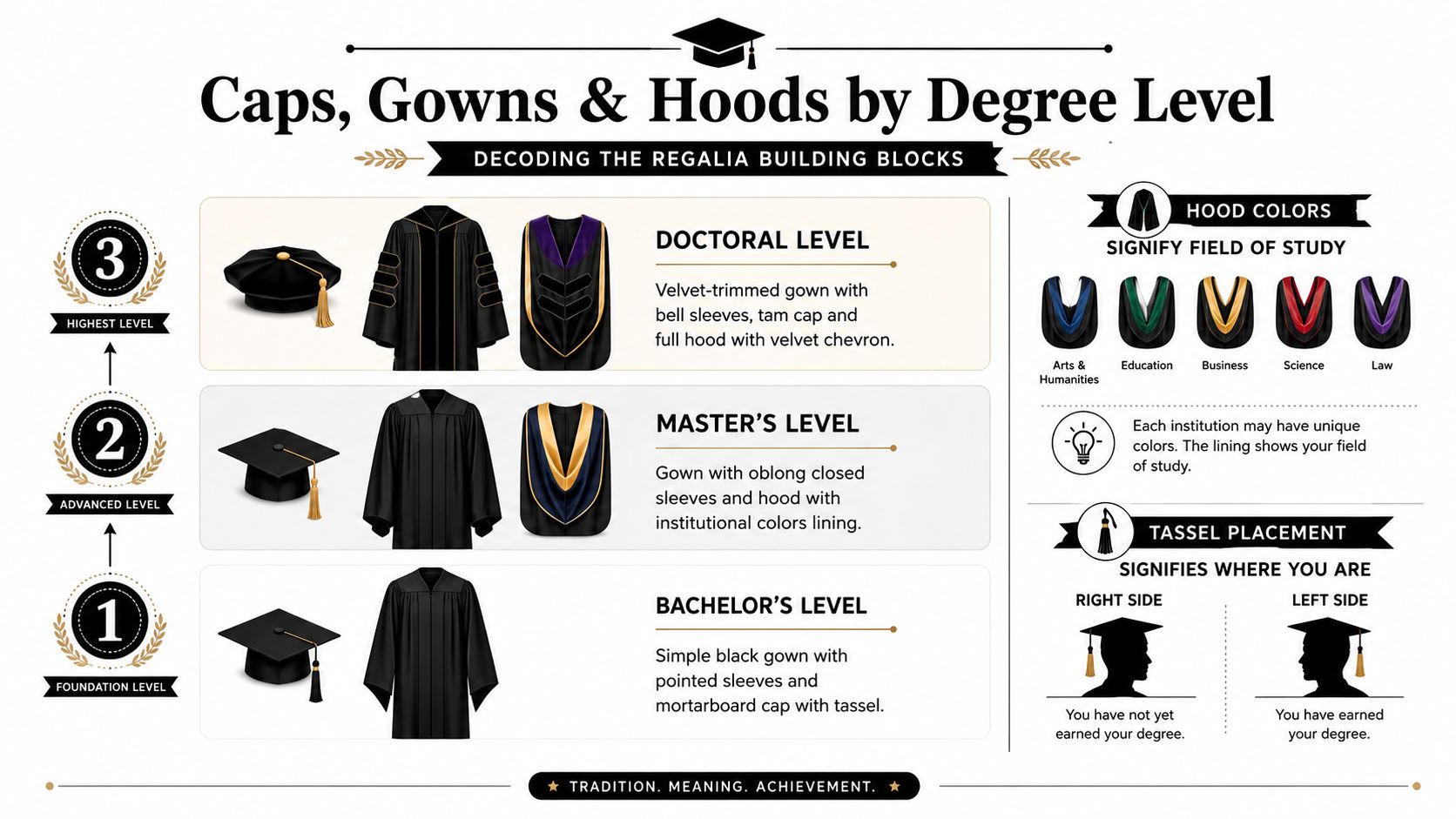
Degree level affects more than the wording on your diploma. U.S. academic dress traditionally uses a material hierarchy: bachelor's gowns may be made from worsted stuff, serge, or Russell cord; master's gowns may use worsted stuff, serge, Russell cord, or silk; doctoral gowns are traditionally made from silk. Fabric weight, drape, and sheen act as visual signals of academic level, while black remains the default unless a school authorizes an institutional color variation. The overview of academic dress in the United States outlines these conventions.
The three degree levels at a glance
| Regalia Element | Bachelor's | Master's | Doctoral |
|---|---|---|---|
| Gown | Traditionally a simpler gown with pointed sleeves | A gown with distinctive oblong, closed sleeves | A more elaborate gown, traditionally with velvet trim and bell sleeves |
| Headwear | Mortarboard cap with tassel | Usually a mortarboard cap with tassel, unless the institution specifies otherwise | Often a tam, though the university may specify a different style |
| Hood | Often not worn, depending on institutional policy | Commonly worn, with lining and trim connected to institution and field | Full hood, often with velvet trim or chevrons |
| Material convention | Worsted stuff, serge, or Russell cord | Worsted stuff, serge, Russell cord, or silk | Silk |
| Color | Black by default unless the school approves another color | Black by default unless the school approves another color | Black by default unless the school approves another color |
The sleeve is one of the quickest visual clues. Bachelor's gowns traditionally have pointed sleeves. Master's gowns use oblong closed sleeves. Doctoral gowns traditionally feature bell sleeves and velvet trim. These details aren't decorative trivia. They help the audience read the level of the degree without stopping to inspect a diploma.
The hood carries another layer of information. Its lining can use institutional colors, while the velvet trim or chevron traditionally relates to the field of study. Because schools can adapt their regalia, you should confirm the exact hood color, trim, and wearing instructions with your institution before ordering.
If you're comparing options, this guide to graduation caps and gowns can help you identify the basic pieces and understand how they work together. Still, a general guide can't override a university's own approved design.
A common confusion concerns color. A black gown is usually the safe visual expectation, but a school may authorize a different institutional color or a specific design. Don't substitute a fashion-colored gown just because it photographs well. Match the official regalia package first, then use your personal clothing, stole, or approved accessories for individuality.
What to Wear Under Your Gown and How to Choose Footwear
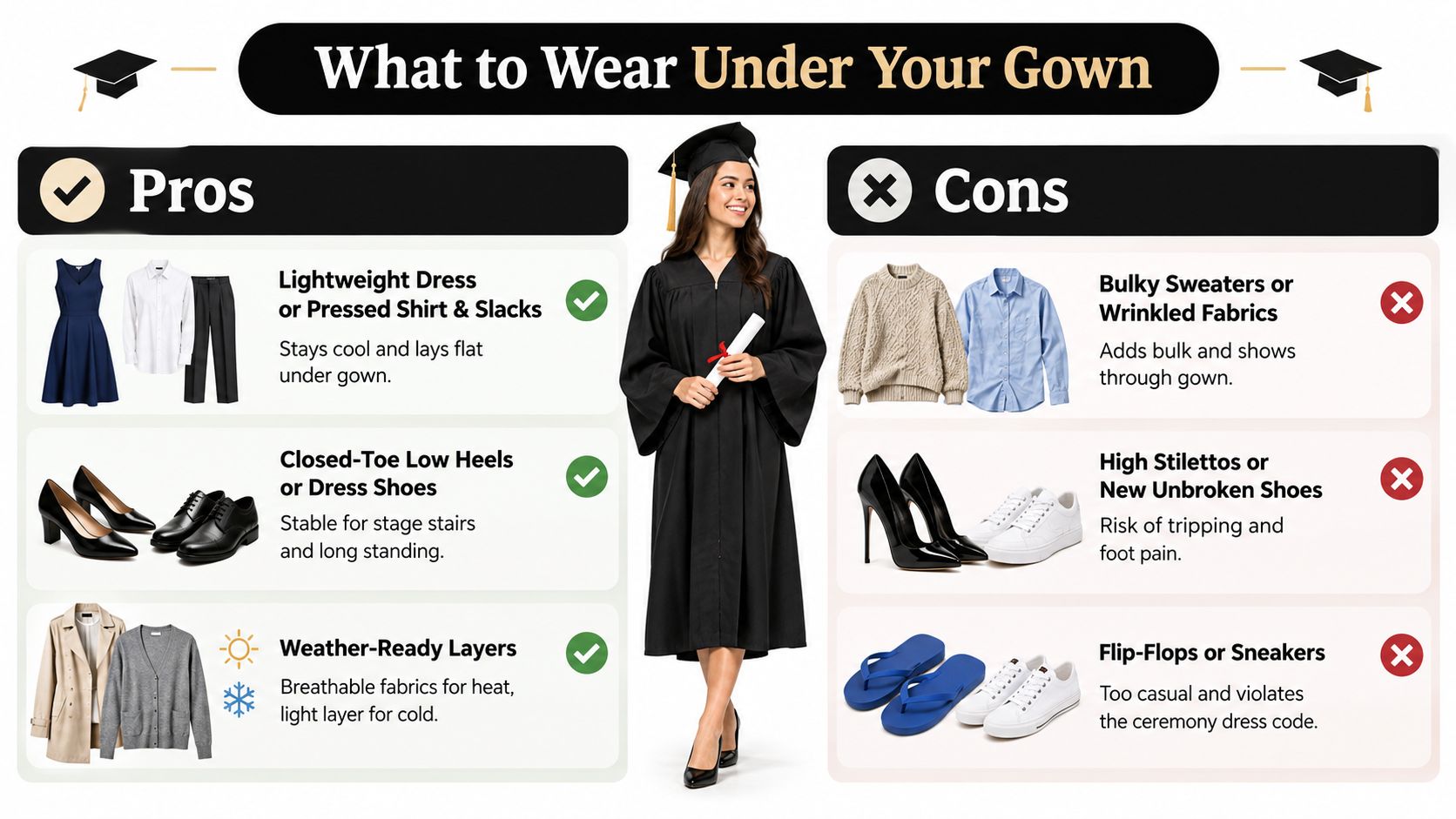
The clothing underneath should be lightweight, smooth, and easy to move in. A gown can hide much of your outfit, but it won't hide bulky shoulders, stiff collars, wrinkled fabric, or uncomfortable waistbands. Choose pieces that stay flat and let you sit, stand, walk, and cross the stage without constant adjustment.
A simple formula works for many ceremonies: a pressed shirt with slacks, a blouse with well-fitting trousers, or a lightweight dress. A neat skirt can also work when it allows comfortable movement. Avoid oversized sweaters and thick jackets unless the venue or outdoor weather truly requires them. Heavy layers can create bulk under the gown and make you feel hotter while waiting in line.
Build the outfit from the stage backward
Start by considering the moment people will see most clearly, your walk across the stage. Your shoes should be stable, broken in, and suitable for stairs or uneven surfaces. Closed-toe low heels, flats, loafers, dress shoes, or another formal option approved by your school can provide a polished appearance without making the crossing harder than it needs to be.
Some ceremony policies prohibit trainers and casual sandals, and formal footwear may be required. That means comfortable doesn't automatically mean informal. A cushioned dress shoe or supportive flat can offer ease while still respecting the event's expectations. Avoid high stilettos, brand-new shoes, flip-flops, or anything that shifts under your feet.
Stage test: Wear the complete outfit, including gown and shoes, and walk, sit, turn, and climb a step if you can. The best graduation outfit is the one you stop noticing once the ceremony begins.
Weather changes the calculation. For a warm outdoor ceremony, breathable fabric and a simple base layer can prevent the gown from feeling oppressive. For cold conditions, use a thin layer that fits under the robe without distorting its shape. Check the venue guidance because outdoor ceremonies may impose additional rules about bags, umbrellas, or weather equipment.
Accessories need restraint and security. Honor cords should sit where the school directs, and a stole should lie flat rather than twist under the hood or gown. Keep jewelry modest enough that it won't catch on fabric, and secure anything that could fall during the processional.
For more outfit combinations and practical under-gown guidance, see what to wear under a graduation gown.
If you prefer visual guidance, this video can help you think through the relationship between the gown, personal outfit, and ceremony presentation.
The final check is simple. Look for clean lines, secure footwear, weather-appropriate layers, and enough freedom to move. Your outfit should support the regalia, not become another thing you need to manage.
Ceremony Etiquette and How to Wear Your Cap and Tassel Correctly
A commencement ceremony has a rhythm. You line up, enter, sit, respond to cues, receive recognition, and leave with the group. Knowing that sequence helps you manage small clothing details before they become distractions.
Start during lineup. Put on the gown before you join the procession, check that the zipper or closure sits correctly, and make sure cords or stoles are secure. If you'll be hooded on stage, follow the staff member's instructions about carrying or wearing the hood. Different ceremonies handle hooding differently, so don't assume that a general tradition applies at your university.
The mortarboard should sit level rather than tilted. Guidance from the University of Tennessee places it about one inch above the eyebrows. The University of Tennessee's regalia instructions also explains that there isn't a universal rule for tassel placement before graduation, although institutions commonly ask graduates to begin with the tassel on the right and move it to the left after degrees are conferred.
A practical ceremony timeline
- Lineup: Check your cap, gown, hood, cords, stole, and footwear before entering the seating area.
- Processional: Walk at the pace set by the group. Keep personal items secure and avoid carrying anything that the ceremony policy prohibits.
- Recognition: Listen for your name, move when directed, and keep your gown closed and accessories in place as you cross the stage.
- Conferral: Move the tassel only when the institution gives the cue. Some schools handle bachelor's, master's, and doctoral candidates differently.
- Recessional: Leave with your row or group rather than rushing toward guests for photographs.
You can find more detail on which side the graduation tassel belongs, but your university's instructions take priority. A school may specify different placement for different degree levels or may move the tassel as part of a coordinated ceremony moment.
Photos create another etiquette question. Take them before or after the formal portion when possible, and keep your phone silent during the ceremony. Avoid adjusting your cap repeatedly while seated. If the mortarboard feels loose, solve the problem before lineup with approved pins, clips, or a better fit, rather than reaching up during speeches or recognition.
The goal isn't perfect stillness. Graduates naturally smile, wave, and celebrate. Good etiquette protects the experience for the people sharing the ceremony with you.
Common Policy Exceptions and Accommodations for Every Graduate
Generic graduation advice often stops at “wear business attire” or “dress modestly.” That isn't enough for every graduate. A useful college graduation dress code must address mobility, sensory needs, religious observance, adaptive clothing, footwear, and cultural expression alongside formal presentation.
Institutional guidance emphasizes communicating expectations while respecting diverse identities and expressions. The Illinois State Board of Education's graduation attire guidance also highlights the tension created when ceremonies prohibit trainers or casual sandals, require formal footwear, or restrict styling choices involving caps, shoulders, and hair accessories. Those rules can create genuine barriers for students who need adaptive clothing, supportive shoes, religious headwear, or culturally specific styling.
Start with the policy, then request a workable alternative
A school may prohibit decorating mortarboards altogether. Northwestern State University's guidelines specify black gowns and black mortarboards for bachelor's and master's candidates, and state that the Academic Costume Code prohibits mortarboard decoration. Northwestern State University's commencement dress and conduct guidelines provide that example.
Wake Forest University also requires full academic regalia with a traditional black gown and mortarboard with tassel. Its policy discourages decoration, limits any permitted decoration to something minimal and non-distracting, and says that nothing may hang from the mortarboard except the university-approved tassel. Wake Forest's regalia conduct guidelines show how much institutional policies can differ.
For an accommodation, contact the commencement office, registrar, or accessibility office as early as you can. Explain the functional need, identify the part of the policy that creates a barrier, and propose a solution that preserves the ceremony's visual requirements.
- Footwear: Ask whether supportive trainers, orthopedic shoes, flats, or another adaptive option can be approved when formal shoes aren't safe.
- Headwear: Explain religious requirements clearly and ask how a hijab, turban, yarmulke, scarf, or other item can be worn with the mortarboard or hood.
- Mobility: Request guidance on stage access, ramp routes, seating, gown length, and whether the robe can be altered without affecting the ceremony.
- Sensory needs: Ask about softer fabrics, reduced contact around the neck, quiet waiting areas, or permission to modify closures.
- Cultural expression: Confirm whether a stole, hairstyle, hair accessory, or traditional garment can be worn with the approved regalia.
The strongest accommodation request is specific. Describe what you need to participate safely, then ask the institution to help you meet the ceremony's appearance and conduct standards.
Don't wait until the doorway check. Staff may be able to provide an approved alternative, but last-minute requests leave less time for fitting, documentation, or coordination. Respectful communication protects both your access and the ceremony's consistency.
Your Pre Ceremony Checklist and Smart Regalia Shopping Tips
A calm graduation morning starts with decisions made before the gown arrives. Begin with the university's official regalia instructions, then compare every item you plan to wear against that information. Don't rely on a product photograph alone, because a school may require a specific hood lining, gown color, cap shape, tassel, or accessory.
Verify the required pieces
Use this checklist while ordering and again when your package arrives:
- Degree level: Confirm whether you're buying bachelor's, master's, or doctoral regalia.
- Gown color and cut: Match the institution's approved design, including sleeve shape and any doctoral trim.
- Cap or tam: Check the required headwear and make sure it sits securely without blocking your vision.
- Tassel: Confirm the correct color and whether your school provides a specific ceremony instruction.
- Hood: Verify the lining, velvet trim, field color, and degree-level design where a hood is required.
- Stole and cords: Check which items are officially permitted and practice arranging them so they lie flat.
- Fit: Try on the complete set with your intended clothing and shoes.
- Movement: Walk, sit, turn, and use stairs or a ramp in the outfit.
- Delivery: Allow enough time to inspect the package and resolve a sizing or color issue before the ceremony.
Graduation Attire offers caps, gowns, tassels, tams, beefeaters, academic hoods, honor cords, diploma covers, frames, medals, garment bags, and custom stoles. Its school finder and size, color, and fabric guides can help shoppers match a purchase to university requirements. For a separate resource when planning costume-related clothing, you can also use ABC Hire for costume needs, especially when a themed event or non-academic outfit is involved.
Make the final fitting practical
Steam or press the gown according to its fabric instructions, then hang it where it won't crease. Test the cap with your hairstyle and any approved religious headwear. If you need an accommodation, confirm that the final arrangement has been approved rather than assuming a staff member will accept it at check-in.
Place your shoes beside the outfit and wear them during the fitting. A polished appearance matters, but stable movement matters more. Pack only what the venue allows, keep your phone charged, and leave enough time for check-in and lineup.
The dress code isn't meant to erase your personality. It gives the ceremony a shared frame, while approved stoles, accessories, and personal clothing allow you to mark the achievement in your own way. Prepare carefully, ask questions early, and you'll be able to focus on the walk, the name announcement, and the people celebrating with you.
Graduation Attire provides degree-specific caps, gowns, hoods, tassels, tams, accessories, and custom stoles to help you build regalia that fits your ceremony requirements and personal identity. Visit Graduation Attire to compare options, use the school finder, and prepare your complete graduation outfit with confidence.