

A doctoral regalia hat is usually a black velvet tam, not a mortarboard, unless your university specifies another shape. That single exception is where most orders go wrong, because a prettier or higher-sided hat can still be the wrong one for your stage.
You're probably looking at a commencement email, a bookstore deadline, and three product photos that all claim to be doctoral. One is flat, one is soft and round, one has eight corners and a gold tassel. You don't want to learn the difference from a marshal in the robing room. Work from the school's printed spec first, then choose sides, tassel, and fit to match it.
What a Doctoral Regalia Hat Signals
From the family seating, doctoral gowns blur together. They're long, mostly black, and moving in a line. The doctoral regalia hat is what people read first, because its soft, lifted crown sits nothing like the flat board they remember from an undergraduate ceremony.
That difference carries history. The Texas A&M ceremonial symbols guide traces academic dress to medieval European universities in the 12th and 13th centuries, when scholars wore long gowns and head coverings partly for warmth in unheated buildings and partly to mark themselves as members of an academic community.

The 1895 Turning Point in the United States
Oxford style square caps were in practical use by about 1600, but American campuses needed a common language. In 1895, the Intercollegiate Commission created the Intercollegiate Code of Academic Costume, linking degree level to gown design, hood form, and academic colors. For doctoral graduates, that code permits a soft velvet tam rather than requiring the square mortarboard used most commonly for bachelor's and master's degrees.
The tam itself is often four, six, or eight sided, and exact construction varies by institution. Its velvet and larger silhouette separate doctoral graduates and faculty from other degree holders at a glance. That's the signal, achievement at the highest degree level, worn in a form older ceremonies would still recognize.
Three shapes cause nearly all the confusion. There's the multi-sided tam, the square mortarboard, and the round beefeater or Tudor bonnet. They aren't interchangeable styles of the same hat.
The tam signals the doctorate, but the commencement office decides which version of that signal you're allowed to wear.
Buyers miss that last part. They assume more sides or richer velvet must mean more correct. It doesn't, if your school named something plainer.
Tam Types, Sides, and Tassels
Doctoral hat types at a glance
| Hat | Typical wearer | Shape | Material | Usual tassel | When it is the right choice |
|---|---|---|---|---|---|
| Doctoral tam | Doctoral graduates and many faculty | Soft gathered crown, often 4, 6, or 8 sides | Velvet, usually black | Gold bullion, some schools allow silver or a school color | Default under the U.S. code, Iowa State requires a doctoral tam |
| Mortarboard | Bachelor's and master's graduates, some doctoral candidates | Flat square board on a skullcap | Cloth or synthetic board, not typically velvet | Degree, school, or honor color | Only when the school permits it, as Toledo does for doctoral candidates |
| Beefeater or Tudor bonnet | Some UK and Commonwealth graduates and some faculty or professional dress | Round soft bonnet, often with a brim | Velvet or cloth | Often gold or a matching cord | Not the U.S. Intercollegiate default, wear it only if that institution specifies it |
Read that table by columns, not by looks. Shape tells you which family the hat belongs to. Material tells you whether it's built for doctoral dress or for a lighter undergraduate set. The last column is the one that protects you, because it asks who authorized the hat, not who sold it.
How to Read the Tam Row
A doctoral tam has a three dimensional, gathered crown. It poufs slightly, holds its panels, and sits on a headband rather than balancing a board. That scale matches a doctoral gown, which is fuller than a bachelor's gown and carries velvet panels and sleeve bars.
The standard reference on academic dress identifies velvet as the characteristic doctoral material, and institutional specifications commonly call for a black, multi-sided tam with a gold bullion tassel. That's your starting spec in the United States, not a universal guarantee.
Side count deserves a plain answer, because it's where marketing misleads people. Each institution sets its own number, and the range is real. MIT specifies an eight-sided silver-gray tam with a cardinal-red tassel, while the Texas A&M University Corpus Christi graduation regalia page describes doctoral tams as four-sided. Both can be correct, each on its own campus.
Say your cousin earned a doctorate two states away and wore an eight-sided tam. That tells you what her university allowed. It tells you nothing binding about yours.
How to Read the Mortarboard Row
A mortarboard is a flat square board fixed to a small skullcap. It's light, rigid, and familiar from high school, bachelor's, and many master's ceremonies. The board gives it that hard, level profile in photos, with corners that should sit square, not tipped back like a halo.
For a doctoral candidate, a mortarboard is correct only when the school says so. Some campuses offer it as a rental default or as an allowed alternate. Others expect the tam and will treat the board as the wrong degree's hat.
A mortarboard is often cheaper and cooler, and those are real advantages on a hot field. But if your commencement page names a tam, saving money on a board buys you a problem at check in.
How to Read the Beefeater Row
The beefeater, or Tudor bonnet, is round and soft, often brimmed, with roots in British and Commonwealth academic dress. It can look distinguished, and on the right campus it is exactly right. On a U.S. campus following the Intercollegiate Code, it's not the default substitute for a tam.
Graduates who studied abroad sometimes own one already. Faculty sometimes inherit one with a gown from another institution. Owning it doesn't authorize it. Ask whether your current ceremony lists it before you pack it.

Velvet and Why It Matters Beyond Looks
Velvet isn't used just because it photographs well. Its dense pile gives a deeper, more formal black and coordinates with the velvet facings, sleeve bars, or chevrons on a doctoral gown. Put a thin synthetic cap next to those panels and you'll see two different blacks under arena lighting.
The University of Rhode Island regalia specification describes an eight-sided tam made from fine velvet with a gold bullion tassel, which is a useful model of how a school writes the full spec in one line. Material, sides, and tassel travel together. When a listing omits one of the three, ask before you pay.
Velvet also behaves differently on your head. It can be heavier and less forgiving than lightweight synthetic cap fabric, and it shows pressure marks if you stuff it in a tote. Look for these construction points when you compare tams at the same side count.
- Stable inner headband: The band should grip without digging, and adjustable sizing helps if your hairstyle changes volume.
- Structured but flexible crown: Panels should hold their shape when you pick the tam up, then flex enough to pack without creasing hard.
- Secure tassel attachment: The button or loop should not spin loosely, because a swinging bullion tassel distracts in every photo.
A hood follows the same matching logic, which is why degree color on velvet matters across the set. The Deluxe Bachelor/Master Hood - Light Blue Velvet, Royal Blue & Golden Yellow shows how a listing can carry its color spec right in the name: light blue velvet paired with royal blue and golden yellow. Match those named colors against your school's spec, not the shade in a thumbnail.
Tassels and the Three Lines to Confirm
Doctoral tassels carry their own signal. Gold bullion is the common doctoral choice, a metallic tassel that's heavier and more formal than a colored rayon one. UTSA states that doctoral recipients wear a gold bullion tassel, while discipline-based tassel colors mark other graduate distinctions.
California State University, San Bernardino shows why you can't stop at the word gold. It specifies a black tam and allows either gold or silver bullion selected to match the gown's metallic piping. If your gown piping is silver and you order gold out of habit, your set will clash in a way that's obvious up close.
Which side the tassel hangs on, and whether it moves during the ceremony, is a separate school instruction. Our guide on which side a graduation tassel goes on walks through that placement so you aren't copying the person in front of you. Set it before you line up, then leave it alone unless a marshal directs a change.
The catalog describes the hat. The commencement office authorizes it.
Before you order any doctoral regalia hat, confirm three lines with the registrar or commencement office.
- Side count: Four, six, or eight, exactly as printed.
- Tam color: Usually black, but a school color tam changes everything downstream.
- Tassel metal or color: Gold bullion, silver bullion, or a named school or discipline color.
Write those three answers at the top of your order notes. If a product page can't match all three, it isn't your hat, however many doctoral photos appear beside it.
When the University Overrides Tradition
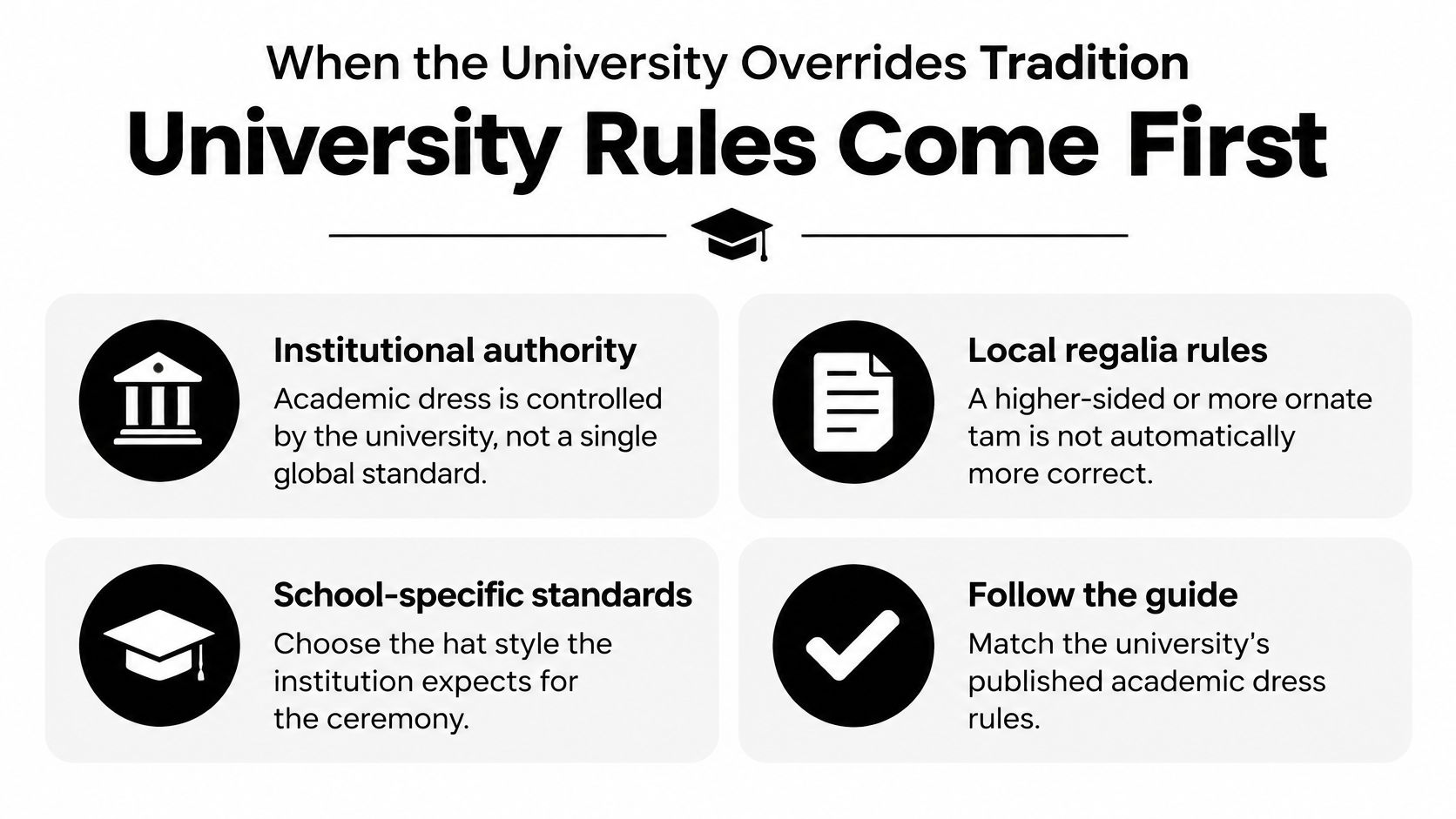
A simpler mortarboard can be the correct doctoral hat. That sounds backwards until you accept who runs the ceremony. Academic dress is institution controlled, not governed by one universal doctoral hat standard, so a higher-sided or more ornate tam is not automatically more correct.
The infographic below sums up that hierarchy before the campus examples make it concrete.
Three Campuses and Three Different Answers
The University of Toledo regalia guidance says doctoral candidates may choose a four-sided mortarboard or a four, six, or eight sided tam. At Toledo, choice is built into the rule. A candidate in a mortarboard there is compliant, full stop in practical terms.
Iowa State takes the opposite approach. It requires official doctoral regalia that includes a doctoral tam. A borrowed mortarboard from a master's ceremony would fail that check, even if it fits perfectly and looks clean.
North Carolina State's DVM ceremony adds a decoration rule. Candidates must bring a gown, doctoral hood, tam, and tassel, and tams may not be decorated. A custom emblem, a painted message, or glued letters can violate that rule even when the tam shape, color, and sides are right.
The rule that matters: The compliant hat is the one your school named, even when it is the plainer choice.
This short video is worth watching before you finalize an order, especially if your program mixes degree types in one procession.
The Five Checks to Run on Your Commencement Page
Don't read the page looking for the word tam and stop. Run all five checks, because a miss on any one can send you back to reorder.
- Required silhouette: Tam or mortarboard, and whether it is offered as a choice.
- Number of sides: Four, six, or eight, if a tam is required.
- Tassel type and side: Bullion metal or color, and the side it hangs on.
- Decoration policy: Whether painting, emblems, or custom additions are banned.
- School colors or insignia: Whether they are mandatory on the tam or only on the gown and hood.
A Ph.D. tam and a professional doctorate tam are not automatically different products. Any difference between a Ph.D., an Ed.D., a DVM, or a Pharm.D. hat is whatever that school prints. If the page gives one doctoral spec for all, buy one doctoral spec for all.
British universities, professional schools, and American campuses each publish their own costume. An imported beefeater can be perfect at one ceremony and noncompliant at the next. If your page is vague, email the commencement office with your degree and ceremony date, and keep the reply with your order receipt.
How to Measure Fit and Order Early
More commencement mornings are ruined by fit and timing than by symbolism. A tam that slides every time you turn for a photo, or a custom set still in transit, will occupy your whole attention on a day that should feel settled.
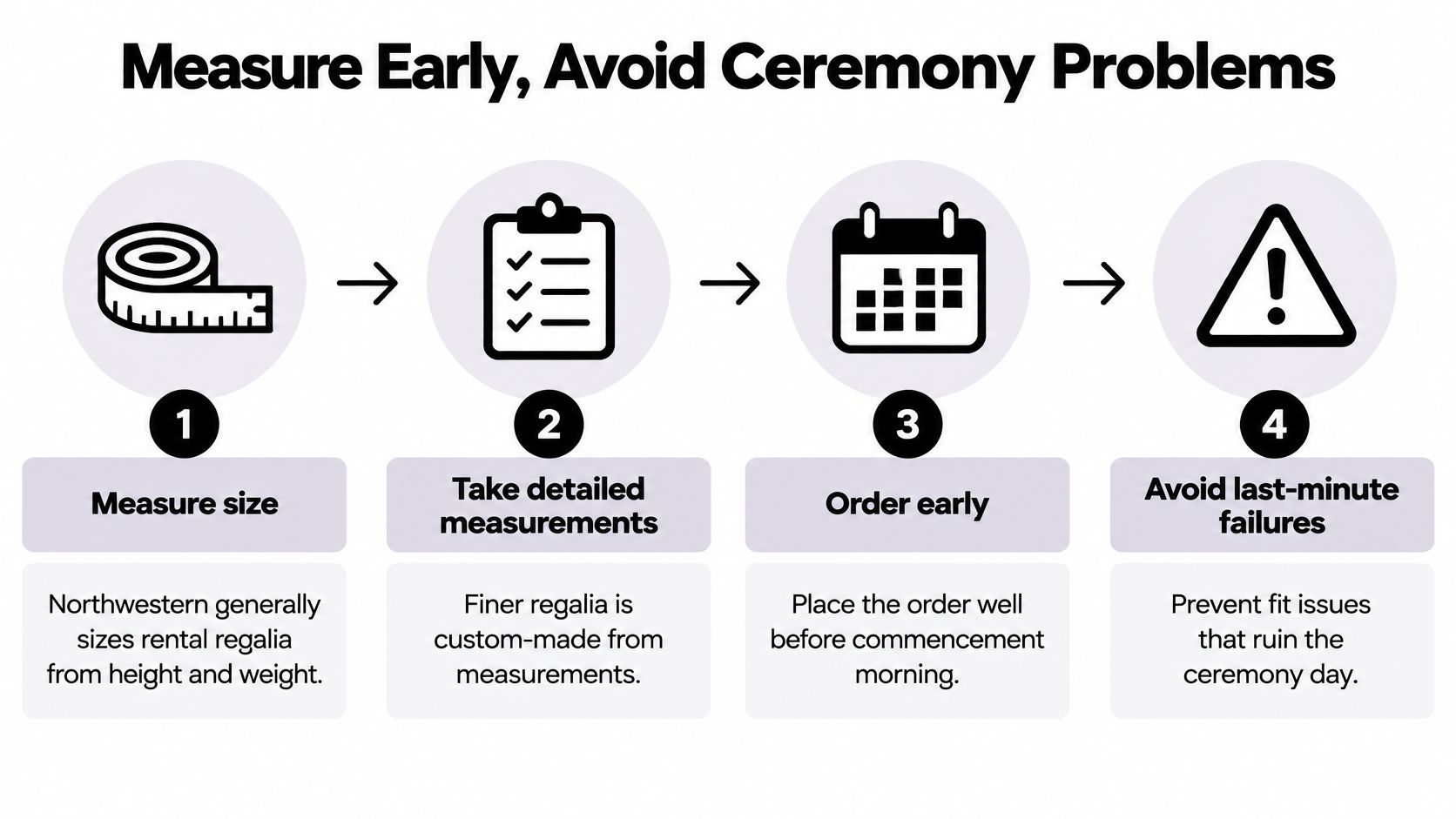
The Northwestern commencement regalia page states that rental regalia is generally sized from height and weight, whereas finer regalia is custom made from measurements, and it advises allowing eight to ten weeks for custom regalia to arrive. UCLA similarly warns that custom sized fine regalia, including a doctoral tam, requires ordering weeks before the ceremony, while its rental package uses a standard flat cap rather than a tam.
Read that UCLA detail twice. Renting can change which hat ends up on your head. If your school requires a tam and the rental bundle substitutes a flat cap, you have solved a budget question and created a compliance one.
The Six Step Measurement Routine
Height and weight charts don't know your head. Use them for gown length if you must, then measure the tam separately using this routine.
- Measure head circumference: Wrap a soft tape about an inch above your eyebrows, over the hairstyle you plan to wear that day, and record the number without pulling tight.
- Note anything that changes fit: A bun, braids, religious headwear, or a mobility need can change how the tam sits and how easily you can adjust it in line.
- Check the band type: Confirm whether the inner band is fixed, elastic, or adjustable, and match that to your measurement instead of guessing small, medium, or large.
- Try it with the gown: Put the full set on, set the tassel on the side your school specifies, and check the look from the front and side.
- Walk and turn: Take twenty steps, turn your head both ways, and look down as if reading a program. If it slides, tighten the band or use a small comb or pins inside, which is safer than decorating a crown your school may forbid.
- Order with a buffer: The eight to ten weeks Northwestern advises for custom regalia is your starting window, so add time on top for alterations or an exchange if the first fit is off.
If measuring at home feels imprecise, ClothME's guide to accurate measurements is a helpful companion on keeping a tape level and recording numbers consistently. Measure twice on different days if your hairstyle is still undecided. A half inch of hair volume is enough to turn a snug band into a headache by the second hour.
Measure for the morning of the ceremony, with your hair and any headwear arranged exactly as they will sit under the tam.
What Campus Prices Tell You About Renting Versus Buying
Prices vary by campus, and published 2025 figures show the scale. In 2025, the Kansas State University graduation information page listed a doctoral regalia package including tam, gown, tassel and hood at $170.75. In 2025, the CUNY Graduate Center commencement FAQ stated that doctoral graduates could rent regalia for $98, while new doctoral regalia sets cost approximately $1,200. That spread explains why both choices exist.
Rental can be enough for one ceremony, especially if you will never march again. A measured purchase suits faculty, administrators, and graduates who expect to attend future academic events in regalia, and the hat itself stays a modest line item: Graduation Attire's 8 Sided Doctoral Tam for faculty regalia lists at $37.95 and is available for as low as $30.36. Decide by how many times you expect to wear the set, and let that count settle the question.
Field Colors That Must Match the Set
Once the shape is settled, color tells the second story. Velvet color can identify the doctoral field or degree type, and the exact system may be institution specific. That color usually lives on the gown panels and the hood, while the tam stays black, which is exactly where buyers get tripped up.
The MIT commencement history and symbolism page states that blue trim represents PhD degrees and yellow trim represents ScD degrees. UT Tyler gives discipline specific examples: royal blue velvet for a Doctor of Philosophy, apricot for a Doctor of Nursing Practice, and olive for a Doctor of Pharmacy. Its guidance also says faculty colors are represented in doctoral and master's hoods.
The last four rows below follow the widely used academic costume convention that many U.S. schools draw on. Treat them as the common default, since a given campus can always assign its own colors.
Doctoral colors readers must match
| Degree or field | Velvet or trim color | Where this color is specified |
|---|---|---|
| Doctor of Philosophy | Blue or royal blue | MIT blue trim, UT Tyler royal blue |
| Doctor of Science | Yellow | MIT yellow trim for the ScD |
| Doctor of Nursing Practice | Apricot | UT Tyler |
| Doctor of Pharmacy | Olive | UT Tyler |
| Education | Light blue | Widely used academic convention |
| Medicine | Green | Widely used academic convention |
| Law | Purple | Widely used academic convention |
| Engineering | Orange | Widely used academic convention |
Read that table as a lookup. It tells you what a color means when you spot it across a stage. Your school's own page still decides whether that color may appear on your regalia at all, and where.
Why the Tam Often Stays Black
In many U.S. sets, the tam stays black with a gold tassel while field color sits on the gown velvet and the hood. The hood adds more information still, with its velvet band for the field and its lining for the university. Our breakdown of graduation hood colors and what they mean explains how those hood elements divide the work.
A colored tam is only correct when your school says so. Field color belongs wherever the campus spec puts it, and that is usually the gown and hood.
A royal blue tam ordered online because it matched your field can still break a campus spec. Say you're a philosophy graduate. Royal or dark blue identifies your field, and it may belong on your gown trim and hood velvet rather than the hat. A nursing graduate in apricot and a pharmacy graduate in olive stay readable without opening the program, as long as each color lands where the school expects it.
Buy the Set Against One Page
The practical unit is the set: tam sides and tassel, gown velvet, and hood, checked against the same school page. Print or save that page and work through each item in order. If one piece comes from a rental bundle and another from a purchase, compare their blacks and velvets in daylight before ceremony week.
Match the hat to the gown and hood your school already requires. Buy the colored tam only when that page names one.
Order the Hat Your School Allows
By ordering time, you should have six facts written down. You know the silhouette, the side count, the tassel, the decoration rule, your head measurement, and whether the tam stays black while color sits on the gown and hood. If any one of those is still a guess, you're not ready to check out.
If your school names a tam, order that side count. Don't upgrade to eight sides because it looks more doctoral in a thumbnail. If your school allows a mortarboard, don't substitute a beefeater because you already own one.
We offer doctoral packages that include a gown, tam, and hood, with options for custom combinations, and our faculty doctoral tams come in 4, 6, or 8 sided options. If you only need the hat, our 8 Sided Doctoral Tam for faculty regalia lists at $37.95 and is available for as low as $30.36, so the tam doesn't have to be bundled when your gown and hood are already set.
Readers who need the full outfit can compare a classic doctoral tam and gown set with a custom doctoral gown, then add the hood in their school and degree colors. Our guide to the best doctoral regalia choices can help you weigh classic against custom before you commit.
Use the school finder to match your campus requirements and the size guide to confirm your measurement before you pay. Place the order inside the safe custom window if your measurements or colors are special. Waiting until the final month turns a simple exchange into a crisis.
Then do the last, simple thing. Match the product's sides, color, and tassel to your commencement reply, line by line, and buy or rent only that hat.
When you're ready, shop doctoral tams in 4, 6, or 8 sided options, complete doctoral packages with a gown, tam, and hood, and hoods built to your school and degree colors at Graduation Attire. Bring your commencement office's answers for silhouette, sides, and tassel, use the school finder and size guide to confirm the match, and order the exact doctoral regalia hat your ceremony allows.