

You're standing in a hallway before commencement, holding a folded hood over your gown and trying to decide whether the color belongs to your program, your university, or both. The answer is both, but the hood communicates those details through separate parts of the garment.
The easiest way to understand graduation hood colors meaning is to treat the hood as a two-channel message. The velvet trim identifies the academic field, while the satin or silk lining identifies the institution that awarded the degree. The hood's shape and trim width add a third clue, the degree level.
By the end, you'll know how to identify the velvet's discipline color, read the lining as school identity, recognize the degree level from the hood's proportions, and spot the local rules that make a generic color chart incomplete.
A Hood on Your Shoulders and a Code to Read
A graduate sorting through a pile of regalia may see black fabric, bright lining, velvet edging, and a long pointed tail. At first glance, those pieces can look ceremonial rather than informational. In fact, academic dress works more like a visual code than ordinary clothing.
The hood answers two different questions at once. What did this person study? Look at the velvet trim. Which institution granted the degree? Turn your attention to the lining and its color arrangement. Those signals sit on the same garment, but they come from separate systems.
The modern U.S. interpretation of hood colors became more consistent through the Intercollegiate Code of Academic Costume in 1895. Before that standardization, academic dress varied without fixed meanings for style and color. The code assigned discipline colors to hood velvet, including white for arts and letters, golden yellow for science, dark blue for philosophy, and scarlet for theology. The history of academic hood colors explains how that framework continues to influence academic regalia in major markets.
Four questions help you read the garment
- What does the velvet trim mean? It marks the academic discipline or faculty.
- What does the satin lining mean? It displays the colors and pattern of the degree-granting institution.
- How does degree level change the hood? The velvet width, length, and overall drape distinguish bachelor's, master's, and doctoral regalia.
- Why can't one chart tell the whole story? Universities may refine or override broad discipline-color conventions.
That last point matters when you're ordering. A light blue hood may suggest education, yet the correct lining still depends on the university. A purple trim may suggest law, while the hood's shape tells you whether the wearer holds a master's-level or doctoral-level degree.
Practical rule: Read the hood in layers. Start with the velvet, inspect the lining, then judge the width and silhouette.
Anatomy of an Academic Hood
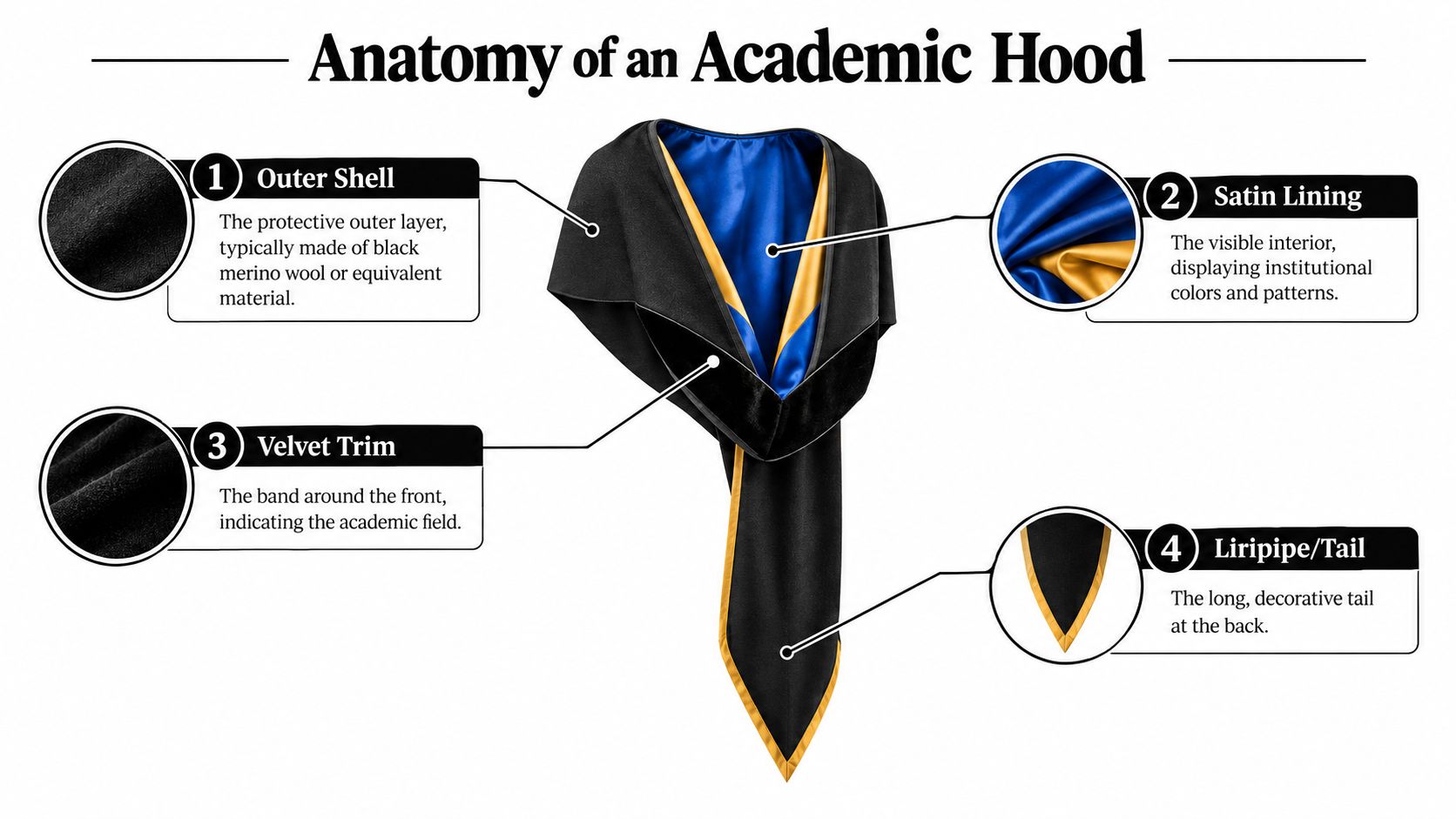
Before interpreting color, identify the hood's physical parts. Think of it as an anatomy lesson for academic dress. The outer shell is the garment's body, the lining is its visible interior, the velvet is its identifying border, and the tail extends behind the shoulders.
The outer shell forms the main fabric structure. It rests around the neck and shoulders, then falls down the back. The shell may use black merino wool or an equivalent academic-regalia fabric, depending on the supplier and institutional requirements.
Inside that shell, the satin or silk lining becomes visible when the hood is turned back and arranged correctly. This is the part that displays the institution's colors. A school may use a single official shade, divided panels, chevrons, or another registered arrangement.
Locate the identifying border
The velvet trim runs along the front edges of the hood and frames the opening around the neck. This border carries the discipline color. Some designs also use a narrow piping edge or internal chevrons, especially on doctoral hoods, but those additions shouldn't be interpreted without checking the institution's specifications.
The long pointed section at the back is often called the liripipe or tail. It gives the hood its distinctive silhouette and helps the fabric hang behind the graduate. The shoulder area may also be described through the cowl and cape panels. The cowl is the portion that wraps around the neck, while the broader panels spread over the shoulders and upper back.
Academic hoods come in different lengths. Common catalog anchors include a 48-inch bachelor's hood, a 54-inch master's hood, and a 60-inch doctoral hood, as described in this guide to academic hood construction. Those measurements help suppliers match the hood to degree level and wearer proportions.
Once you can name each part, color interpretation becomes much easier. The shell gives the hood its structure, the lining represents the institution, and the velvet border identifies the field. The hood is a small garment, but every visible surface has a job.
What the Two Color Channels Really Mean
The most useful idea in graduation hood colors meaning is that the hood uses two independent color channels. The velvet and the lining don't compete to communicate the same fact. They work in parallel.
The velvet trim answers the academic question. It identifies the field of study through a discipline-color system associated with the Intercollegiate Code. White can represent arts and letters, golden yellow can represent science, light blue can represent education, orange can represent engineering, and purple can represent law. The specific university may refine the assignment, so the broad code is a starting point rather than a final purchase instruction.
The satin or silk lining answers the institutional question. It uses the official colors of the college or university that awarded the degree. As the academic regalia color guide explains, the velvet border identifies the field while the lining and chevrons identify school colors.
One degree field, two different linings
Consider two graduates who both earned PhDs in education. Their hoods may use the same light blue velvet, because the discipline is the same. If they attended different universities, however, the linings may show entirely different school colors or patterns.
That difference doesn't mean one hood is wrong. It means the velvet is carrying the field signal while the lining is carrying the institutional signal. A viewer who reads only the outer edge sees the discipline. A viewer who looks inside the hood also sees where the degree came from.
The velvet edge or piping can reinforce the field color, and doctoral designs may add broader velvet treatment around the neckband. But color alone doesn't establish degree rank. The key rank signal is the width of the velvet, supported by the hood's length and drape.
This two-channel design also explains why buyers make mistakes. They may find the correct field color on a chart, then order a lining that belongs to another school. Matching the discipline is only half the task.
Common Discipline Colors You Will See Most Often
The Intercollegiate Code's discipline colors provide a working vocabulary for reading academic hoods. The color generally appears on the velvet border, not the lining. The table below brings together commonly cited assignments, while noting that overlapping uses and local university rules require confirmation.
| Velvet Color | Discipline / Field | Typical Degree Levels | Overlap Notes |
|---|---|---|---|
| White | Arts, letters, and humanities | Bachelor's, master's, and doctoral degrees | Broad humanities groupings may be divided by individual schools. |
| Golden yellow | Science | Bachelor's, master's, and doctoral degrees | Science programs may use more specific local distinctions. |
| Light blue | Education | Bachelor's, master's, and doctoral degrees | Verify whether education leadership or related programs follow the same assignment. |
| Orange | Engineering | Bachelor's, master's, and doctoral degrees | Engineering is commonly associated with orange, but university rules can refine the shade. |
| Purple | Law | Professional and doctoral-level law degrees | Some institutions publish their own law-regalia specifications. |
| Green | Medicine | Professional and doctoral-level medical degrees | Health-related programs may use separate colors, including nursing or pharmacy shades. |
| Pink | Music | Bachelor's, master's, and doctoral degrees | Music is commonly associated with pink velvet. |
| Scarlet | Theology and divinity | Master's and doctoral degrees | Theology is distinct from several other religion-related programs in local charts. |
| Dark blue | Philosophy and political science | Master's and doctoral degrees | Philosophy and political science may overlap in institutional charts. |
| Sapphire blue | Philosophy and, in some charts, public administration | Master's and doctoral degrees | Confirm which blue a university assigns to the program. |
| Drab or olive | Business and commerce | Bachelor's, master's, and doctoral degrees | The muted shade can be confused with other green-based assignments. |
| Copper | Economics | Bachelor's, master's, and doctoral degrees | Economics may be grouped with business at some institutions. |
| Peacock blue | Public administration and urban planning | Master's and doctoral degrees | Public administration appears in more than one color tradition. |
| Russet | Forestry | Bachelor's, master's, and doctoral degrees | Forestry-specific rules may differ by university. |
| Citron | Social work | Bachelor's, master's, and doctoral degrees | Check whether social work is separated from related public-service programs. |
| Apricot | Nursing | Professional, bachelor's, master's, and doctoral degrees | Nursing uses a distinct shade in many university regalia guides. |
| Crimson | Journalism | Bachelor's, master's, and doctoral degrees | Journalism may be grouped with communications locally. |
| Sage green | Physical education | Bachelor's, master's, and doctoral degrees | The color can resemble other health or education-related shades. |
| Brown | Fine arts | Bachelor's, master's, and doctoral degrees | Fine arts and arts-and-letters assignments aren't interchangeable everywhere. |
| Lilac | Dentistry | Professional and doctoral-level degrees | Dentistry has a specialized color in expanded code listings. |
| Olive green | Pharmacy | Professional and doctoral-level degrees | Pharmacy may be separated from medicine and other health fields. |
| Gray | Veterinary science | Professional and doctoral-level degrees | Veterinary science has its own expanded-listing assignment. |
| Maize | Agriculture | Bachelor's, master's, and doctoral degrees | Agriculture may be listed separately from general science. |
These assignments come from expanded Intercollegiate Code color listings and university regalia references. They're most useful as a first filter. If your program appears in two color traditions, don't choose based on a photograph alone.
For example, a graduate in public administration may encounter sapphire blue or peacock blue in different references. A graduate in philosophy may see dark blue or sapphire blue. Those overlaps are precisely why the registrar's instructions outrank a broad online chart.
How Degree Level Changes the Hood Itself
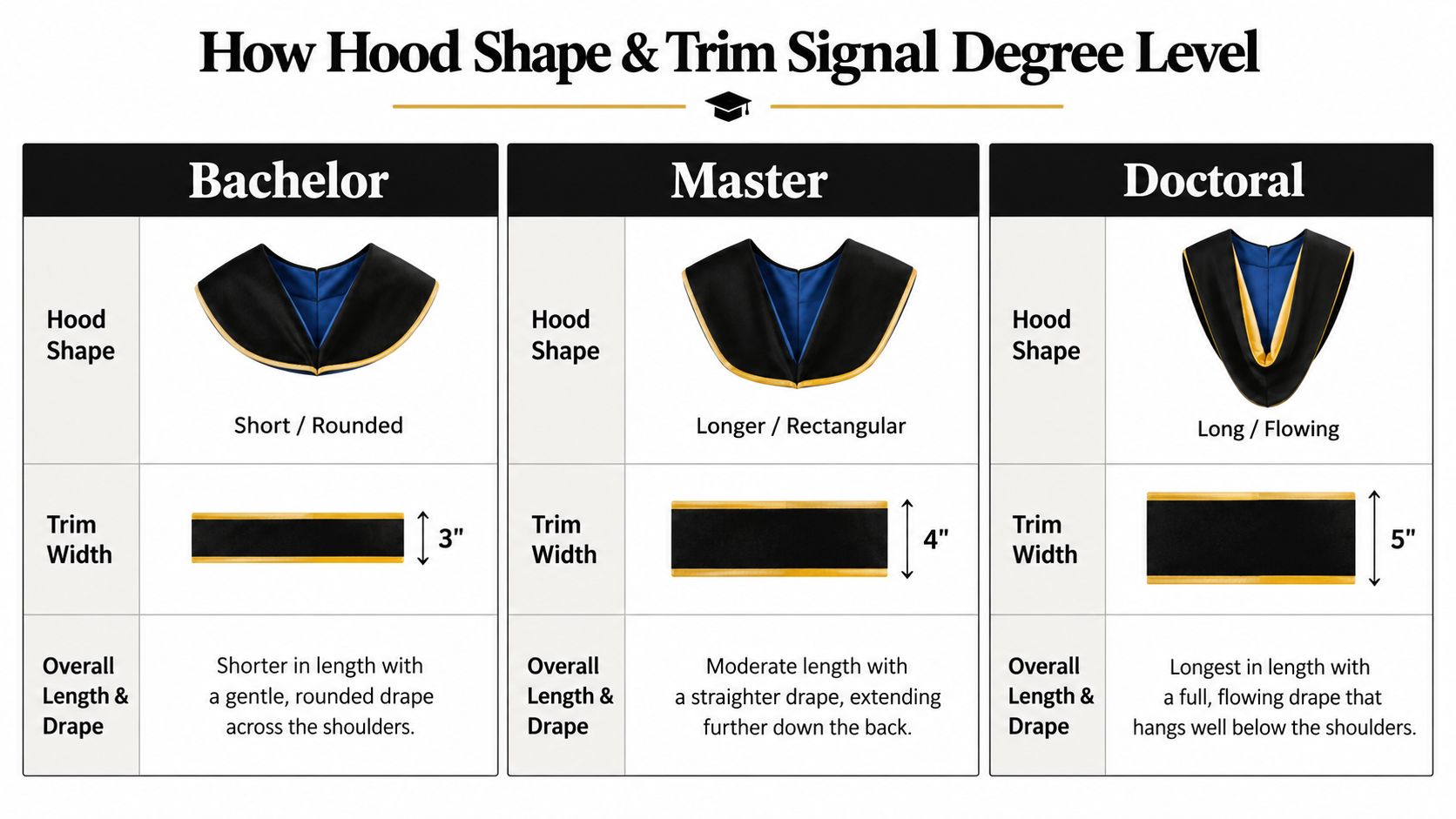
Color identifies the field, but velvet width identifies degree rank. The revised Intercollegiate Code specifies two inches for a bachelor's hood, three inches for a master's hood, and five inches for a doctoral hood. That mechanical distinction works independently of the subject color and school lining. The revised code's construction rules also specify silk or satin for the lining and velvet or velveteen for the trim.
A bachelor's hood has the narrowest velvet treatment. A master's hood uses a wider band, and a doctoral hood uses the broadest. The hood's length and drape can support that reading, but the width rule is the clearest construction clue.
Read shape after width
A shorter, simpler hood generally belongs to bachelor's regalia. Master's hoods extend farther down the back and create a fuller drape. Doctoral hoods are longer and more substantial, with broader velvet that may continue around the neckband and include piping or chevrons depending on institutional design.
The hood communicates the wearer's highest earned degree rather than necessarily describing the program being marched in. That matters when a graduate holds more than one credential or participates in a ceremony with several degree levels represented.
Use the master's degree hood color guide when you're comparing a master's hood with a bachelor's or doctoral design. The color may overlap across levels, but the width and silhouette should not be treated as interchangeable.
A doctoral hood for a PhD, EdD, DMA, JD, or another professional doctorate may therefore share a discipline color with a lower-level degree while remaining visually distinct through construction. Look at the band first, then the length, and only afterward interpret decorative details.
Why School Variations Break Generic Charts
A generic discipline chart can point you in the right direction, but it can't guarantee the hood your university expects. Institutions continue to publish program-specific rules for fields such as law, engineering, public health, nursing, and education, and those instructions may diverge from broad internet summaries. Virginia Tech's hood-color guidance illustrates why local verification matters.
The safest assumption is that the Intercollegiate Code supplies a baseline. Your school may refine the shade, assign a different color to a specialized program, or specify a particular lining arrangement. Some institutions also use multiple chevrons or custom combinations that a simple one-color chart can't explain.
Why lining patterns vary
The 1895 code established the role of institutional lining colors, but it didn't originally define one universal method for combining multiple school colors. Later registry practice allowed patterns such as chevrons and divided fields. The Intercollegiate Registry database documents how institutions receive distinctive lining patterns when they adopt the code.
That history explains why two hoods can use the same field velvet but look different inside. It also explains why a photograph may mislead you. A lining can appear as a single field from one angle and reveal a divided pattern when the hood is turned back.
A color chart is a decoder, not an authorization form.
Before ordering, check the university's official commencement page, graduation packet, registrar email, or graduate-school instructions. If those sources conflict with a retailer's general chart, follow the university's requirements and ask the commencement office to resolve any ambiguity.
You can also use Graduation Attire's university finder as a starting point for locating school-specific regalia options. Treat any catalog match as something to verify against your institution's current instructions, especially when the program has a specialized title or the lining includes more than one color.
Choosing and Ordering the Correct Hood
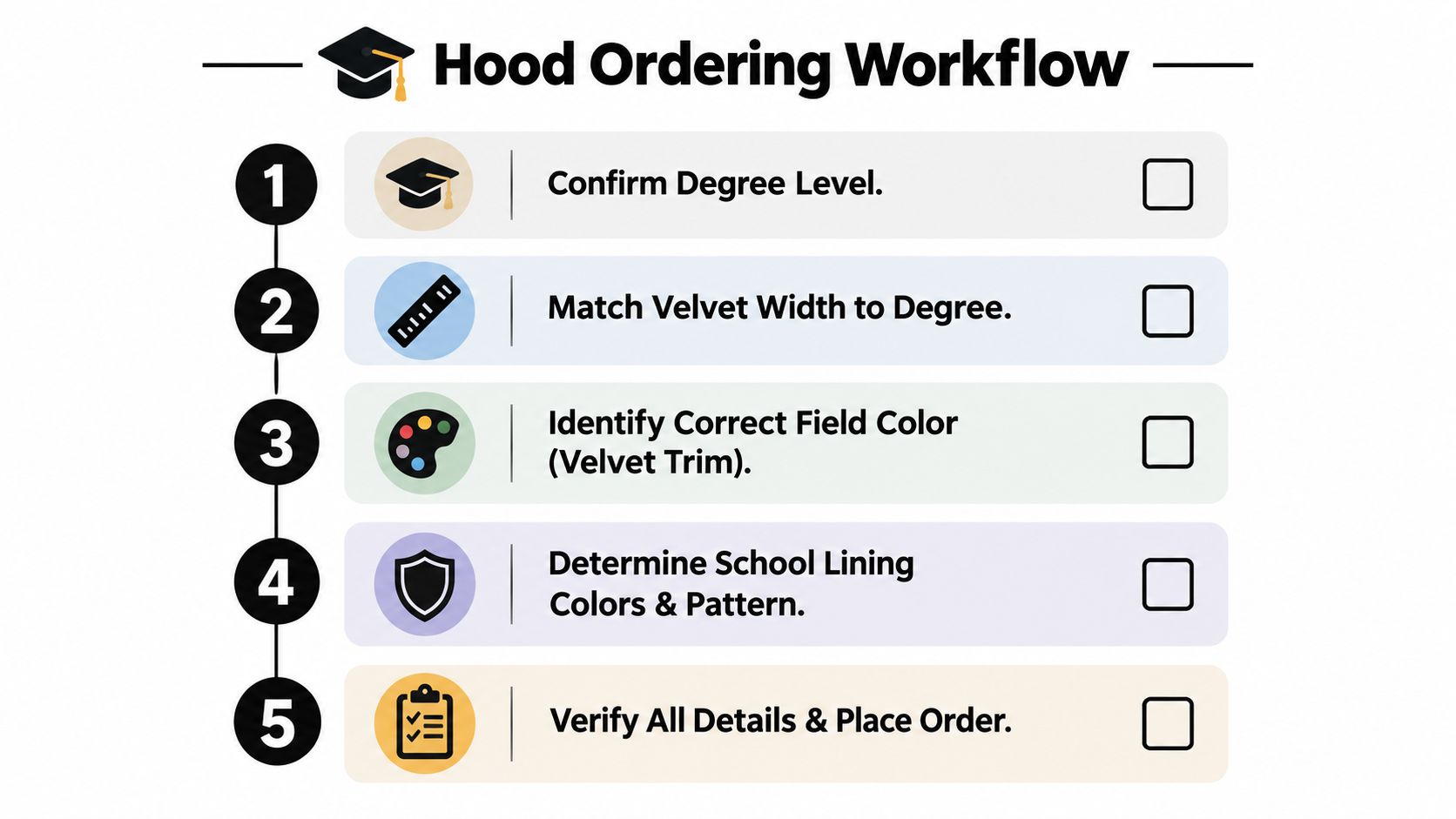
Ordering gets easier when you separate the decision into distinct checks. Don't begin with the color you like in a product photograph. Begin with the credential, then confirm the field, institution, fabric, and fit.
Follow the order of operations
- Confirm the degree level. Identify whether the ceremony recognizes a bachelor's, master's, or doctoral degree. The level determines the hood construction and velvet width.
- Match the velvet width. Use the applicable code specification, two inches for bachelor's, three inches for master's, and five inches for doctoral hoods, then compare it with your university's regalia instructions.
- Identify the field color. Use the discipline chart as a starting point. Education commonly uses light blue, engineering orange, law purple, medicine green, and theology scarlet, but specialized programs need local confirmation.
- Verify the lining. Ask the registrar, graduate school, or commencement office for the official institutional color and pattern. Don't infer it from the gown alone.
- Check fabric and size. Compare matte gabardine with premium satin or another approved material, then use the supplier's length guide to choose a hood that hangs correctly for your height.
- Review the complete set. Confirm whether the tassel color must match a school or degree requirement. If you're ordering a gown, tam, piping, or chevrons separately, keep those details consistent.
The fabric choice changes the visual finish. Matte fabric tends to reduce glare in photographs, while premium satin creates a brighter surface and makes the lining more prominent when the hood is turned back. Neither choice replaces the school's required construction or color specification.
Custom lining patterns need planning before commencement. Build in a lead time of four to six weeks for custom linings, as stated in this academic-regalia ordering guidance. That window gives you time to confirm institutional colors, correct an order, and coordinate the hood with the rest of the set.
A supplier such as Graduation Attire offers academic hoods organized by degree level with customizable colors, along with gowns, caps, tams, tassels, and other regalia accessories. Use those product categories to assemble a coordinated set, but keep your university's written specification as the final authority.
A Quick Reference for Decoding Any Hood
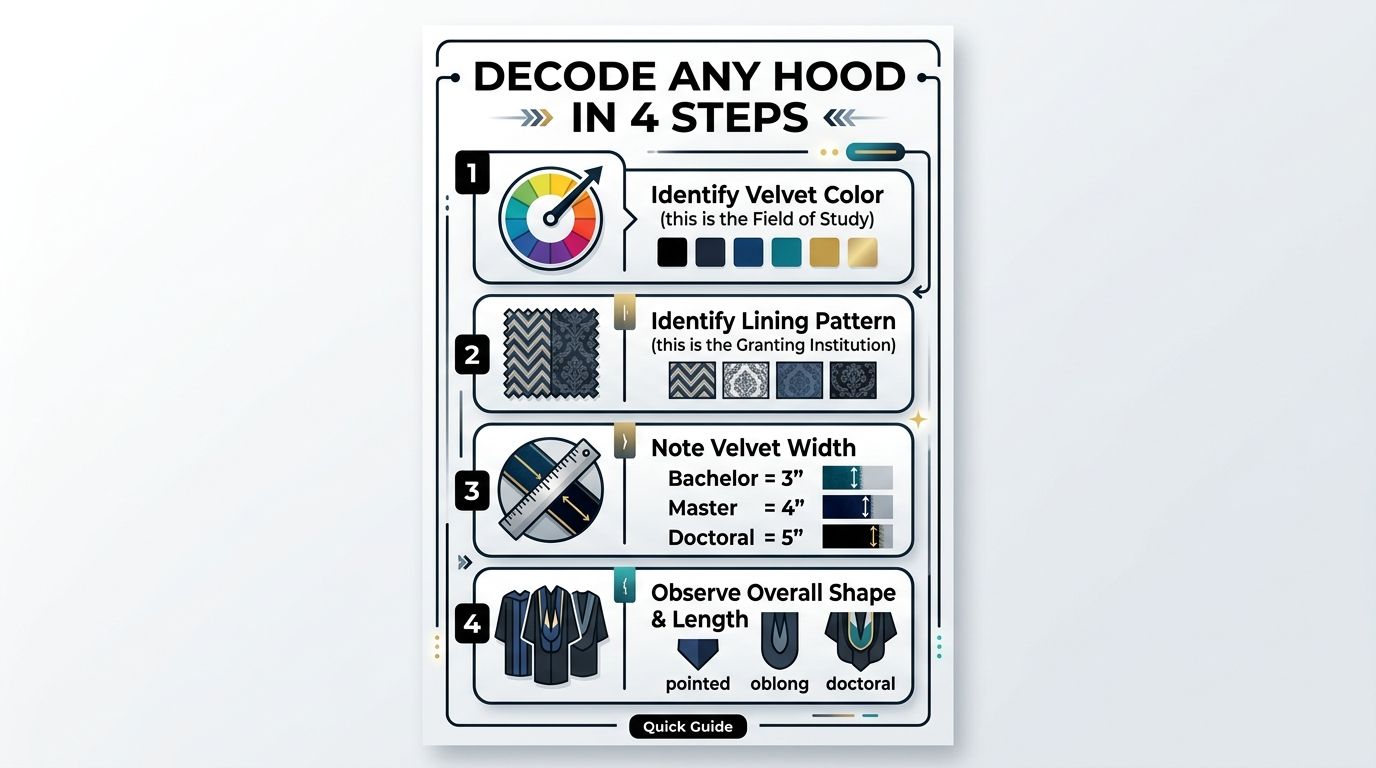
When you see an unfamiliar hood, use four checkpoints:
- Find the velvet color. This usually identifies the academic field.
- Inspect the lining. Its colors and pattern represent the institution that awarded the degree.
- Measure or compare the velvet width. The code uses two inches for bachelor's, three inches for master's, and five inches for doctoral hoods. The academic costume code provides the construction reference.
- Study the silhouette and additions. Hood length, drape, piping, and chevrons may reveal degree level or a local institutional treatment.
If the velvet color seems to fit but the lining looks unfamiliar, the hood may follow a university-specific pattern. If two fields share a similar blue, don't guess from shade alone. Use the school's official commencement instructions to settle the question.
Graduation Attire offers customizable academic hoods and coordinated commencement regalia for bachelor's, master's, and doctoral ceremonies. Visit Graduation Attire to compare hood options, review degree-level choices, and match your order to your university's requirements before commencement day.