

You're standing in front of the mirror in your gown, deciding whether to add a medallion, cords, a stole, or nothing beyond the regalia your school issued. The piece may look like a simple finishing touch, but the important question isn't just whether it matches your gown. It's whether your school or organization recognizes it and permits you to wear it at the ceremony.
Graduation medallions can represent academic honors, program completion, service, or membership. Knowing who awarded yours, what it signifies, and what your commencement rules allow will help you choose something meaningful without risking an awkward request to remove it before you cross the stage.
What a Graduation Medallion Actually Is
A graduation medallion is a medal-like emblem, commonly metal, worn around the neck over academic dress. It's usually attached to a ribbon, though some designs use a chain. In standardized American academic dress, medallions are typically reserved for students who meet defined academic standards, complete an honors program, or belong to an authorized honor or service society, distinguishing them from the rest of the graduating class (academic regalia and honor medals).
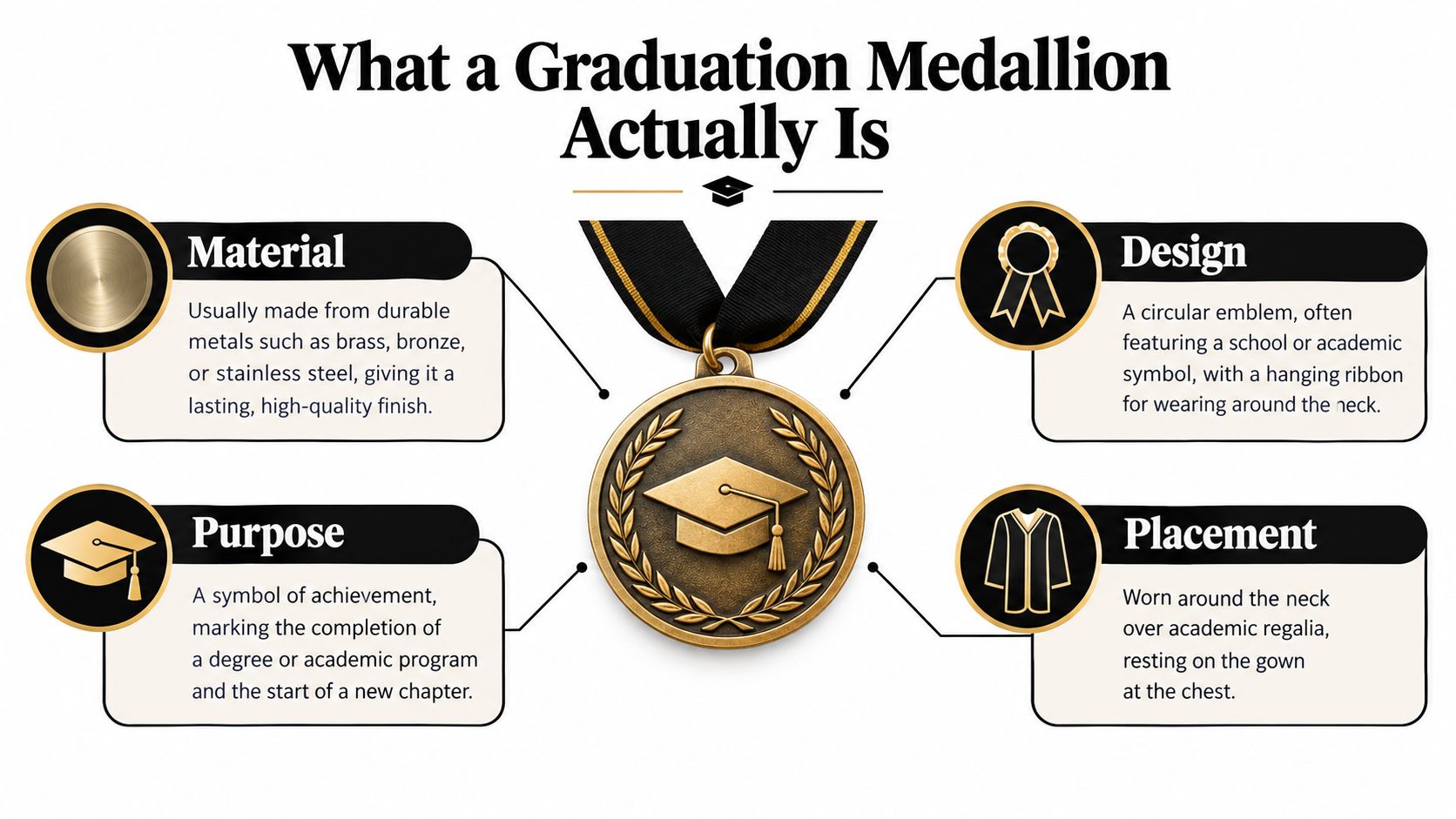
Think of the medallion as doing three jobs. It can identify affiliation, such as membership in an approved society; signal achievement, such as an honors distinction; and preserve the moment as a wearable keepsake. The same-looking medal can mean different things at different schools, so the issuing institution or organization matters as much as the design.
Medallions, cords, and stoles
The difference is partly visual and partly institutional. Honor cords are usually braided strands worn over the gown, while a stole is a broad strip of fabric that can display a school, cultural group, or organization's identity. A medallion hangs at the chest and draws attention to a specific award or affiliation. University guidance may assign these items different meanings, so wearing several adornments doesn't necessarily mean they all communicate distinct honors.
Before buying, ask what recognition the item represents and whether another piece already signals the same thing. A medallion and cord might be allowed together, or the school may designate just one adornment for that award.
Practical rule: Check the ceremony's rules before choosing an item for its color or size.
If you're considering a personal commemorative piece rather than an official award, review the design options for personalized medallions and keep the distinction clear: a custom keepsake isn't automatically approved commencement regalia.
The History Behind the Tradition
Academic regalia has roots in clothing worn at European universities during the 14th and 15th centuries. The garments later became recognizable symbols of academic standing and ceremony. In the United States, universities adopted a shared framework through the Intercollegiate Code of Academic Costume in 1895, helping standardize how academic dress communicates degree and institutional identity.
Medals have their own history as awards, not merely as accessories added to a modern cap-and-gown outfit. Historical university collections preserve a graduation medal awarded to a University of Edinburgh medical graduate in 1845. Vanderbilt University, founded in 1873, has awarded gold medals to first-honors graduates from each of its schools since 1877, only a few years after the university opened (historical university graduation medals).

Why the symbolism still matters
A medallion can make an honor visible during a ceremony, but its meaning doesn't come from metal alone. Institutions use awards to recognize different things, including academic distinction, service, society membership, or a program's completion. In earlier university examples, wearable keys and medals served as tangible forms of recognition alongside other awards.
That history helps explain why schools often control how medallions are designed and worn. A piece may carry a seal or society emblem that represents an institution, not just a graduate's personal style. For more background on how academic dress developed, see this account of the history of the graduation cap and gown.
A well-chosen medallion joins the ceremony's visual tradition while giving the graduate something they can keep. Its lasting value comes from a clear connection to an achievement or affiliation, not from making the outfit more elaborate.
Types and Materials You Will See
Start by identifying what kind of medallion you're shopping for. University-issued medallions are awarded under school rules and often carry an official seal. Society medallions represent an authorized honor, Greek, or service organization. Personal commemorative medallions are purchased as gifts or keepsakes; they may be meaningful, but they don't automatically qualify as approved commencement adornments.
The material affects weight, appearance, and care. Because the supplied university examples don't establish standard material specifications or price ranges, compare vendor descriptions directly rather than assuming a particular metal is universal.
| Material | Look & Finish | Durability | Typical Price |
|---|---|---|---|
| Die-stamped brass | Crisp, defined detail; finish depends on plating or polish | Solid for regular keepsake use; finish can wear with friction | Depends on size, finish, and customization |
| Cast bronze | Substantial, traditional appearance with a warm tone | Robust, though surface finish still needs care | Depends on weight and design |
| Plated alloy | Broad range of colors and finishes, often used for detailed designs | The outer finish may scratch or wear over time | Depends on base metal and plating |
| Sterling silver | Bright, refined appearance | Durable with proper storage; may tarnish and need polishing | Depends on silver content and workmanship |
Size and two-sided design
A university medallion can be much larger than a personal or society piece. Arizona State University describes a six-inch-diameter medallion suspended from a silver rope, with the university seal in gold on one side and silver-and-turquoise circular elements on the reverse (ASU commencement medallion). That institutional example isn't a universal sizing standard. It does show how a large, two-sided design can carry branding and additional visual detail, while requiring a comfortable suspension and careful balance.
For a personal or society piece, ask the maker for the actual diameter and weight, and consider how the medal will sit over the gown and any approved adornments. A supplier's explanation of stainless-steel plaque materials and fabrication can help you understand why metal choice and finish affect the look of engraved pieces, though a plaque and a wearable medallion serve different purposes. Match the material and scale to the occasion, and don't pay for a large ceremonial style if a modest keepsake better suits the graduate.
Who Can Actually Wear One
There isn't a universal rule that lets every graduate wear any medal they buy. Some schools issue medallions for specific awards; others require approval for organization adornments or restrict what appears in the ceremony. That makes legitimacy more important than size, shine, or price.
Oakland University reserves commencement medallions for Presidential Award recipients. Its academic and departmental honors use cords instead, and master's and doctoral recipients don't receive graduation honors or honor cords under that policy (Oakland University commencement policy). A graduate at another institution may encounter different rules, so don't use another school's practice as permission for your own ceremony.

Make these checks before you buy
- Confirm the award: Is it issued by the university, awarded by an approved organization, or a personal commemorative item?
- Ask who grants permission: Check the registrar, commencement office, or the office that oversees student organizations.
- Check ceremony-specific rules: Undergraduate, graduate, doctoral, and high-school ceremonies may follow different policies.
- Ask about deadlines and listings: Some schools require prior design approval or require the award to appear in the commencement program.
- Verify eligibility: If it's an official honor, confirm the criteria and who checks that recipients qualify.
Kansas State, for example, requires prior approval for organizational cords, stoles, and medallions, limits an organization to one adornment type, and sets submission deadlines. The University of Richmond also requires approval for distinctive adornments and says approved items must appear in the commencement program. These rules illustrate why a medallion that looks appropriate may still be unauthorized.
Appearance can't establish permission. Get approval from the office responsible for commencement before placing an order.
A useful comparison is how schools distinguish medallions from graduation cords and their meanings. If you're unsure whether an item is an official award or a personal memento, describe it to the commencement office and ask for a written answer.
Customization, Sizing, and How to Wear It
A personal medallion can carry details that make it recognizable years later: a school or society name, an emblem, a recipient's name, or the graduation year. Decide what needs to be legible from the audience and what can be reserved for close inspection. Large symbols and strong color contrast are easier to recognize from a distance than fine engraving.

Set the design around the wearer
Choose a ribbon color that works with the gown but doesn't disguise an official organization color if the award requires one. A two-sided design can place a school or society emblem on one face and a name, date, or recipient-specific inscription on the other. Enamel accents can make a crest more distinct, while a simpler metal finish may suit a formal institutional award.
Sizing shouldn't be guessed from the degree level alone. Ask the supplier for the medal's dimensions and weight, then check how it sits over the actual gown. A larger piece may be visible in photos but can feel heavy or compete with a stole, hood, or cords. If the graduate will wear several approved items, lay them out together and check whether the ribbon catches or the medal hides another emblem.
Choose an attachment that sits securely
A neck ribbon is straightforward and visible, while a chain may feel more like a personal keepsake. Pins and detachable clips can work for display or clothing, but they aren't substitutes for an approved neck-worn award. Check whether the medal rests over the gown without slipping beneath a hood or tangling in cords.
For families choosing a graduation gift, a graduation gift guide for him can help you compare keepsakes beyond jewelry. The best choice is one the graduate can wear comfortably and keep safely after the ceremony.
The video below offers a visual reference for graduation medallions and how they appear with academic regalia.
Ordering Tips for Individuals and Bulk Buyers
Suppose an honor society is arranging its first medallion order. Before comparing vendors, its coordinator should confirm the school permits the design and that recipients meet the society's eligibility rules. Then the group can settle the emblem, metal finish, ribbon color, engraving, and delivery plan without risking a box of unusable accessories.
University approval can affect the calendar. Utah State University requires new or changed adornment designs to be submitted at least 60 days before commencement. SUNY Downstate assigns funding responsibility to the sponsoring program, honor society, office, or organization, and prohibits student activity fees from paying for these accessories (adornment guidelines and funding responsibilities).
Coordinate the order, not just the artwork
Once approval and funding are clear, ask the vendor for a written specification and proof. Confirm the final dimensions, material, finish, ribbon attachment, engraving, packaging, delivery date, and the process for correcting a production error. A proof matters because a wrong year or unclear emblem can turn a carefully planned award into a disappointing keepsake.
For an organization order, confirm who will verify the recipient list and who will distribute the pieces. Keep a record of the approved design and the final recipient list so the next coordinator can reorder consistently. If the school has a deadline, work backward from it and leave time for review and delivery rather than relying on a rushed final order.
Individual buyers often have a simpler choice. An in-stock medal may work when timing is tight and the design fits the occasion, while custom work makes more sense when the engraving or emblem is central to the gift. In either case, ask whether the item is meant for ceremony wear or display, and make sure the buyer understands that a purchase doesn't replace institutional approval.
Care, Storage, and Passing It Down
A medallion often outlasts the gown, but the ribbon and finish need sensible care. After the ceremony, wipe the metal gently with a soft, dry cloth. Let a damp ribbon air-dry fully before storage, and avoid leaving the piece in a hot car or pressing it under heavy objects.
A simple keepsake routine
- Before the ceremony: Check the attachment, smooth the ribbon, and keep the medal in a protective pouch until it's time to dress.
- After wearing: Wipe away fingerprints and let the ribbon dry completely.
- For storage: Keep the medal in a divided jewelry box or anti-tarnish pouch, with the ribbon protected from snags.
- For display: Use a shadow box or a stand that supports the medal without bending the ribbon.
The material and finish determine how much polishing a piece needs. Don't use an abrasive cleaner on plated surfaces or enamel details unless the maker says it's safe. A jeweler can assess a loose jump ring or damaged attachment; replacing a frayed ribbon is usually better than trying to repair it with an improvised fastener.
Medallion designs can differ widely. Texas State University awards a crystal graduation medallion to honors graduates, while Ball State issues bronze medallions with red-and-white ribbons to Honors College graduates who achieve a cumulative GPA of 3.33 or higher (Ball State honors recognition). That variation is one reason to preserve the story alongside the object: note who awarded it and what recognition it represented. A shadow box display guide can help you plan a display that protects both medal and ribbon.
Common Questions Buyers Ask First
Can I wear a medallion my university didn't issue? Only if the school's policy allows it or the appropriate office approves it. Lewis & Clark College describes medallions as academic symbols for achievements recognized by the college and listed in the official commencement program. Mississippi University for Women says graduates may be required to remove unauthorized items before the ceremony (commencement regalia and attire policies).
Can I wear more than one? Policies differ. Utah State permits graduates to wear more than one medallion, but its adornments still require formal approval. Ask your commencement office rather than assuming another university's allowance applies to your ceremony.
What if approval comes late? Don't wear the item until the office confirms it's permitted. Ask whether the award can be listed in the program or recognized another way.
How can I tell an official medallion from a decorative one? Check the issuing organization, the stated eligibility criteria, and whether the award appears in official ceremony materials.
Is a personalized medallion a suitable gift? Yes, if the design is accurate and the recipient can keep or display it. A name, school or organization, and graduation year can help preserve its meaning.
Graduation Attire offers caps, gowns, academic regalia, and accessories including medals, honor cords, and diploma keepsakes for graduates and schools. Before ordering, confirm your ceremony's adornment rules, then visit Graduation Attire to explore regalia and graduation accessories.