

At commencement, a graduate adjusts a black gown, steadies a square cap, and walks toward the stage as applause rises. That familiar outfit carries a story from medieval European universities through American standardization and into today's choices about degree level, color, fabric, and personal identity.
Walking Across the Stage in a Twelve-Hundred-Year-Old Outfit
A graduate steps toward the stage, adjusts a square cap, and crosses the room in clothing shaped by centuries of academic tradition. Modern graduation attire traces to the first European universities formed in the 1100s and 1200s, when scholars commonly wore long gowns and hoods for warmth and as signs of status. The Congressional Research Service history of academic dress documents how this European custom later entered American academic life.
The gown, hood, and cap did not begin as a coordinated costume. Each grew from older clothing. The gown belonged to the world of clerks and scholars, the hood covered the head and neck in cold buildings, and the cap developed from clerical headwear. Universities associated with Bologna, Paris, and Oxford adapted these garments for their own scholarly communities, keeping practical features while assigning them institutional meaning.
That history still affects a purchase today. A gown is more than a black outer layer chosen for appearance. Its cut can indicate whether the wearer has earned a bachelor's, master's, or doctoral degree. A hood is more than fabric resting on the shoulders. Its velvet facing points to a field of study, while its lining can identify the institution.
The useful idea: Academic regalia is a visual language. The shape tells one part of the story, and the colors tell another.
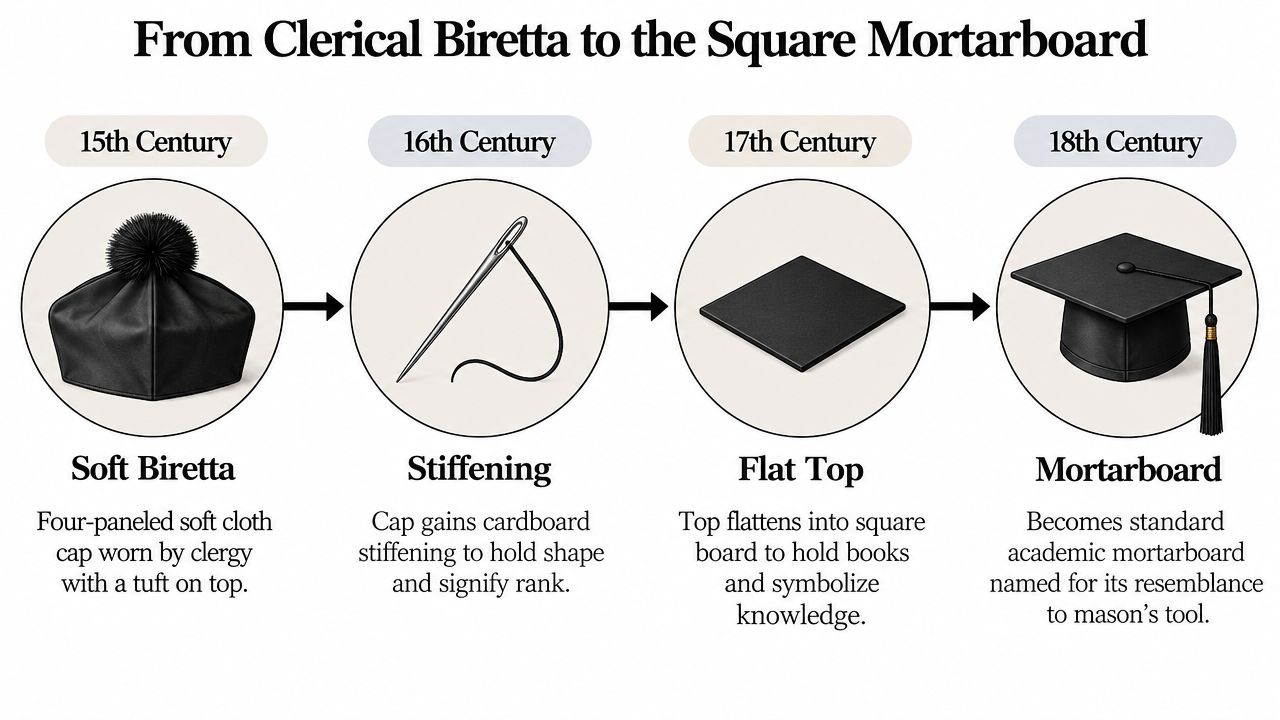
The square mortarboard carries its own layered history. Its form is generally traced to the 15th century, when academic headwear developed from clerical styles such as the biretta. Later changes made the cap firmer and flatter, producing the recognizable board worn at commencements. Its shape creates a ceremonial outline and gives the tassel a steady central point.
American universities eventually needed a shared system. Before the major code, institutions could follow different local customs. In 1895, the American Intercollegiate Commission established a uniform code for academic costume, helping turn a varied European tradition into a recognizable graduation uniform across major American institutions.
For a modern graduate, the story offers a fitting guide. The medieval gown explains the basic silhouette, the biretta helps explain the mortarboard, and standardization clarifies why sleeves and hoods follow familiar patterns. Degree level affects the cap and gown style, while trim colors and hood linings help match the regalia to the field and institution. History becomes practical at checkout: use it to order the right pieces rather than treating every black gown as interchangeable.
Medieval Roots of Academic Dress in Europe's First Universities
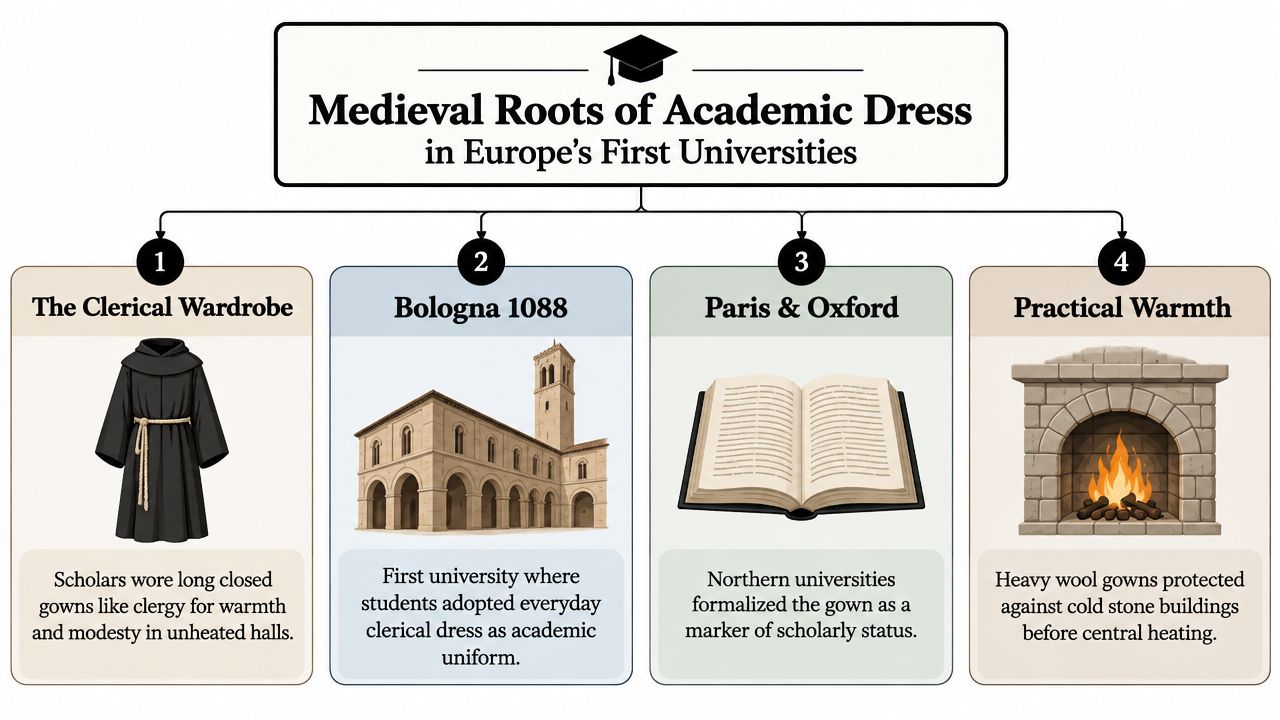
Medieval academic dress grew from clothing people already recognized. In Europe's early universities, scholars often dressed like clerks because universities developed closely alongside cathedral schools and religious institutions. The garments communicated modesty, learning, and membership in a community whose leaders were frequently connected to the clergy.
The gown solved a practical problem
Start with the gown, a long outer garment that covered much of the body. Medieval university halls were often cold, and scholars spent long periods studying in buildings without modern heating. A heavy gown offered warmth, much as a long winter coat does today, though its meaning went beyond insulation.
The gown also created a sober silhouette. Religious and civic rules often discouraged excessive display, and academic communities adopted clothing that placed learning above fashion. Black and other restrained colors became associated with serious academic presentation, though historical clothing wasn't perfectly identical everywhere.
The hood framed the scholar
The hood began as a useful covering for the head and neck. Think of it as a medieval combination of a scarf and a collar, attached to the gown rather than wrapped separately. A scholar could pull it up during a lecture or wear it resting behind the shoulders.
Over time, the hood became a visible marker of academic identity. Its size, fabric, and trim could help distinguish status and institutional custom. Modern hoods still preserve that basic idea. They sit around the neck, fall down the back, and display colors that can identify the degree field and school.
The biretta supplied the headwear pattern
The biretta was a soft clerical cap with a structured, paneled form. A useful modern comparison is a soft four-paneled beret, although the historical shapes changed across time and place. Clergy wore related headwear to signal office and learning, and universities drew on that visual association.
The connection wasn't accidental. In medieval Europe, scholarship and religious life were closely connected, so clerical-style dress gave academic communities a recognized language of authority. A student or scholar wearing these garments appeared as part of a learned institution rather than as a private reader.
Three garments became one tradition
The gown, hood, and soft cap formed the foundation for later academic regalia. Their original purposes differed, but each garment acquired symbolic weight as universities matured. The plain-language guide to academic regalia helps translate those historical parts into the modern set of gown, cap, tassel, and hood.
For a graduate choosing attire, this foundation explains why the pieces still appear together. The gown provides the main body of the uniform, the hood adds degree and institution signals, and the cap completes the scholarly outline. The modern ceremony looks efficient, but its components retain the logic of medieval academic dress.
From Clerical Biretta to the Square Mortarboard
The mortarboard didn't appear as a finished modern object. Its history is a gradual change from soft clerical headwear to a firm academic symbol. The transformation is generally associated with the period from the 15th through the 18th centuries, when the biretta's panels became more structured and the top developed a flatter, more angular form. The history of graduation caps and gowns from Herff Jones traces this broader transition from clerical origins to commencement wear.
Soft cloth became a stable board
A soft cap can collapse, wrinkle, or lose its shape. A stiffer cap presents a clearer outline and stays recognizable during a formal gathering. As academic headwear became more structured, the square top created a stable surface for the tassel and made the cap easier to identify from a distance.
The flat top also works as a simple piece of design engineering. It distributes the cap's structure across a broad surface instead of concentrating it in a rounded crown. That doesn't mean medieval scholars designed the mortarboard through modern technical testing. It does mean the shape offered practical advantages as academic ceremonies and formal portraits became more important.
The square outline became a visual sign of education. A round or soft cap could look like ordinary headwear, while the angular board announced that the wearer belonged to an academic setting. The design made the cap legible even when the crowd was large or the graduate was viewed from behind.
Why the name sounds like masonry
The British term mortarboard comes from the cap's resemblance to the square tool used by masons to hold mortar. The nickname endured because the shape was so distinctive. Its association with building also lends the cap an accidental metaphor. Graduates have built knowledge over years of study, and the cap resembles a small board carried above that achievement.
This is why the mortarboard should be understood as more than a decorative fashion. It represents the moment when earlier clerical clothing became a specialized academic form. The soft biretta supplied the ancestry, while stiffening and flattening supplied the recognizable modern profile.
The cap's history also clarifies a common purchasing mistake. A graduate may focus on color or decoration first, but the correct cap form begins with the degree and ceremony requirements. A standard mortarboard fits many bachelor's and master's ceremonies, while advanced regalia may call for a different headwear style.
The 1895 Intercollegiate Code That Standardized the Gown
By the late nineteenth century, an American commencement could look familiar without being easy to interpret. Colleges had inherited European academic traditions, yet their gowns varied in cut, sleeve shape, and color. A crowd of graduates clearly belonged to academic life, but the clothing did not always explain what each person had earned.
The American Intercollegiate Commission brought those practices into a shared system through the Intercollegiate Code established in 1895. The code became a major standardization milestone, turning separate institutional habits into a common American vocabulary for academic dress. That choice still shapes what shoppers see in a graduation gown today.
Sleeves became degree shorthand
The code assigned information to sleeve construction. A bachelor's gown uses pointed long sleeves. A master's gown uses long closed sleeves. A doctoral gown uses round open sleeves. The silhouette lets spectators identify degree level without stopping to ask.
The system works like visual punctuation. A bachelor's sleeve points downward, a master's sleeve hangs in a more closed form, and a doctoral sleeve opens into a fuller shape. Doctoral gowns also include velvet elements that create another visible distinction. A historical overview of graduation traditions and academic costume explains how robe construction became part of degree signaling.
That history gives shoppers a practical starting point. A gown chosen only for its color may still have the wrong construction. Degree level determines the gown's basic cut before personal preference enters the decision.
Standardization allowed room for identity
The code created a framework rather than erasing every school tradition. Gown cut and sleeve form could identify the degree, while the hood lining and related details could represent the institution granting it. Academic dress became understandable across universities while preserving local identity.
The code also set conventions for caps and tassels. Bachelor's, master's, and doctoral graduates use a mortarboard or trencher cap with a tassel. Under the revised Intercollegiate Code, a master's tassel is always black, a bachelor's tassel may use the faculty color, and a doctoral tassel may be black or made with metallic gold thread.
Shopping rule: Select the degree-level gown first. Then verify the hood, trim, tassel, and institutional colors against the school's requirements.
That sequence prevents a common mismatch. Each part carries a separate message: sleeve shape identifies degree level, hood trim points toward discipline, and lining connects the regalia to the institution. Before ordering, match those structural details to the ceremony instructions, then choose the approved color and finish.
Mortarboards, Tams, and Beefeaters by Degree Level
Academic headwear becomes easier to choose when the forms are compared directly. The mortarboard is the familiar square cap, while the tam and Tudor bonnet offer softer, more elaborate silhouettes associated with advanced degrees.
| Cap Style | Degree Level | Shape & Material | Tassel Cue | Best For |
|---|---|---|---|---|
| Mortarboard | Bachelor's and many master's ceremonies | Firm square cap, commonly covered in fabric | Confirm the approved color and placement with the institution | Standard commencement attire |
| Tam | Often used with doctoral regalia and some advanced academic dress | Soft, rounded or multi-sided cap, commonly velvet | May include an attached tassel or use a separate tassel | Doctoral and formal advanced-degree ceremonies |
| Tudor bonnet, sometimes called a beefeater | Doctoral regalia | Soft velvet bonnet with a fuller ceremonial profile | Follow the school's doctoral regalia instructions | Traditional doctoral presentation |
The mortarboard is the familiar default
A bachelor's candidate usually expects a mortarboard. Its square profile makes it the clearest continuation of the cap described in the history of the graduation tam and advanced academic headwear. Master's candidates may also wear a mortarboard, depending on institutional practice.
The cap should sit securely and level rather than tilt dramatically backward. The elastic or fitted portion belongs at the back, and the tassel attaches to the button at the center. Commencement staff may give specific instructions, so the ceremony handbook remains the final authority.
Tams and bonnets mark advanced ceremony
A tam is softer than a mortarboard and often made with velvet. Its rounded or multi-sided form gives doctoral regalia a different visual weight. The Tudor bonnet, sometimes nicknamed the beefeater, is another doctoral style with a fuller, historic profile.
These forms aren't interchangeable decorations. The degree level and university tradition determine whether a graduate should wear a mortarboard, tam, or bonnet. A doctoral candidate who orders a standard cap because it looks familiar may end up with an outfit that doesn't match the hood or gown.
Tassel placement also carries ceremony-day meaning. In many American ceremonies, graduates begin with the tassel on the right and move it to the left when degrees are conferred. Color may echo the faculty or field, but the institution's instructions take priority, especially for graduate and doctoral candidates.
Before ordering, compare the cap style with the degree-level gown. Matching a doctoral tam to a bachelor's gown, or pairing a doctoral bonnet with the wrong hood, can make the historical language of the outfit difficult to read.
Reading the Color Language of Hoods and Velvet Trim
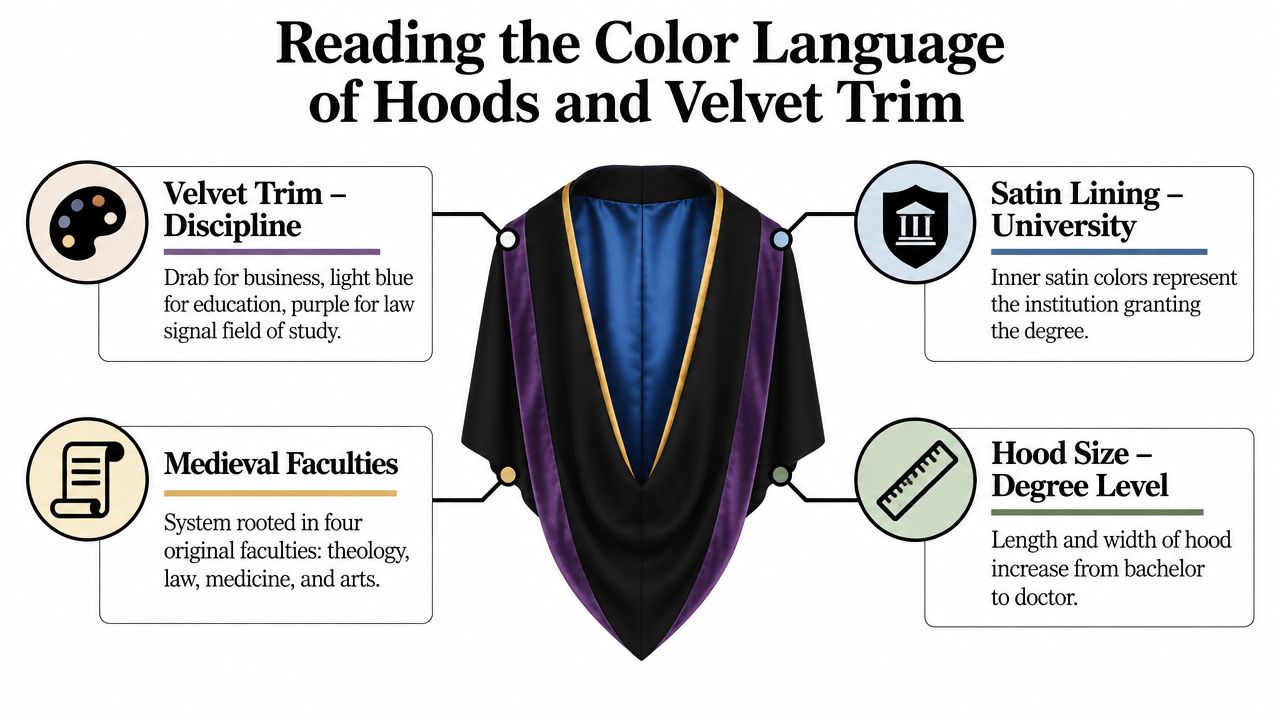
The hood is the most information-rich part of many academic outfits. Its history reaches back to the medieval practice of wearing a hood for warmth, but modern academic dress uses the hood as a carefully organized signal. The velvet trim generally indicates the academic discipline, while the satin lining represents the institution.
Read the hood in three parts
Begin with the outer velvet facing. Academic costume traditions assign colors to fields so viewers can identify a graduate's area of study. Common examples include drab for business, light blue for education, golden yellow for science, dark blue for philosophy, and green for medicine. Other fields use their own designated colors within the academic palette.
The color isn't a personal preference in the same way as choosing a favorite shirt. A graduate earning an education degree may need light blue trim, while a graduate in medicine may need green. The exact institutional interpretation should be checked before purchase because schools can publish specific requirements.
Next, inspect the satin lining. The lining displays the colors of the institution granting the degree. That means two graduates can wear similar black gowns and discipline colors yet show different school identities through the inner hood.
Finally, consider the hood's size and shape. Degree level affects the hood's proportions, with more advanced regalia using a fuller, more substantial hood. The hood should sit properly around the neck, point forward, and fall evenly down the back.
The color system preserves old academic categories
The palette reflects older divisions of scholarly work, including theology, law, medicine, and the arts. Modern disciplines expanded far beyond those original faculties, but the principle remains recognizable. Academic communities use color to make expertise visible.
This system is especially useful in a graduation photograph. The black gown creates a common background, and the hood trim supplies the field-specific detail. The lining adds institutional contrast. A viewer who knows the code can read several layers of information at once.
Before you buy: Confirm the field color, lining colors, hood length, and degree level together. A correct trim with the wrong hood size is still an incomplete match.
The practical lesson is simple. Don't choose a hood because its color looks attractive in a product image. Cross-reference the university's regalia guide, then confirm that the velvet trim matches the degree being earned. The guide to graduation hood colors and their meaning offers a useful starting point for interpreting the system.
How Regalia Is Changing in the Age of Identity and Sustainability
Academic dress has never been frozen. Medieval scholars adapted clerical garments for cold university halls, and American institutions later adapted European customs into a shared code. Today's graduates are continuing that pattern by asking how regalia can express identity, reduce waste, and remain affordable.
Polyester remains a dominant material because it helps keep regalia affordable. At the same time, industry coverage describes growing interest in recycled fabrics and custom designs that reflect institutional or personal identity, as discussed in recent coverage of graduation gown and cap trends. The result is a tension between cost, durability, environmental preferences, and ceremony expectations.
Personal expression sits on a standardized base
The gown still provides the common silhouette, but graduates can add meaning through accessories. Stoles, cords, and sashes allow students to recognize cultural heritage, military service, first-generation status, nursing, LGBTQ identity, international background, or membership in a student organization.
A Kente stole, a First Nations item, or military insignia can place a graduate's personal history alongside the academic tradition. These additions don't necessarily reject uniformity. They show how a standardized garment can create a backdrop for individual achievement.
Designers are also experimenting with gender-neutral gowns, adjustable caps, and custom medallions. Such changes address comfort and self-expression while preserving the ceremony's recognizable visual structure. The tradition changes at its edges first, then gradually changes what audiences expect from the whole outfit.
Sustainability adds a new historical chapter
The environmental question changes how people think about ownership. A graduate may compare a rental polyester gown with an eco-friendly option made from recycled fibers. Another may prioritize a durable garment that can be reused, shared, or kept as a family memory.
Neither choice has one universal answer. The right decision depends on the ceremony's rules, budget, fit, and the buyer's values. What matters is that shoppers now treat material as part of the meaning of regalia rather than an invisible technical detail.
The history of graduation cap and gown therefore has a living ending. Medieval clothing became academic dress, academic dress became a standardized American language, and modern graduates are adding sustainability and identity to that language. Regalia remains formal, but it isn't a museum costume.
Using the History to Choose Your Own Regalia Today
History gives you a reliable buying sequence. Instead of selecting a cap and gown by appearance alone, use the same signals that academic communities have developed over centuries.
Start with the degree level
Confirm whether the ceremony is for an associate, bachelor's, master's, or doctoral degree. Degree level affects the gown cut, sleeve architecture, hood proportions, and cap style. A bachelor's gown generally uses pointed long sleeves, a master's gown uses long closed sleeves, and doctoral regalia uses round open sleeves, as established by the American academic costume tradition.
Then check the headwear. A mortarboard may suit bachelor's or master's regalia, while a doctoral ceremony may require a tam or Tudor bonnet. The institution's instructions should settle any uncertainty.
Match the academic field and institution
Identify the discipline before choosing hood trim. Business commonly uses drab, education uses light blue, science uses golden yellow, philosophy uses dark blue, and medicine uses green. Verify the exact color with the school because a field label alone doesn't guarantee that every institution presents it in precisely the same way.
Check the hood lining next. It should represent the institution granting the degree. Many otherwise careful orders go wrong. A hood can have the right field trim but the wrong school colors.
Choose material and accessories with purpose
Compare standard polyester with recycled-fabric options if both meet the ceremony's requirements. Consider how often the garment will be worn, whether it needs to travel, and whether you want to preserve it after commencement.
Accessories can add meaning without changing the gown's academic structure. Look at stoles, honor cords, diploma covers, medals, garment bags, and tassel charms. If you're choosing a meaningful keepsake for a graduate rather than regalia itself, graduation presents for him offers ideas centered on a milestone that extends beyond the ceremony.
Leave time for a proper check
Use a fitting timeline that gives you two to four weeks before commencement to verify size, color, degree level, and delivery. Try on the gown with the hood and cap together. Check that the sleeves fall correctly, the hood sits evenly, and the cap stays level.
Before finalizing the order, gather the school's ceremony guide, degree information, field color, institutional colors, and required accessories. That small preparation turns centuries of academic history into a straightforward modern decision.
Graduation Attire offers caps, gowns, hoods, tams, beefeaters, tassels, stoles, cords, and other regalia for students across degree levels, with guides that help match color, fit, and ceremony requirements. Visit Graduation Attire to use the school finder and regalia selection tools, then choose an outfit that connects the history of academic dress with your own graduation day.