

Staring at a list of high school graduation requirements can feel like trying to decipher a secret code. Let's be honest, it’s a lot of information. But once you understand the logic behind it, it’s much simpler than it looks. These requirements are the blueprint for your diploma—a clear, structured plan to make sure you have a solid foundation for whatever comes next, whether that’s college, a career, or military service.
Think of it as the ultimate checklist for your future.
What Are High school Graduation Requirements Anyway?
Crossing the stage in your graduation cap and gown is a massive milestone, but what does it actually take to earn that moment? High school graduation requirements aren't just a random set of hurdles to jump over. They are a carefully designed set of academic and performance standards put in place by your state and local school district.
Imagine you're building a house. You can't just start throwing up walls wherever you feel like it. You need a solid foundation, sturdy framing, and the right electrical wiring before you can even think about paint colors. Your high school diploma works the same way.

The Blueprint for Your Diploma
This academic blueprint is designed to ensure every single student leaves with a baseline of essential knowledge and skills. It’s usually broken down into a few key parts that all work together to create a well-rounded education.
- Core Subject Credits: This is the concrete foundation of your academic house. We're talking about the essentials: English, math, science, and social studies.
- Elective Credits: Think of these as the custom features that make the house yours. Electives let you explore your interests, whether that's art, music, coding, or career tech.
- Statewide Testing: This is the final inspection. Standardized tests or other assessments confirm that everything is "up to code" and you've mastered the necessary material to move forward.
- Other Local Requirements: Some districts might add a few extra elements, like physical education, health, or even a financial literacy course to round things out.
Once you see this structure, the whole process becomes much less intimidating. Every requirement is there for a reason—to prepare you for the challenges and opportunities that lie ahead.
To give you a clearer picture, here's a quick look at what's typically expected across the U.S. Keep in mind that your local district will have the final say, but this table provides a solid starting point.
Typical High School Graduation Requirements at a Glance
| Requirement Category | Common Mandate (Varies by State) | Purpose |
|---|---|---|
| English/Language Arts | 4 credits (four full years) | To develop critical reading, writing, and communication skills essential for any career or college path. |
| Mathematics | 3-4 credits (including Algebra I & Geometry) | To build foundational problem-solving and logical reasoning abilities. |
| Science | 3 credits (often including a lab science like Biology) | To foster scientific literacy and an understanding of the natural world. |
| Social Studies/History | 3 credits (U.S. History, Government, World History) | To create informed citizens with a grasp of historical context and civic responsibility. |
| Electives | 4-8 credits (Varies widely) | To allow students to explore personal interests, career pathways, and fine arts. |
| Statewide Exams | Pass specific End-of-Course exams or meet a competency score on the SAT/ACT. | To ensure a consistent standard of academic achievement across the state. |
This framework is your roadmap. By understanding each piece—from core credits to final exams—you can navigate your four years with a clear sense of direction, making sure you're on track to celebrate that final, well-earned walk across the graduation stage.
Why These Requirements Evolve
High school graduation requirements aren’t set in stone. They change over time to keep up with the demands of the modern workforce and higher education. These evolving standards have a direct impact on student success.
Over the years, requirements have become more rigorous, which has directly influenced the number of students earning their diplomas. As of the 2022-2023 academic year, a record-breaking 3,369,380 students graduated from high school, with an adjusted cohort graduation rate of 85.3% for public schools.
This reflects stricter standards, as most states now mandate at least 20-24 credits, including four years of English and three to four years of math. You can explore more about high school completion rates and see how these trends impact student outcomes.
The goal isn't just to hand you a piece of paper. It's to ensure that paper represents a meaningful level of achievement and readiness for your next chapter, whatever that may be.
Building Your Academic Foundation with Core Credits
Core subject credits are the absolute bedrock of a high school diploma. They represent the essential knowledge that prepares you for whatever comes next, whether that’s college, a trade school, or heading straight into the workforce. Think of these courses as the load-bearing walls of your academic house—they provide the strength and structure for everything else you build on top.
These requirements aren't just about memorizing facts for a test; they’re designed to forge your ability to think critically, solve problems, and communicate clearly. Mastering these subjects ensures you have a versatile skill set that will serve you for the rest of your life.

English Language Arts The Power of Communication
Four years of English might sound like a lot, but it's arguably one of the most practical requirements you'll face. Every single English class, from analyzing literature to sweating over a research paper, sharpens your ability to think critically and express yourself with clarity.
These skills are indispensable. You'll lean on them when you write a resume, present an idea at work, or even just try to make sense of a complex news article. It’s no surprise that strong communication is consistently one of the top skills employers hunt for.
By the time you graduate, you won't just know how to write an essay—you'll know how to build a convincing argument, a skill that opens doors in every single field.
Mathematics The Language of Logic
Math requirements, which usually include courses like Algebra and Geometry, are about so much more than just crunching numbers. They teach you a systematic, logical approach to breaking down and solving problems. Each formula you learn and proof you complete trains your brain to think in a clear, sequential way.
This is the kind of thinking you'll need for everything from managing a personal budget to understanding data in a business report. While a strong math foundation is completely non-negotiable for students eyeing STEM fields, its practical applications truly benefit everyone.
- Algebra I & II: Teaches abstract reasoning and how to solve for unknown variables—a key skill in planning and forecasting.
- Geometry: Develops spatial reasoning and logical deduction, which is incredibly valuable in design, engineering, and even everyday problem-solving.
- Statistics: Provides tools to interpret data and understand probability, helping you make more informed decisions in a world full of information.
Science Understanding the World Around You
Science courses like Biology, Chemistry, and Physics are your window into how the world actually works. Lab requirements are especially critical because they teach you the scientific method in action—how to form a hypothesis, test it, and draw conclusions based on real evidence.
This process builds analytical skills that are crucial for making informed health decisions, understanding environmental issues, and adapting to new technologies. It’s about learning to ask why and then knowing how to find a credible answer. High school science requirements are designed to create scientifically literate citizens who can navigate an increasingly complex world.
Social Studies Creating Informed Citizens
Social studies, which covers everything from U.S. History and World History to Government, provides the essential context for the world you live in. These classes help you understand how societies are built, how governments function, and how events from the past ripple into our present.
Learning about civics, for example, prepares you to be an engaged and responsible citizen. Understanding different cultures and historical perspectives fosters empathy and a more global viewpoint. These subjects are truly foundational for participating in a complex, interconnected world.
State-level high school graduation requirements reflect a commitment to ensuring every graduate has this foundational knowledge. The US proudly reports that 91.4% of adults aged 25 and older hold at least a high school diploma, but the path to get there is always evolving. States like Illinois and California now mandate FAFSA completion for graduation, while others require exit exams or resume-building exercises, all with the goal of preparing students for what's next. You can learn more about how educational attainment is measured by exploring these statistics on educationdata.org. Each core subject contributes to a cohesive education, giving you the tools to succeed long after you've moved that tassel from right to left.
Navigating Standardized Tests and Assessments
Passing your classes is a huge part of crossing the finish line, but for most students, it’s not the whole story. Many states also require you to prove what you’ve learned through standardized tests. Think of these as a final quality check, ensuring that every student who earns a diploma shares a common baseline of essential skills.
While the thought of a big, high-stakes test can be nerve-wracking, it helps to understand what they're actually for. These exams aren't designed to trick you. They’re built to confirm that you’ve truly mastered the fundamental concepts from your core classes, like algebra and biology. It's the state's way of verifying that a diploma from one school district represents the same level of academic achievement as one from anywhere else.
The Role of Statewide Exit Exams
Statewide exams come in a few different flavors, but they generally fall into two main buckets. Knowing the difference is key to figuring out what you need to prepare for.
- End-of-Course (EOC) Exams: These are tied directly to specific classes. You’ll usually take an EOC for courses like Algebra I, Biology, or U.S. History right after you finish the class. In many cases, passing the exam is required to earn credit for the course itself.
- Comprehensive Exit Exams: Some states use a single, broader test that pulls questions from multiple subjects to measure your overall competency. This type of exam works like a final checkpoint before you can graduate.
It's also worth noting that these requirements are always changing. In recent years, a number of states have started moving away from the single, all-or-nothing exit exam model. The thinking is that a single test score doesn't always capture a student's full range of abilities, which is a big step in the right direction.
Alternative Pathways to Demonstrate Competency
Thankfully, many districts recognize that students learn and excel in different ways. This has led to more flexible options for showing what you know—a positive change that creates multiple routes to the same destination: a high school diploma.
These alternative pathways give you a chance to showcase your skills in a more hands-on, practical way.
Common Alternatives to Traditional Tests:
| Pathway Option | What It Involves | Skills Demonstrated |
|---|---|---|
| Capstone Project | A long-term research project on a topic you're passionate about, ending with a final paper and presentation. | Research, critical thinking, public speaking, and project management. |
| Portfolio Review | A curated collection of your best work from different classes, designed to show your growth and mastery over time. | Self-reflection, organization, and evidence of consistent academic progress. |
| Career & Technical Ed | Earning an industry-recognized certification in a specific trade or technical field, like welding or graphic design. | Practical, job-ready skills and the real-world application of knowledge. |
These options empower you to take ownership of your learning and prove you're ready for the future in a way that plays to your strengths. For instance, after implementing rigorous new graduation requirements, some districts like San Diego Unified later created alternative pathways. This helped ensure that higher standards didn't become unfair barriers for students who struggled with traditional tests.
This shift shows that the goal is not just about passing a test, but about genuinely preparing students for college and careers by providing multiple ways to demonstrate readiness.
Beyond what your state requires, many students also prepare for college entrance exams. You can get proven strategies on how to study for SAT Math to build your confidence for these important tests. By understanding all your assessment options—from EOCs to capstone projects—you can build a plan that clears this critical graduation hurdle with confidence.
Finding Your Unique Path to a Diploma
The classic four-year high school journey is a well-worn road, but it’s far from the only way to get to the finish line. Every student learns differently and faces their own unique circumstances, which is why a one-size-fits-all approach to education just doesn’t work. Luckily, the system recognizes this and offers multiple, totally valid and respected ways to earn a high school credential.
This flexibility is all about making sure every student has a real shot at success, no matter their personal challenges or learning style. It’s about meeting you where you are and giving you the right tools to cross that graduation stage with pride.
The GED: A Powerful Alternative
For students who step away from the traditional high school setting, the General Educational Development (GED) test is a powerful alternative. The GED is a credential that proves you have high school-level academic skills. It isn’t a lesser option; it’s a different one, designed for a different journey.
The whole thing is broken down into four subject tests: Mathematical Reasoning, Reasoning Through Language Arts, Social Studies, and Science. Passing these exams shows you’ve mastered these core areas, and the credential you earn is accepted by 98% of colleges and universities across the United States.
- Who is it for? The GED is a fantastic option for adult learners, students who need to jump into the workforce early, or anyone whose life got in the way of finishing a traditional program.
- What does it provide? It unlocks the same doors to higher education, better job opportunities, and military service that a standard diploma does.
Credit Recovery: Getting Back on Track
Sometimes, a single failed class can feel like a massive roadblock on your path to graduation. That’s exactly where credit recovery programs come in. These are specialized courses designed to help you make up for failed credits without having to repeat an entire semester or year.
Think of it as an academic detour rather than a dead end. Instead of falling behind, you can take a focused course—often online or over the summer—to really nail the material and earn the credit you need. This keeps your graduation timeline on track and makes sure a temporary stumble doesn't derail your long-term goals.
Credit recovery is a safety net built right into the system. It acknowledges that everyone messes up sometimes and provides a clear, structured way to get back up and keep moving toward that diploma.
To help you see how these different pathways stack up, we've put together a quick comparison table.
Comparing Common Graduation Pathways
This table breaks down the traditional diploma pathway alongside common alternatives like the GED and credit recovery programs, giving you a clear look at who each option is for and what it delivers.
| Pathway | Who It's For | Key Features | Outcome |
|---|---|---|---|
| Traditional Diploma | Students following a standard four-year high school plan. | Follows a set curriculum of credit hours, state tests, and attendance requirements. | Standard high school diploma recognized everywhere. |
| GED | Adult learners or students who left the traditional high school system. | Four subject-based exams testing high school-level knowledge. | High school equivalency credential accepted by most colleges and employers. |
| Credit Recovery | Students who have failed a required course but are otherwise on track. | Focused, often condensed courses to make up for specific failed credits. | Earns the necessary credit to stay on the original graduation timeline. |
Ultimately, each of these pathways leads to a credential that opens doors for your future. The "best" one is simply the one that fits your life and your goals.
Accommodations for Diverse Learners
Meeting high school graduation requirements also means making sure every single student has the support they need to succeed. For students with documented disabilities, an Individualized Education Program (IEP) or a 504 Plan is put in place to outline specific accommodations and create a fair learning environment.
These legal documents aren't about lowering standards; they're about removing barriers. Accommodations might include things like:
- Extended time on tests and assignments.
- Modified assignments that focus on the core learning goals.
- Use of assistive technology, like text-to-speech software.
- Alternative ways to be tested, like oral exams or projects instead of traditional written tests.
These plans ensure that a student’s disability doesn't get in the way of them showing what they know and can do. It’s a critical part of making graduation achievable for everyone.
Transferring Credits: Making a Smooth Transition
Life happens. Families move, and students switch schools. The good news is, the system is designed to handle these changes. When you move to a new district or switch from homeschooling to a public school, your guidance counselor will work to transfer your existing credits. The new school will look at your transcript to figure out how your completed courses line up with their own graduation requirements.
As states continue to adjust their high school graduation requirements to better prepare students for the future, flexibility is still the name of the game. The nationwide graduation rate hit a solid 87% in 2019-20, partly because states are creating more pathways to success, even as they raise the bar. While some states still have exit exams, others are ditching them for better alternatives, making sure more students can proudly wear their graduation stoles and gowns. You can discover more insights about national graduation rates to see how these policies are shaping student outcomes. The message is clear: whether you earn a GED, use credit recovery, or need an IEP, your path is valid, and your achievement is absolutely worth celebrating.
Your Four-Year Graduation Game Plan
The secret to a stress-free high school experience? Having a plan. Instead of letting high school graduation requirements pile up until they feel like a mountain, you can tackle them year by year. This approach turns that mountain into a series of small, manageable hills, making sure you stay organized, confident, and completely in control.
Think of the next four years as a project with clear milestones. By breaking down the journey from freshman to senior year into simple, actionable steps, you create a practical roadmap. This game plan will help you navigate everything from tracking credits to applying for college, all while leaving plenty of time to actually enjoy the experience.
This timeline shows how different paths to a diploma, from the traditional route to alternative options, progress through the high school years.
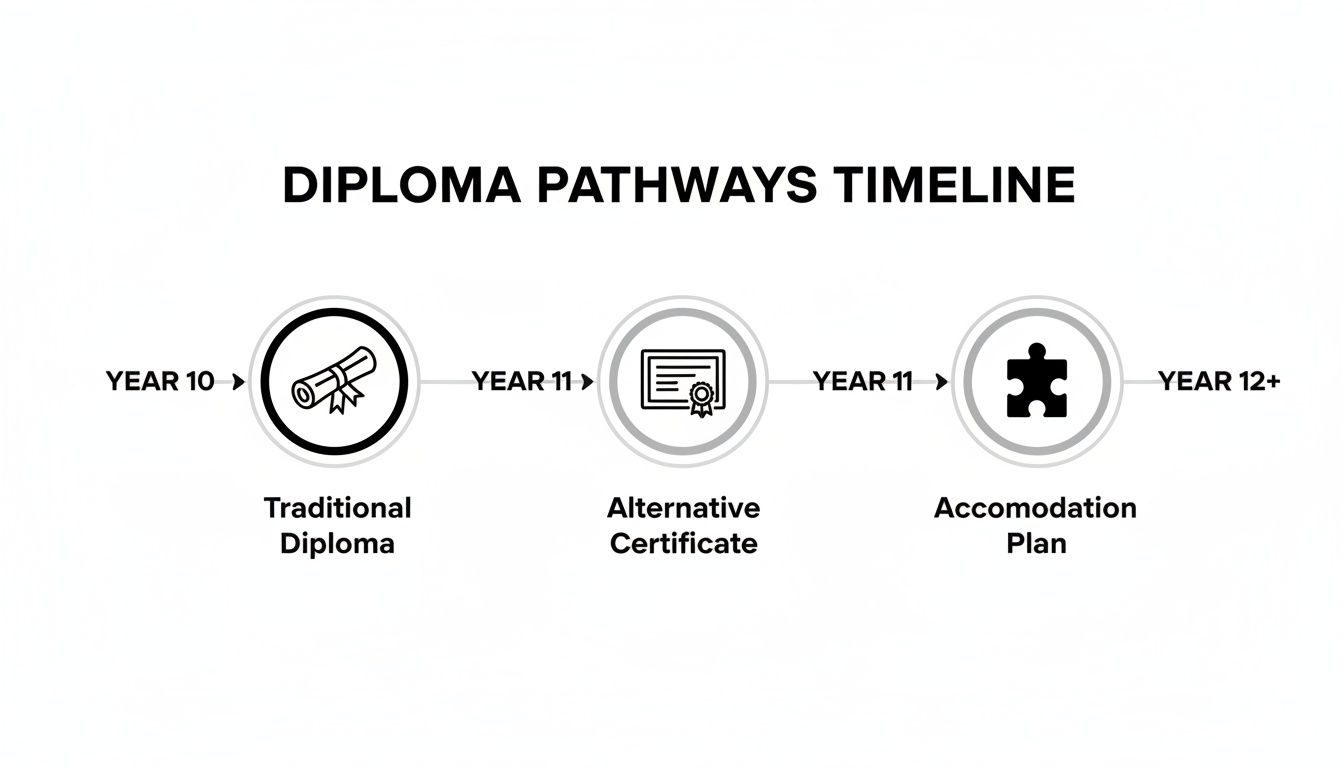
The key takeaway here is that every student's timeline can be customized to fit their academic journey. There's always a clear path to a diploma for everyone.
Freshman Year: Laying the Foundation
Your first year is all about setting yourself up for success. This is the time to build strong habits, understand the rules of the game, and start figuring out what you’re actually interested in.
- Meet Your Counselor: Your guidance counselor is your new best friend. Schedule a meeting to map out a preliminary four-year plan so you start on the right foot and know your school’s specific credit requirements.
- Track Your Credits: Get familiar with how your school tracks credits. Learn to read your report card and understand the difference between the core classes you have to take and the electives you get to choose.
- Explore Electives: Use your elective slots to try new things! Join a club, take that intro to photography class, or finally learn a foreign language. This is how you discover what you're passionate about.
Sophomore Year: Building Momentum
With one year down, sophomore year is about digging deeper academically and starting to think a bit more seriously about the future. The real pressure isn't on yet, but the decisions you make now will definitely matter later.
Keep your grades up in core subjects and start thinking about which standardized tests you might need to take down the road. This is also a great time to start documenting your extracurricular activities—you'll thank yourself when it's time to fill out applications.
Sophomore year is often when students start taking more advanced classes. Nailing this year sets a strong academic precedent for junior and senior years, which are absolutely critical for college applications.
Junior Year: The Strategic Push
Junior year is, without a doubt, the most critical year of your high school journey. This is when the academic rigor really ramps up and post-graduation planning kicks into high gear.
- Standardized Test Prep: This is prime time to prepare for and take college entrance exams like the SAT or ACT. Most students take them for the first time in the spring of their junior year, leaving time for a retake if needed.
- Advanced Coursework: Now is the time to crush it in your AP, IB, or honors classes. Strong performance here shows colleges you are more than ready for higher education.
- Start Your College Search: Begin researching colleges, going on virtual tours, and building a list of potential schools that feel like a good fit for your interests and academic profile.
Senior Year: The Final Stretch
You’re almost there! Senior year is a balancing act—you have to finish strong academically while finalizing your plans for whatever comes next. Organization is your best friend during this wonderfully chaotic time.
- College Applications & FAFSA: The fall is all about applications and deadlines. Make sure to complete the Free Application for Federal Student Aid (FAFSA) as soon as it becomes available.
- Maintain Your Grades: Do not, under any circumstances, catch a case of "senioritis." Colleges will see your final transcripts, and a big drop in grades can put your admission offers at risk.
- Plan for the Big Day: As you wrap up your final requirements, start thinking about the celebration. Now is a great time to learn about the traditions behind your graduation cap and gown and what they all mean.
By following this year-by-year game plan, you can guarantee a smooth and successful path to graduation. Each step builds on the last, leading you straight to that well-deserved diploma.
Leveraging Your Diploma for What Comes Next
Getting that high school diploma is a huge deal, but it's not the finish line. Think of it as the starting block for the rest of your life. This single piece of paper is the key that unlocks the doors to college, trade schools, the military, and better-paying jobs. Your journey through high school has armed you with knowledge, resilience, and the ability to think critically.
Now, it’s time to put all that hard work to use. Your diploma is the foundation you'll build your adult life on. It’s a signal to employers and college admissions officers that you have the discipline and core knowledge to succeed in more challenging environments.
Your Diploma as a Launchpad
The value of completing your high school graduation requirements is hard to overstate. It’s the baseline, the minimum entry ticket for almost every path you can take after high school.
- Higher Education: A diploma is non-negotiable if you’re applying to a four-year university, and it’s required for most community colleges, too.
- Military Service: Every branch of the U.S. military requires either a high school diploma or a GED. No exceptions.
- Career Opportunities: The difference is staggering—workers with a high school diploma earn significantly more over their lifetime than those who don't have one.
To truly grasp what this credential means, just consider the challenges faced by individuals who drop out of high school and the limited opportunities they often run into.
Celebrating Your Milestone
As you get ready to walk across that stage, it's so important to celebrate this moment in a way that honors your dedication. The cap, gown, and graduation tassels you’ll wear are powerful symbols of this transition, marking the official start of your next chapter.
Preserving this achievement is just as important as earning it. For ideas on how to protect this crucial document for years to come, you can learn more about getting a personalized diploma cover to keep it safe.
Congratulations, graduate—your journey is just getting started.
Common Questions About Graduation Requirements
Navigating the last few years of high school always seems to kick up a storm of last-minute questions. Whether you're a student trying to map out your future or a parent making sure all the boxes are checked, getting straight answers is the key to a stress-free walk across that graduation stage.
Here are some of the most frequent questions we hear.
What Happens If I Fail a Required Class Senior Year?
Failing a required class your senior year can feel like hitting a brick wall, but trust me, schools have systems in place for this. The very first thing you should do is talk to your guidance counselor—immediately.
They'll be able to lay out all your options. This usually includes things like summer school, an online credit recovery course, or sometimes even taking a competency exam to prove you know the material. Schools genuinely want you to succeed and will work with you to find a path to get that diploma.
Is It Possible to Graduate from High School Early?
Yes, absolutely. Plenty of high schools allow students to graduate early, but it’s something you have to plan for from day one. This isn't a last-minute decision.
You'll need to work closely with your school counselor to map out an accelerated plan. That typically means taking a heavier course load each semester, using summer school to get ahead, or even enrolling in dual-credit college courses. You still have to meet every single state and district requirement—just on a condensed timeline. It's a fantastic option for highly motivated students.
How Do I Find My School's Specific Graduation Requirements?
When it comes to graduation requirements, the most accurate information is always local. Your first stop should be your school's or district's official website. Look for documents like the "Student Handbook" or "Program of Studies."
Even better? Your school guidance counselor is your number one resource for personalized advice. They can provide a checklist to help you track your progress. Remember, requirements can change even between neighboring towns, so always, always rely on your school's official info.
The single best source for your high school graduation requirements is your school counselor. They know the state mandates, district policies, and your personal academic history, making them the ultimate guide.
Do AP or Honors Classes Affect My GPA Differently?
In most schools, they sure do. Courses like Advanced Placement (AP), International Baccalaureate (IB), and honors classes are usually "weighted." This means they're graded on a higher GPA scale—often a 5.0 instead of the standard 4.0.
What that means for you is that a top grade in a tougher class gives your overall GPA a bigger boost. The system is designed to reward you for taking on more challenging coursework, and it can be a huge advantage when you're strengthening college applications or aiming for graduation honors. Speaking of honors, understanding what all your regalia means can make the ceremony even more special; you can learn more about the different graduation ropes color meanings in our detailed guide.
At Graduation Attire, we believe every graduate deserves to celebrate their incredible achievement with high-quality, affordable academic regalia. From caps and gowns to custom stoles and honor cords, we have everything you need to make your commencement day perfect. Shop our full collection today!