

Knowing how to wear your academic hood correctly is one of those small details that makes a huge difference on graduation day. It’s the key to looking polished and feeling confident. The basics are pretty simple: you’ll place the hood over your head with the velvet side up. The V-shape should rest at the front of your neck, letting the rest of that beautiful fabric drape down your back.
Get it right, and you turn your graduation regalia into a proud display of your entire academic journey.
Your Quick Guide to Wearing an Academic Hood

Graduation day can feel like a blur, and the last thing you want to worry about is wrestling with your regalia. This guide is designed to give you a quick, clear walkthrough so you can get your hood on perfectly in just a few moments. We'll start with the most important first steps, like identifying the velvet trim and getting it positioned just right over your graduation gown.
This process is about more than just tradition—it’s about presenting your hard-earned achievements with the pride they deserve. And beyond just wearing your hood, you might be looking for other ways to capture the moment, like finding services for making your graduation day special.
Key Hood Differences by Degree
Before you even start putting it on, it helps to know what your hood actually represents. Did you know the length of your academic hood is strictly tied to your degree level? It’s a tradition that’s been standardized for over a century.
Bachelor's hoods measure exactly 3 feet, master's are 3.5 feet, and doctoral hoods reach a full 4 feet long. That difference visually signals your academic journey as you walk across the stage. This whole system was formalized way back in 1895 by the Intercollegiate Code of Academic Costume and is still used by the vast majority of U.S. colleges today.
Your academic hood is a visual summary of your education. The length signifies the degree you’ve earned, the velvet color represents your field of study, and the satin lining displays your university’s colors.
To help you instantly recognize your specific regalia and understand its unique features, here’s a quick breakdown of what to look for at each degree level, from a Bachelor's Hood to a Doctoral one.
Academic Hood Specifications by Degree Level
This table offers a quick reference for the key differences you'll see in academic hoods, from the overall length to the width of the velvet trim that signifies your field of study.
| Degree Level | Hood Length | Velvet Trim Width | Shell Fabric | Lining & Chevron |
|---|---|---|---|---|
| Bachelor's | 3 feet | 2 inches | Black | Displays university colors |
| Master's | 3.5 feet | 3 inches | Black | Displays university colors |
| Doctoral | 4 feet | 5 inches | Black | Displays university colors, wider opening |
As you can see, the progression from a bachelor's degree to a doctorate is marked by an increase in both the hood's length and the prominence of its velvet trim. These details are a time-honored way of distinguishing the level of academic achievement at a glance.
Getting to Know Your Academic Hood
Your academic hood is so much more than a piece of your graduation outfit. Think of it as a wearable diploma, with every detail telling the story of your academic journey. To really appreciate what you’re wearing, you need to understand its four key parts.
The main body of the hood is called the shell. It’s almost always made of black fabric to match the traditional academic gown. This black shell is a great unifier, connecting graduates from all different fields and universities to the long-standing traditions of academia. It creates the perfect backdrop for the more colorful, personal details of your hood.
Showcasing Your University Pride
The most vibrant parts of your academic hood are the satin lining and the chevron. These elements are designed to proudly display the official colors of the institution that's granting your degree. The lining is the fabric on the inside of the hood, which becomes visible once it’s properly folded and worn.
- The Lining: This is the primary field of color inside your hood. For example, if your university's colors are blue and gold, the lining might be a solid, brilliant blue satin.
- The Chevron: When a university has two official colors, the second one is often shown as a V-shaped stripe, or chevron, layered on top of the lining. This creates a distinct, recognizable pattern that’s unique to your school.
Learning more about these components can really deepen your appreciation for your regalia. You can explore a detailed breakdown in our article on what a graduation hood is and the history behind it.
The Velvet Trim: Your Field of Study
The most significant part of your hood's story is told by the velvet trim. This is the colored band that edges the shell of the hood, and its color is anything but random. It’s a specific code that signifies your academic discipline or field of study. White represents Arts, Letters, and Humanities, while a brilliant golden yellow stands for Science.
The velvet trim on your academic hood isn't just decoration—its color represents your field of study, a code deciphered by millions at graduations every single year. You'll see light blue for education, apricot for nursing, and orange for engineering, with over 60 official colors standardized by the Intercollegiate Bureau way back in 1895. This system is still used today by 85% of North American universities.
Just to give you an idea of the scale, in 2023, the more than 200,000 nursing grads in the U.S. alone made apricot the most common trim color, making up 22% of all master's hoods sold globally.
Once you understand these elements, your regalia transforms. Your hood isn't just fabric—it’s a symbol of your unique academic journey, your institution, and your hard-won expertise.
How to Put On Your Hood for a Perfect Fit
Let's get down to the nitty-gritty of actually wearing your hood. While you can definitely do it yourself, my number one tip is to grab a friend, family member, or faculty marshal to help out. Trust me, having an extra set of hands makes the process so much smoother and guarantees you’ll look flawless for all those photos.
First things first: drape the unbuttoned hood over your shoulders. You want the velvet trim facing up, sitting closest to your neck. The narrow part of the hood, that V-point, should rest comfortably at the front of your throat, kind of like how you’d wear a scarf before tying it.
Securing the Front for All-Day Comfort
Once the hood is draped correctly, the next step is absolutely crucial for keeping it in place. You’ll see a small cord or loop on the V-point of your hood. This little thing is a game-changer, designed to attach to your graduation gown to stop the hood from sliding back or pulling on your neck during the ceremony.
Most modern graduation gowns are designed with this in mind. For instance, many gowns from Graduation Attire include a built-in cord keeper—a small fabric loop or button located just behind the zipper—made specifically for this. Fastening the hood's cord to this keeper is the secret to keeping your regalia perfectly in place all day.
Pro Tip: If your gown doesn't have a button or loop, don't sweat it. A small, discreet safety pin works just as well. Simply pin the cord to your gown's fabric or even to the collar of your shirt underneath to get that same secure, comfortable fit.
Getting this front anchor right is everything. It not only keeps you comfortable but also ensures the hood drapes correctly down your back, setting the stage for the final adjustments that will show off your university colors. To get a better sense of how each part works together, this diagram breaks down the core components of a standard academic hood.
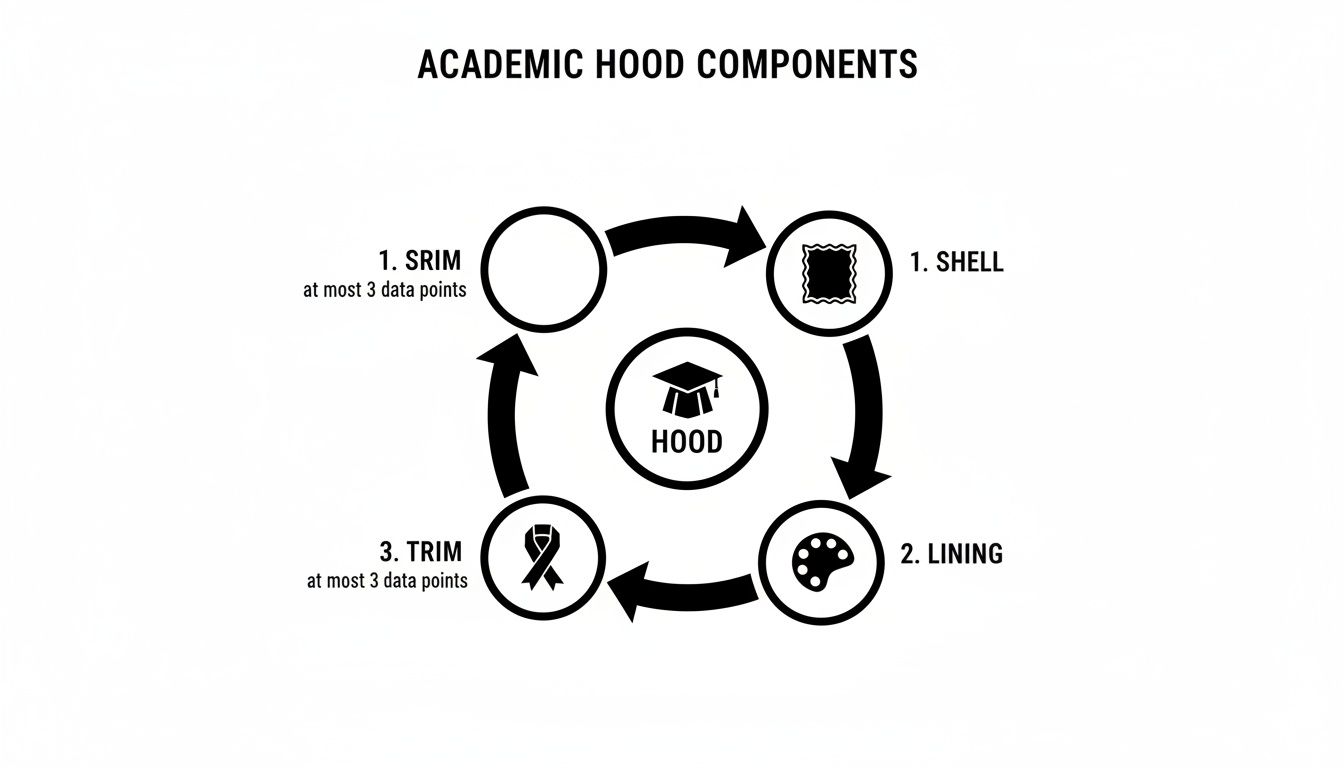
This visual guide highlights the shell, lining, and trim, which all come together to create that final, polished look once your hood is secured. The next steps will focus on adjusting these parts to proudly display your colors.
The Initial Drape and Positioning
With the front secure, let the rest of the hood hang down your back. Right now, it probably just looks like a simple black drape with the colorful lining still hidden. This is totally normal—it’s the correct starting position before you make the final, most satisfying adjustment.
The velvet trim should be fully visible, neatly framing the black shell fabric. Before you move on, do a quick check to make sure the hood feels balanced and isn't twisted. You want it to lie flat and symmetrically across your shoulders.
For a complete overview of graduation day attire, you might want to check out your complete guide to the perfect graduation cap and gown, which covers all the essentials. Now, you're ready for the final step: revealing your school's colors.
Adjusting the Back to Display Your Colors
 Once the front of your hood is securely anchored, you've handled the most critical part for comfort. Now for the grand finale—the flourish that reveals your university's colors and truly completes the look.
This is the part that turns the hood from a simple black drape into a vibrant symbol of your academic home. It's also nearly impossible to get right by yourself since you can't see what's happening on your back. Grab a friend or family member to help you with this final maneuver.
Turning Out the Satin Lining
Your helper should stand behind you and find the velvet trim at the base of the hood. Just below where that trim ends, they’ll feel the satin lining—that’s the colorful part currently hiding from view. The goal here is to flip this satin panel outward so it drapes beautifully over the black shell.
Have them gently slide their hand under the velvet edge and turn the lining inside-out, almost like peeling a banana. They should continue this motion down the length of the hood until the full field of color and the chevron pattern (if you have one) are on full display. This single move creates that classic, elegant cascade of color down your back.
Key Takeaway: The secret to a distinguished look is turning out the lining. Without this step, your university's colors remain hidden, and the hood won’t have its intended shape or visual impact. It’s the difference between wearing it and wearing it well.
Fastening the Back Cord to Hold the Shape
With the colors beautifully displayed, you need to make sure they stay that way. On the back of the velvet trim, usually near the bottom point, you'll find a small cord. This little cord is designed to be fastened to your gown to hold the turned-out lining perfectly in position.
Have your assistant find this rear cord and secure it to your gown. If there’s a button on the back of your gown, that's the perfect spot. No button? A small safety pin works just as well. This final step is what truly locks everything in place.
Securing your hood's cords correctly transforms a potential wardrobe slip into a polished display—a fact backed by observations showing 25% of graduates have to fix their hoods mid-ceremony without proper fastening. Nearly all hoods (99%) from providers like Graduation Attire include dual cords: one for the front to anchor it away from your neck, and one for the back to prevent it from sliding off your shoulders. This mechanism, refined since the 1895 Intercollegiate Code, was designed specifically to ensure stability and a perfect drape.
This small step is what truly completes the look, giving your academic hood its distinguished and finished appearance. To see the beautiful results of a perfectly worn hood, you can explore a full gallery of vibrant university colors in our guide to master's degree hood colors.
Common Hood Mistakes and How to Fix Them
Even with the best intentions, it’s surprisingly easy to get your academic hood on a little wonky. Let's walk through the most common slip-ups graduates run into and give you the quick fixes to make sure you look polished and feel comfortable on your big day. Sidestepping these frequent issues is the key to wearing your regalia with total confidence.
Putting the hood on backward is probably the number one mistake. You’ll know you did this if the colorful satin lining is facing your neck instead of draping down your back. The fix is simple: just take it off and drape it again, making sure the velvet trim is facing up and is the part closest to your neck.
Troubleshooting Your Hood's Fit and Appearance
Is your hood riding up and feeling tight against your throat? That’s a telltale sign that the front cord isn't properly anchored. That small loop is designed to attach to a button on your shirt or a keeper on your gown, which takes all the pressure off your neck. Securing it is the single most important step for all-day comfort.
Another classic issue is when your university's colors are nowhere to be seen. If all you see from the back is the black shell of the hood, it just means the final, crucial step was missed.
- The Problem: The satin lining is tucked away inside the hood, completely hidden.
- The Fix: Grab a friend or ask a faculty marshal to flip the lining outward from the base of the hood. They just need to turn that section inside-out until the full color field and chevron are beautifully displayed, creating that classic, elegant drape.
The most common mistakes are almost always related to the two anchor points: the front cord for comfort and the back cord for appearance. Getting these two small details right makes all the difference in how your academic hood looks and feels.
Ensuring You Have the Correct Hood from the Start
Perhaps the biggest mistake of all is ordering the wrong hood entirely. An incorrect hood might have the wrong velvet trim for your degree or the wrong lining colors for your university, and discovering that at the last minute can be incredibly stressful.
The best way to sidestep this is to order from a trusted, specialized source from the get-go. When you explore options like the Doctoral Hood or the Master's Hood from Graduation Attire, you’ll find clear guides to match your specific school and field of study. Using our school finder and detailed product descriptions ensures you get the right regalia, perfectly tailored to your academic achievements, saving you from any graduation day surprises.
Your Last-Minute Questions About Academic Hoods
Even after a complete walkthrough, a few specific questions always seem to pop up on graduation day. Having quick, clear answers can make all the difference, helping you feel totally prepared and confident as you get ready for the ceremony. Here are some of the most common queries we hear from graduates.
We’ve pulled together some practical advice to tackle any last-minute concerns you might have. From a gown hiccup to storing your regalia, this is your go-to guide for those final details.
What If My Gown Doesn’t Have a Button for the Hood?
This is a really common problem, but the fix is simple and works every time. If your gown is missing a dedicated button or loop for the hood's front cord, a small safety pin is your best friend. Just discreetly pin the cord directly to the fabric of your gown near the zipper.
You can also pin it to the collar of the shirt you're wearing underneath. This is a great trick to keep the hood from riding up and putting uncomfortable pressure on your neck. For the back cord, another pin can secure it to your gown to keep the colors perfectly displayed.
A quick heads-up: gowns from Graduation Attire are designed with a built-in cord keeper to avoid this issue entirely, ensuring a secure and comfortable fit right out of the bag.
Can I Put My Academic Hood On by Myself?
While it’s technically possible to put on your own hood, it’s a whole lot easier with an assistant. Having a friend, family member, or faculty marshal help you makes a huge difference, especially when it comes to getting the back just right.
Someone else can see what you can’t, making sure the satin lining is turned out correctly and hangs evenly for that picture-perfect look. Don't be shy about asking for help—most universities have staff on-site before the ceremony specifically to help graduates with their regalia.
How Do I Care for My Hood After Graduation?
Your academic hood is so much more than part of an outfit; it's a cherished keepsake of an incredible achievement. To store it properly, hang it on a wide, sturdy hanger. This will help avoid creating creases in the delicate velvet trim.
- Protection: A garment bag offers the best defense against dust and sunlight, which can cause those vibrant satin colors to fade over time.
- Cleaning: If the hood picks up a small stain, gently spot clean it with a damp cloth.
- Avoid: Do not machine wash your hood. The process can permanently damage the velvet and satin fabrics.
At Graduation Attire, we offer high-quality keepsake graduation garment bags that are perfect for preserving your complete regalia for years to come.
Do High School Graduates Wear Academic Hoods?
No, academic hoods are reserved exclusively for graduates of higher education. You’ll only see them worn by those earning associate's, bachelor's, master's, or doctoral degrees.
High school regalia is traditionally made up of a cap, gown, and tassel. However, many high schools use other accessories like honor stoles or cords to recognize specific achievements, which serve a similar purpose of celebrating student success. For these occasions, Graduation Attire provides a wide selection of custom stoles and honor cords for high school commencements.
Here at Graduation Attire, we are committed to making your commencement day perfect. From high school ceremonies to doctoral defenses, we provide high-quality, affordable regalia to help you celebrate your incredible achievements. Explore our full collection of gowns, hoods, and accessories at https://www.graduationattire.com.