

That moment you finally put on your doctoral regalia is more than just getting dressed for a ceremony—it’s the physical culmination of years of relentless effort and intellectual dedication. This isn’t just an outfit. It's a uniform with centuries of academic history woven right into its fabric, with each piece representing a specific part of your academic journey.

The Meaning Behind the Attire
The tradition of wearing academic regalia goes way back to the 12th and 13th centuries in Europe, when the first universities were just emerging. By the 14th century, as schools began to formalize their dress codes, doctoral gowns became the absolute pinnacle of prestige.
You can spot them by the black velvet facings down the front and the signature three bars across the bell-shaped sleeves—details that clearly distinguish a Ph.D. holder from someone with a bachelor’s or master’s. This system was largely standardized in the U.S. under the Intercollegiate Code, which has been widely adopted since 1896. You can explore more about the history of academic regalia and its fascinating traditions.
Knowing this history adds a whole new layer of meaning to the process. When you learn how to wear doctoral regalia, you’re not just getting ready for a party; you're taking part in a tradition that connects you with scholars throughout history.
Your regalia is a statement of accomplishment. It tells a story of late nights, groundbreaking research, and a deep commitment to your field. Wearing it correctly honors that story and the institution that guided you.
This guide will give you a clear, practical walkthrough to make sure you wear each component with the confidence it deserves. We'll demystify the entire process—from the distinguished gown and symbolic hood to the velvet tam—so you can focus on your achievement, not on wardrobe malfunctions. Our goal is to make sure you feel as accomplished as you look.
What Each Piece Signifies
Every single element of your academic dress has a specific purpose and meaning, setting doctoral graduates apart from everyone else on the field.
- The Doctoral Gown: The full, bell-shaped sleeves and velvet chevrons aren't just for show; the gown's design signifies the highest academic rank. Our collection of high-quality doctoral gowns ensures a dignified appearance for your special day.
- The Doctoral Hood: This is easily the most colorful and symbolic piece of your attire. Its velvet trim tells everyone your field of study, while the satin lining proudly displays the official colors of your university.
- The Tam or Beefeater: Instead of a traditional mortarboard, doctoral recipients wear a soft, velvet tam, often with six or eight sides and a gold tassel. It’s a clear and immediate marker of your doctoral status.
By understanding what these components mean, you can really appreciate the rich symbolism you'll be wearing. This guide will make sure you assemble them perfectly.
Getting Your Gown and Tam Just Right
Let's start with the foundation of your academic regalia: the gown and tam. Getting these two pieces right is the first step to looking the part, and it sets the stage for the rest of your look. It’s all about nailing the details to convey the dignity of your doctoral achievement.
The doctoral gown is designed to have a commanding presence, with its full cut and iconic bell sleeves creating a powerful silhouette. When you first put it on, take a moment to pull the zipper all the way up and make sure it’s perfectly centered. This simple alignment is key to ensuring the two velvet front panels hang straight and parallel, beautifully framing your attire underneath.
Those velvet panels, along with the three matching bars on each sleeve, are the defining features of your doctoral status. A little care in handling them goes a long way in preventing wrinkles and ensuring you look polished.
Nailing the Gown's Fit and Drape
Your gown should feel substantial, not restrictive. Doctoral gowns, with their velvet-trimmed front panels and three sleeve bars, are often worn open to show off that beautiful velvet. For that classic, authoritative look, you’ll want the deepest point of the gown to hang about 10-12 inches from the ground. Your sleeves should hang freely down to about mid-hand, a silhouette favored in 85% of elite Ivy League events. This length looks formal and impressive without becoming a tripping hazard. For a deeper dive into these traditions, you can discover more insights about regalia history on upenn.edu.
This visual guide shows just how distinct doctoral regalia is compared to other forms of academic dress.
You can see the evolution here—the doctoral gown’s fuller cut and sleeve chevrons clearly mark it as the highest academic rank.
Positioning Your Doctoral Tam
Next up is the tam, the soft, velvet cap that takes the place of the standard mortarboard. Unlike a mortarboard, a tam has a definite front and back, so the first step is to find the front—it's usually marked by a slightly shorter point or a specific seam.
Once you’ve found it, place the tam squarely on your head. It should sit level, not tilted to one side. A common issue, especially at outdoor ceremonies, is the wind. A study of windy outdoor events showed that using bobby pins under the chin strap can prevent mishaps for about 30% of graduates.
Expert Tip: The best trick I've learned is to use two bobby pins in an "X" formation. Pin them through the tam's inner lining and into your hair. It creates a surprisingly secure hold that will withstand wind, movement, and all the excitement of the day without anyone seeing them.
Finally, the tassel. For doctoral candidates, the tassel starts and stays on the left side. This placement signifies you've already earned the highest academic degree; the hooding ceremony is the final symbolic moment. If you want to know more, check out our detailed guide and learn more about the graduation tam in our article. Master these foundational pieces, and your regalia will look impeccable from the first photo to the last.
How to Properly Drape Your Doctoral Hood
Alright, your gown is on and your tam is sitting just right. Now for the main event: the doctoral hood. This is easily the most symbolic piece of your regalia, but let's be honest, it's also the most confusing. It’s a beautifully strange piece of fabric, but getting it to hang correctly can feel like a puzzle.
Don't worry. Once you understand its three basic parts—draping, anchoring, and turning—it’ll click. The whole process is just a series of small, intentional adjustments that make a huge difference.
This visual guide gives you a quick overview of the whole process, from gown to tam to the final accessories that pull it all together.
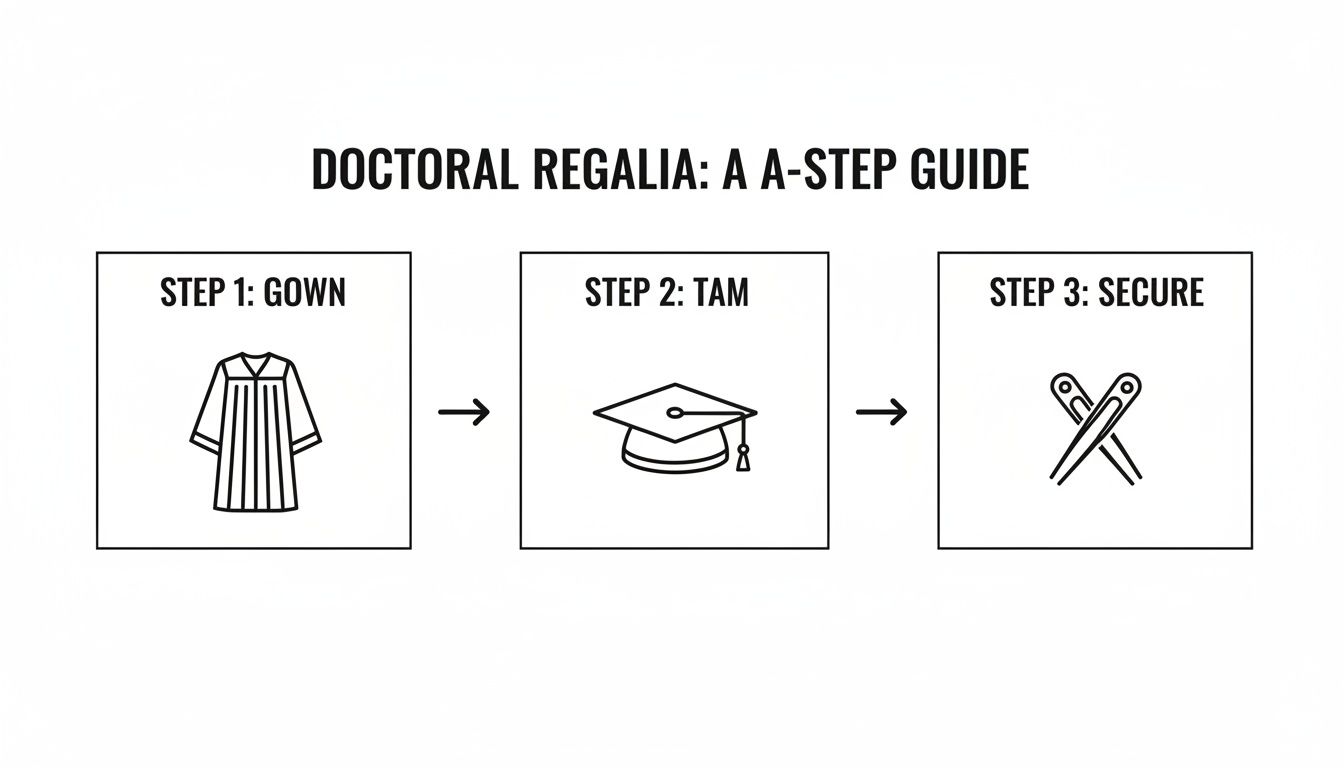
Think of it this way: get the gown on, put the tam in place, and then secure everything for that final, polished look.
The Initial Drape and Placement
First, grab the hood and hold it out in front of you. You’ll want the velvet trim facing up, with the small, V-shaped end pointing away from your body. The velvet part is what everyone will see from the front.
Now, lift it over your head and let that V-neck part settle on your chest, kind of like a stole. The rest of the hood, with all its colorful satin lining, should be hanging down your back. Right now, it probably just looks like a flat panel of fabric back there. That’s perfect—you're exactly where you need to be.
The key is to get it sitting comfortably on your shoulders without choking you. The velvet should frame the neckline of your gown.
Anchoring the Hood Securely
Next up is making sure that hood stays put. If you skip this, you’ll spend the entire ceremony yanking it away from your throat. Look on the inside of the velvet V-neck and find a small cord or loop. This little thing is your hood cord, and it's the secret to a perfect fit.
You’ve got a couple of options for using it:
- The Shirt Button Method: If you're wearing a button-down shirt, this is the classic move. Just loop the cord around your top button before you button it up. It’s the most secure way to do it.
- The Safety Pin Trick: No button-down? No problem. A small safety pin works just as well. Pin the loop to the inside of your gown, right below the collar. Some gowns even have a little fabric tab built in for this exact purpose.
A common mistake is skipping this step, which leads to constant readjusting. Securing the hood cord ensures it stays put throughout the entire ceremony, from the procession to the final photos.
Getting the details right on your hood really matters. A standard doctoral hood is 42 inches long, and when it’s draped correctly, the cowl should sit perfectly on your shoulders. The colors are a dead giveaway to your field—green for medicine, citron for social work. There's a lot of history here, too. A 1987 change to the academic code mandated dark blue for all Ph.D.s, a rule that now applies to 100% of new ceremonies. It’s worth getting it right, especially since improper hood alignment mars an estimated 25% of graduation photos.
Turning the Lining to Reveal the Colors
This is the final touch, the big reveal that makes the whole thing look right. Right now, all those beautiful satin university colors are tucked away inside the hood on your back. It’s time to show them off.
Reach behind you and feel for the velvet trim at the base of the hood. Gently take hold of the top edge of this velvet and flip it outward, essentially turning it "inside-out" over the back of the hood.
You don't need to flip the whole thing. Just turning out the top half or two-thirds is enough to create that beautiful cascade of color over the hood's black shell. If you can, grab a friend or a faculty member to help you get it perfectly centered.
For a great visual breakdown, check out our guide on how to wear an academic hood. With this final adjustment, your regalia is complete. You’re ready to walk.
Understanding the Colors and Symbols
Your doctoral regalia is steeped in history, and every piece tells a story about your academic journey. The gown, the hood, and the tam aren't just ceremonial garments; they’re a visual language that communicates your field of study, your alma mater, and your hard-won level of achievement.
The tradition of academic dress goes way back. In the U.S., colonial colleges like Princeton and Columbia actually mandated the daily wear of academic attire all the way until the 19th century.
This long-standing practice eventually led to the Intercollegiate Code of 1896, an effort to standardize regalia that was adopted by 90% of institutions. This code is why we have black gowns with velvet facing, three sleeve bars, and specific hood colors like salmon pink for public health (since 1935) and brown for fine arts. You can explore more of the rich history behind academic regalia traditions on Clothesminded.
Knowing this history adds a deeper layer of appreciation for your accomplishment and highlights why wearing your regalia correctly is such a big deal.
The Story Told by Your Hood
The doctoral hood is, without a doubt, the most descriptive part of your entire outfit. Think of it as a vibrant billboard for your academic credentials. Every color and fabric is there for a reason.
- The Velvet Trim: This is the big one. The color of the wide velvet border on your hood directly represents your specific field of study and the degree you earned.
- The Satin Lining: The colors splashed across the satin lining are the official colors of your university, proudly showing everyone where you earned your degree.
- The Black Shell: The outer fabric of the hood is almost always black to match the gown, creating a formal backdrop that makes the symbolic colors pop.
When you drape and turn out your hood correctly, you're putting this whole narrative on display for everyone to see. It’s a powerful, silent declaration of your expertise and your academic heritage.
Decoding the Velvet: Your Field of Study
The color of that velvet trim is governed by a standardized system, which means anyone familiar with academic tradition can recognize your discipline at a glance. For instance, the dark blue velvet of a Doctor of Philosophy (Ph.D.) is one of the most common, signifying mastery across the arts and sciences.
Your hood's velvet color is the primary symbol of your academic discipline. It’s a universal code that connects you to a global community of scholars in your field, transcending institutional boundaries.
Here's a quick reference for some of the most common velvet colors you'll see on doctoral hoods. Our own customizable academic hoods are made to match these exact specifications, ensuring your regalia is both accurate and impressive.
Doctoral Hood Velvet Color by Field of Study
The velvet colors assigned to each discipline are part of a standardized code, making it easy to identify a graduate's field of expertise at any ceremony. This table breaks down some of the most common pairings.
| Discipline | Velvet Color | Common Degrees |
|---|---|---|
| Philosophy | Dark Blue | Ph.D. |
| Education | Light Blue | Ed.D. |
| Medicine | Green | M.D. |
| Law | Purple | J.D. |
| Engineering | Orange | D.Eng., Ph.D. |
| Fine Arts | Brown | D.F.A., Ph.D. |
| Theology | Scarlet | D.Min., Th.D. |
| Public Health | Salmon Pink | Dr.PH. |
Of course, this is just a small sample. There are dozens of designated colors for all sorts of specialized fields, each with its own unique history.
The Significance of the Gown Chevrons
Finally, don’t overlook the details on the gown itself. The three velvet chevrons—those distinct bars—on each of the full, bell-shaped sleeves aren't just for decoration. They are an exclusive mark of the doctoral degree.
Bachelors' gowns have pointed sleeves with no ornamentation, and masters' gowns have oblong sleeves. Those three velvet bars on your sleeves immediately signal that you have reached the highest level of academic achievement. Paired with the matching velvet panels down the front, these chevrons complete the distinguished look that is unique to a doctor.
Ensuring a Perfect Fit and Final Preparations
A doctoral gown that fits perfectly is the difference between looking the part and just feeling awkward. Getting that commanding presence right really comes down to good measurements, making sure your gown and tam feel comfortable, not like a burden, during the long ceremony ahead.

Learning how to wear your regalia correctly is just the first step. These final preparations are what guarantee you’ll feel just as confident as you look, letting you focus completely on your achievement.
Taking Accurate Measurements
For your gown, the single most important measurement is your height, from head to toe. This is what determines the proper length, which should hit somewhere between your knee and ankle. For a deeper dive into how different lengths work, check out our guide on the ideal length of a graduation gown. This is key to avoiding a gown that’s comically short or so long it becomes a tripping hazard.
When it comes to the tam, you’ll need to measure the circumference of your head. Grab a flexible measuring tape and wrap it around the widest part—usually about an inch above your eyebrows. That number corresponds directly to tam sizes, taking all the guesswork out of it.
Day-of-Ceremony Best Practices
Beyond the fit, a few last-minute preps will help your graduation day go off without a hitch. These are the little details that seasoned academics and faculty members swear by.
First, think carefully about what you’ll wear underneath. Stick with professional attire made from breathable fabrics like cotton or linen. Commencement ceremonies can get surprisingly warm, especially under all that heavy velvet. Comfortable shoes are an absolute must; you will be standing and walking far more than you think.
Your regalia is the star, but what you wear underneath is the supporting cast. Prioritize comfort and professionalism to ensure you can fully enjoy your moment without being distracted by pinching shoes or overheating.
With 55,283 doctorates awarded in the U.S. in 2020 alone, you can bet that small mistakes are common. One of the biggest offenders? The backward hood, an issue that pops up in an estimated 20% of ceremonies. To avoid these little pitfalls, make sure the velvet bars on your sleeves are parallel to the floor for a polished, intentional look.
Final Touches for a Polished Look
The last thing you want is a wrinkled gown stealing the show in your photos. Most regalia arrives folded up and will definitely have some creases. Never iron velvet directly. Instead, hang your gown in a steamy bathroom for about 20 minutes or use a handheld steamer on a low heat setting to gently smooth out the wrinkles.
Finally, always transport your regalia in a proper garment bag. It’s a simple step that protects it from dirt, snags, and picking up new wrinkles on the way to the ceremony. These final adjustments ensure that when you put on your doctoral attire, it looks pristine, professional, and worthy of the immense achievement it represents.
Common Questions About Doctoral Regalia
Even after you've got the basics down, a few specific questions always seem to pop up. Think of this as your quick-reference guide for those final details, tackling the most common things we hear from doctoral candidates and faculty.
What Is the Difference Between a Doctoral Tam and a Mortarboard?
This one’s easy. The doctoral tam is the traditional headwear reserved for those who have earned a doctorate. It's usually crafted from rich velvet with six or eight sides and comes with a distinctive gold tassel, instantly signaling the highest level of academic achievement.
The flat, square mortarboard, on the other hand, is the standard for bachelor's and master's graduates. While a few schools have their own unique rules, choosing a high-quality velvet tam is the true mark of a doctorate and gives you a more distinguished, historically accurate look for your ceremony.
Which Side Does the Tassel Go on for a Doctorate?
This is probably the most frequent point of confusion, but for doctoral recipients, the answer is simple: your tassel stays on the left side.
Unlike undergraduate ceremonies where the tassel gets ceremoniously moved from right to left, doctoral candidates usually start with the tassel already on the left. Why? Because your hooding is the big moment that signifies the degree has been conferred, making a separate tassel-turning moment redundant. For faculty who already hold a doctorate, the tassel always remains on the left.
Can I Wear Honor Cords or Stoles with My Doctoral Regalia?
Generally, the answer is no. Additional honor cords and stoles are not typically worn with doctoral regalia. The doctoral hood is considered the primary and most significant academic adornment—it already tells the full story of your degree, discipline, and institution.
Piling on extra cords or stoles can create a cluttered look and often goes against institutional protocol. The elegant simplicity of the gown and hood is designed to stand on its own as the ultimate symbol of your accomplishment.
Your doctoral hood is the ultimate honor. It tells the complete story of your academic journey—your university, your field, and your achievement. Additional adornments are typically reserved for undergraduate and master's level accomplishments.
That said, every university has its own traditions. It never hurts to confirm your specific university's commencement guidelines before adding anything else to your regalia.
How Should I Care for My Regalia After the Ceremony?
Your doctoral regalia is a significant investment and a cherished symbol of a monumental achievement. A little proper care will keep it in pristine condition for any future academic events or just as a treasured memento.
Once commencement is over, professional dry-cleaning is your best bet to properly care for the delicate velvet and other materials. For long-term storage, just follow these key steps:
- Use a breathable garment bag. Whatever you do, avoid plastic bags. They can trap moisture and lead to mildew or fabric damage over time.
- Hang it properly. A sturdy, wide hanger is a must to support the gown’s weight and prevent the shoulders from stretching or losing their shape.
- Store in a cool, dark place. A closet away from direct sunlight is perfect. This keeps dust off and protects the rich colors from fading.
By following these simple care instructions, you can preserve the dignity and beauty of your academic attire for years to come. You earned it, and properly storing it ensures it will be ready for any future occasion where you need to represent your scholarly achievement.
At Graduation Attire, we understand how much every detail matters on your big day. From doctoral tams to perfectly customized hoods, we provide high-quality regalia to help you celebrate your incredible achievement with confidence and style. Explore our full collection and find everything you need at https://www.graduationattire.com.