

Your gown is hanging on the door, your stole is still folded in its packaging, and you're trying to work out which piece goes on first. The arrangement looks simple until the stole slides when you walk, disappears beneath a hood, or catches against your chair.
Start with permission and fit, not the photograph. Your school's rules decide what you can wear, and your movement, seating, and accessibility needs decide how to secure it comfortably.
How to Put On a Graduation Stole Step by Step
Place the stole around the back of your neck, bring both ends down the front of your gown, and make them even. The ends commonly hang toward the knees, but your school's length requirements and your seated fit take priority over that general guide.
Prepare Before You Drape
- Confirm approval before handling the stole. Check that the design, wording, dimensions, and organization are permitted for your ceremony. NSU Oklahoma's commencement dress guidelines prohibit altering stoles, so don't assume you can add patches or text after receiving one.
- Steam according to the garment label. Hang the stole so the fabric can fall freely, then smooth storage creases using the care instructions for that garment. Steaming is the safer starting choice than pressing regalia with a hot iron, but don't apply heat if the label prohibits it.
- Find the midpoint and turn the decoration outward. Hold the stole at its center, checking which surface carries the embroidery, insignia, or decorative trim. Untwist the fabric before bringing it toward your neck, rather than trying to correct a hidden twist after dressing.
Keep the gown closed while fitting the stole. An open zipper changes the surface beneath it and can make an otherwise balanced arrangement look crooked.
The basic drape is easiest to understand from the front.
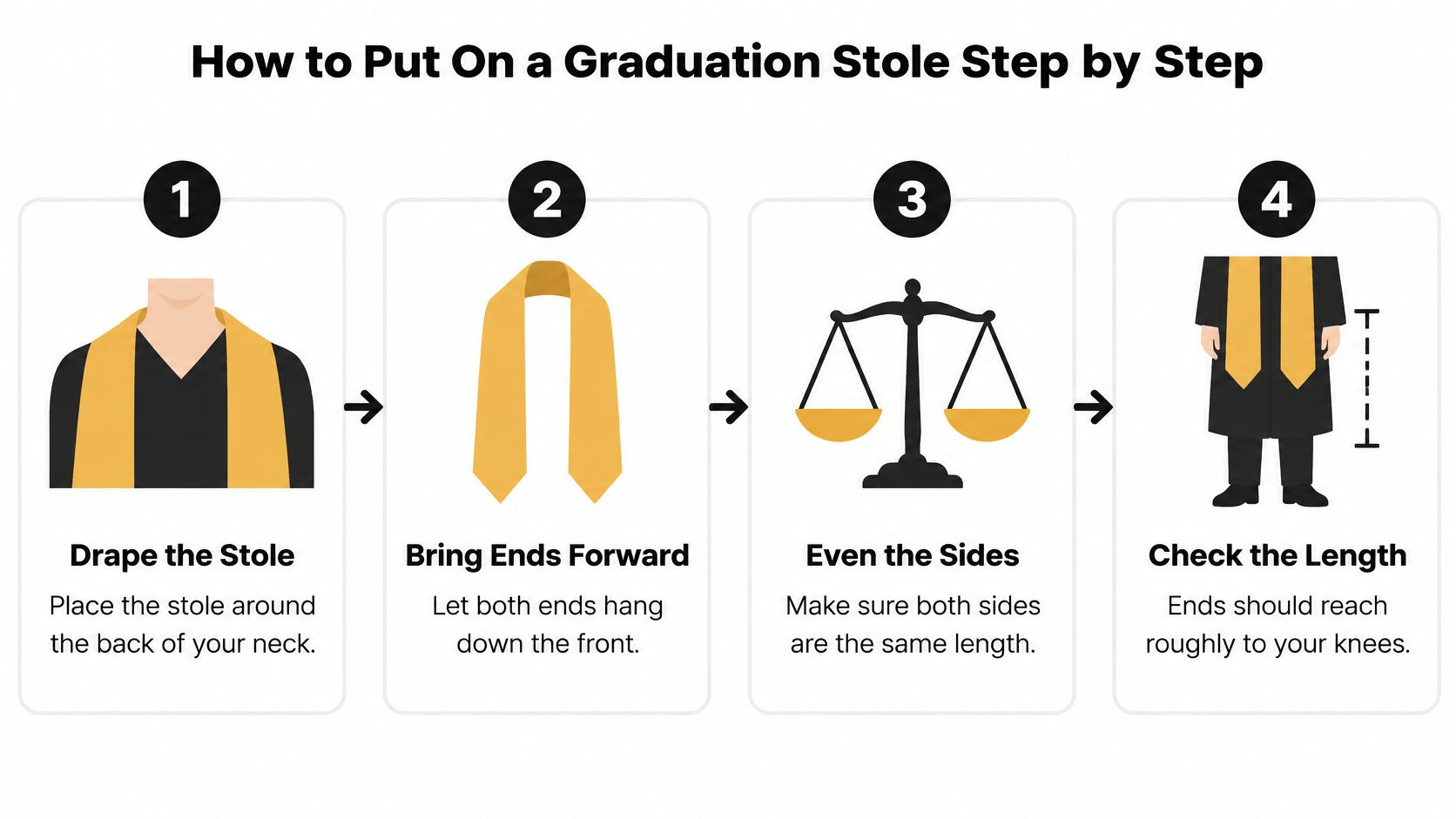
Set the Position and Test Movement
- Place the midpoint at the back of your neck. Let the fabric rest smoothly across your shoulders instead of balancing it on a raised shirt collar. Flatten the back edge with your fingers so it doesn't roll into a narrow band.
- Bring both sides forward together. Drape them over the front shoulders and down your chest without crossing them. Keep the gown's zipper accessible rather than trapping the stole ends inside the opening.
- Compare the hanging ends. They should reach the same point, sit flat, and face forward, not rest over a single shoulder. If the usual knee-level placement conflicts with your school's rules or catches against equipment, stop and resolve the length before ceremony day.
- Check movement in a mirror. Turn sideways, walk, and sit in the position you'll use during commencement. Watch whether a bag strap, collar, necklace, or arm movement pulls either side backward.
Symmetry matters because a graduation stole is a front-facing symbol. Even lengths keep its lettering readable and prevent a heavier embroidered end from gradually pulling the whole garment off center.
Before lining up: Check that the ends are even, the embroidery faces outward, and no fabric bunches at the neckline.
Don't keep tugging only the shorter end. Lift the fabric gently at the back, redistribute it across the shoulders, and lower both sides together. That corrects the drape rather than moving the twist somewhere less visible.
Where the Stole Sits Under the Hood and Gown
Despite the common question about wearing a stole under a graduation gown, the stole belongs outside the gown. The usual dressing order is gown first, stole over it, academic hood above the stole, and then approved cords arranged so they remain visible.
The hood needs an unobstructed position around the neck and shoulders. Don't pull the stole over its velvet trim or spread it across the hood's lining just to display more embroidery.
Secure the Hood Independently
Saint Mary's College of California's regalia guidance notes that the hood's front loop can go over a shirt button or be pinned to clothing beneath the gown. Ask your commencement office whether that arrangement is permitted for your ceremony, especially if you're borrowing regalia.
Don't use the stole as the hood's anchor. When the hood pulls backward, an attachment between the pieces can drag the stole toward your throat or lift its ends unevenly.
For help identifying the loop, velvet, and lining before dressing, use our guide to how to wear the academic hood. Master's and doctoral candidates should pay particular attention to where the hood overlaps the stole, since the additional fabric can shift the shoulder placement.
Check Before the Procession
If you'll be hooded on stage, rehearse the arrangement without fastening anything across the area the hooding official needs to reach. Check your accessories in the lineup area, then let the official place the hood rather than trying to adjust everything during the presentation.
Use this final fit check:
- Shoulders flat: The hood rests evenly without dragging the neckline backward.
- Stole ends balanced: Both ends remain visible beneath the hood's drape.
- Neckline clear: No folded fabric is trapped between the hood, shirt collar, and gown.
A helper can inspect the back while you look at the front. Pulling on the front alone won't reveal a folded hood edge behind your neck.
Which goes first, the stole or the hood? Stole first, then hood, unless your school's handbook specifies another arrangement.
School Rules That Decide What You Can Wear
Read each rule against the handbook for your own undergraduate or graduate ceremony. The Kansas State University regalia guidelines require an Academic Regalia Adornment Approval Form for eligible recognized organizations, with deadlines of October 1 for fall commencement and March 1 for spring commencement.
Stole Rules by School and General Size Limits
| School | Rule | What to check |
|---|---|---|
| Kansas State University | Approved organization stoles only; Academic Regalia Adornment Approval Form required | Use the submission deadline for your ceremony |
| University of South Dakota | Stoles and cords generally may not extend below the waist or exceed six inches in width; no more than two stoles and three cords | Count stoles and cords together before the ceremony |
| University of Southern Indiana | One additional approved stole or cord beyond specified university-provided items | Noncompliant items may require removal at entry |
| NSU Oklahoma | No alteration; no added patches or text | Wear the stole as issued |
| Bethel | Heritage and military stole content restricted | Confirm with the commencement office before ordering |
| Several universities, general range | Approximately 4–5 inches wide and 66–72 inches long | Compare with your school's stated maximum |
Don't treat the general range as permission to buy. A school's waist-level restriction can rule out a stole that otherwise looks conventional.
Approval covers the item and its design, not simply your eligibility to celebrate an achievement.
Read the college graduation dress code guide alongside your ceremony handbook so your clothing, footwear, and adornments work together.
Layering Several Stoles Without Crowding Your Regalia
More stoles don't automatically mean better recognition. Stacked satin can hide lettering, push cords out of view, and create a thick ridge beneath the hood.
The University of Southern Indiana's regalia policy permits only one additional approved stole or cord beyond specified university-provided items and warns that graduates may have to remove noncompliant or offensive adornments before entering.
Choose What Takes Precedence
- Start with required university regalia. Keep the gown and degree-specific pieces complete.
- Add only approved stoles. Permission for an organization stole doesn't automatically authorize a separate identity or department stole.
- Protect visibility. Don't cover the hood, cords, or required collar and trim with an extra layer.
- Choose the front-facing item deliberately. If multiple stoles are permitted, arrange them so the intended lettering remains readable without pulling the lower stole sideways.
- Resolve uncertainty with the sponsoring department. Ask which item takes precedence before arriving at the lineup.
Say you're a first-generation nursing graduate at a school that permits a single additional stole. You select the item the school approves, confirm that choice with the commencement office, and leave the other off during the ceremony.
That doesn't diminish either achievement. You can use a different arrangement for personal photographs where the setting permits it.
Keep Meaning Separate From Permission
A stole may represent heritage, military service, LGBTQ+ identity, academic achievement, or organizational membership. Its personal significance and its authorization for commencement are separate questions.
Social-media advice about which stole belongs on top can't override your institution's policy. For the narrower placement questions involving cords, use our guide to how to wear graduation honor cords rather than treating cords and stoles as interchangeable layers.
Wearing a Stole With Mobility Aids and Medical Devices
Most stole demonstrations assume you're standing still without mobility equipment. That leaves out the fit questions that matter when you use a wheelchair, walker, hearing device, or another accommodation.
Harvard's commencement information lists wheelchair loans, assistive listening devices, ASL, Braille, large-print, and accessible digital materials as possible accommodations. Wake Technical Community College advises graduates needing mobility support to contact disability services at least one week before the ceremony.
A seated fit deserves its own check, not an adaptation made at the last moment.

Fit the Stole Around Your Equipment
- Request an approved shorter length if needed. The ends should clear wheelchair footrests, wheels, and walker bags. Ask before shortening an issued stole, since an alteration may invalidate its approval.
- Consider concealed, low-profile fasteners. Where pinning is allowed, attach the stole to the gown rather than to a harness, medical tubing, or equipment strap. Avoid exposed pin points near skin or transfer surfaces.
- Keep the neck area clear. Don't drape fabric across medical-device controls or neck-worn hearing equipment. Ask your clinical or accessibility support team about device-specific concerns rather than repositioning equipment to accommodate the stole.
- Perform a seated mirror check. Use your actual chair or mobility aid, lean within your normal comfortable range, and check the armrests and lap. Confirm that the embroidery remains visible without fabric catching.
- Rehearse the stage route and any transfer. Tell your support person where the stole is secured so they don't accidentally pull it while assisting.
If your route includes thresholds or tight turns, DME Superstore's guidance on how to navigate obstacles with a rollator walker can help you identify movements worth rehearsing with your regalia.
A pin isn't a universal accessibility fix. A secure stole still needs to allow comfortable movement and access to equipment.
Some institutions require accommodation requests through a designated portal and deadline. Arrange support early enough to check comfort, safety, photo visibility, and institutional approval together.
Fixing a Stole That Slips, Twists or Bunches
Stole Symptoms, Likely Causes and Fixes
| Symptom | Likely cause | Fix |
|---|---|---|
| Slides off the shoulders while walking | Slick fabric and uneven weight on one side | Pin discreetly to the gown at the shoulder seam, if the school allows it |
| Twists around the neck | Midpoint isn't at the back of the neck | Lift from the back, re-center the midpoint, and redrape both sides together |
| One end longer than the other | Uneven draping on the front shoulders | Compare both ends against the knees and adjust them as a pair |
| Bunches under the hood | Fabric caught beneath the hood's edge | Smooth the fabric outward from the neck, then reseat the hood |
| Sits on one shoulder only | Off-center placement or unsuitable width | Re-center the midpoint and check the width against the school's limit |
| Covers the hood lining or trim | Excess width or poorly positioned hanging fabric | Check dimensions and placement; shorten only if alterations are allowed |
| Creased or wrinkled | Packed or folded in a bag | Steam following the care label; don't iron unless expressly permitted |
Start with the cheapest fix: lift, re-center, and redrape. Then address creases before considering a fastener.
If pins are permitted, conceal the closure inside the gown's shoulder seam allowance or placket without piercing decorative stitching. Carry a small pin kit in your bag, and ask a partner to compare the hanging ends from behind and from the front.
Pins can't make an oversized stole compliant. Replace an unsuitable length or width rather than folding excess fabric into a bulky neckline.
Most positioning fixes can be handled in the lineup area without leaving the procession. Steaming and replacement belong before arrival.
Confirm Approval and Order Your Stole Early
Turn Permission Into an Order Checklist
- Find the right handbook entry. Read the regalia and adornments rules for your specific ceremony, including any separate undergraduate or graduate requirements.
- Send the actual design for approval. Email the registrar or commencement office a photo, wording, width, and total length. If a form is required, submit it before the institution's deadline and retain the response.
- Choose the approved category and dimensions. We sell Class of 2026, First Generation, International, LGBTQ, Veteran & Military, Nursing, Student Athlete, HBCU, Kente, and Greek organization stoles, plus custom graduation stoles you can design and personalize online. For a custom order, email us the details of what you want so we can create a mockup for you to check against school requirements before production.
- Rehearse the complete outfit at home. Include the gown, stole, hood, footwear, and any equipment you'll use. Ask someone to check the back while you perform the standing or seated movements that apply to you.
- Store it without crushing the fabric. Keep the stole flat and protected in a garment bag, without heavy items pressing folds into the embroidery.
If the school approves the stole and its dimensions fit, order it. If it doesn't, choose the approved alternative.
Graduation Attire offers group-specific and personalized graduation stoles, along with gowns, hoods, and honor cords to complete your ceremony outfit. Visit Graduation Attire to choose a stole that matches your achievement, then confirm its design and measurements with your school before ordering.