

You're standing in front of your closet, commencement date approaching, and wondering whether the package in your cart matches your master's degree. The gown looks familiar, the cap seems straightforward, but the hood has unfamiliar colors, unusual length, and a trim that may identify your discipline. One wrong selection can leave you with regalia that doesn't follow your university's ceremony requirements.
A master's cap and gown is more than a formal outfit. The gown establishes your academic level through its cut, the cap completes the traditional silhouette, and the hood communicates your degree field and institution through color. Once you understand those visual signals, choosing the right package becomes much easier.
What Every Master's Cap and Gown Includes on Graduation Day
As your name is called and you walk toward the stage, three pieces create the recognizable master's silhouette: the gown, the cap, and the academic hood. Each serves a different purpose, and the hood is usually the piece that requires the most careful checking before you order.
The gown is generally black and designed with long, oblong sleeves. A velvet trim running down the front signals graduate-level status, giving the garment a more formal appearance than a standard bachelor's gown. The cap is usually a black mortarboard with a tassel, although some programs may allow a soft tam. The hood rests over your shoulders, showing a colored lining associated with your university and velvet edging associated with your discipline.

The three pieces and what they communicate
- Gown: Its length, sleeve shape, fabric, and front velvet trim distinguish graduate regalia from undergraduate clothing.
- Cap: A mortarboard gives the traditional academic appearance, while an approved tam offers a softer alternative for some programs.
- Hood: The hood identifies your degree level, institution, and academic discipline through its shape, lining, and trim.
The hood deserves special attention because a black gown and mortarboard can look similar across degree levels. The hood's length and velvet edging provide much of the visual information that separates master's regalia from bachelor's regalia.
Practical rule: Treat the hood as a required academic identifier, not as an optional decorative extra.
Before checkout, confirm your school's official regalia instructions, identify the exact program name, and compare the required colors with the product listing. You'll also need to consider the master's silhouette, your measurements, fabric finish, delivery window, and accessories such as cords or stoles. Making those decisions in that order helps you avoid a rushed correction close to commencement.
How Master's Regalia Differs from Bachelor's and Doctoral
Master's regalia occupies a distinct place between bachelor's and doctoral dress. The gown is intentionally different from the bachelor's cut, and the hood is longer than a bachelor's hood while remaining different from doctoral regalia. A standard academic-regalia reference describes a master's hood as about 3.5 feet long, compared with a 3-foot bachelor's hood and a 4-foot doctoral hood according to this academic dress specification.
The sleeves provide another useful clue. Master's gowns typically use long, oblong sleeves with an opening near the wrist, creating a flowing shape that's easy to recognize in photographs. Bachelor's gowns use pointed sleeves, while doctoral gowns generally feature bell sleeves and velvet panels. Doctoral garments may also include gold trim, so pairing a doctoral-style gown or tam with a master's package creates an obvious mismatch.
The cap choice
Most master's candidates wear a black mortarboard with a tassel. Some institutions and programs permit a six-sided or eight-sided soft tam, but you shouldn't assume that a tam is acceptable just because it appears in a retailer's catalog. Your university's graduate school or commencement office has the final say.
| Feature | Bachelor's | Master's | Doctoral |
|---|---|---|---|
| Gown sleeve | Pointed sleeve | Oblong sleeve with an opening near the wrist | Bell sleeve, often with velvet details |
| Hood | Shorter hood, where provided by institutional rules | Longer hood with wider velvet edging | Longer doctoral hood with distinctive construction |
| Cap | Usually mortarboard | Mortarboard or approved soft tam | Often a doctoral tam |
| Front decoration | Generally simpler | Velvet trim down the gown front | Velvet panels and other doctoral details |
| Visual position | Undergraduate level | Graduate level between bachelor's and doctoral | Highest commonly recognized degree level |
Why the hood length matters
The master's hood is not merely a larger version of the bachelor's hood. Its wider velvet edging and longer shape help distinguish it from lower-degree regalia, especially when graduates stand together during a procession or group photograph. The gown's oblong sleeve reinforces the same message from another angle.
When shopping, start with a product template explicitly labeled for master's candidates. Don't select a bachelor's package and attempt to correct the appearance with a different hood. The sleeve construction, gown proportions, and hood size need to work together.
Decoding Hood Colors by Degree and Discipline
The hood acts like a visual code. In widely used American academic-regalia conventions, the velvet trim identifies the discipline, while the satin lining commonly identifies the institution through university colors. That means two graduates may wear similarly shaped master's hoods but display different trim colors because their degrees belong to different fields.
Common discipline colors include white for arts and letters, drab for commerce and business, light blue for education, orange for engineering, peacock for public administration, salmon for public health, and yellow for science as summarized by Grand Valley State University's regalia guide.
A quick color reference
| Discipline | Trim Color | Typical Lining | Common Override |
|---|---|---|---|
| Arts and letters | White | University colors | Program or campus-specific sheet |
| Business and commerce | Drab | University colors | Business-school instructions |
| Education | Light blue | University colors | School of Education designation |
| Engineering | Orange | University colors | Engineering department guidance |
| Public administration | Peacock | University colors | Public affairs program sheet |
| Public health | Salmon | University colors | Health-school designation |
| Science | Yellow or golden yellow | University colors | Degree-specific university chart |
The phrase “typical lining” matters. Lining colors aren't interchangeable with trim colors. A university may use its own colors inside the hood while retaining a discipline color on the velvet edge, so don't choose a hood based on the lining alone.
Why program sheets override general charts
Universities often assign colors at the program level, not only by broad degree title. A 2025–2026 hood sheet from the University of La Verne lists different colors for individual master's programs, including gold for several science programs, peacock for a Master of Public Administration, salmon for a Master of Public Health, and drab or light brown for other programs. Another institutional guide lists white for an M.A., drab for an M.Acc. and M.B.A., orange for an M.Engr., pink for an M.M., peacock blue for an M.P.A., and golden yellow for an M.S.
Use a general color chart to understand the system, not to make the final purchase. Check your registrar's or graduate school's official hood sheet, then ask whether combined degrees, special programs, or honor societies affect your accessories. The master's degree hood color guide can help you interpret the terminology before you compare it with your school's instructions.
How to Choose the Right Size, Fit, and Fabric
Your usual suit, dress, or shirt size won't tell you enough about a master's gown. Academic gowns need room for clothing underneath, and their sleeve proportions depend on your height and body breadth. Start by measuring your height without shoes, then measure around the fullest part of your chest or torso while wearing the type of clothing you expect to wear under the gown.
Compare those measurements with the seller's chart, not with a familiar letter size. A sizing guide such as this graduation gown measurement resource is useful because it directs attention to the measurements that affect drape and sleeve position.
Fit for movement and photographs
Master's gowns need enough space to hang smoothly from the shoulders. If the fabric pulls across your chest, the front zipper or buttons may strain, the hood can shift, and the oblong sleeves may bunch. If you're between sizes, a roomier full-fit or plus-size option can produce a cleaner result than sizing down to force a narrower silhouette.
Height-based ranges help control gown length. The table below is a fitting framework, not a substitute for the manufacturer's chart, because sellers organize ranges differently.
| Height Range | Recommended Gown Length | Fabric Options |
|---|---|---|
| Shorter stature | Hem should allow easy walking without pooling | Lightweight matte polyester |
| Average stature | Hem should fall evenly with room for formal clothing | Matte polyester or poplin |
| Taller stature | Choose a length that preserves sleeve proportion | Matte polyester or breathable poplin |
| Fuller build | Use a full-fit or plus-size cut when offered | Matte polyester with generous drape |
The two details that appear most clearly in photographs are drape and sleeve length. A gown that hangs evenly looks polished from the front and side, while sleeves that finish correctly preserve the master's profile.
Choosing the surface finish
Traditional matte polyester has a subdued appearance and photographs cleanly under bright ceremony lighting. Satin-shine fabric reflects more light and can look more prominent in flash photography, while poplin may offer a different balance of structure and breathability. Your school may also specify a particular finish, so check its policy before choosing based on appearance alone.
Steam wrinkles gently before the ceremony, and remeasure after a major weight change. Don't rely on an older measurement or assume that every manufacturer uses the same fit system.
Ordering Timelines and Shipping Tips
A master's cap and gown order involves more than the time needed for a box to travel. Custom colors, personalization, hood verification, university approval, and return policies can all affect the usable timeline. Standard production may require three to six weeks, while rush service and overnight delivery shorten the window at a higher cost. The production estimate and shipping estimate are separate, so read both before paying.
Compare the main ordering paths
- Standard order: Best when your ceremony date is known early and your hood color is uncomplicated.
- Rush order: Useful when the school has confirmed the specifications but the standard production window has passed.
- Overnight shipping: Moves a completed package quickly, but it doesn't necessarily eliminate production time.
- Custom or university-specific order: Requires extra attention because color approval or program verification may delay fulfillment.
Work backward from commencement weekend. Include time for rehearsal, photography appointments, travel, and a possible exchange if the fit or hood is wrong. If international delivery is involved, check for shipping surcharges and customs-related delays before choosing the fastest option.
Order around your ceremony, not around the day you place the order.
Use this printable-style checklist:
- Ceremony date: Write down the event and arrival time.
- Production window: Count back at least three to six weeks for standard production.
- Verification time: Leave room for your university to confirm the program and hood colors.
- Fit review: Plan to try everything on before photographs or rehearsal.
- Delivery address: Use an address where someone can receive a signature-required package.
- Exchange buffer: Keep the seller's return window in mind, especially near commencement.
If you're between sizes, many shoppers prefer ordering the larger option, but follow the seller's measurement guidance and confirm the school's regalia office requirements before checkout.

Wearing, Accessorizing, and Caring for Your Regalia
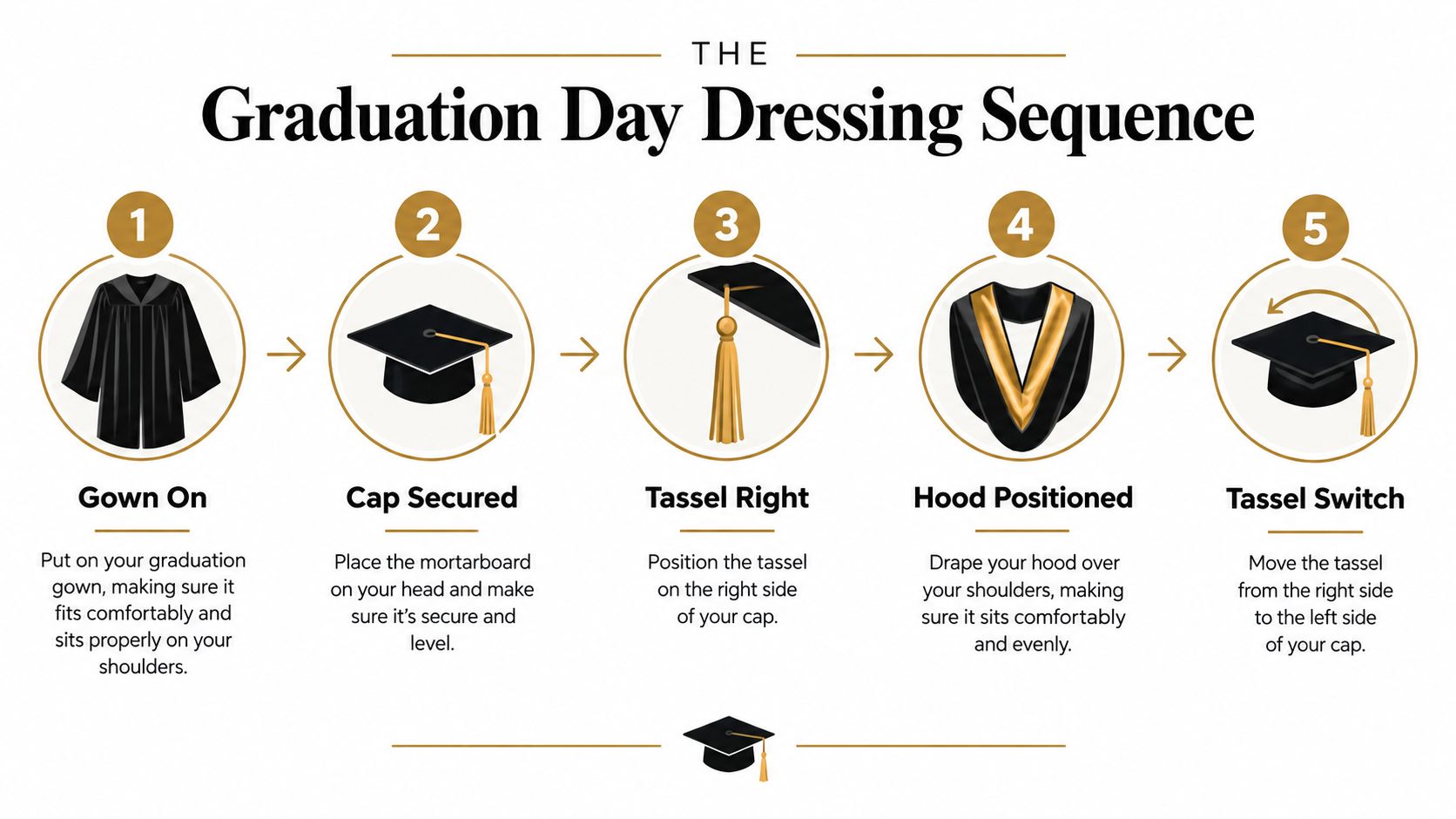
Graduation morning goes smoothly when you dress in a fixed sequence. Put on clothing that won't create bulky ridges under the gown, then check the cap and hood in a mirror before leaving for the venue.
Start with the gown. Zip or button it fully, smooth the shoulders, and make sure the sleeves fall naturally. Place the mortarboard flat on your head, with the top level rather than tilted. Follow your university's tassel instruction, which commonly places the tassel on the right before the degree-conferral moment and moves it to the left afterward. Some institutions provide different directions for master's candidates, so use the ceremony guide as the final authority.
Positioning the hood
The hood should rest over your shoulders with the velvet trim facing outward and the satin lining visible. The longer point falls down your back, while the front edges sit evenly on both sides of your chest. Use the supplied cord, button loop, pin, or discreet safety pin to keep it attached to your clothing, taking care not to damage the gown.
For a detailed visual walkthrough, follow this guide to wearing graduation regalia. Ask someone to check the back of the hood, since the lining can twist even when the front appears correct.
Add accessories after the core regalia sits properly:
- Stoles: Wear one approved stole so it remains visible without covering the hood trim.
- Honor cords: Use the number permitted by your institution, often no more than two.
- Charms and medals: Secure them where they won't pull the neckline or obscure the hood.
- Personal items: Avoid bulky additions that change the gown's drape or interfere with photographs.
Before the ceremony, take a seated and standing photo. Look for a crooked cap, uneven hood points, tangled cords, and sleeves that cover your hands. Small corrections are easier before lineup than onstage.
The video below offers another dressing reference:
Caring for the pieces afterward
Spot-clean polyester rather than washing the entire outfit unless the care label permits it. Steam wrinkles from a safe distance, and don't press satin trim directly with a hot iron. Fold the hood flat to protect the velvet, then store the gown, cap, and hood in a breathable garment bag. That routine helps preserve the set as a keepsake and keeps it in usable condition if the seller accepts rental returns.
Common Mistakes and How to Avoid Them
Most regalia problems come from treating every black graduation gown as interchangeable. Master's clothing has specific visual markers, and the hood often carries the information your school cares about most.
- Wrong hood trim: You accidentally select a bachelor's discipline color. Confirm the trim on your university commencement site and match it to your exact master's program.
- Doctoral tam with a master's gown: A tam may look polished, but it can create a style mismatch. Choose the mortarboard unless your program explicitly approves a soft tam.
- Shiny polyester: A reflective finish may conflict with a formal institutional dress standard. Request a matte fabric description or swatch before ordering.
- Ill-fitting gown: A familiar clothing size doesn't guarantee proper academic drape. Use height and chest measurements, then select a full-fit option when the chart calls for it.
- Missing hood: Some shoppers add a cap and gown but overlook the academic hood. Confirm that your package includes the master's hood required by your school.
- Late order: Waiting until commencement week leaves little room for production or corrections. Lock in the order during the standard production window whenever possible.
Also read the official regalia policy and any program addendum before checkout. Some institutions restrict vendors, specify lining patterns, limit hoods, or define which cords and stoles may be worn.
Cart check: Does your package match the master's gown template, program-level hood color, approved cap, measured size, and ceremony deadline?
Your Next Steps and Quick Answers
You can move from research to checkout with four deliberate actions.
- Find your institution: Use the school finder and select the university that grants your degree.
- Confirm the hood: Pull the program-level color sheet from the registrar, graduate school, or commencement office.
- Measure yourself: Record height and chest measurements, then compare them with the seller's size guide.
- Place the order: Choose the required package, verify personalization, and allow enough time for production, delivery, and a possible exchange.
Can master's regalia be reused for a future PhD ceremony?
Usually, not as a complete set. Doctoral gowns, hoods, and caps use different silhouettes and details, so ask the future institution whether any black gown component can be reused.
What should you do if the gown arrives wrinkled?
Hang it in a breathable space and use gentle steam according to the care label. Keep direct heat away from satin trim, and check the gown for size and color before removing tags or discarding packaging.
How can you verify that a vendor follows academic-regalia conventions?
Compare the listing with your institution's official instructions. Check the gown silhouette, hood length, velvet trim, lining colors, and package contents rather than relying only on a product title.
Are honor-society stoles and cords universally accepted?
No. Universities and ceremonies may set their own accessory rules. Confirm whether your school permits the specific stole, cord, medal, or charm before wearing it onstage.
Graduation Attire's school finder, size resources, customizable academic hoods, master's cap and gown packages, accessories, and return policy support the main decisions you need to make before commencement. Review the school requirements first, then complete your measurements and order while there's still time to correct an issue.
Graduation Attire offers master's cap and gown packages, academic hoods with customizable colors, caps, tams, cords, stoles, and related commencement accessories. Visit Graduation Attire to match your university requirements, review the size guide, and place your order with a delivery option that fits your ceremony date.