

At 11 p.m., you're comparing three browser tabs that all promise a purple graduation gown, yet none looks alike. One shows a solid purple robe, another shows a black gown with purple velvet trim, and a third offers a lavender school shell labeled “Regent Purple.” The confusion isn't your fault. Academic dress uses color in several different places, and schools don't always use the same system.
The safest way to shop is to treat the search as three separate purchases: a full purple gown, purple hood or trim accents, or a school-branded purple shell. Your ceremony rules, degree level, discipline, and school colors determine which one belongs on stage.
Why a Purple Graduation Gown Feels Like Three Different Purchases
A commencement coordinator usually starts with one question: “What color gown do I need?” The better question is, “Where is the purple supposed to appear?” Purple may cover the entire gown, edge a hood, line a velvet panel, or match a university's branded color. Those garments can look dramatically different while all being described online as purple regalia.
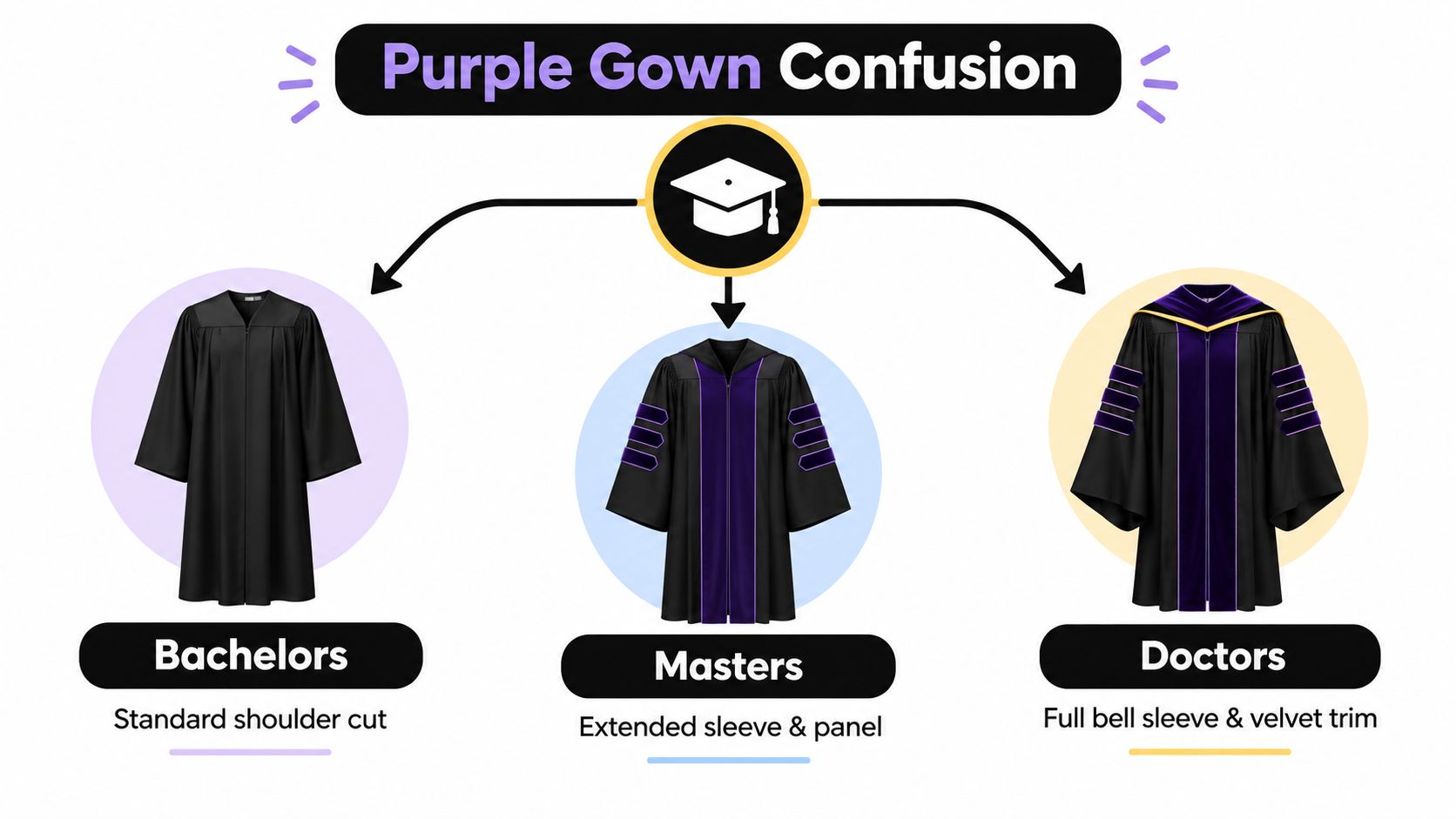
A bachelor's candidate may need a standard gown with a modest shoulder cut and a purple shell approved by the institution. A law graduate may wear a black gown with purple velvet trim or hood edging because purple identifies the discipline. A doctoral candidate may need a doctoral gown with fuller sleeves and formal velvet details, with purple assigned to the hood or trim rather than the entire robe.
The full purple gown
This is the most visually obvious option. The gown shell itself is purple from shoulder to hem, often paired with a matching cap and tassel. It can work for schools, charter programs, honor societies, or ceremonies that explicitly permit a complete purple garment. It isn't automatically correct just because purple appears in your school logo.
A full purple robe may also be a personal or group choice for a less standardized ceremony. Before ordering, confirm whether graduates must wear black, whether the institution supplies the gown, and whether the color must match an approved shade.
Purple hood or trim
Many buyers make an expensive mistake. A black gown with purple velvet trim can communicate something different from a solid purple bachelor's robe. The purple may identify law, a doctoral distinction, theology, or another institutional category, depending on the school's system.
Your gown shell, hood velvet, hood lining, chevrons, and sleeve panels should be considered separately. The graduation cap and gown guide can help you identify the basic garment before you add discipline-specific color.
The school-branded shell
A university may use a named shade such as lavender, violet, amethyst, or “Regent Purple.” In that case, the school's approved color takes priority over a generic purple gown listing. Two suppliers may call their products purple while producing visibly different shades, so a catalog photo isn't enough for a coordinated class order.
Start with the commencement office, not the shopping cart. Once you know whether the purple belongs on the shell, hood, or trim, the rest of the purchase becomes much easier.
What Purple Means in Academic Dress Through the Centuries
Purple carries meaning in academic dress because universities used color to make fields and faculties recognizable. The tradition is older than modern graduation retailers. Academic gowns trace to medieval university life, with recorded appearances at Cambridge in 1284 and a long gown requirement at Coimbra as early as 1321, as documented by Heidelberg University's history of academic clothing.
Think of the gown as the base layer and the hood or trim as a signpost. The base layer creates a shared ceremony. The colored edge tells viewers where the graduate's study belongs.
The European foundation
Faculty colors were already in use at European universities during the 16th and 17th centuries, according to Heidelberg's historical account. One Heidelberg color code assigned purple to theology, red to law, green to medicine, yellow to sciences and mathematics, and blue to philosophy.
That example explains why no universal purple answer exists. In one system, purple can point toward theology or divinity. In another, it can identify law. The color's meaning depends on the university, country, degree, and location of the color on the regalia.
Purple also became memorable because it carried associations with ceremony, prestige, and senior academic status. Its visual richness made it useful as a distinction, but the academic code matters more than symbolism alone.
The American standardization
In the United States, the Intercollegiate Code for Academic Costume was adopted in 1895, and one widely cited mapping assigned purple to law. The same system associated white with arts and letters, scarlet with theology, blue with philosophy, gold with science, pink with fine arts, and green with medicine, as summarized by Friends of Albany History.
That standardization turned scattered customs into a recognizable language. It helped make purple trim or hood edging legible as a legal-study color across many institutions, even though individual universities can still modify the system.
Practical rule: Treat a color chart like a dress code, not a suggestion. The school's official instructions outrank a general online chart.
A modern purple graduation gown therefore echoes several traditions at once. The hood may identify the degree field, the velvet may indicate the degree level, and the shell may display institutional branding. The word “purple” alone can't tell you which layer carries the meaning.

The history is useful because it prevents a common assumption: a purple gown is not merely a fashionable robe. In formal academic dress, purple can be a coded academic signal, a school identity color, or both.
Choosing Between a Full Purple Gown, Purple Trim, and School-Specific Shells
The three options look similar in a product search but solve different problems. Use the table as a first filter, then confirm the result with your commencement office.
Three Purple Gown Purchase Paths Compared
| Purchase Path | Best For | Typical Ceremony | Disqualifying Rule |
|---|---|---|---|
| Full purple gown | Independent ceremonies, charter schools, honor societies, or programs with an approved purple charter | A ceremony that permits a colored shell or requires a named purple shade | The institution requires a black gown or supplies a different shell color |
| Purple hood or trim | Graduates whose school uses discipline or degree colors on formal regalia | Law, doctoral, master's, theology, or other programs using coded hood or velvet colors | The ceremony prohibits personal hoods, trim, or non-issued regalia |
| School-specific shell | Universities with a licensed lavender, violet, amethyst, or branded purple | Institution-controlled commencement with approved school colors | The shade is unlicensed, mismatched, or the ceremony requires a standard shell |
Route one is the complete purple shell
Choose a full purple gown when the ceremony instructions clearly approve it. This route is common in settings where color is part of the program's identity rather than a faculty code. Ask whether the cap, tassel, stole, and hood must match or whether the school wants contrasting accessories.
A full shell can also be appropriate for a school-wide color theme. That still doesn't mean any shade will do. Request the official color name or supplier reference before buying for a group.
Route two keeps purple in the academic details
A black gown with purple trim may be the correct answer when purple identifies a discipline or degree distinction. Academic regalia guides assign purple to Doctor of Law, and hood-color charts use purple for law and selected related fields, as shown in the academic regalia reference from the University of New England.
This distinction matters in photographs. A black shell with purple velvet reads as formal academic dress. A solid purple shell may read as a school color or special-event garment, even if both listings use the same keyword.
Route three follows the institution's visual identity
School-specific shells require the closest color matching. A university might call its shade “Regent Purple,” while another uses lavender or violet. The name is less important than the approved sample, especially when an entire graduating class appears together under stage lighting.
At the University of Michigan, for example, academic attire assigns purple to Law, while Literature and Arts use white and Information uses lemon, according to its academic apparel color guide. That example shows why a school's own chart should settle the question.
Shade, Fabric, and Finish Differences That Show Up on Stage
A product listing's color name tells you less than you might expect. Shade, fabric, dye performance, and surface finish are separate variables, and each changes how a purple graduation gown looks in a ceremony photograph.
Royal purple usually reads as a strong, blue-leaning violet. Plum carries more red and feels darker. Amethyst is often lighter and more jewel-like, while eggplant tends toward a deep, muted purple. “Regalia violet” may be a supplier's formal label rather than a universal color standard. Unless the school provides a Pantone or physical reference, treat these names as approximate descriptions, not guarantees.
Shade under different lights
Cool LED lighting can push purple toward blue. Warm tungsten lighting can make the same fabric look redder or more wine-toned. A gown that appears soft lavender in an online photograph may read as saturated violet on stage, especially when surrounded by black robes.
Ask the seller for a fabric swatch when matching a school shade. Compare it beside the school's stole, hood, or official color reference under both indoor and natural light. Screens vary, and two suppliers may not match even when both use the word “purple.”
Fabric changes the silhouette
Polyester is common in graduation gowns because it can be woven into different surfaces and dyed for repeated event use. Polyester poplin has a structured, subdued appearance. Matte polyester satin offers a smoother face without the strongest glare, while lightweight tricot drapes easily but can look less substantial in photographs.
The fabric's weight also affects movement. A very light fabric may flutter and reveal more folds, while a heavier weave hangs with cleaner vertical lines. Don't choose by color alone. Check whether the listing identifies the fabric, finish, opacity, and care method.
Fastness is the technical question
Colorfastness determines how well the dye resists washing, light, perspiration, and rubbing. Published polyester dye studies report washing fastness commonly in the 4–5 range and light fastness from about 4 to 6–7, depending on dye chemistry, as shown in this published polyester dye-performance table.
Those figures aren't a promise about every gown. They show what to ask for. A supplier should be able to explain its testing or production standard, particularly for a saturated purple that may show fading first at the sleeves, folds, and collar.
| Shade / Fabric | Pantone Anchor | Best For | On-Stage Appearance |
|---|---|---|---|
| Royal purple, structured polyester | Request the school's approved reference | Bold school identity or group coordination | Strong, defined color with orderly folds |
| Plum, matte polyester | Request a physical swatch | Formal, darker ceremonies | Rich and subdued under warm light |
| Amethyst, satin-faced polyester | Request a named color standard | Decorative shells or coordinated accessories | Brighter, with more reflected light |
| Eggplant, matte weave | Request a physical swatch | Deep formal styling | Dark purple that may photograph near burgundy |
| Regalia violet, supplier-defined polyester | Confirm the supplier sample | Academic hood or trim matching | Depends heavily on lighting and dye lot |
For hoods, matte finishes usually photograph with less glare. Satin linings can add movement and color contrast, but flashes and stage lights will reveal more reflection. The safest purchase is the one with a verified shade reference and clear fabric information.
Sizing and Fit for Strong Photographs
A gown can be the correct color and still look wrong if the hem, sleeves, or hood drape fight the wearer. A purple gown photographs best when it hangs from the shoulders, leaves the hands usable, and keeps its academic details in place. Height alone cannot determine the size. Graduates of the same height may have different shoulder widths, chest measurements, arm lengths, or shoe heights.
Measure with a flexible tape and, if possible, a second person. Stand naturally in the shoes planned for commencement, since footwear changes the hem position.
Measure in the right order
- Shoulder to hem: Measure from the top of the shoulder to the intended hem position. The gown should fall cleanly without pooling around the feet.
- Chest: Measure around the fullest part of the chest while keeping the tape level. Leave room for formal clothing underneath.
- Sleeve length: Measure from the shoulder point to the wrist, or to the sleeve reference specified by the manufacturer.
- Head size: Measure around the head where the cap or tam will sit.
- Hood placement: Check the neckline, shoulder width, and closure method. These details determine whether the hood lies flat or twists.

Avoid the three visible fit failures
A hem that pools around the feet can create a trip hazard and form a heavy dark band in photographs. Sleeves that cover the hands make it harder to hold a diploma, shake hands, or display a watch. A twisted hood pulls the velvet edge off-center and may conceal the discipline color you selected.
Use these online clothing fit tips when comparing your measurements with a retailer's chart. A familiar streetwear size does not necessarily transfer to academic apparel, whose cut must accommodate layers and formal accessories.
Bachelor's, master's, and doctoral gowns also differ visually. A bachelor's gown generally has a simpler shoulder and sleeve treatment. A master's gown may include an extended sleeve and panel, while a doctoral gown commonly has fuller sleeves and formal velvet features. Check the degree-specific cut rather than ordering a larger bachelor's gown.
The guide to graduation gown length can help you compare hem placement. If you fall between sizes, follow the seller's measurement priority. Size up if chest or shoulder movement feels restricted. Size down if the larger option would drag, overwhelm the sleeves, or leave the hood too loose.
Try the complete outfit before commencement. Put on the cap, hood, stole, cords, and shoes, then walk, sit, raise both arms, and hold an object about the size of a diploma. A small adjustment at home is easier than correcting a twisted hood on stage.
Matching Your Purple Gown to School Regalia and Accessories
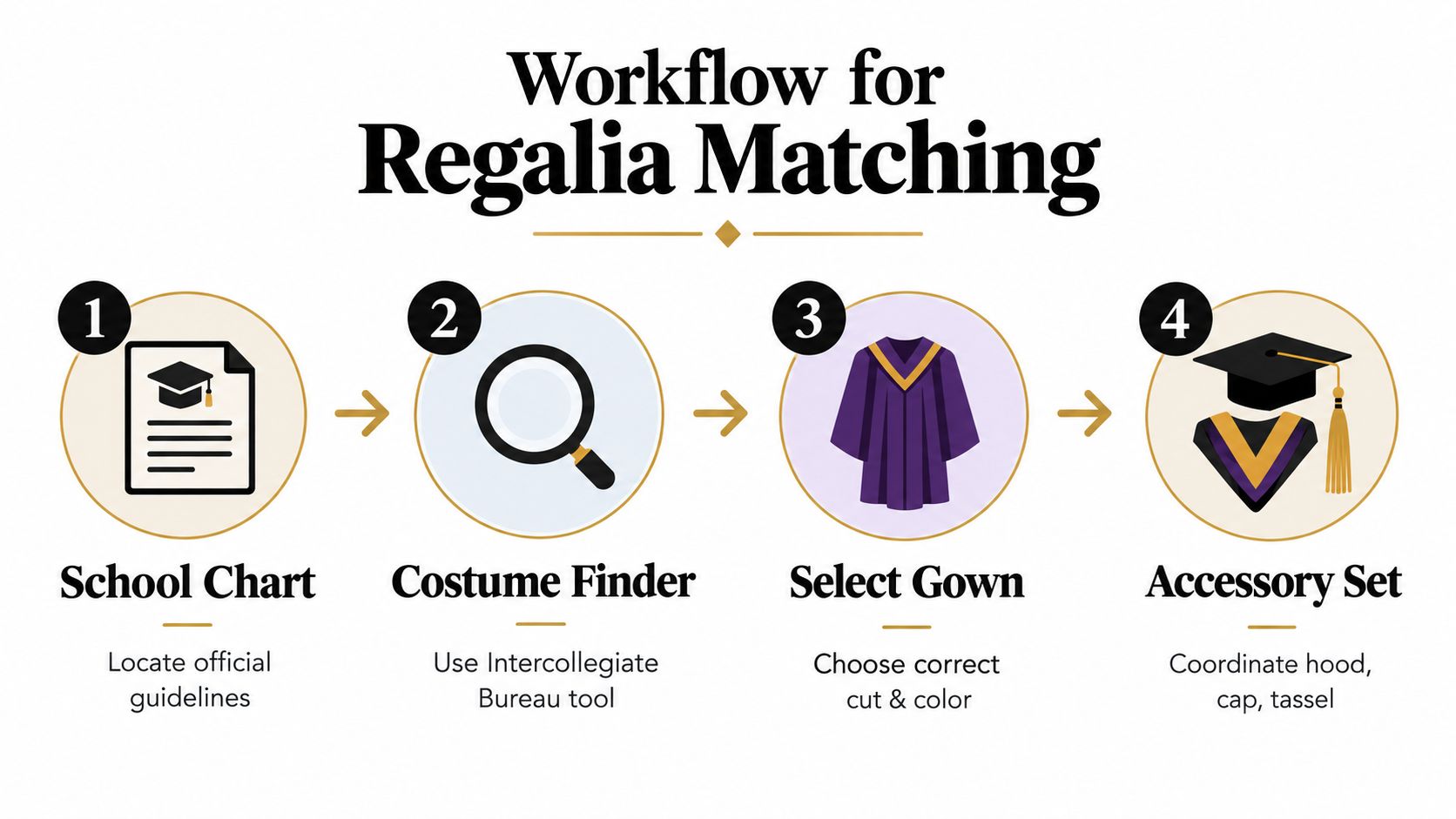
Start with the school's official academic costume chart. Don't begin with a marketplace search, because a generic purple gown may place the color in the wrong location. The school may require purple on the hood velvet, lining, shell, or a separate stole.
Four checks before you buy
- Locate the official guidelines. Look for commencement instructions, a regalia order page, or a faculty color chart. Confirm the gown cut, hood type, cap or tam, and permitted accessories.
- Use a costume finder. The Intercollegiate Bureau's academic costume finder can help you compare faculty and degree conventions, but the institution's instructions remain decisive.
- Select the shell and academic color. Match the degree level first, then confirm whether purple belongs to the discipline, school brand, or honor group.
- Coordinate the accessory set. Add the hood, tassel, stole, cords, tam, or beefeater only after the core garment is settled.
Pair accessories by purpose
A law graduate may need a black gown with purple hood velvet, rather than a solid purple shell. An education candidate may need a school-approved shell with a different hood color for the degree field. A business graduate should verify the institution's faculty color instead of assuming that purple belongs to the program. A fine arts graduate may encounter pink or another designated shade, even at a school where purple appears elsewhere.
Use the hood as the academic identifier and the stole or cord as a personal or organizational identifier, unless the school states otherwise. Some ceremonies restrict the number of cords or prohibit stacking items that obscure the hood. Honor society regalia may also require advance approval or a specific ordering process.
The commencement hood color guide can help decode the relationship between degree level and field. Bring the chart to your final fitting, especially when a purple shell and purple hood use different tones.
Match the most formal item first. If the hood is mandatory, choose its velvet and lining before selecting decorative stoles or cords.
Family members often want coordinated celebration clothing. If that's part of your plan, browse DTF graduation shirt designs separately from academic regalia. A family shirt can echo the purple palette without copying official academic colors or adding unauthorized decorations to the gown.
Customization and Personalization That Tells Your Story
A purple gown can identify a discipline or school, but personalization can show the person inside it. The right detail feels intentional. The wrong detail can cover a hood, interfere with a sleeve, or conflict with commencement rules.
Consider a graduate whose family lives across state lines. A small state flag on a stole may tell that story more clearly than a large emblem on the gown. A legacy graduate might choose a family crest, while a law or nursing candidate may prefer discipline piping that supports the academic theme.
Choose the placement before the artwork
Embroidery can appear on the gown front, sleeve, or hood. Traditional placement may differ by degree level, so ask the vendor where the design will sit when the hood and stole are worn. A crest that looks balanced on an unadorned robe may disappear beneath a hood during the ceremony.
Thread color should match a physical school chart or approved sample where possible. A stitched crest gives a built-in, formal finish. A woven shield patch can offer sharper detail for complex artwork and may be easier to replace or preserve.
Kente trim, serape accents, international flags, first-generation designs, veteran and military symbols, LGBTQ identities, nursing motifs, Greek affiliations, and honor markings each communicate something different. Keep the hierarchy clear. Academic hood first, school identity next, personal recognition after that.
Leave room for proofing
Custom work needs more coordination than a stock purple gown. Many vendors describe a typical custom lead time of 4–8 weeks, but the exact schedule depends on artwork, approval, production, and shipping. Ask for a digital proof before production and check spelling, crest proportions, thread color, placement, and ceremony date.
A student honoring a family crest should approve the proof with relatives who know the design. A first-generation graduate may want a stole message that remains visible in photographs. Someone adding a gold cord chevron or honor bar should confirm that the school permits it.
For relatives helping with the celebration, these personalized graduation gift ideas can complement the regalia without altering the official gown. Personalization works best when it preserves the garment's purpose: the ceremony should still be able to read the degree, discipline, and institution at a glance.
Ordering, Shipping, Care, and Storage From Cart to Keepsake
Treat the gown as eventwear with a deadline, not as a last-minute costume. Stock purple gowns may need 2–3 weeks for ordering and delivery, while custom embroidery may need 4–8 weeks. Rush services can reduce delivery to 5–7 business days when available, usually with an added charge, so confirm the production cutoff rather than relying only on the shipping estimate.
Choose standard ground when the ceremony is comfortably ahead. Expedited shipping makes sense when production is complete but the event is close. Campus bookstore pickup can simplify returns or exchanges, while international buyers should ask about customs duties and delivery responsibility before checkout.
Inspect immediately
Open the package as soon as it arrives. Check the shade against the order, inspect seams and closures, confirm the cap or tam size, and test the hood with the gown. If the color or cut is wrong, an early return is far easier than a ceremony-week exchange.
Read the care label before washing. Polyester matte-taffeta may tolerate gentle machine washing in a mesh bag, while satin-faced shells may require hand washing or low-heat steaming. Never use chlorine bleach on purple dye. Heat can also damage synthetic fibers or flatten a finish, so use the lowest safe temperature and avoid pressing directly over velvet, embroidery, or satin.
Store it without permanent creases
After the ceremony, let the gown dry fully before storing it. Hang it in a breathable garment bag with acid-free tissue around embroidered areas and folds. Avoid plastic bags that trap moisture.
For long-term storage, fold and roll rather than crushing the shoulders. Place tissue between major folds, roll the body loosely, and keep the cap supported so it doesn't develop a sharp crease. Recheck the garment before a future ceremony or display. A carefully stored purple graduation gown can remain part of family photographs, academic events, or a graduate's keepsake collection for years.
Graduation Attire offers purple gowns for school and university ceremonies, including matte purple high school and bachelor's styles, plus doctoral regalia, caps, hoods, tassels, cords, stoles, garment bags, and school-finder tools. Review the degree-specific cuts and color options at Graduation Attire, then confirm your institution's rules before ordering.