

The photos are the problem. One cousin poses in a full scarlet gown with a hood over her shoulders. A friend from a different school stands in a black gown with a red stole across it. A third photo shows a four-year-old in a tiny red cap, tassel swinging past her ear. Now it's your turn to order, and the dropdown lists crimson, scarlet, cardinal, and maroon as if the choice were cosmetic.
It isn't. Red in academic dress is one of the most informative signals a graduate can wear, and one of the easiest to get wrong, because the same family of shades can mean a doctoral degree at one ceremony, a journalism hood at another, and a college identity at a third. The reliable path through is to know which piece of the outfit carries the color at your level, then check your own institution's chart before you buy anything.
Red Cap and Gown Options by Ceremony Level
Find your row first. The level you're graduating from, and the piece that carries the red, decide everything that follows.
| Level | Typical red element | What to verify |
|---|---|---|
| Pre-K and kindergarten | Full red cap, gown and tassel | School palette and one-size cap fit |
| High school | Matte or shiny red cap and gown package | Accepted red shade and tassel color |
| Bachelor's | Red stole, tassel or trim on the institution gown | Commencement chart for gown color |
| Master's | Hood with red velvet or lining | Hood length and velvet edging width |
| Doctoral | Scarlet or crimson hood, or program-specific red PhD regalia | Exact institution, degree and ceremony policy |
Pre-K and kindergarten. The whole outfit is red here, cap, gown and tassel included, so the only real questions are the school's palette and whether the mortarboard sits on a small head. Most preschool sets use an elastic rim that covers a range of sizes, which is why one product serves a whole class.
High school. Packages arrive as complete red cap and gown sets in a matte or a shiny finish. Confirm two details with the school before ordering: which shade of red it accepts, and whether the tassel carries a school color or a year charm.
Bachelor's. Red rarely covers the whole gown at this level. It appears as a stole, a tassel, or trim, because the gown color itself belongs to the institution. The commencement chart decides, and it often decides something other than red.
Master's. The hood is where red lives now, either in the velvet edging that marks the field or in the lining that carries the school's colors. Length and edging width matter as much as the shade.
Doctoral. Scarlet and crimson hoods appear at many schools, and some universities issue their own red doctoral regalia as a separate item. Confirm the institution, the degree and the ceremony policy rather than assuming a doctorate means scarlet.
Not every red is a garment. At the University of Nebraska–Lincoln, undergraduate regalia includes a gown, cap, tassel, and a Nebraska red stole, while master's students receive a cap, tassel, hood, and gown, as the UNL commencement details set out. The University of Wisconsin–Madison goes further still: bachelor's gowns are black with course-color tassels, master's gowns are black with closed sleeves, and doctoral gowns have open fronts, bell-shaped sleeves, and velvet sleeve crossbars, with a redesign that added university colors, crest details and a visible pop of red. Get the piece right and the shade becomes a detail. Get the piece wrong and no shade of red will rescue the order.
Gown, Hood and Institution Rules Before You Choose Red
The institution's gown rule decides the purchase before the shade does. In U.S. academic regalia, discipline colors sit primarily on hood velvet, doctoral gown facings, sleeve bars, and sometimes tassels, while the gown itself is generally institution-specific in color. A red gown usually says something about your school first and your degree second.
That split between the garment and its trim is the whole system in one picture.
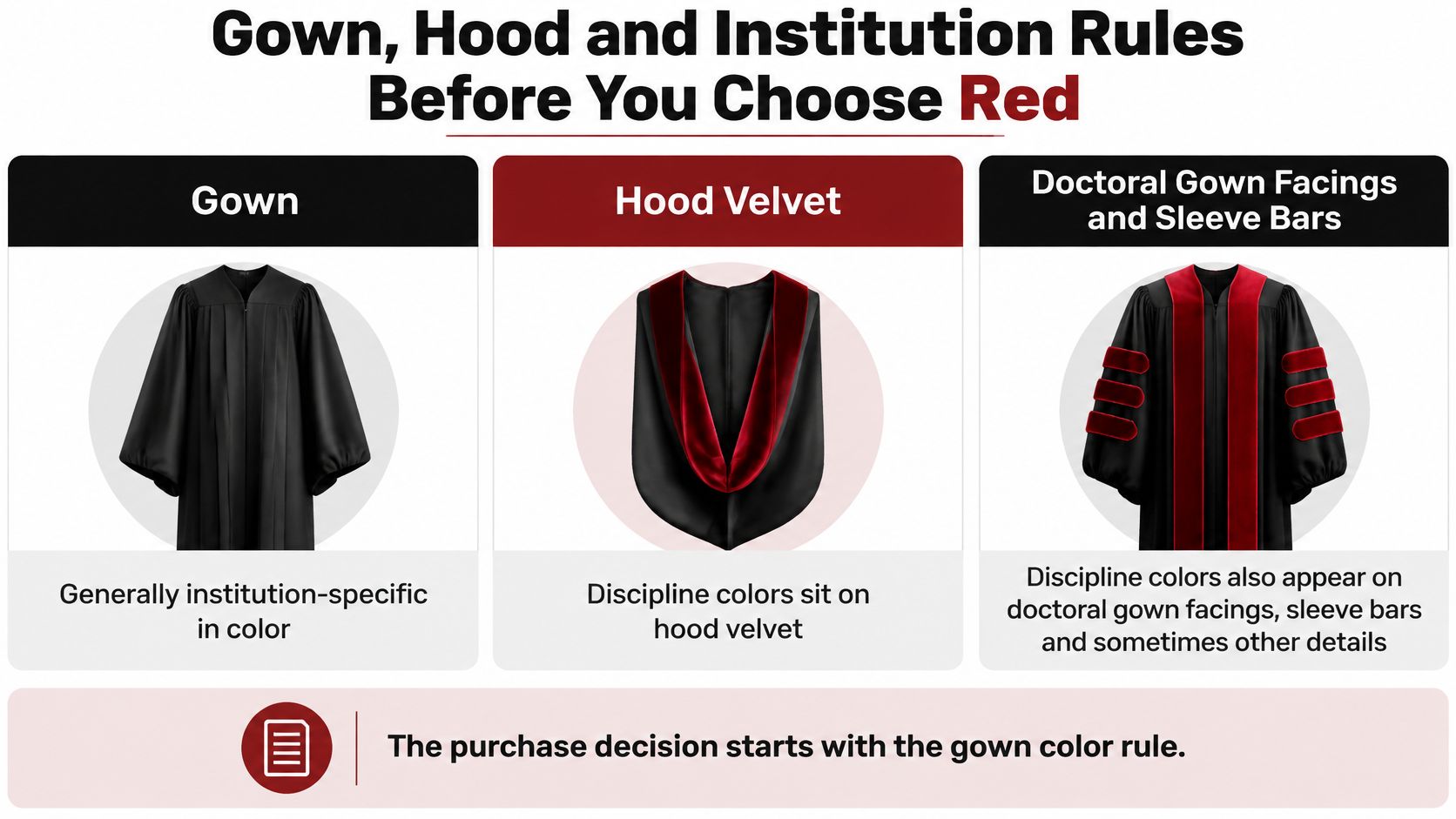
Separate the four color decisions. Before you open a product page, write down the four colors the institution specifies: gown, hood velvet, hood lining, and tassel. They work like four dials on the same board, and turning one never moves the others. The University of Kentucky commencement guide makes the point with two red-family shades, associating red or crimson with journalism and scarlet with theology. Two swatches from the same card, two different fields.
Compliance covers the whole set, so a red gown paired with an incorrectly colored hood fails the requirement even when the garment itself fits perfectly. Read the commencement specification first and shop second.
Check the hood against the degree
Hood dimensions give you something concrete to measure at the fitting. The commonly cited U.S. code figures in Anderson UCLA's regalia standards set bachelor's hoods at about 3 feet long with 2-inch velvet edging, master's at about 3.5 feet with 3-inch edging, and doctoral at about 4 feet with 5-inch edging, with the lining carrying the institution's official colors and the velvet edging representing the academic field.
| Degree | Hood length | Velvet edging width | Lining |
|---|---|---|---|
| Bachelor's | About 3 feet | 2 inches | Institution colors |
| Master's | About 3.5 feet | 3 inches | Institution colors |
| Doctoral | About 4 feet | 5 inches | Institution colors |
Those widths change what people see. A wider edging puts more contrasting color against a red gown, so a doctoral hood in crimson velvet reads very differently from a bachelor's hood in the same shade. Schools publish variations on these figures, and the institution's regalia guide overrides any table when the two disagree.
Where institutions diverge
The University of Bristol's academic dress regulations define a specific University red for academic hoods, and the same document notes that the University of Surrey prescribes cardinal-red gowns for several doctoral awards while varying hood lining and trim by qualification. Same country, same word "red", two different systems.
The University of Illinois Chicago takes another route, listing UIC Red PhD Regalia under a separate order number from its other regalia, per the UIC caps and gowns page. There, the red set exists as a university-approved product with its own entry, so the correct purchase is a designated item rather than a shade picked from a color menu.
Practical rule: Match the gown to the institution, the hood velvet to the field, the lining to the school, and the tassel to whatever the chart names.
When a shopping listing and the school's chart disagree, the chart wins every time.
Why Red Means Different Things at Different Schools
In 1893, representatives of leading U.S. institutions formed an Intercollegiate Commission on Academic Costumes and Ceremonies. The commission met at Columbia University in 1895 and adopted a national code specifying the cut, materials and colors of caps, gowns and hoods, as the record of academic dress shows. The code made black the default for the gown, cap and hood shell, then pushed meaning into the edging and lining.
That framework turned color into an information system. White stood for arts and letters, golden yellow for science, purple for law, orange for engineering. Red developed as a local choice, the shade a campus adopted when it wanted its own mark on the ceremony.
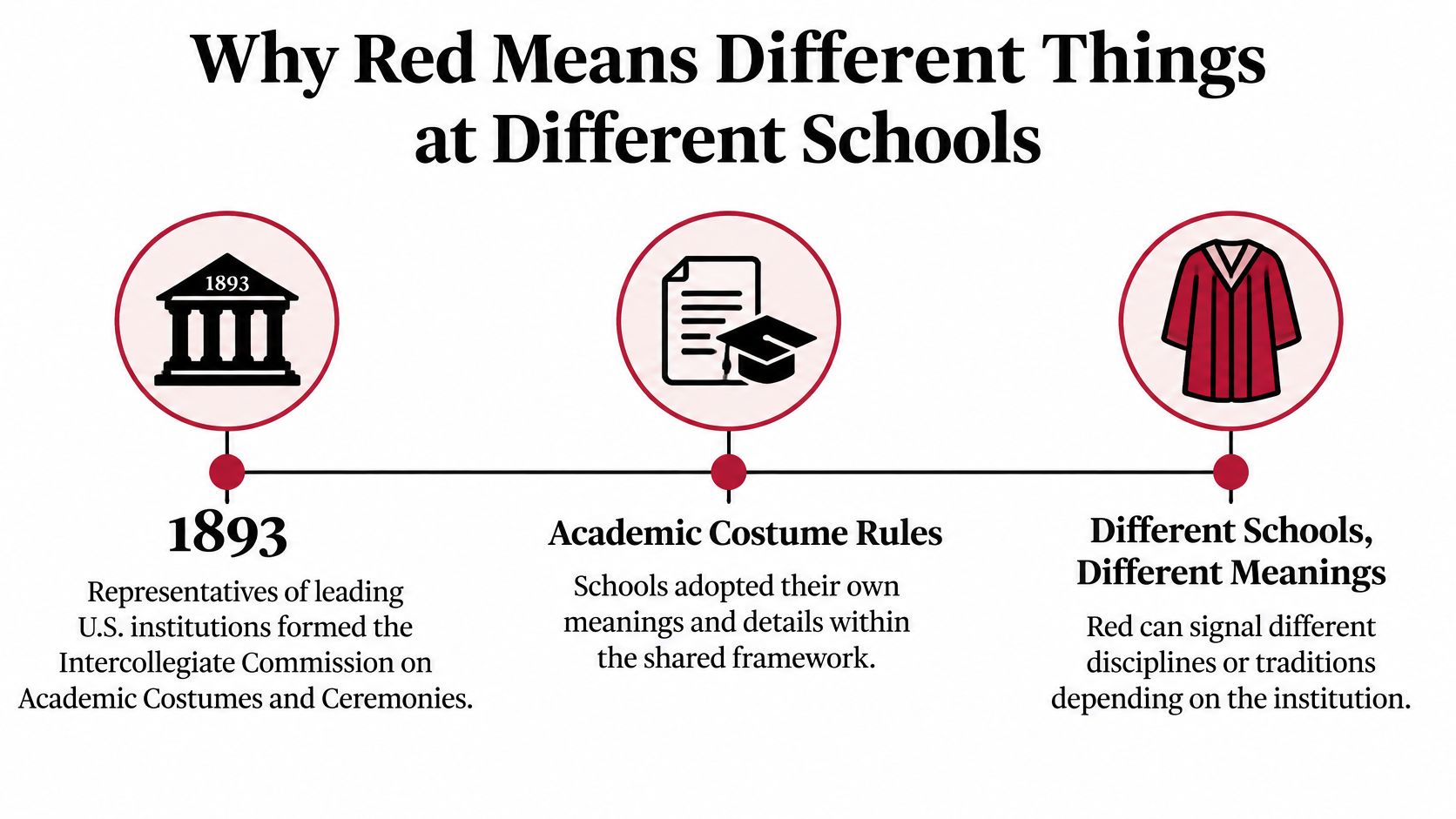
Harvard's crimson doctoral gowns show the pattern. A single university decision became so recognizable that later graduates could mistake a campus custom for a national rule. Treat red as a school color first and a credential second: the same swatch can belong to a doctorate at one institution, a college at another and a recognition stole somewhere else.
What each red actually signals
| Example | Red element | What it signals |
|---|---|---|
| Harvard University | Crimson doctoral gowns | A university-specific doctorate tradition |
| Purdue University | Red | Polytechnic Institute college color |
| University of Nebraska Lincoln | Nebraska red stole | Undergraduate recognition accent |
| United Kingdom and Ireland | Scarlet cloth for doctoral hoods | Regional academic custom |
Purdue's commencement guide lists red as the official color for all programs in its Polytechnic Institute, alongside olive green for pharmacy and peacock blue for public policy, per the Purdue commencement attire guide. On that campus red reads as a college, not a credential.
The deeper inheritance explains why the color carries weight at all. Academic dress emerged in the 12th century, when scholars at developing universities wore long robes influenced by clerical and monastic clothing, garments that served warmth in unheated buildings while marking scholarly and religious status. By 1321 the University of Coimbra had formally required Doctors, Bachelors and Licentiates to wear gowns, one of the earliest documented institutional rules for academic dress, according to Arizona State University's history of grad garb. In the United Kingdom and Ireland, doctoral hoods are traditionally cut from scarlet cloth.
That history is still visible on stage today.
Discipline colors follow their own logic, and the reference on graduation hood colors and their meanings is the place to check a specific field before ordering. Read red as a clue to a school or a field, then confirm it against that school's own chart. The color rarely announces a degree level by itself.
Stoles, Honor Cords and Personal Touches That Stay Within Rules
Sort everything you plan to wear into three buckets before ceremony day, because they follow different rules. Required regalia is whatever the degree and institution demand: the gown, the hood, the cap, and the tassel. Permitted recognition items are the ones the school sanctions, such as honor cords, an approved stole, a cultural sash, or a military cord. Optional self-expression is everything else, and it's the bucket that causes trouble at the door.
The confusion starts with the color itself. Red can signal institutional identity, theology, doctoral status, honorary rank, or a school's chosen palette, as Oxford's academic dress page sets out in describing academic colors as historical markers of status and occasion. Whittier College makes a similar point from the other direction, noting that academic dress identifies degree level, institution and discipline even though the growing number of fields makes identification imperfect. One shade, several possible readings.

Placement is where identity accessories and ceremony rules collide. Some universities specify which side of the hood's silk should be exposed and regulate discipline-based colors for gowns, hoods and stoles. An accessory that hides the hood lining, or flips the silk, removes the marker the ceremony is built around.
Think it through with a common pairing. A red stole issued by the school reads as institutional recognition. A first-generation stole worn over a red gown adds personal meaning, but the school may need to approve extra stoles before you wear one in the procession.
Run three tests before you add anything. Will the item show clearly in photographs? Does it cover the hood or its lining? Is it listed in the school's rules?
If any answer is no, leave it off the regalia and wear it to the party afterward. Further guidance on approved accessories lives in this overview of cords and stoles. Settle the required and permitted items first, then choose personal touches that fit inside the approved set.
How to Size and Order Your Red Cap and Gown Set
A red gown that drags on the floor or a cap that wobbles in the lineup photo usually traces back to one skipped step. Work through the sequence below in order and the set arrives right the first time.
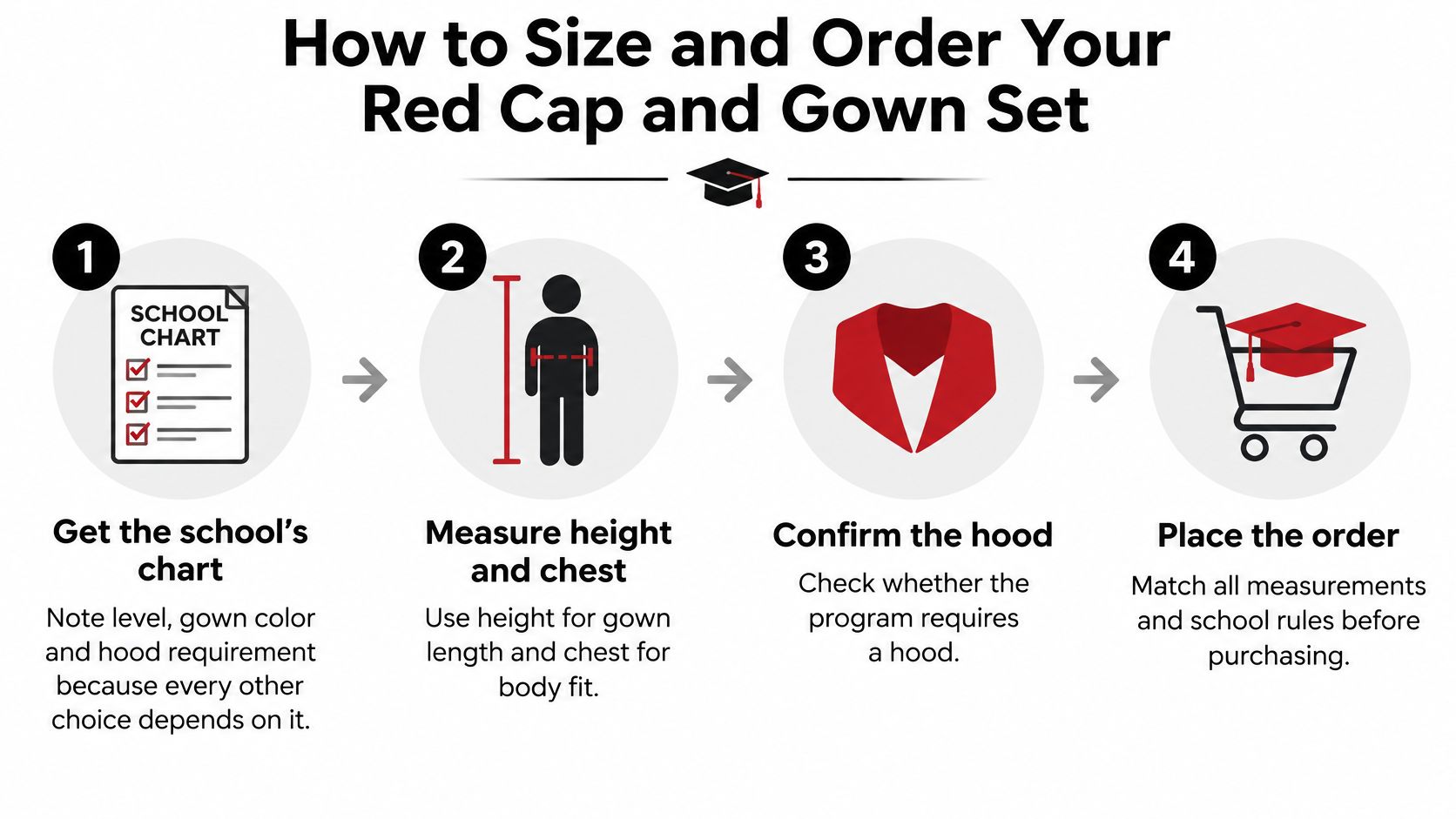
- Pull the school's chart first. Write down your level, the shade of red it specifies, and whether a hood belongs in the set. Red points to a school or a field more often than to a degree level, so that page decides everything that follows, and it is the one place where a wrong guess gets expensive.
- Measure height for the gown and chest for the body. Take both numbers with a tape measure rather than from memory, and read them against the seller's size chart instead of your clothing size. The steps for a proper graduation gown measurement show which height ranges sellers use, and the Robosize guide to fashion sizing helps when a chart's labels do not match the system you know.
- Check the cap sizing. Where a package bundles the cap, the product page states whether it is sized or one size fits all, so a head measurement only matters when the listing asks for one. At the preschool end, the Child Matte Red Graduation Cap & Gown combines gown and cap in a single order. Read the contents line rather than the photo: ordering a tassel separately because the picture did not show one is the usual mistake.
- Match the hood to the degree table. Hood length and edging width mark the degree, so a wrong length appears in every photograph and cannot be fixed on ceremony morning. If your level wears one, a bachelor's package that bundles the gown, cap, tassel and hood in a single order keeps the pieces consistent with each other.
- Choose the tassel color and year charm. Cap and gown packages ship with a current year charm on the tassel, so a dated charm normally arrives with the set. Order a different color only when the school's chart asks for one; buying it later means paying shipping twice for an item that weighs almost nothing.
- Pick the finish the school photographs in. High school gowns come in matte and shiny finishes, and the two reflect stage lighting differently. Match the school's own ceremony photos rather than the swatch that looks best on your screen.
- Compare prices on comparable bundles. Price follows what is inside the package. A matte high school cap and gown lists at $25.49 and falls to $20.39 at volume, while bachelor's packages that add a hood list at $66.44 for the matte version and $110.85 for the deluxe, dropping to $53.15 and $88.68 respectively. Compare identical contents before you compare totals.
- Test-fit about a week before. Zip the gown, seat the cap, pin the hood where it will sit, and climb a flight of stairs. A week leaves time to exchange; the night before does not.
Confirm the Right Red Set Before You Order
Three checks settle the order: your level, your institution's color rule, and the hood or stole that rule allows. Run them in that sequence and the shopping list gets short.
For pre-K and kindergarten ceremonies, the Child Shiny Red Graduation Cap & Gown pairs the gown with a matching cap. For high school, cap and gown packages come in all sizes and colors, with the gown and mortarboard offered in matte or shiny finishes, and the tassel carries a current year charm. Bachelor's packages bundle the gown, cap, tassel and hood into a single order, which matters at schools that require a hood, since ordering the pieces separately invites a mismatch in fabric or shade.
For master's and doctoral sets, the hood works like a name tag for the degree: the velvet color names the field, and the lining shows the school's colors. Confirm both against your institution's chart before adding a hood to the cart, and remember that help is available for determining the proper colors for the velvet and chevrons. If a listing and the registrar ever disagree, treat the registrar's answer as final, because the school owns the rule.
Graduation Attire stocks red regalia at every level, from preschool caps and gowns through bachelor's, master's and doctoral sets, along with the stoles, honor cords, tams and year charms that complete an outfit. If your school's chart calls for red, we can help you match the velvet and chevron colors on the hood to the field your degree names and get the set to your door with time for a proper fitting. Start at Graduation Attire with your institution's color chart in hand.