

You're halfway through ordering graduation attire when the ceremony packet stops you: royal blue cap and gown, not navy, cobalt, or “whatever blue looks close on the website.” That small wording difference can affect the gown body, tassel, hood, trim, fabric finish, and even whether the outfit follows your school's rules.
Royal blue works beautifully in graduation photos, but it isn't always just a fashion choice. Academic-dress systems use blue shades to identify programs, degree meanings, school colors, and honor groups, while individual institutions may use the shade in completely different places. The safest approach is simple: verify the school's specification first, then choose the right size, material, finish, and accessories.
Starting Your Royal Blue Cap and Gown Search the Right Way
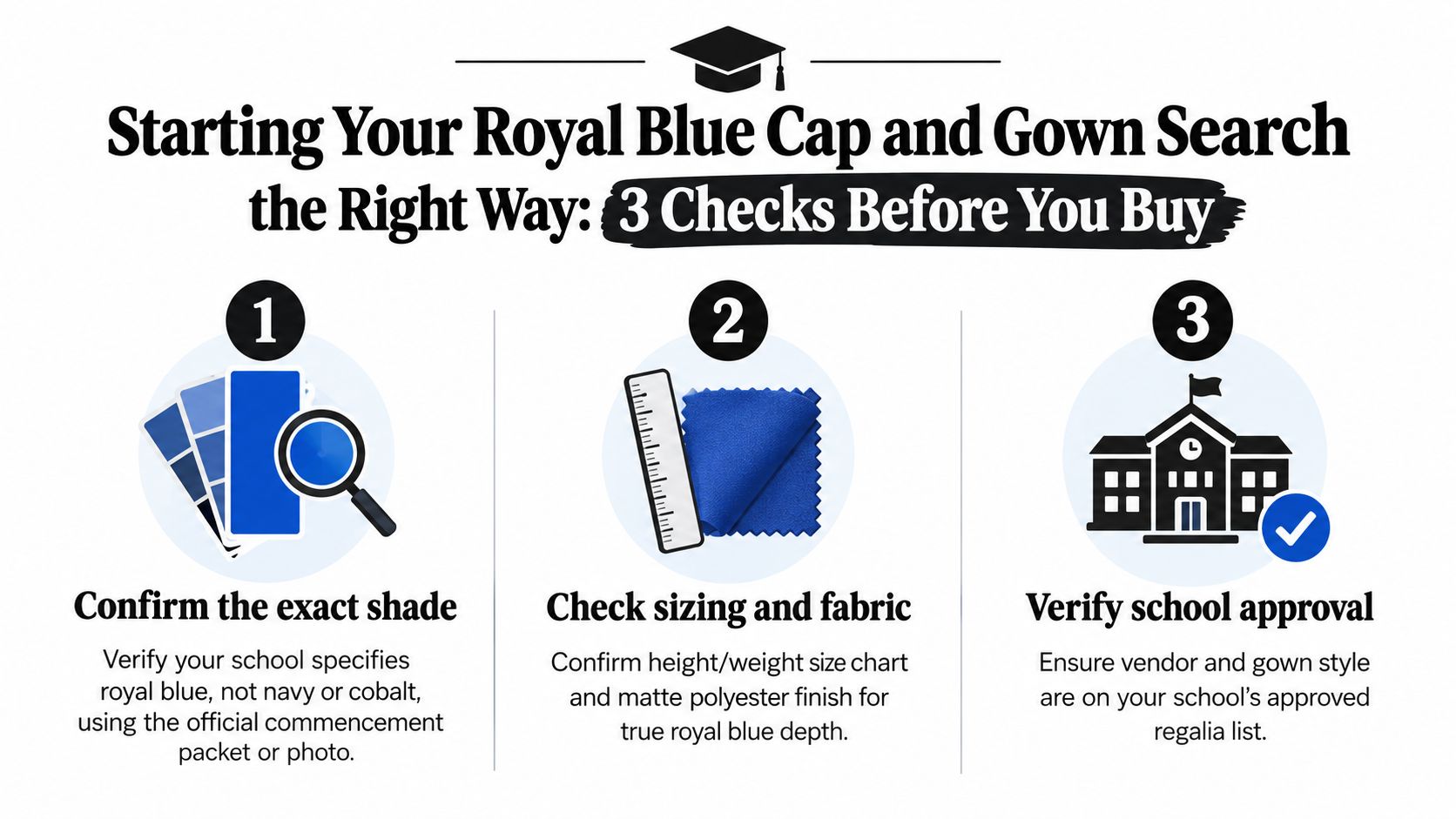
A graduation order usually goes wrong before checkout. Someone sees a bright blue product photo, assumes it matches the school's royal blue, and discovers later that the university wanted a black gown with a royal blue hood edge or tassel instead. Start with the official commencement packet, regalia email, bookstore listing, or approved-vendor page.
Check the shade before the product page
Search the school's materials for the exact wording. Royal blue, dark blue, navy, and cobalt aren't interchangeable descriptions. If the school provides a photograph, compare the product swatch with the official image, but don't trust a phone screen as your final color reference. Screen brightness, display settings, and photography lighting can make the same fabric appear lighter or more violet.
The name itself has a long history. Sources date the first recorded English use of “royal blue” to 1810–1820, connecting it with a dress-making competition for Queen Charlotte in England. Canva's overview of royal blue explains why the shade carries associations with formality and prestige rather than being a recent branding invention.
Build the order around the correct graduate
Measure height and chest with the shoes you'll wear, then confirm the degree level. An associate or bachelor's order isn't built the same way as a master's or doctoral order, even when the color is identical. A doctoral candidate may need a tam, velvet panels, or a hood, while a bachelor's graduate may need only a cap, gown, and tassel.
Don't borrow a friend's gown two sizes up just because the color looks right. Extra fabric can drag, bunch at the shoulders, and make the sleeves look uneven in photographs. Also check the zipper placement, because royal blue regalia doesn't follow one universal construction.
Practical rule: Verify the school's shade, your measurements, and your degree level before comparing fabric or price.
For a useful ordering companion, graduation celebration registry tips can help families organize related ceremony needs without mixing them into the regalia decision. You can also review this cap and gown buying guide before choosing a package. Those three checks turn a visually appealing order into a verified match for color, fit, and configuration.
What Royal Blue Means in Graduation Regalia
Royal blue can be a fashion choice or an institutional code. Those are separate questions. A saturated blue may look formal in photographs, yet still be the wrong academic color, placement, or degree configuration for your ceremony. The shade has carried associations with prestige for more than 200 years, while academic dress in the United States was standardized in 1895. Treat those as historical context, not proof that every royal blue gown carries the same meaning. The summary of academic dress in the United States provides the stronger reference for academic-dress conventions.
Some institutions use royal blue for a faculty, discipline, honor group, class identity, or school-color system. Academic-regalia references connect blue shades with areas such as philosophy, leadership, service, political science, counseling, public administration, and education, but your school's rule controls. Graduation Attire's explanation of graduation rope colors describes royal blue as a visible distinction color rather than one universal emblem.
Read the school's rule in the right order
Check the school's documents before comparing retailer swatches:
- Commencement regalia FAQ: Confirm gown color, hood requirements, tassel color, and degree-specific instructions.
- Bookstore product listing: Check whether the school sells a full royal blue gown or a black gown with royal blue accents.
- Faculty or hood-color chart: Identify whether royal blue belongs on the velvet facing, hood border, sleeve stripe, lining, or cap.
- Approved vendor information: Match the retailer's construction and finish to the required design.
A gown can look correct in isolation and still violate the dress code if the institution requires royal blue only on a facing or hood edge. The color name alone does not confirm placement, sheen, fabric, or degree meaning. Confirm all four before checkout.
| Source | Typical Royal Blue Shade | Approx. Pantone Reference | Notes for Buyers |
|---|---|---|---|
| School regalia guide | Institution-specific blue | May provide a swatch or named color | Treat this as the controlling specification |
| Retailer product page | Bright royal blue or a deeper blue | Often not provided | Request a swatch when color matching matters |
| Academic hood chart | Royal blue trim, edging, or lining | Depends on the institution | Confirm whether the color applies to the whole gown |
| Personal fashion choice | Saturated jewel-toned blue | Not an academic standard | Suitable only when the school permits custom attire |
Degree level matters as much as shade. A bachelor's graduate may need a cap, gown, and tassel, while a master's or doctoral candidate may need a hood, velvet panels, sleeve details, or a tam. The academic costume tradition also distinguishes field and degree colors. Dark blue signifies the Master of Philosophy, and Doctor of Philosophy gowns use dark blue velvet regardless of discipline. That is different from selecting royal blue because you like its appearance.
Use a school-approved shade, then verify the fabric and configuration. If you're planning a personal speech or family celebration, custom speech for graduation can support that part of the event. Keep the creative choices separate from the regalia decision. Your preferred blue should never override the school's documented requirements.
Choosing Fabric and Finish That Photographs Well
For most royal blue cap-and-gown orders, 100% polyester is the practical starting point. Regalia references describe polyester as lightweight, shrink-resistant, mildew-resistant, quick-drying, and more stable in color over time than acetate, while also warning that prolonged sun exposure can fade it. This royal blue matte gown reference supports choosing polyester when the garment must survive shipping, handling, and ceremony-day movement.
Matte versus satin
Matte polyester gives royal blue a controlled, substantial appearance. It usually photographs more evenly under direct light and hides minor packing wrinkles better than a highly reflective surface, though it can look less dramatic in a dim indoor venue.
Satin creates brighter highlights and a more vivid stage appearance. That can be attractive in photographs, but strong sunlight, flash, or overhead lighting may reflect across the chest and sleeves, making the blue appear lighter in some frames. If you're sensitive to shine, choose matte.
Acetate and other non-polyester satin alternatives deserve caution for bulk orders. Independent regalia guidance describes them as less color-fast and more likely to require dry cleaning, which creates avoidable care and consistency problems when many gowns need to match. A second royal blue matte zipper gown reference also emphasizes checking whether royal blue is used as the body fabric or as a trim element.
| Fabric Type | Finish | Weight | Wrinkle Resistance | Camera Performance | Care Needs |
|---|---|---|---|---|---|
| Polyester | Matte | Product-specific | Strong, especially for travel | Even, lower glare | Hang, steam, and spot-clean according to label |
| Polyester | Satin | Product-specific | Generally practical, but highlights reveal creases | Brighter reflections under flash or sun | Handle carefully and avoid direct high heat |
| Rayon blend | Soft or semi-satin | Product-specific | Can crease more easily | Elegant drape, but lighting may vary | Follow the care label closely |
| Cotton mix | Matte or textured | Product-specific | Depends on the blend | Natural appearance with less sheen | May need more careful pressing and storage |
Use the ceremony as your shortcut
Choose matte polyester for travel, repeated handling, outdoor ceremonies, or anyone who dislikes shine. Choose satin when the school requires it or when a high-reflection finish fits the event. Consider a blend only after checking its care instructions and confirming that the shade matches the official specification.
The custom academic regalia fabric guide describes royal-blue-compatible Verona fabric as a 100% polyester crepe weave with wrinkle resistance and long life. That makes fabric selection a construction decision, not just a color preference.
Getting the Size and Fit Right by Degree Level
A royal blue cap and gown should hang cleanly from the shoulders, clear the floor, and leave enough room for movement without swallowing your frame. Measure your chest at its fullest point, record the shoulder-to-hem length, and measure your head circumference at the brow band for the cap. Wear the ceremony shoes during the length check. Ignoring shoe height is one of the easiest ways to order a hem that looks fine barefoot but drags during the procession.
Match the cut to the degree
Degree level changes the sleeve shape, gown length, and headwear. Don't select a master's height chart for a bachelor's gown, and don't choose a plus-size option when a tall size better matches your proportions. Width and length solve different fit problems.
| Degree | Gown Length | Sleeve Style | Cap | Fit Watch-Out |
|---|---|---|---|---|
| Associate | School chart | Usually open-front, matte polyester style | Mortarboard | Avoid excess length and shoulder pooling |
| Bachelor's | School chart | Usually open-front with unlined sleeves | Mortarboard | Check sleeve reach and shoe height |
| Master's | School chart | Longer cut with closed or oval sleeves | Mortarboard | Don't confuse extra length with extra width |
| Doctorate | School chart | Velvet chevron and sleeve bars may be required | Matching tam may be required | Confirm doctoral construction, not only the color |
Associate and bachelor's gowns commonly use an open-front cut with unlined sleeves. Master's gowns typically use a longer cut with closed or oval sleeves and a fabric panel that covers the arms. Doctoral regalia can include a velvet chevron down the front, three velvet bars on each sleeve, and a soft tam in matching royal blue, but your institution's rules control the final configuration.
Sleeves should end at the wrist bone, not cover your hands. Length should be judged in the shoes you'll wear on stage.
Try the complete outfit at home. The hem should clear the floor by about one inch in your ceremony shoes, the sleeves should finish at the wrist bone, and the cap should sit flat without sliding forward when you bow. If the cap tips, adjust the fit at the band or use discreet pins approved by the ceremony rules.
Before ordering, use this graduation gown measurement guide to compare your measurements with the seller's chart. Never assume a small, medium, or XL means the same thing across vendors.
Timing Your Order and Customization
Regalia problems often come from timing, not product quality. A standard gown may arrive in time while an embroidered name, custom stole, hood lining, or special tassel follows later. Build your order around the ceremony date and leave room for inspection, exchange, and steaming.
Use an eight-week countdown
At eight weeks before commencement, confirm the approved vendor, the exact royal blue shade, the degree-level configuration, and the school's accessory rules. Don't place the order until you know whether royal blue applies to the full gown or only to an accent.
At six weeks, order the base gown and cap. Standard sizes need to arrive with enough time for a try-on, and earlier ordering gives you a chance to correct a height, chest, cap, or zipper mismatch.
At four weeks, submit personalization for stoles, hood lining, embroidered names, or custom tassels. These items may ship separately, so treat the personalization cutoff as its own deadline rather than assuming it travels with the gown.

Protect the final two weeks
At two weeks out, review every shipping confirmation, verify the delivery address, and check whether your school offers campus pickup or requires a rented cap to be returned. Test the full outfit immediately rather than waiting for rehearsal.
At one week out, steam the gown, inspect the seams and zipper, and pack a backup stole if you'll wear one. Put a needle, thread, safety pins, and backup tassel in a small emergency kit. On ceremony morning, keep the regalia in a garment bag instead of leaving it compressed on a hanger until you're ready to dress.
The exact deadlines vary by vendor and school, but the logic doesn't. Base regalia comes first, personalization comes next, and the final buffer protects you from a late delivery or exchange.
Matching Accessories to Your Gown and School
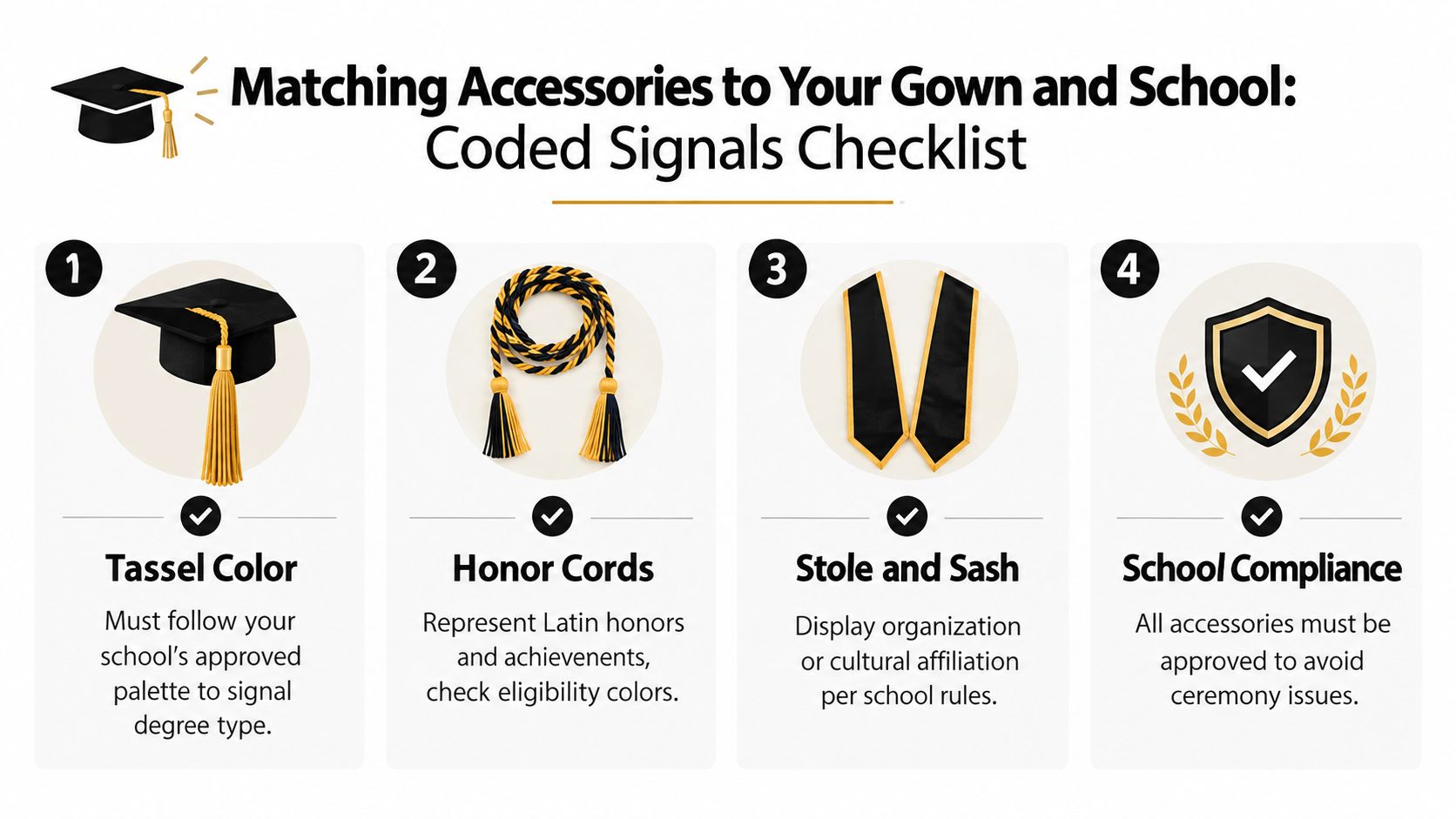
Accessories aren't random decoration. Each one can identify a degree type, honor, organization, cultural affiliation, military connection, or field of study. Royal blue can make those details especially visible, so the wrong accent color or an overloaded neckline will show quickly in stage photographs.
Read each accessory as a signal
Tassels usually follow the school's approved palette and may indicate degree type or academic area. Don't substitute a royal blue tassel just because it matches the gown. At CU Boulder, for example, royal blue is used for Business, while another institution may assign it to a different program or group.
Honor cords can represent Latin honors, club membership, service, or military affiliation. Wear only cords you're entitled to receive, and verify their colors through the commencement program or student affairs office.
Stoles and sashes sit over the shoulders and may display fraternity letters, cultural heritage, first-generation identity, nursing, HBCU affiliation, Kente, serape, veteran status, or another approved connection. One or two strong pieces usually photograph more clearly than a crowded stack.
Match the hood to the degree
Hoods generally belong to master's and doctoral regalia. Their lining and velvet trim can reveal the field of study, but the mapping varies by institution. Royal blue velvet may connect with education, philosophy, or another discipline in one catalog and carry a different meaning elsewhere.
Charms and medallions attach to a cap tassel or hang below the gown. Check the tassel cord length before adding weight, especially if the cap already has a large year charm. The accessory should hang securely without pulling the tassel across your face.
Photograph-first rule: Choose accessories that remain readable from the audience, then remove anything your commencement program doesn't authorize.
Schools can remove unapproved items at the stage door, so check the commencement program before adding a custom stole or extra cord. For tassel construction and placement ideas, review this guide to tassels for graduation.
A short visual reference can also help you compare how accessories sit on a gown:
Caring for Your Regalia and Handling Returns
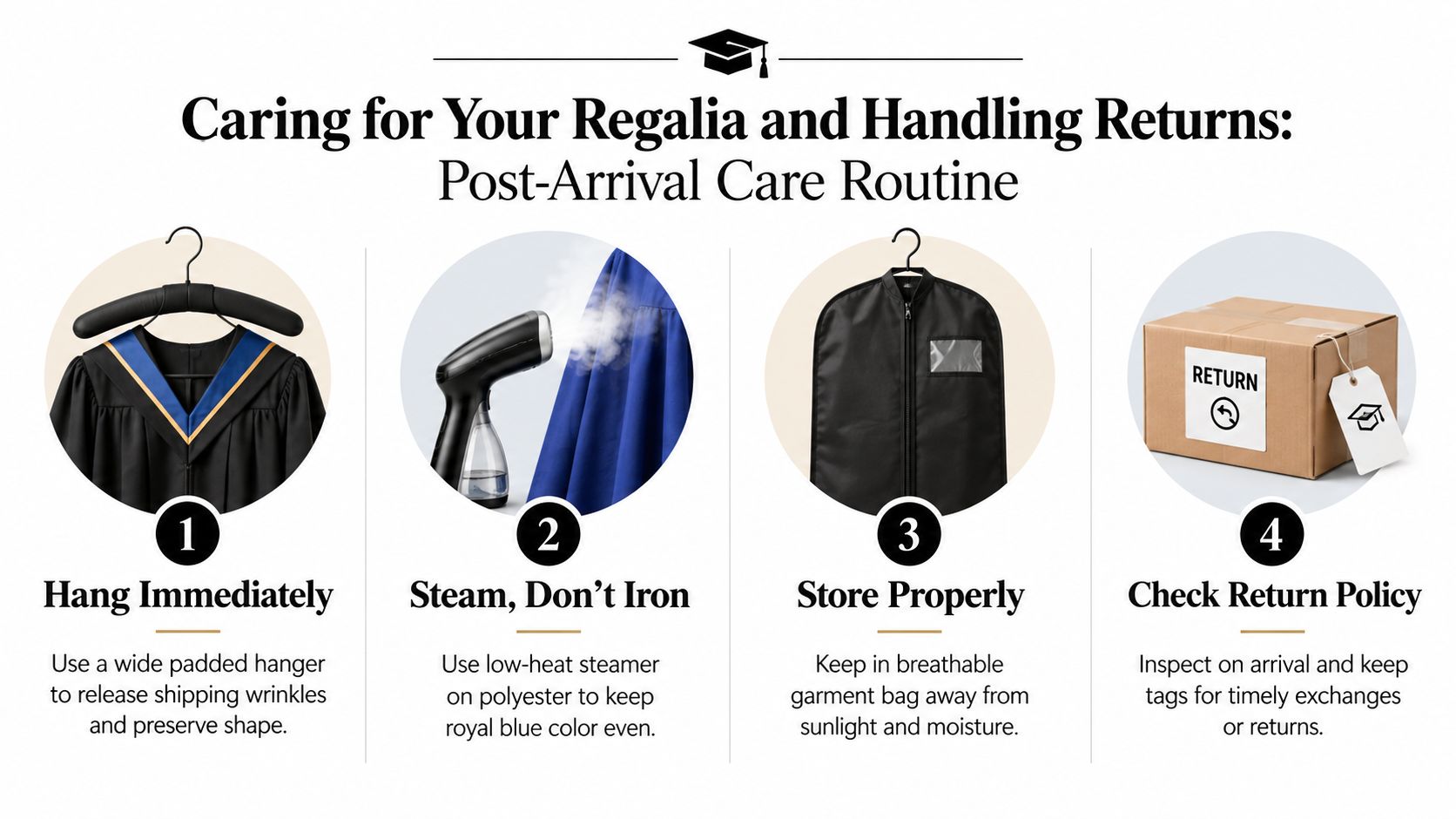
Royal blue polyester usually arrives compressed, so unpack it as soon as it reaches you. Hang the gown on a wide padded hanger, keep it away from direct sunlight and moisture, and let the fabric release its shipping wrinkles before judging the fit.
Use a handheld steamer rather than a hot iron. Hold the steamer roughly six inches from satin or shiny fabric, keep it moving, and avoid pressing the head directly against the gown. Direct heat can flatten texture or create shine marks that stand out under ceremony lighting.
Clean and pack without damaging the finish
For a small mark, use a damp microfiber cloth and mild detergent on the affected area. Don't dry-clean the entire gown unless the care label or seller specifically requires it. Full cleaning can introduce unnecessary risk before a single ceremony.
For travel, roll rather than fold the gown. Rolling reduces hard creases that a camera flash can catch across the front. Keep the cap supported so the mortarboard doesn't bend, and use a breathable garment bag for storage instead of sealing damp fabric in plastic.
Check the return policy before removing tags
Before the order ships, confirm whether customized items can be returned or exchanged. Save the original packaging, photograph the unboxed regalia if it arrives damaged, and write the return-window end date on your calendar. Try on the gown as soon as it arrives, because a sizing exchange is only useful if it happens before commencement.
Check the zipper, seams, hem, cap fit, color consistency, and accessory contents. If the blue looks different across pieces, photograph the comparison in neutral daylight and contact the seller before washing, altering, or personalizing anything.
Graduation Attire offers royal blue cap-and-gown options across school levels, along with matte and shiny finishes, tassels, tams, hoods, cords, stoles, garment bags, and other regalia accessories. Visit Graduation Attire to compare the available configuration with your school's requirements, confirm sizing, and order with enough time for inspection before commencement.