

Your academic hood is what transforms a simple graduation gown into a powerful statement of everything you’ve accomplished. Think of it as a wearable resume, a piece of your academic regalia that instantly tells a story about your degree level, your field of study, and the university that granted it. It's far more than just an accessory; it’s a tribute to your entire educational journey.
Decoding the Academic Hood

The academic hood is a long, draped garment worn over your shoulders and down your back as part of traditional graduation attire. Every single element—from its fabric to its colors and size—is carefully designed to communicate specific details about your academic achievements.
Once you know how to "read" a hood, you’ll see that it's the centerpiece of the whole commencement look, speaking a rich and silent language of academic tradition.
The Three Key Parts of a Hood
Every hood is built from three distinct components, and each one has a specific job to do in telling your story:
- The Shell: This is the main body of the hood. It’s almost always made of black fabric to perfectly match your graduation gown, creating a seamless foundation.
- The Silk Lining: Here’s where it gets personal. The interior lining is where the official colors of your university are proudly displayed, often in a chevron (V-shape) or split pattern. This is what connects you to your alma mater.
- The Velvet Trim: The colored velvet band running along the outer edge is arguably the most informative part. Its color signifies your specific academic discipline or field of study—the area you’ve mastered.
Think of the academic hood as a map of your educational journey. The shell is the foundation, the lining shows where you studied, and the velvet trim reveals what you mastered.
Distinctions by Degree Level
One of the quickest visual cues a hood provides is the wearer's degree level. The size and shape change noticeably as you move up the academic ladder, creating a clear visual hierarchy. Understanding these differences is key to appreciating the full story of academic regalia.
This table gives you a quick summary of the key features that distinguish hoods for Bachelor's, Master's, and Doctoral degrees at a glance.
Comparing Academic Hoods by Degree Level
| Feature | Bachelor's Hood | Master's Hood | Doctoral Hood |
|---|---|---|---|
| Length | 3 feet | 3.5 feet | 4 feet |
| Shape | Simple, pointed shape | Longer, with an extended cape | Fullest, with wide panels |
| Velvet Width | 2 inches | 3 inches | 5 inches |
As you can see, the variations are deliberate, ensuring that each level of academic achievement is distinct and instantly recognizable. At Graduation Attire, we specialize in providing custom academic hoods that perfectly match your specific credentials, ensuring you look the part as you celebrate your incredible milestone.
The Rich History of Academic Regalia
The academic hood you’ll wear on graduation day is much more than just a piece of ceremonial dress. It’s steeped in a history that stretches back nearly a thousand years, with roots not in celebration, but in pure, practical necessity.
Its story begins in the cold, drafty halls of medieval European universities during the 12th and 13th centuries. Back then, scholars were often members of the clergy, and their clothing reflected that connection. They wore long gowns and simple hoods, or capa clausa, for one main reason: to stay warm. The hood was a functional garment, designed to be pulled over the head to shield against the bitter chill of stone monasteries where they studied.
From Function to Symbolism
As universities grew more organized, this humble piece of clothing began its slow transformation from a practical necessity into the powerful symbol of achievement we know today. The first major shift happened when decorative touches were added to tell people apart, marking the beginning of the academic hood as a status symbol.
These origins are deeply tied to church tradition. In those early days, scholars were required to wear clerical dress, and the hood was simply part of the uniform for staying warm while poring over ancient texts. You can discover more about the tradition's ecclesiastical roots at johnmarshall.edu.
By the 14th century, England started to formally regulate academic dress, and the materials used for hoods began to signify a clear hierarchy.
- Undergraduates wore plain, unlined black hoods.
- Bachelor’s degree holders were allowed to add modest linings of wool or badger skin.
- Master’s and Doctoral graduates—along with those of high birth—were given hoods lined with luxurious materials like silk and fur.
This shift created a visual language that has lasted for centuries, turning the hood into an immediate indicator of one's academic standing and field of study. The materials once used to show status are now represented by the vibrant colors of silk and velvet.
Honoring a Timeless Tradition
This long and storied past is why understanding what an academic hood is feels so significant. When you are hooded at your commencement ceremony, you’re not just celebrating your own success; you are taking part in a tradition that connects you to countless scholars who came before.
It’s a powerful moment that bridges the past and the present, a public recognition of your dedication and hard work.
At Graduation Attire, we honor this incredible legacy by crafting high-quality regalia that is both beautiful and historically accurate. Each academic hood we provide is a tribute to this heritage, allowing you to wear your achievements with pride and a deep appreciation for the timeless tradition you are now a part of.
Decoding the Anatomy of an Academic Hood

Think of an academic hood not just as a piece of regalia, but as a wearable map of your educational journey. Every color, fabric, and fold tells a story about your hard-won success. By understanding its distinct parts, you can read the language woven into every thread and appreciate the rich symbolism it carries.
The hood is built from three core elements, each playing a specific role. Together, they paint a complete picture of your degree, your discipline, and the institution you proudly call your alma mater.
The Shell: The Foundation of Your Hood
The main body of the hood—the part that gives it shape and structure—is called the shell. Tradition dictates that this part is made of black fabric, designed to perfectly match your black graduation gown.
This creates a clean, uniform backdrop that makes the other, more colorful elements pop. Think of the shell as the foundational chapter of your story. Its consistent black color represents the universal community of scholars you are now joining, setting the stage for the personal details to come.
The Lining: Your University Colors
The most personal part of the academic hood is its silk lining. When the hood is draped over your shoulders, the lining is turned out to display the official colors of the university that granted your degree. This is your direct connection to your alma mater, a vibrant and proud display of school spirit.
These colors are often arranged in specific patterns to represent the university’s brand with total accuracy. You’ll commonly see a few arrangements:
- A solid color: One of the school’s main colors fills the lining.
- A chevron pattern: A V-shaped stripe of a secondary color is set against the primary color.
- Equal division: The lining is split neatly into two or more of the university's official colors.
At Graduation Attire, our School Finder tool makes it easy to find your university's exact color combination, ensuring your regalia is a perfect representation of your academic home.
The Trim: Your Field of Study
The velvet trim is the colored band that runs along the outer edge of the shell. This component is arguably the most significant, as its color instantly identifies your specific field of study. For instance, a bright gold velvet trim immediately signals a degree in the sciences, while a rich, dark blue signifies the prestigious Doctor of Philosophy (Ph.D.).
This standardized color code allows anyone to recognize your area of expertise at a glance. Of course, wearing your hood correctly is key to making sure all these elements are displayed properly. You can check out our detailed guide on how to wear an academic hood to make sure you look your best on the big day.
By understanding these three parts—shell, lining, and trim—you can fully appreciate what an academic hood truly is: a personal and powerful symbol of your success.
Understanding What the Hood Colors Mean
The vibrant colors on an academic hood are much more than just decoration—they’re part of a visual language that tells everyone at the ceremony exactly what you studied. The color of the velvet trim, in particular, is a standardized code that instantly reveals your academic discipline.
This system is why a nursing degree is represented by apricot velvet and an engineering degree by orange, no matter which university you attended. It creates a universal language of achievement, making sense of the rainbow of colors you see on graduation day and making each graduate's expertise clear at a glance.
The Intercollegiate Code and Color Standardization
The fact that these colors are so consistent is no accident. It’s the result of a deliberate effort in the late 19th century to create a unified system for academic regalia across the United States. In 1894, an American Intercollegiate Commission hammered out the standards, deciding that all robes should be black and that hoods would carry the story.
This group effectively made the U.S. the first nation to systematically use colors to signify specific fields of study. These frameworks transformed the hood from a random piece of clothing into a precise symbol where every color, fabric, and length conveys specific information about your degree. You can learn more about the long and fascinating history of academic regalia at gradshop.com.
Thanks to this code, when you see dark blue velvet, you know the wearer has earned a Doctor of Philosophy (Ph.D.), one of the most recognized and respected color designations. The system brings order and meaning to what would otherwise be a chaotic mix of colors.
A Guide to Common Degree Colors
While the full list of academic colors is incredibly long, there are a handful of fields you'll see over and over again at every graduation ceremony. The velvet trim is the key—it’s the quickest visual cue to a graduate’s expertise. Getting familiar with these common colors is the first step to decoding any academic hood you see.
For a deeper dive, especially if you're looking for information on advanced degrees, our guide to Master's degree hood colors offers a ton more detail and context for a whole range of disciplines.
To get you started, we've put together a table of the most common degree colors you'll run into. This will help you identify the achievements of your fellow graduates and make sure you’re ordering the right regalia for your own big day.
Common Academic Degree Colors
| Field of Study | Velvet Color | Common Degrees |
|---|---|---|
| Arts, Letters, Humanities | White | Bachelor of Arts (B.A.), Master of Arts (M.A.) |
| Science | Golden Yellow | Bachelor of Science (B.S.), Master of Science (M.S.) |
| Engineering | Orange | Bachelor of Engineering (B.Eng.), Master of Engineering (M.Eng.) |
| Nursing | Apricot | Bachelor of Science in Nursing (B.S.N.), Master of Science in Nursing (M.S.N.) |
| Education | Light Blue | Bachelor of Education (B.Ed.), Master of Education (M.Ed.) |
| Business/Commerce | Drab (Tan) | Bachelor of Business Administration (B.B.A.), Master of Business Administration (M.B.A.) |
| Fine Arts | Brown | Bachelor of Fine Arts (B.F.A.), Master of Fine Arts (M.F.A.) |
| Medicine | Kelly Green | Doctor of Medicine (M.D.) |
This color system turns the graduation ceremony into a living library, where every graduate’s story of hard work and expertise is on full display.
Here at Graduation Attire, our detailed product pages and color charts make it easy to find the exact combination you need, so you can order your custom academic regalia for your degree with complete confidence.
Distinguishing Between Degree Levels
Not all academic hoods are created equal. In fact, the size and shape of a hood are carefully designed to reflect the level of the degree you've earned. Think of it as a visual hierarchy of achievement—the more advanced the degree, the longer and more elaborate the hood. This system ensures that every graduate’s level of accomplishment is immediately recognizable.
This visual progression is a core part of academic tradition, celebrating the dedication required to move from one educational stage to the next. Understanding these distinctions helps you not only appreciate the precision of your regalia but also ensures you select the correct type for your ceremony.
From Bachelor's to Doctoral A Visual Guide
The journey up the academic ladder is clearly marked by the increasing length of the academic hood. Each level has a specific measurement and design that sets it apart, ensuring there’s no confusion on graduation day.
- The Bachelor’s Hood: At three feet long, this is the shortest and simplest of the hoods. While bachelor's hoods exist, they are less common in U.S. ceremonies, with most universities reserving hoods for postgraduate degrees.
- The Master’s Hood: Taking a step up, the master's academic hood is three and a half feet long. Its longer drape and wider velvet trim clearly distinguish it from a bachelor's hood.
- The Doctoral Hood: Representing the pinnacle of academic achievement, the doctoral academic hood is the most impressive, measuring a full four feet in length. It features wide, bell-shaped panels and the widest velvet trim, making a bold statement.
This tiered system of length and design is a time-honored tradition. It turns the academic procession into a visual narrative, with each hood telling a story of progressive intellectual accomplishment.
This infographic breaks down the core components of every hood, illustrating how the shell, lining, and trim work together to tell your academic story.
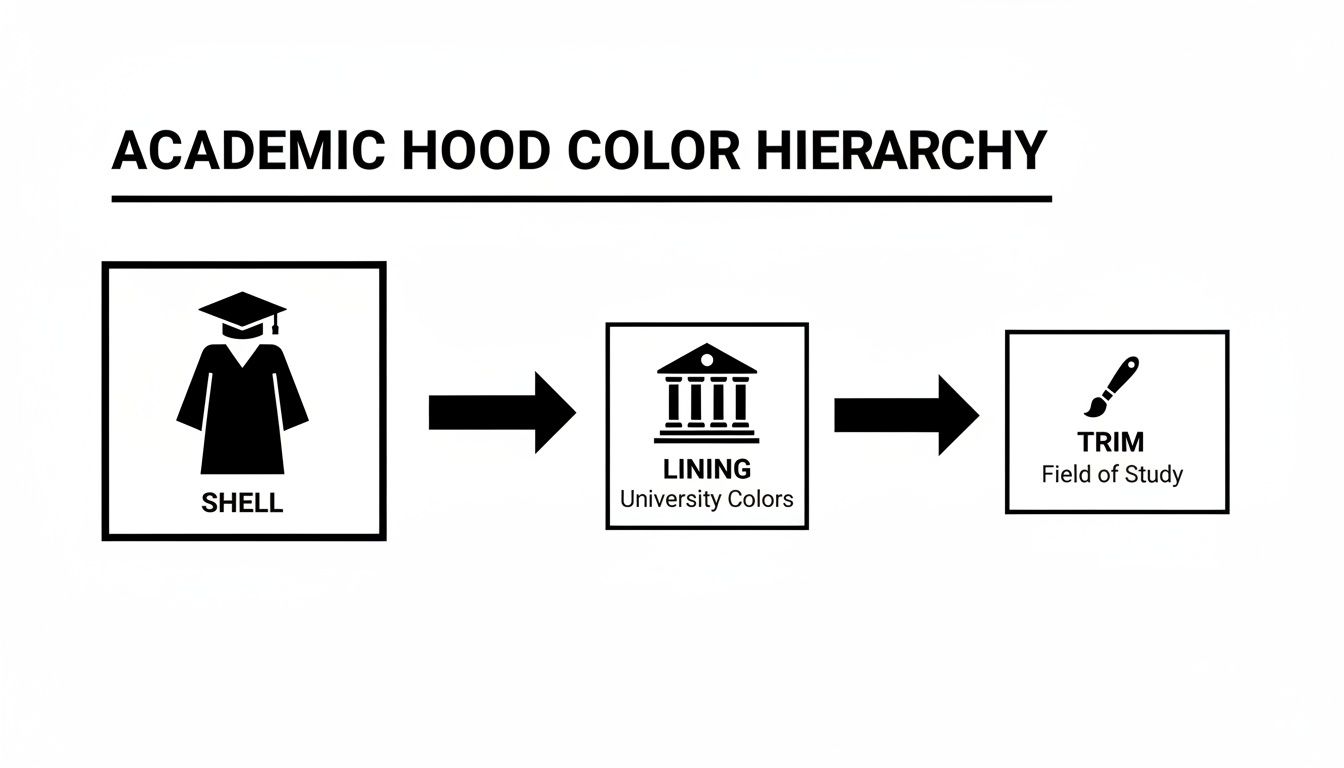
As you can see, the black shell is the foundation, the lining displays your university colors, and the velvet trim signifies your specific field of study.
The Evolution of Academic Status
The journey of academic hoods from practical medieval clothing to sophisticated symbols of status is fascinating. Precise rules now govern their lengths and appearance, turning them into a clear visual language. The doctor's hood, at exactly four feet long, represents the height of regalia design, while master's and bachelor's hoods are progressively shorter.
Every hood is black on the outside and bordered by a two, three, or five-inch velvet band whose color signifies the degree received, while the lining displays the institution's colors. This meticulous design has transformed the hood from a functional garment for warmth into a decorative symbol that communicates both discipline and institutional loyalty. You can uncover more about the cultural significance of graduation gowns at cagraduation.com.
Your Top Questions About Academic Hoods Answered
Figuring out the details of graduation regalia can bring up a lot of last-minute questions. As you get ready for commencement, you want every piece of your outfit to be perfect, especially that all-important academic hood. This FAQ section cuts through the confusion with clear, straightforward answers to the questions we hear most often, so you can walk across that stage feeling totally confident.
Our goal here is to solve the common sticking points—from how to actually wear the thing to making sure it stays a treasured keepsake for years to come.
How Do I Wear My Academic Hood Correctly?
At first glance, the academic hood can look a little complicated, but it’s actually pretty simple once you know the secret. Just place the hood over your head so it drapes down your back with the velvet side facing up. The V-shaped part should sit comfortably at the front of your neck.
To keep the hood from pulling back and feeling like it's choking you, find the small loop at the point of the "V." You can fasten this loop to a shirt button or use a small safety pin to attach it to the inside of your gown's zipper. This little trick keeps it perfectly in place through the entire ceremony.
Finally, it's time to show off those colors. Ask a friend or a faculty marshal to help you "turn out" the silk lining at the back of the hood. This small flip reveals the vibrant colors of your university, with the velvet trim creating a perfect frame. A quick practice run before the big day will make sure you look polished and professional.
Does a Bachelor’s Degree Get a Hood?
This is one of the most common questions we get, and the answer really comes down to your school’s traditions. While bachelor's hoods do technically exist, you almost never see them used in the United States. Most American universities reserve the formal hooding ceremony for their master's and doctoral candidates.
This tradition makes the hood a powerful symbol of postgraduate achievement, marking a major step into advanced study. Of course, customs can vary. It’s always a good idea to check your university's specific commencement guidelines to be certain.
If your school doesn't use bachelor's hoods, you can still celebrate your accomplishment with other regalia. Many graduates wear custom graduation stoles or honor cords to represent their field of study, club memberships, or personal identity.
How Do I Find the Correct Colors for My Hood?
Getting the colors right is everything. Your academic hood has two key sets of colors that have to be accurate:
- The Velvet Trim: This color represents your specific academic discipline. For example, White is for Arts, Golden Yellow is for Science, and Light Blue is for Education.
- The Silk Lining: This is where you'll find the official colors of your university, often displayed in a chevron or split pattern.
The easiest and most reliable way to nail this is to use a dedicated online tool. Here at Graduation Attire, our School Finder makes it incredibly simple. Just select your institution, and we’ll show you the exact regalia with the correct lining colors for your school. For the velvet trim, you can check our detailed degree color chart on each product page to guarantee a perfect match.
What Is the Best Way to Store My Hood After Graduation?
Your academic hood is so much more than part of your graduation outfit—it’s a memento of all your hard work. To keep it looking great, avoid folding it up tightly, which can create permanent creases in the delicate velvet and silk.
The best way to store it is on a wide, padded hanger that helps it keep its natural shape. Then, place it inside a breathable garment bag to protect it from dust, moisture, and pests.
Find a cool, dark, and dry spot for it, like the back of a closet. Keeping it out of direct sunlight is absolutely critical, as UV rays can cause the vibrant colors of the lining and trim to fade over time. With a little care, your hood will remain a beautiful symbol of your achievement for years to come.
At Graduation Attire, we’re dedicated to helping you celebrate your academic milestones with pride. From finding the perfect academic hood to selecting custom stoles that tell your unique story, we provide high-quality regalia to make your commencement day truly unforgettable. Explore our full collection and find everything you need at https://www.graduationattire.com.