

You've ordered the gown, selected the hood colors, and perhaps even scheduled the hooding ceremony. Then the regalia form asks for one more detail: doctoral tam size. Guessing from a standard hat size or choosing “one size fits most” can leave the velvet crown pressing against your head, sliding during the processional, or sitting unevenly once the hood rests across your shoulders.
A doctoral tam is part of the entire regalia structure. Its fit affects how securely the hood sits, how the gown's shoulder drape frames your body, and how composed you'll look in photographs. Measure carefully, confirm the supplier's chart, and treat the tam as a fitted component, not an accessory you can fix at the last minute.
Why Your Doctoral Tam Requires a Custom Fit
Your final fitting can fail in a predictable way. The tam presses against your head, the hood pulls at the neckline, and the gown's shoulder drape shifts the whole silhouette. A doctoral tam is a structural anchor for the regalia, so choose it by measured circumference rather than by a familiar hat size.
A tam differs from a mortarboard in both shape and fit. Its soft velvet crown, multiple panels, and circumference-based fit allow the crown to settle around your head, but that flexibility also exposes sizing errors. Review what a graduation tam is before ordering, then confirm how the specific model is constructed.
Doctoral tams are commonly velvet, soft-crown caps with an eight-sided construction. University regalia guides generally associate the eight-sided tam with doctoral dress. Academic dress history also places the tam's development in the early twentieth century and its broad standardization for master's and doctoral wear by the 1950s, as documented in this guide to the tam graduation cap.

The fit controls the silhouette
The inner band determines whether the crown sits naturally. If it is too tight, the crown cannot settle and pressure builds during a long commencement. If it is too loose, the tam shifts as you walk, turn for photographs, or receive the hood.
The hood creates a second point of contact. Its neckline and velvet trim rest across the upper shoulders and chest, while the tam stays above your head. A level, secure tam gives the hood room to drape evenly. A slipping tam can tilt the visual balance of the hood and gown, even when the hood itself is positioned correctly.
The gown's shoulder drape makes this interaction more visible. A band that fits correctly keeps the crown centered while the hood settles across both shoulders. That stability matters in photographs and during the processional.
Practical rule: Order from a measured circumference, then verify the supplier's exact chart. Labels such as small, medium, large, or one size do not describe every tam's internal construction.
Published doctoral tam sizing information associates adult head measurements with product sizes ranging roughly from 20.25 inches to 26 inches. Retailers and university regalia offices may also use small, medium, large, and extra-large bands covering approximately 21 to 24 or more inches, according to the cited doctoral tam sizing information. The range is broad. Ask for your actual head circumference and the way that model accommodates it, not the hat size you usually wear.
How to Measure Your Head Circumference Accurately
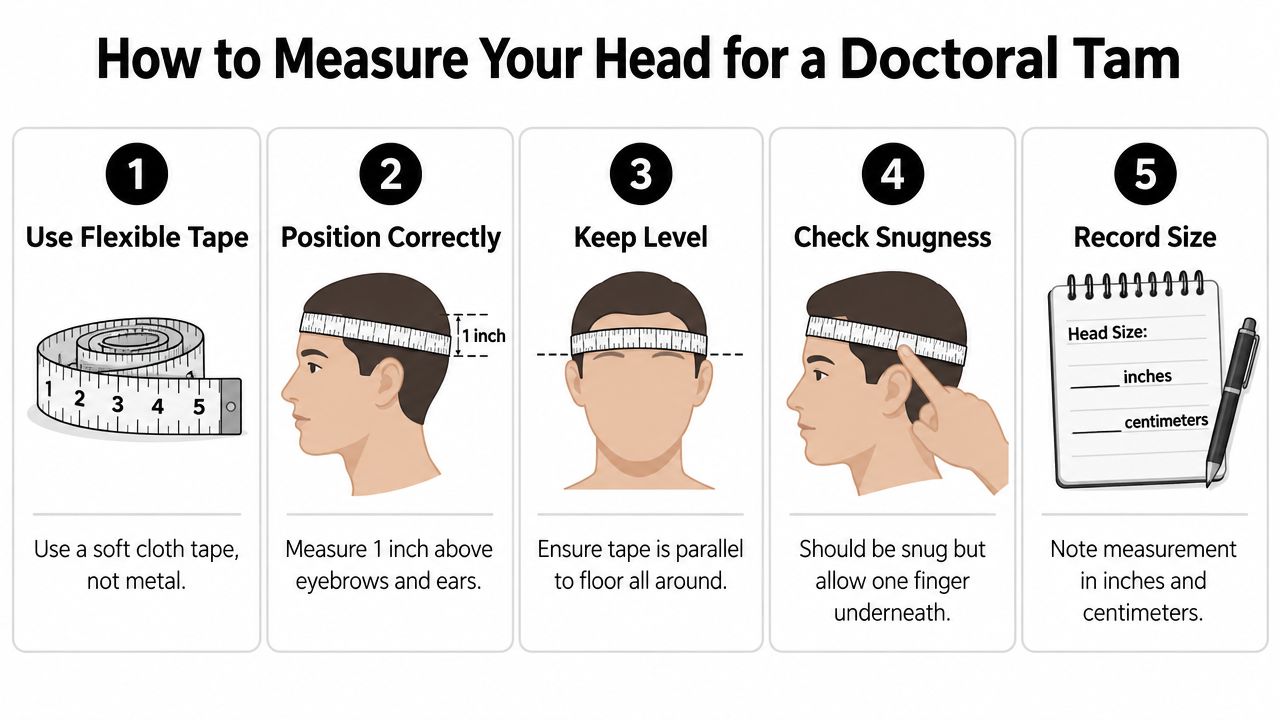
Use a flexible tailor's tape if you have one. You can also use a piece of string and measure the string against a ruler, but don't use a rigid metal tape because it won't follow the curve of your head accurately.
Follow the correct measuring path
- Place the tape about 1 inch above your eyebrows and ears. This position captures the head circumference used by institutional doctoral tam charts. Keep the tape around the widest practical path of your skull, not low across the forehead or high over the crown.
- Keep the tape level. Look in a mirror or ask another person to check that the tape stays parallel to the floor all around your head. If it slopes upward at the back, your result can be smaller than the band needs to accommodate.
- Use gentle tension. The tape should be secure against your head without being pulled tight. A practical check is to leave enough room for one finger beneath the tape. The doctoral regalia sizing guide from the University of New Mexico warns against tight or incorrectly positioned measurements because a falsely small circumference can translate into uncomfortable pressure during extended ceremonies.
- Take the measurement more than once. Keep the tape in the same position each time and record the result. If your measurements differ, use the consistent reading that reflects the correct placement rather than choosing the smallest number.
- Record the result before ordering. Write the circumference in inches, and add the centimeter equivalent if the supplier requests it. Match the number to the manufacturer's chart, not to a generic S/M/L assumption.
Avoid the two common errors
Measuring too low on the forehead is the first mistake. It shortens the circumference and often produces a tam that feels fine for a quick fitting but becomes uncomfortable during a prolonged ceremony. Pulling the tape tight creates the same problem.
Rounding down is the wrong response to an in-between measurement. Use the supplier's stated range and select the larger option only when your measurement sits clearly at the margin or the manufacturer specifically recommends it. Don't automatically size up if the chart places you securely inside a smaller range.
The following video can help you visualize tape placement and tension:
Reading the Doctoral Tam Size Chart
Once you have a reliable circumference, translate it into the product's actual sizing system. Institutional charts are more precise than a generic “one size fits most” label because they show where each band begins and ends.
A university chart published by East Tennessee State University maps doctoral tam measurements from Small at 20.25 to 21.125 inches through Extra Large at 24.25 to 26 inches. The complete practical conversion looks like this:
| Measured Circumference (Inches) | Regalia Size | Traditional Hat Size |
|---|---|---|
| 20.25 to 21.125 | Small | Not specified by this institutional chart |
| 21.25 to 22.875 | Medium | Not specified by this institutional chart |
| 23 to 24.125 | Large | Not specified by this institutional chart |
| 24.25 to 26 | Extra Large | Not specified by this institutional chart |
A separate retailer chart connects tam sizing to traditional hat sizing, listing Small at 21 inches, corresponding to baseball cap sizes 6.5 to 7.0; Medium at 22.5 inches, corresponding to 7.0 to 7.5; and Large at 24 inches, corresponding to 7.5 to 8.0, as shown in these doctoral tam selection instructions. Use those traditional hat ranges as a cross-check, not as a substitute for measuring your head.
Why “one size” can mislead
Suppliers don't all build their tams the same way. One doctoral tam listing describes a Velcro-adjustable interior fit of approximately 19 to 23.5 inches, while another supplier lists a comfort range of 21 to 24 inches, according to this adjustable doctoral tam specification. Those ranges overlap, but they aren't identical.
A tam's internal band, closure, crown geometry, and velvet weight all affect how securely it sits. Check the product page for the actual fit range before ordering, especially if your measurement falls near an edge.
A one-size label describes a product's marketing category. It doesn't prove that the tam will fit your head comfortably.
If your measurement falls between chart bands, don't round down just to avoid ordering a larger label. Select the range that gives you secure coverage without compression, then confirm whether the tam includes an adjustable band. The right choice depends on the model's architecture, not the size name alone. You can compare the relevant measurements and materials through Graduation Attire's size, color, and fabric charts.
Choosing Between 4, 6, and 8-Sided Tams
The number of sides changes more than the appearance. It influences how the velvet crown distributes its fullness and how the tam frames your face above the gown and hood.
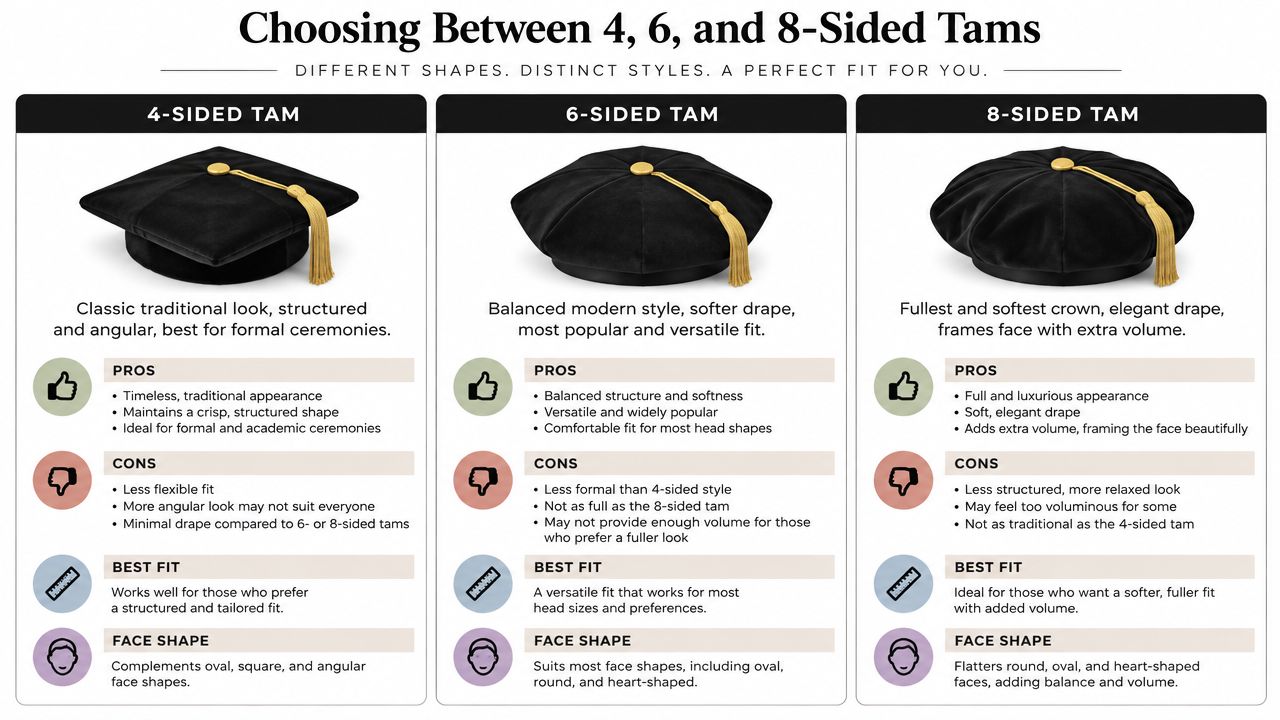
Doctoral tams are commonly available in 4-sided, 6-sided, and 8-sided styles. The eight-sided design is the traditional doctoral standard, and suppliers often recommend it for larger individuals because its fuller crown can create a more balanced relationship with a substantial gown. The six-sided option provides a middle ground, while the four-sided design has a more angular, compact profile.
Compare the crown structures
| Style | Crown character | Practical recommendation |
|---|---|---|
| 4-sided | More structured and angular | Choose it when institutional tradition calls for it or when you prefer a compact, defined profile |
| 6-sided | Balanced and moderately full | Choose it as a flexible middle option when the school permits it |
| 8-sided | Fullest, softest, and most traditionally doctoral | Choose it for the standard doctoral appearance or a broader overall proportion |
An eight-sided tam usually gives the hood and gown a stronger visual anchor. That matters when the shoulder drape is wide or the velvet trim has substantial presence. A smaller crown can make a full doctoral ensemble look top-heavy below the face, while an excessively full crown can overwhelm a narrow face or smaller frame.
The six-sided design works when you want a softer profile without the full volume of an eight-sided crown. It can also be a sensible choice when a supplier offers a better-fitting internal band in that construction, provided your institution permits it.
The four-sided option deserves a specific reason. Don't select it because it's available. Its sharper geometry can look formal and deliberate, but it may not provide the same visual balance as an eight-sided tam when paired with a fuller gown.
Your university's rule comes first. If the institution identifies the doctorate with an eight-sided tam, follow that standard rather than treating the side count as a purely personal styling decision.
Balancing the Tam with Your Gown and Hood
A tam can fit your head perfectly and still look wrong with the rest of your regalia. The reason is proportion. The doctoral gown adds fullness around the body, and the hood creates a structured shoulder drape that changes how the head and upper torso relate visually.
Plus-size and larger-bodied graduates often receive separate gown options based on height and weight, while the tam is frequently offered as a one-size or near-universal headwear range around 19 to 23 inches, according to this doctoral regalia order form.pdf). Those charts separate head and gown measurements, but they don't fully describe how the pieces interact during movement.

Treat the ensemble as one structure
The hood rests across the shoulders and chest, not on the tam, but its weight and placement can affect how you perceive the cap's security. During a hooding ritual, someone may adjust the hood from behind while you stand still or turn slightly. A tam that's already loose can shift when the hood settles, and a tam that's too tight can feel more restrictive once the ceremony's layers are fully arranged.
Use this fitting sequence:
- Test the tam alone. It should sit level and stay secure when you turn your head naturally.
- Add the gown. Check whether the shoulder seams and neckline restrict movement.
- Place the hood. Confirm that the velvet trim lies evenly and that the tam remains level during the adjustment.
- Inspect the photographs. Look from the front and side. The crown should complement the gown's fullness rather than compete with it.
A larger tam can visually balance a fuller gown, but don't use crown volume to compensate for an incorrect head measurement. Size determines comfort and security. Side count and crown shape influence proportion.
For practical placement guidance across the full ensemble, use this guide to wearing doctoral regalia. Before commencement, practice standing, walking, sitting, and turning while wearing all three pieces. The tam should stay level, the hood should remain centered, and the gown should move without pulling against the neckline.
Fitting standard: The complete regalia should remain composed when you move, not only when you stand still in front of a mirror.
Ordering Logistics and Ceremony Day Adjustments
Give the supplier more than your head measurement. Doctoral regalia orders commonly require head size, tam type, velvet color, and tassel type, and a regalia source confirms that velvet tams are available in 4-, 6-, or 8-corner versions, with the eight-corner style preferred by many, as described in these academic cap ordering details.
Before submitting the order, verify:
- Institutional style: Confirm the permitted tam side count and whether your program requires a specific doctoral construction.
- Circumference: Submit the measurement taken about one inch above the eyebrows and ears.
- Velvet color: Match the tam and gown velvet to the institution's regalia standard.
- Tassel type: Check whether the ceremony requires a particular tassel construction or color.
- Adjustment system: Confirm whether the interior uses a fixed band, elastic, or Velcro.
Try the tam with the gown and hood as soon as it arrives. If it's loose and includes Velcro, adjust the band gradually while the tam is level on your head. If it's tight, don't soak, steam, stretch, or reshape the velvet without the supplier's approval. Contact the seller first, because customized regalia may have specific exchange conditions and alterations can affect eligibility for return.
Keep the original packaging until the full fitting is complete. Take clear photographs of the label, band, and tam construction if you need support, and ask for an exchange before the ceremony rather than relying on pins or improvised alterations on commencement day.
Graduation Attire offers doctoral tams, including 4-sided and custom options, along with gowns, hoods, tassels, and sizing resources for coordinating the full ensemble. Measure your circumference, confirm your institution's style, and visit Graduation Attire to select regalia that stays balanced from the processional through the hooding ceremony.