

Completing your master's degree is a huge accomplishment, and the regalia you'll wear on graduation day is the special uniform that celebrates this incredible milestone. This outfit isn't just a simple robe; it's made up of a distinctive gown, a cap or tam, and a colorful academic hood. Each piece of your graduation regalia masters set is packed with symbolism that reflects all your hard work and academic discipline.
Decoding Your Master's Graduation Regalia
Earning that master's degree was a journey of pure dedication, and the regalia you wear on graduation day is so much more than a ceremonial outfit. Think of it as a visual storybook. Every component—the gown, the hood, and the cap—narrates a different chapter of your academic success. It's a uniform that connects you to a centuries-old tradition of scholarship, instantly identifying you as a master in your chosen field.
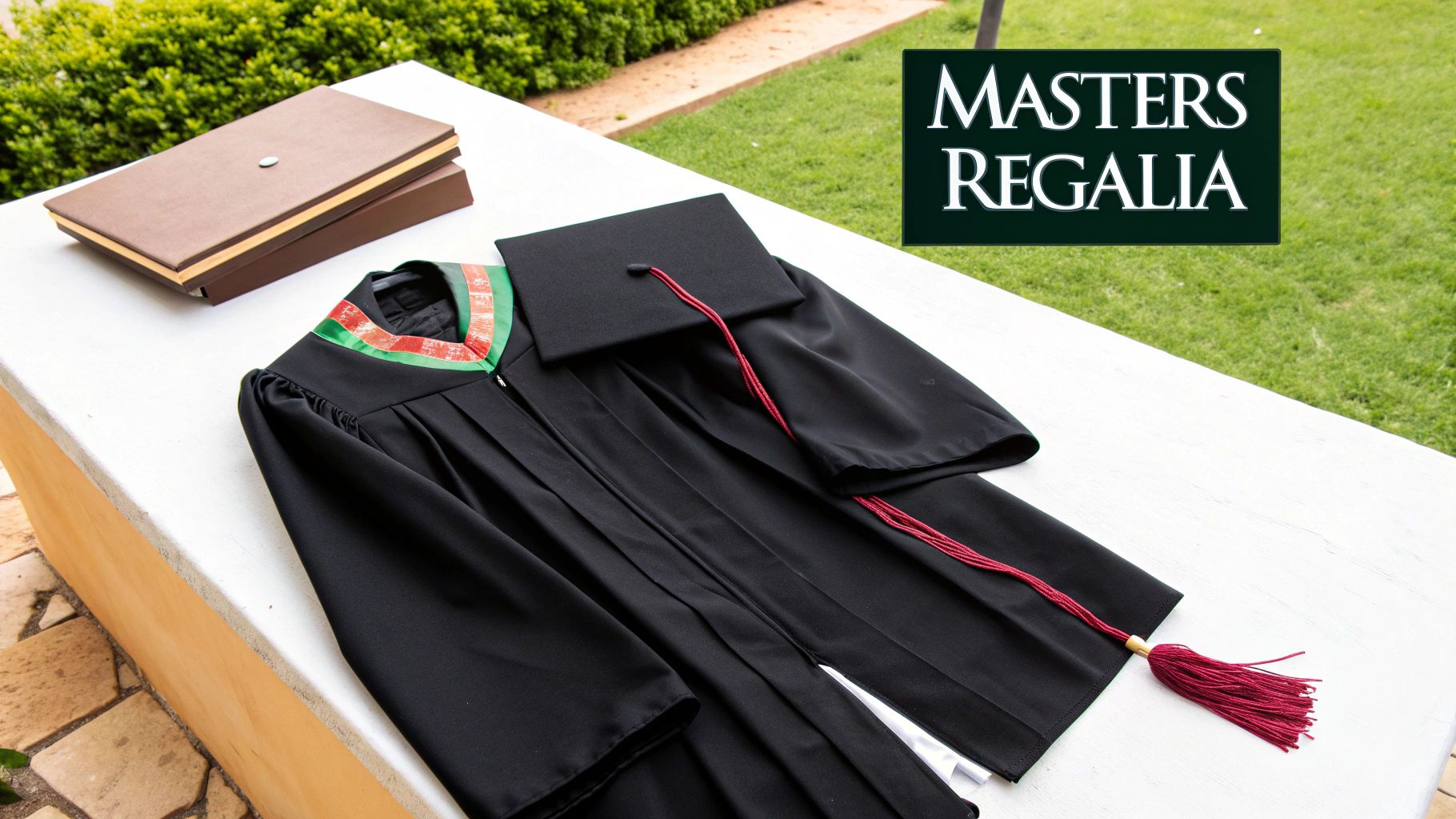
This guide will be your roadmap to understanding every single piece of your master's regalia. We'll break down the meaning behind those unique gown sleeves, the significance of the hood colors, and even the right way to wear your cap. When you understand these details, the experience transforms from just wearing a uniform to proudly displaying a symbol of your achievement.
The Symbolism Behind the Attire
Every element of your academic dress is intentional and carries a lot of historical weight. For instance, you can spot a master's gown by its unique, oblong sleeves, which sets it apart from the pointed sleeves on a bachelor's gown. This is a clear visual marker of your advanced academic standing.
But the most personal and telling piece is the academic hood. Its colors tell you two key things:
- The velvet trim represents your specific field of study.
- The satin lining displays the official colors of your university.
The growing importance of these traditions is reflected in the market itself. The global graduation attire industry was valued at approximately $2.6 billion in 2025 and is projected to hit $5.1 billion by 2032. This growth really highlights the value that graduates and universities place on celebrating academic milestones with the proper regalia.
If you want to dive deeper into these traditions, you might be interested in our guide on the history and meaning of academic regalia.
The Three Core Components of a Master's Regalia
The complete regalia for a master's degree is a carefully coordinated outfit, with each piece telling a part of your academic story. It might look like just a cap and gown, but the master's version has specific details that set it apart from what you wore for your bachelor's degree.
Understanding these three core components—the gown, the cap, and the hood—transforms them from simple attire into a proud display of your advanced degree. Each part has its own job and meaning, all contributing to a long-standing tradition of academic dress.
The Master's Gown
The gown is the foundation of your entire look. At first glance, it seems similar to a bachelor's gown, but the real giveaway is in the sleeves. This isn’t some minor design choice; it's the primary way to visually identify a master's graduate in a crowd.
Unlike the simple, pointed sleeves on a bachelor's gown, the master's gown has unique oblong sleeves. They’re designed to be open at the wrist, with a long, square-cut panel that hangs down. Historically, this space might have been used as a pocket, but today its purpose is purely symbolic, signifying a higher level of scholarship. The gown itself is traditionally black and has a fuller cut, giving it a more formal and distinguished feel.
The Cap and Tassel
Next up is the headwear, where you generally have a choice between two classic styles. Most master's candidates will wear the traditional mortarboard—that flat, square cap that has been a staple of graduation ceremonies for centuries.
However, some universities and specific fields allow for a velvet tam, which is a soft, multi-sided hat often seen as a more comfortable and distinguished alternative. Whichever style you choose, the tassel is a non-negotiable part of the tradition.
Before the ceremony kicks off, you'll wear your tassel on the right side of your cap. Then comes the big moment. Once your degree is officially conferred, you’ll move the tassel over to the left side in a symbolic gesture known as "the turning of the tassel." It’s a small action, but it signifies your official transition from candidate to graduate. To learn more about the specifics of headwear, check out our guide on the graduation cap and gown.
This image shows the clear distinctions between bachelor's, master's, and doctoral regalia in the United States.
Notice how the master's gown in the center features the distinct oblong sleeves, while the hood is longer and more prominent than the bachelor's, yet less elaborate than the doctoral regalia.
The Academic Hood
The most symbolic and visually striking piece of your graduation regalia masters attire is, without a doubt, the academic hood. It drapes over your shoulders and down your back, acting as a colorful canvas that tells your entire academic story in a single glance.
The hood is where your specific achievements are put on full display. It communicates not just that you earned a master's degree, but also your field of study and the institution that granted you the degree, all through the language of color.
The hood has two main color-coded sections that do the storytelling:
- The Velvet Trim: The color of the velvet running along the outer edge of the hood signifies your specific field of study. For example, light blue represents Education, golden yellow stands for Science, and drab (a tan color) is for Business.
- The Satin Lining: The colors on the inside of the hood are the official colors of your university. You'll often see this displayed with a primary color and a secondary color in a chevron pattern, proudly representing your alma mater.
Together, these three pieces—the distinct gown, the traditional cap, and the expressive hood—create a powerful and meaningful uniform. They connect you to a long history of academic achievement while celebrating the unique path you took to earn your master's degree.
Understanding the Language of Hood Colors
While the master's gown shows you've reached a higher level of learning, it's the academic hood that truly tells your story. Think of it as a wearable diploma. This draped, colorful piece isn’t just for decoration; it’s a color-coded biography that tells everyone your specific field of study and the university that granted your degree.
This tradition of using specific colors for academic disciplines has been around for centuries and is now guided by the American Council on Education (ACE). It creates a shared visual language, so a master's graduate in social work from California wears the exact same color as one from New York.
This diagram breaks down how the three main parts of your master's regalia work together.

As you can see, the hood is the central piece that carries all the personalized details of your achievement.
The Velvet Trim: Your Degree Color
The first thing you’ll notice on the hood is the thick velvet trim lining its outer edge. This is the most important color, as it directly represents your master's degree field. The system is pretty specific, giving a unique color to each broad area of study so anyone familiar with the tradition can spot your expertise from across the room.
For instance, a Master of Business Administration (MBA) graduate will have a hood trimmed in Drab, a distinct tan color. Someone with a Master of Social Work (MSW) is represented by Citron, while a Master of Public Administration (MPA) gets Peacock Blue.
Here are some of the most common master's degree colors you'll see at commencement:
- Light Blue for Education (M.Ed.)
- Golden Yellow for Science (M.S.)
- White for Arts and Letters (M.A.)
- Drab for Business and Commerce (MBA)
- Citron for Social Work (MSW)
- Salmon Pink for Public Health (MPH)
This color-coding turns the procession of graduates into a rich tapestry of academic achievement. To see the full spectrum, check out our complete guide on master's degree hood colors.
Masters Degree Hood Color Guide by Field of Study
Here's a quick reference table to help you decode some of the most common velvet trim colors you'll see on graduation day. Each color is a badge of honor for a specific area of expertise.
| Field of Study | Velvet Color | Example Degrees |
|---|---|---|
| Arts & Letters | White | M.A. in English, M.A. in History |
| Business & Commerce | Drab | Master of Business Administration (MBA) |
| Education | Light Blue | M.Ed., M.A. in Teaching |
| Fine Arts | Brown | Master of Fine Arts (MFA) |
| Music | Pink | Master of Music (M.M.) |
| Nursing | Apricot | Master of Science in Nursing (MSN) |
| Public Administration | Peacock Blue | Master of Public Administration (MPA) |
| Public Health | Salmon Pink | Master of Public Health (MPH) |
| Science | Golden Yellow | M.S. in Biology, M.S. in Chemistry |
| Social Work | Citron | Master of Social Work (MSW) |
This system is a beautiful way of celebrating the diverse knowledge gathered in one room, turning the ceremony into a vibrant display of accomplishment.
The Satin Lining: Your University Colors
While the velvet trim announces your discipline, the inside of the hood—the satin lining—is all about school pride. This section features the official colors of your college or university, making it a clear nod to your alma mater.
The combination is powerful: the velvet shows what you studied, and the satin lining shows where you studied. Together, they create a complete picture of your academic identity on one of the most important days of your life.
Schools often use a primary color for the main lining and a secondary color in a chevron (a V-shape) pattern. For example, a university with blue and gold colors might have a hood with a gold satin lining and a bold blue chevron.
This two-part color system makes your hood a unique and personal symbol of all your hard work. When you order your regalia, getting the velvet color right for your degree and the satin lining perfect for your school are the two most critical steps to ensure your academic dress is a flawless reflection of your success.
How to Wear and Care For Your Masters Regalia
Opening that box with your master's regalia inside is a thrilling moment. Suddenly, graduation feels real. But to look the part on the big day, you need to know how to wear each piece correctly. Think of it as putting on a uniform of honor—every component has its place, and getting it right creates that polished, dignified look you've earned.

This guide will walk you through assembling your attire perfectly, from gown prep to the final tassel flip. We'll also cover the essential care tips to keep your regalia looking sharp for the ceremony and pristine for years to come.
Assembling Your Academic Attire Step By Step
Getting your regalia on correctly is all about comfort and making sure the symbolism of each piece shines through. It's a pretty simple process once you know the order and a few key tricks.
-
Get the Gown Ready First: Your gown is going to be wrinkled from the packaging. The best move is to take it out a few days before the ceremony and hang it up. A good steaming is the best way to get the creases out. Whatever you do, avoid direct ironing—the heat can easily damage the delicate fabric. When you're ready, zip it up over your ceremony outfit.
-
Drape the Academic Hood: This is usually the trickiest part for most people. Drape the hood over your head so the velvet trim is closest to your neck, with the velvet side facing up. The rest of the hood should hang down your back.
-
Adjust and Secure the Hood: This is where you’ll probably want to grab a friend or family member for help. To show off your university's colors, have them flip the satin lining out at the base of the hood, essentially turning it "inside-out" so the colors are on full display. Use the small cord on the front to loop it around a shirt button or secure it with a pin. This keeps it from sliding backward.
-
Position the Cap and Tassel: Place the mortarboard or tam flat on your head, making sure the front point is centered on your forehead. Before your degree is officially conferred, the tassel hangs on the right side. Afterwards, you’ll join your classmates in the celebratory tradition of moving it to the left.
Keeping Your Regalia in Top Condition
Proper care isn't just about looking great on graduation day; it's about preserving a memento of one of your biggest achievements. Just follow these simple tips before and after the ceremony.
Before the Ceremony
- Steam, Don't Iron: Seriously, skip the iron. The easiest way to get wrinkles out is to use a garment steamer or just hang the gown in your bathroom while you take a hot shower. About 20 minutes in the steam should do the trick.
- Do a Quick Inventory: Make sure you have everything: gown, cap, tassel, and academic hood. If you ordered them, now's the time to find your custom stoles or honor cords too.
- Use a Garment Bag: Keep all the pieces protected in a garment bag. It’s the best way to avoid dust, pet hair, or any last-minute spills.
After the Ceremony
- Spot Clean for Small Spills: If you get a small stain, a damp cloth should be enough to gently blot it out. For anything major, check the care label—but when in doubt, dry cleaning is the safest option.
- Store It with Care: Don't just cram it in a box in the back of your closet. To keep it looking good for years, store your regalia in a cool, dry place, ideally in the garment bag it came in. This helps prevent the fabric from yellowing or getting damaged over time.
Your master's regalia is so much more than an outfit for a single day. It's a physical representation of your entire academic journey and all the hard work that went into it. Caring for it properly ensures it will remain a proud keepsake for the rest of your life.
Ordering and Customizing Your Regalia
Alright, you've done the hard work. Now comes the final logistical hurdle before you can just focus on the celebration: ordering your master's graduation regalia. Getting the timing and details right is the key to avoiding any last-minute stress, and this is also your chance to add a few personal touches that tell your unique story.
Think of ordering your regalia like booking flights for a big trip. The earlier you get it done, the more options you'll have—and the less you'll have to worry about. Most universities open up their ordering portals months before the ceremony, so it pays to act fast.
Planning Your Ordering Timeline
A little bit of planning here goes a long way. It can save you from steep rush fees and the anxiety of wondering if your gown will show up on time. As a general rule, you’ll want to start the process two to three months before your graduation date. This gives you a comfortable buffer to confirm all the requirements, place your order, and deal with any exchanges if something doesn’t fit quite right.
Here’s a simple timeline to keep you on track:
-
3 Months Out: Head to your university’s official commencement page. Find the deadlines and any specific regalia guidelines they have. This is also the perfect time to use a school finder tool to make sure the regalia you're looking at matches your school's exact standards for color, fabric, and style.
-
2 Months Out: This is the sweet spot—go ahead and place your order. You’re early enough to beat any stock issues and it guarantees your regalia will arrive with plenty of time to spare.
-
1 Month Out: Your regalia should be in your hands by now. Try everything on the moment it arrives to check the fit of the gown, cap, and hood. If something’s not right, you still have time to make an exchange without panicking.
Waiting until the last minute almost always means you'll be stuck with limited stock and expensive expedited shipping. A little foresight makes the whole experience smooth and stress-free.
The Importance of University Compliance
While ordering regalia online is convenient and often more affordable, you have to be absolutely sure it complies with your school's specific guidelines. This is especially true for the academic hood—the velvet degree color and the satin university colors need to be exact.
The tradition of academic dress in the United States has a long history, with a major resurgence in the 1980s that led to the strict standards we see today. These rules, guided by academic codes, ensure every graduate's attire is uniform and honors the history of the ceremony. You can get a better sense of these traditions by reading about the established codes governing academic attire. Using a school finder tool before you buy is the simplest way to guarantee your regalia is 100% compliant.
Making It Your Own with Customization
Beyond the standard cap, gown, and hood, there are plenty of ways to personalize your look. Customization is a powerful way to tell your story and celebrate the identity, heritage, and communities that supported you on your journey to a master's degree.
These additions allow you to wear your pride on your sleeve—literally. They turn your regalia from a simple uniform into a statement about who you are and what you've accomplished.
Customization is about more than just decoration. It’s a visual declaration of your story, allowing you to honor your heritage, celebrate your identity, and acknowledge the communities that helped you reach this milestone.
Some of the most popular customization options include:
- Custom Stoles: These are a fantastic way to showcase your personal identity. You can find First-Generation stoles that honor your family's journey, vibrant Kente stoles to celebrate African heritage, or beautiful Serape stoles that represent Latinx culture.
- Honor Cords: While you might remember them from undergrad, many master's programs and academic societies also award honor cords for a high GPA or for membership in a specific group. These braided cords are worn around the neck and add a really distinguished touch.
- Personalized Tassels: A simple but meaningful upgrade is a custom tassel. Many grads choose a tassel with a year-date charm or one that features their school colors, adding a small but significant detail to their cap.
Adding these elements helps you stand out in a sea of black gowns, creating a look that’s both respectful of tradition and deeply personal. It's the perfect way to close this chapter and celebrate the full story of your academic success.
Common Questions About Masters Graduation Regalia
When graduation is just around the corner, the small details suddenly become big questions. It's completely normal to wonder about the specifics of your academic regalia. This section is your go-to guide, designed to give you quick, clear answers to the most common questions we hear from master's candidates.
We’ll sort out any lingering confusion so you can walk into your ceremony feeling confident and ready. Each question tackles a real-world concern, from telling gowns apart to figuring out the rules for customization. Let's get you squared away.
What Is the Difference Between a Masters Gown and a Bachelors Gown?
The easiest way to spot the difference between a master's and a bachelor's gown is to look at the sleeves. It's the one key visual cue, rooted in academic history, that sets the two degrees apart.
A bachelor’s gown has simple, pointed sleeves that are closed at the end. A master's gown, on the other hand, is defined by its unique oblong sleeves. These are open at the wrist, with a long, square-cut panel hanging down from the back of the arm. While it gives the gown a more formal, impressive look, that hanging part historically doubled as a pocket or pouch.
While both gowns are almost always black, the cut of the master's gown is usually a bit fuller to signify a higher level of academic achievement. But at a glance, it's the sleeves that will instantly tell everyone you're a master's degree recipient.
Is Wearing the Academic Hood Required for a Masters Degree?
Yes, for nearly every university, the academic hood is a non-negotiable part of the official master's regalia. The cap and gown create the base of the look, but the hood is the single most symbolic piece that truly signifies your advanced degree.
The hood is what tells the story of what you've accomplished. Every part of its design has a specific meaning:
- The velvet trim color on the outside represents your specific field of study (for example, golden yellow for Science).
- The satin lining color(s) on the inside proudly display the official colors of your university.
Without the hood, your regalia would be incomplete and wouldn't properly represent your full academic credentials. Schools require it to uphold the integrity and tradition of the commencement ceremony, making sure every master's candidate's achievement is recognized correctly.
Think of it this way: the gown identifies you as a graduate, but the hood identifies you as a master in your field from your specific university. It’s the centerpiece of your academic story.
Can I Wear Honor Cords or Stoles with My Masters Regalia?
That's a great question, and the answer is: it depends entirely on your university's policies. Customizing your look is a fantastic way to celebrate your personal journey, but you have to check what's allowed at your ceremony first.
Honor cords are often linked to undergraduate achievements like a high GPA, so they may or may not be awarded at the master's level. Some specific master’s programs or academic honor societies do offer them, but you’ll want to check with your department or the registrar's office.
Custom stoles that represent your identity or heritage—like a first-generation stole or a cultural Kente stole—are often more widely permitted as a form of personal expression. Even so, it's critical to verify your institution's rules before you buy one to avoid any problems on the big day. The best first step is always a quick look at the commencement guidelines on your school's website.
How Do I Choose the Right Size for My Gown and Cap?
Getting the right size for your regalia is much easier than it sounds. It all comes down to two simple measurements: your height and your head circumference. Nailing this ensures you’ll look polished and feel comfortable through the whole long ceremony.
For the gown, sizing is based on your height from head to toe. It’s a good idea to measure yourself while wearing the shoes you plan to put on for graduation. Sizing charts will give you clear height ranges (like 5'6" to 5'8") for each gown size. The goal is for the hem to hang somewhere around your mid-calf for a dignified, uniform look.
For your cap or tam, you'll need to measure the circumference of your head.
- Grab a soft measuring tape.
- Wrap it around your head, placing it about one inch above your eyebrows.
- The measurement in inches will match up with a size on the product’s sizing chart.
A proper fit for your headwear is more important than you'd think. A cap that's too tight will be a headache (literally), while one that’s too loose might fall off at the worst possible moment. Taking these two quick measurements will help you find the perfect graduation regalia masters candidates need for a flawless fit.
Your master's degree is a monumental achievement, and your regalia should reflect that. At Graduation Attire, we provide high-quality, university-compliant regalia to help you celebrate in style without the stress. From perfectly colored academic hoods to custom stoles that tell your unique story, we have everything you need to make your commencement unforgettable. Explore our complete collection and find your perfect fit today at https://www.graduationattire.com.