

Getting your academic hood on correctly is a small detail that makes a huge difference on graduation day. It’s the final piece of your academic regalia that showcases your years of hard work, so let's make sure it looks perfect. Knowing how to wear academic hood properly is key to a polished look.
Your Quick Guide to Wearing an Academic Hood
Don't let your regalia become a source of last-minute stress. Knowing how to wear your academic hood the right way ensures you look polished and honor a tradition that’s been around for centuries. This isn't just a piece of fabric; it’s a symbol of everything you’ve achieved, from your Master's Gown to your doctoral distinction.
Honestly, the process is pretty simple once you know the two key securing points: a loop at the front and a cord on the back. These little features are designed to keep your hood stable and comfortable from the processional to the final photo op.
The First Steps to a Perfect Fit
Getting the placement right from the start is everything. You’ll want to drape the hood over your head with the velvet side facing up. Think of the velvet border as the frame for your accomplishment—it should be visible around your neck. This is a crucial step in understanding how to wear academic hood correctly.
Hold the hood with the small, V-shaped end in front and simply swing it over your head so the longer, larger part hangs down your back. It’s a move that 98% of graduates get right on the first try, and it instantly avoids any wardrobe malfunctions.
From there, you just have two quick things to secure. The front loop attaches to a button on your shirt or the zipper of your gown to keep it from rubbing against your neck. The cord on the back keeps it from sliding off your shoulders. It’s a bigger deal than you might think—in 2022, while over 1.1 million master's hoods were worn, an estimated 30% needed adjustments mid-ceremony. That’s a hassle you can easily sidestep.
Properly securing your hood is just one part of the picture. For a complete look at your commencement day attire, check out our guide on the graduation cap and gown.
Academic Hood Essentials at a Glance
To make this even easier, here’s a quick-glance table breaking down the key parts of your hood and what to do with them. Think of this as your two-minute checklist before you walk out the door, perfect for anyone learning how to wear academic hood for the first time.
| Component | What to Do | Why It Matters |
|---|---|---|
| Velvet Trim | Position it so it faces outward, framing your neck and shoulders. | This color represents your specific field of study and should be proudly displayed. |
| Front Loop | Attach the small fabric loop to a shirt button or your gown’s zipper. | This acts as the main anchor, preventing the hood from choking you or slipping backward. |
| Back Cord & Button | Use the cord to secure the back of the hood to your gown. | This keeps the hood from sliding off your shoulders, especially when you’re moving around. |
| Satin Lining | Ask a friend to help you "turn out" the lining to show the colors. | This reveals your university’s official colors, making your hood unique to your alma mater. |
With these four points covered, your hood will sit perfectly and stay put throughout the entire ceremony, letting you focus on your big moment.
Key Actions for a Flawless Look
Let’s break down how to wear an academic hood into a simple mental checklist so you feel totally confident as you’re getting ready.
- Position the Velvet: Make sure the velvet trim, which signifies your field of study, is prominently displayed around your neck and shoulders. It should never be tucked under your Graduation Gown.
- Secure the Front Loop: Find the small loop at the front "V" of your hood and attach it to a button on your shirt or the top of your gown's zipper. This is your primary anchor point.
- Adjust the Back: This is where a friend comes in handy. Have them turn the satin lining out on the back of the hood so the vibrant colors are showing. This is the "turnout," and it’s what really makes the hood pop.
A well-fitted hood should rest comfortably on your shoulders without pulling at your neck. It should feel secure, allowing you to move freely without needing constant readjustment. This detail completes your academic regalia and honors the achievement it represents.
Getting to Know Your Academic Hood
Before you figure out how to put it on, it helps to know what you're actually working with. An academic hood is so much more than a decorative accessory; it's a rich tapestry of meaning, with every piece telling a specific part of your academic story.
Think of it as a wearable diploma, packed with symbols of your hard work and achievement. The three main parts that come together are the shell, the satin lining, and the velvet trim. The shell is simply the black fabric that makes up the hood's body, giving it structure. But the real story is told in the colors.
The Velvet Trim: Your Field of Study
The first thing you’ll probably notice is the velvet trim, a bold band of colored fabric lining the hood's outer edge. This color isn't just for looks; it’s a universal code that signifies your specific academic discipline. It’s the first thing people see and it immediately communicates your area of expertise.
For instance, that crisp white trim you see on some hoods signifies a degree in Arts, Letters, or Humanities. A rich, golden yellow represents the Sciences, while a vibrant light blue is reserved for the field of Education. Just about every discipline has its own designated color, creating a visual language understood across institutions.
Understanding these elements transforms your hood from a piece of graduation attire into a personal emblem of your journey. It’s a physical representation of your degree, your university, and your specific academic discipline, all in one.
The Satin Lining: Your University's Pride
If the velvet represents your field, the satin lining represents your home. Tucked inside the hood, this colorful, silk-like material displays the official colors of your alma mater. When you wear it correctly, the lining is "turned out" to reveal this vibrant combination, proudly announcing where you earned your degree.
A graduate from the University of Michigan will have a lining of maize and blue, while someone from Ohio State will display scarlet and gray. This is one of the most personal parts of your regalia, connecting you directly to your institution's unique identity and community. You can dive deeper into what a graduation hood symbolizes in our detailed guide.
The Shell and Sizing: Your Academic Rank
Finally, the length and shape of the hood's shell itself tells everyone your academic rank. This tradition is standardized by the 1895 Intercollegiate Code of Academic Costume, which dictates precise measurements for each degree level.
- Bachelor's hoods are three feet long.
- Master's Hoods are three and a half feet long.
- Doctoral Hoods are the longest at four feet.
The velvet edging colors are also standardized. You'll see white for arts, golden yellow for science (worn by about 25% of master's grads), and lilac for dentistry. An improper length can throw off the whole look, so getting it right is key. For those purchasing their own regalia, exploring Graduation Packages can ensure all components match perfectly.
This sizing difference is more than just a minor detail; it’s a clear visual indicator of the academic hierarchy. While Bachelor's Hoods are less common, the distinction between a master's and a doctoral hood is immediately apparent, reflecting the advanced scholarship achieved.
A Practical Guide to a Perfect Hood Fit
Ready to get your academic hood sitting just right? This is the hands-on part of learning how to wear academic hood, and it's easier than it looks. Mastering these few simple motions will make sure your regalia looks sharp and feels comfortable all day long.
First things first, start with your gown. Go ahead and unzip it about six inches from the top. This one small move creates a stable base and makes it so much easier to anchor the hood correctly, which will keep it from pulling uncomfortably against your neck later.
Securing the Front for Stability
With your gown slightly unzipped, let's focus on the front of the hood. You'll find a small fabric loop, often called a stay cord, attached right where the velvet trim forms a "V." This little loop is the secret to keeping your hood from riding up and feeling like it's choking you during the ceremony.
If your gown happens to have a button on the inside of the yoke (the fabric around your shoulders), just fasten the loop around it. No button? No problem at all. A small safety pin works perfectly. Pin the loop to your gown right below the collarbone, and your hood will be securely anchored in place.
Pro Tip: If you're wearing a collared shirt under your gown, attach the loop to one of its buttons. This provides an even more secure anchor point and is a common trick used by faculty who wear regalia all the time.
This first step is crucial—it stops the weight of the hood from pulling backward, which is the number one cause of discomfort.
Mastering the 'Turnout' for Full Color
Now for the magic trick that really makes your hood shine: the 'turnout.' This is just the process of flipping the satin lining outward to show off your institution's colors. Most hoods are designed to be folded inside-out for shipping and storage, so it will probably look plain black when you first take it out.
To do the turnout, let the hood drape down your back. Reach behind you and find the velvet trim at its lowest point. Gently flip this edge outward, revealing the vibrant satin colors underneath. The goal is to create a beautiful, symmetrical cascade of color right down the center of your back.
This diagram breaks down the main parts of your hood so you know exactly which piece you're adjusting.
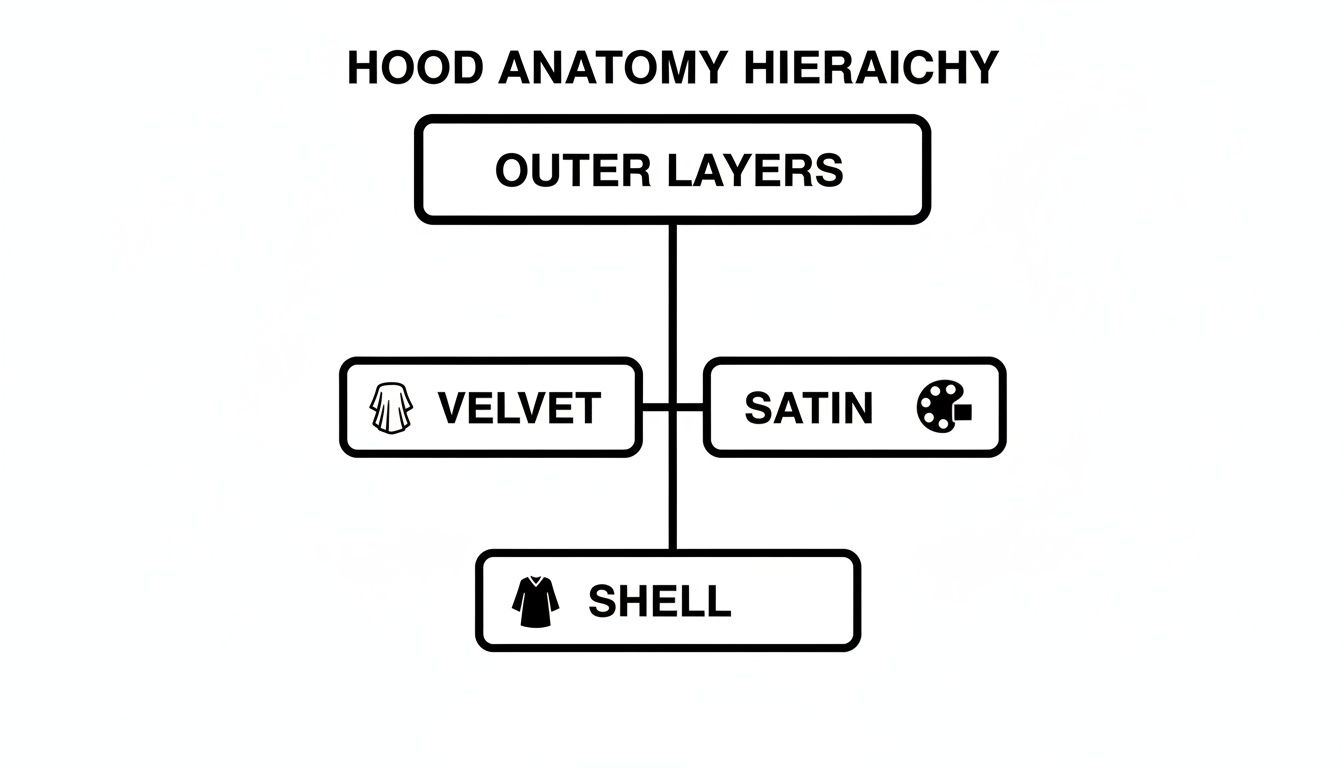
As you can see, the velvet trim acts as the border. Your goal is to flip it just enough to showcase that colorful satin lining against the black shell.
Final Adjustments and Checks
Getting the back perfectly symmetrical by yourself is nearly impossible. This is where a friend, family member, or fellow graduate becomes your best friend. Ask them to check the back and make sure the satin lining is displayed evenly on both sides.
Once the turnout looks good, there's one last step. Find the cord on the back of the hood, just below the velvet. This cord can be fastened to a button on the back of your gown to keep the hood from slipping off your shoulders. A small safety pin can also be used here for some extra security during the long procession.
With these steps complete, your hood will be secure, comfortable, and perfectly displayed. And after the ceremony, don't forget to keep your regalia in pristine condition for years with our specially designed Garment Bags, which are perfect for protecting the delicate velvet and satin.
Navigating Your Hooding Ceremony with Confidence
The hooding ceremony is the defining moment of graduation, especially for those earning a master's or doctoral degree. It’s a formal, deeply traditional recognition of your years of hard work. Knowing the etiquette ahead of time lets you soak in the moment instead of worrying about what to do next.
A little preparation transforms nervous energy into confident poise. This ceremony is steeped in tradition, and every step, from how you carry your hood to the moment it’s placed over your shoulders, has meaning. It’s a powerful moment for you and for your family and friends watching from the audience.
Approaching the Stage
As you line up, you won’t be wearing your academic hood just yet. Instead, you'll carry it draped neatly over your left arm.
Make sure the velvet trim is facing up and visible. This small detail shows respect for the academic discipline it represents and keeps the hood ready for the faculty member who will perform the hooding. Holding it this way also keeps your right hand free for handshakes or receiving your diploma folder.
The Hooding Moment
When your name is called, you’ll walk onto the stage and stand before your faculty advisor or dean. The proper posture is to face the audience, with your back to the person hooding you. This gives everyone a great view and ensures the photos capture the moment perfectly.
You might need to bend your knees or stoop slightly to help them place the hood over your head. Don't worry about the placement—they will handle all the adjustments to make sure it sits correctly on your shoulders.
Once hooded, you'll turn to face the faculty member, shake their hand, and proceed across the stage as directed. For the faculty members taking part in this honored tradition, our premium Doctoral Tams and Beefeaters provide the distinguished look this moment deserves.
Your role is simple: walk confidently, stand still, and enjoy it. The faculty are pros at this. They’ll guide you through the seamless and memorable exchange.
Understanding the Ceremony Flow
Knowing the flow of the ceremony is the key to a stress-free experience. You’ll be instructed on when to walk, where to stand, and when to turn. Pay close attention to the marshal or staff member directing your row.
For anyone new to this tradition, understanding the symbolism of your regalia can make the day even more meaningful. You can learn more about the significance of specific master's degree hood colors in our detailed article.
And once you’ve confidently walked the stage, it's time to celebrate! If you're looking for memorable ways to honor your achievement, explore some unforgettable graduation party ideas to continue the celebration with your loved ones. Following the ceremony’s choreography with poise ensures your focus stays right where it should be—on your incredible accomplishment.
Common Hood Mistakes and How to Fix Them
Even with the best preparation, regalia mishaps are almost a graduation day tradition. But don't worry—knowing the most common mistakes and their quick fixes will keep you looking polished and feeling confident. You didn't come this far to let a simple wardrobe malfunction distract from your big moment.
Most of these issues are surprisingly common and can be solved in just a few seconds. From a crooked hood to one that just won’t stay put, let's troubleshoot the problems that trip up graduates every single year.

Solving Common Hood Placement Issues
Let’s tackle the placement problems first. These are the visual gaffes that show up in photos, but they're incredibly easy to correct once you know what to look for when learning how to wear academic hood.
One of the most frequent errors is putting the hood on completely backward. You'll know it's wrong if the V-shape is digging into the back of your neck instead of resting at your throat. The fix is simple: just take it off and drape it again with the pointed end at the front.
Another classic mistake is letting the velvet trim get tucked under your gown. That colored velvet band is meant to frame your neck and shoulders, not disappear. If it’s hiding, gently pull it out and make sure it lays flat against the outside of your gown for a crisp, professional look.
Finally, make sure your school colors are actually showing! If the back of your hood just looks like a boring black cape, it means the satin lining hasn't been "turned out." Grab a friend and have them reach behind you, find the velvet edge at the bottom, and flip it outward to reveal those vibrant colors you worked so hard for.
Insider Tip: Right before the procession starts, do a quick mirror check or ask a friend to snap a photo of you from the front and back. Catching a mistake early will save you from cringing at photos for years to come.
Keeping Your Hood Secure All Day
Is your hood constantly slipping off one shoulder or, worse, riding up and choking you? This almost always means it isn't properly anchored to your gown. Let’s solve these annoying (and uncomfortable) problems.
- For a Slipping Hood: If your hood keeps sliding off to one side, the cord on the back isn't doing its job. This little cord is designed to loop around a button on the back of your gown. No button? No problem. A small safety pin will give it the stability it needs to stay perfectly centered.
- For That Choking Sensation: A hood that creeps up your neck means the front loop isn't attached correctly. Find that loop and fasten it to a shirt button underneath your gown. If you're not wearing a button-up, just pin the loop to the inside of your gown near your collarbone.
- For Extra Security: For total peace of mind, a small piece of double-sided fashion tape is a lifesaver. Stick a piece on the underside of the hood at your shoulders to keep it firmly in place through the entire ceremony and all the celebration that follows.
These tiny adjustments make a world of difference in your comfort and appearance. And to put the final polish on your look, don’t forget a stylish Year Date Charm for your tassel—it’s the perfect finishing touch.
Your Top Questions About Academic Hoods, Answered
Let's be honest, navigating the world of academic regalia can feel like learning a secret code. But getting the details right is what helps you walk across that stage with complete confidence. Let's clear up a few of the most common questions graduates have about their academic hoods.
Do Bachelor's Degree Graduates Wear a Hood?
This is one of the first questions most undergrads ask. Traditionally, the academic hood is reserved for those who have earned a graduate degree, so bachelor's candidates do not wear a hood.
The hood is a symbol of advanced, specialized knowledge gained in a master's or doctoral program. Your standard undergraduate regalia will just be the gown, cap, and tassel. You can find complete sets in our Bachelor's Graduation Packages.
That said, some universities have their own unique traditions. It’s always a good idea to double-check your school's specific guidelines just in case. If they do require one, you can easily add a bachelor's hood to your regalia order.
How Do I Figure Out My Hood's Velvet Trim Color?
Your hood's velvet color isn't determined by your university—it's determined by your specific field of study. It’s a universal system. For example, a Master of Arts will always have a white trim, while a Master of Science gets golden yellow. Education is light blue, and Social Work is citron.
The final authority on your correct color is always your university's registrar. They can confirm the exact shade for your degree, ensuring you're honoring the academic standard recognized everywhere.
To make things easy, our online 'School Finder' tool does the work for you. Just plug in your university and program, and it will instantly show you the correct Master's Hood or Doctoral Hood, guaranteeing a perfect match.
Can I Wash or Iron My Academic Hood?
Please don't! We strongly advise against washing or ironing your hood. The velvet and satin are incredibly delicate and can be permanently ruined by the high heat from an iron or the chemicals in detergents. You could end up melting the satin or crushing the velvet's texture for good.
If your hood is wrinkled from shipping, there’s a much safer trick: use steam. Hang it up in the bathroom, turn the shower on hot, and let it hang in the steam for about 20-30 minutes. The steam will gently release any creases without damaging the fabric, leaving it looking smooth and perfect for your ceremony.
At Graduation Attire, we're here to make sure you look and feel your best on one of the most important days of your life. From finding the exact hood colors to providing protective garment bags, we've got you covered. Check out our full collection at https://www.graduationattire.com.