

Does a navy blue cap and gown tell people what degree you've earned, or just which school you attend? A navy set is correct only when your school or department permits it; the gown color alone isn't a universal degree code.
The distinction matters before you buy. A matching outfit can look polished while still having the wrong sleeves, hood, tassel, or honors accessories for your ceremony.
What a Navy Blue Cap and Gown Really Signals
A navy blue cap and gown usually expresses institutional identity, not a qualification shared by every graduate who wears that color. Your university chooses the approved ensemble, and your department may add requirements of its own.
The University of California, Berkeley's regalia guidance illustrates that distinction: its reusable EarthGrad set is navy blue with gold braiding and a UC Berkeley seal patch, yet regalia isn't required at campuswide commencement, where participants may wear business-casual or cocktail attire. Department ceremonies can have different expectations. Buying Berkeley-colored regalia therefore answers the color question, but not necessarily the question of what you must wear.
A matching navy ensemble makes a clear visual statement, but its academic meaning comes from the ceremony's rules.

Separate the meanings before choosing the shade
Buyers need to distinguish several uses of blue:
- School branding: A navy gown or mortarboard can identify the university.
- Discipline coding: Blue on hood velvet can identify an academic field.
- Honors recognition: A navy cord may represent a distinction you must qualify to wear.
These aren't interchangeable. A school-color gown doesn't establish eligibility for a matching honor cord, and a navy tassel doesn't tell you which hood to order.
In the United States, black remains the usual academic gown color. The USC Aiken history of regalia explains that dark blue represents philosophy in the commonly used academic color system, and a Ph.D. holder may wear it regardless of specialty under that tradition. That convention concerns academic color placement, not blanket permission to choose a navy gown.
Navy blue is a school choice, not a degree guarantee.
Choose the correct purchase path
Navy gowns appear in institutional ensembles at UT San Antonio, UT Tyler, Simmons for bachelor's and master's candidates, and Berkeley through EarthGrad. Those examples establish possibilities, not permission for another school.
- Black gown required: Skip the navy gown package. Choose navy hood trim, lining, a tassel, or a cord only where the policy specifies it.
- Navy gown required: Order navy, then match the hood length, sleeve construction, and trim to your degree.
- Another degree ahead: Don't assume you can reuse the same navy set when graduating at a different level, even at the same institution.
Before browsing, check the university policy, department policy, and degree level. Those checks determine what you need.
Navy Blue Regalia Options by Degree Level
Navy blue regalia by degree level
| Degree level | Navy gown pattern | Hood and tassel details | What to verify |
|---|---|---|---|
| Bachelor's | Traditional navy gown at Simmons; navy gown and mortarboard at UT Tyler | Navy tassel at Simmons; faculty-color tassel by discipline at UT Tyler | Whether the school uses navy or black gowns |
| Master's | Full-length square sleeves at Simmons; elongated sleeves at UT Tyler | Crescent-shaped sleeve cloth at Simmons; UT Tyler specifies a 3.5-foot hood in its student regalia guidance | Hood length and sleeve style |
| Doctoral | Customized black regalia at Simmons | Doctoral tam, velvet front facings, and velvet sleeve bars at Simmons | Whether the institution permits navy at all |
| High school | School-selected gown color and approved finish | School-assigned tassel; confirm whether any additional pieces are required | School color and cap rules |
| Associate | Program-approved gown color and construction | Confirm tassel color and whether the ceremony requires an associate's hood | Whether the program follows the bachelor's pattern |
The Simmons University commencement cords and stoles policy specifies a traditional navy gown and navy tassel for bachelor's candidates, a navy master's gown with full-length square sleeves and crescent-shaped sleeve cloth, and customized black doctoral regalia with rounded sleeves, velvet facings, sleeve bars, and a doctoral tam. The change in construction is as important as the change in color.
Read the bachelor's and master's rows carefully
For a bachelor's ceremony, start with the approved gown and cap, then check the tassel separately. UT Tyler uses navy gowns and mortarboards for bachelor's and master's candidates, but discipline determines faculty-color tassels or velvet hood facings. A matching navy tassel isn't automatically the correct choice.
A navy blue master's cap and gown needs closer inspection. Product photos can make different gowns look similar from the front, so look for sleeve views and written construction details. A listing that only says navy graduation gown doesn't establish that it meets your master's requirements.
Don't treat sleeve cloth as a substitute for an academic hood. They're different components, and a package description should make clear which pieces it includes.
Doctoral and school-level orders need separate checks
Simmons' doctoral ensemble shows why a navy bachelor's gown isn't an all-purpose graduation garment. Doctoral candidates must verify the cap type as well as the gown, because a tam and a mortarboard aren't interchangeable when the institution specifies one.
High school and associate candidates should use their school's written instructions rather than borrow a university example. Ask whether the required finish is matte or shiny, whether a hood is worn, and whether the cap must be undecorated.
For organizers preparing separate recognition certificates, CertSeal's modern certificate of appreciation design offers a navy-and-gold layout for a coordinated presentation. Keep that design decision separate from academic dress approval: matching stationery doesn't determine which regalia graduates may wear.
Find your degree row first, then compare each component with your institution's requirements. Published examples help you recognize differences; your school decides which pattern applies.
What Each Regalia Piece Says About Your Degree
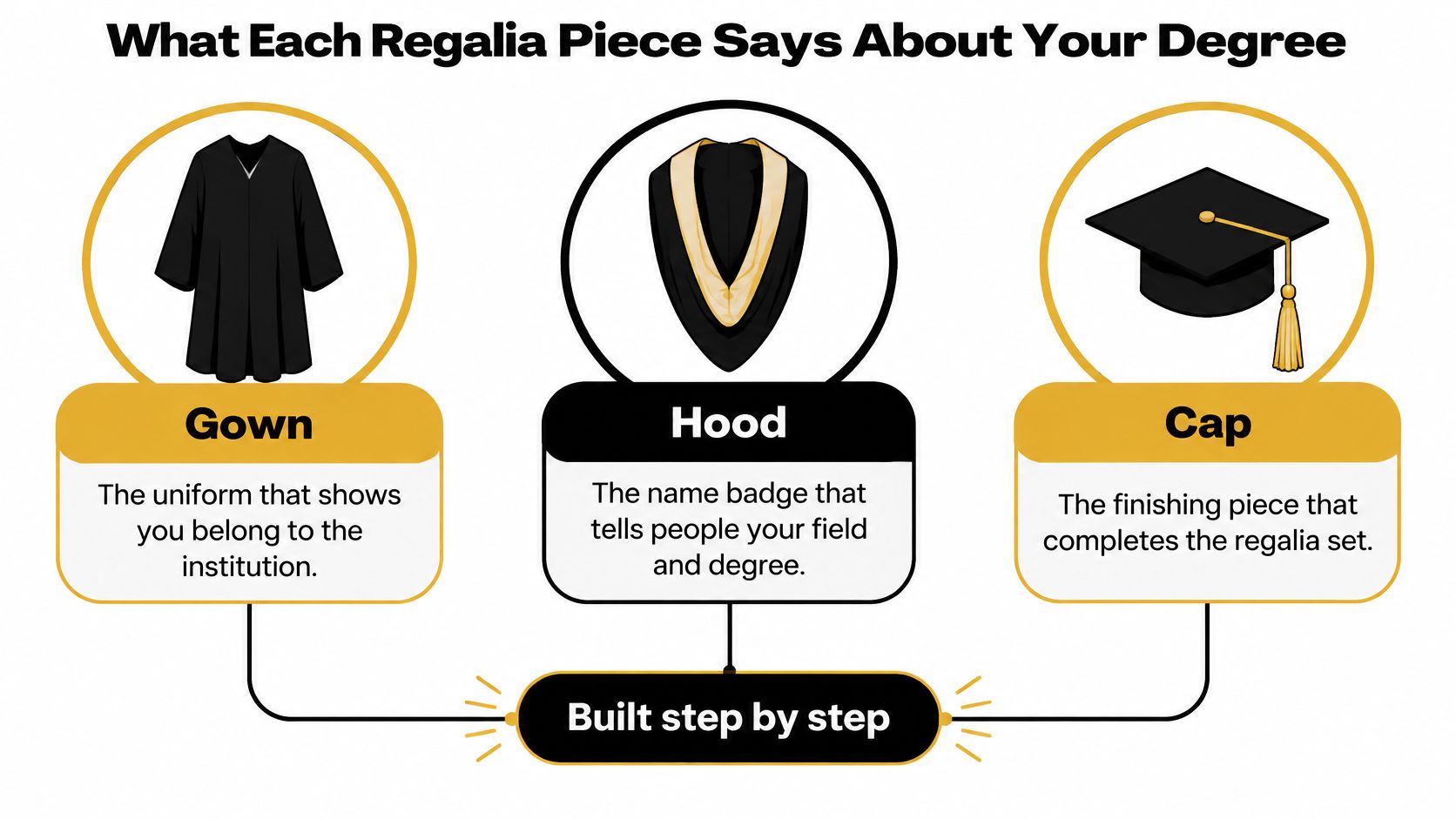
Think of the gown as a uniform that shows you belong to the institution, and the hood as a name badge that identifies your field and degree. The cap completes the ensemble, but it doesn't replace either of those signals.
That analogy is a starting point, not a complete decoding system. Gown construction also communicates academic level, while a hood combines shape, length, lining, and velvet facing.
Use the diagram to distinguish the pieces before inspecting their colors.
Read the hood from the inside outward
In the commonly used U.S. system, hood lining represents the degree-granting institution. Velvet trim identifies the academic discipline. The chevron pattern can also help communicate the institution, so choosing a lining because it looks attractive isn't enough.
The University of Texas at San Antonio's academic regalia explanation describes navy gowns and mortarboards alongside degree-specific construction: master's hoods are shorter than doctoral hoods, while doctoral hoods are longer and lined with institutional colors. The university's navy exterior therefore doesn't settle which hood or gown style a candidate needs.
What each regalia element signals
| Regalia element | What it signals | Where navy blue shows up |
|---|---|---|
| Gown | Institutional color, with black the usual choice in many U.S. ceremonies | Navy at UT San Antonio and UT Tyler; black remains common elsewhere |
| Mortarboard | School color, commonly coordinated with the gown | Navy at UT San Antonio and UT Tyler |
| Hood lining | The institution that granted the degree | Navy when it forms part of the awarding institution's colors |
| Hood velvet trim | The academic discipline | Dark blue for philosophy and Ph.D. holders under the U.S. convention |
Turn the symbolism into an order specification
Say you're earning a master's degree at a school that uses navy gowns. Selecting the right exterior color is only the beginning: you still need the approved sleeve style, master's hood construction, institutional lining, and field trim.
When reading a listing, separate lining color from velvet color. Our guide to graduation hood colors and their meaning can help you distinguish those terms before submitting color selections.
Ordering safeguard: Write down the gown style, hood level, lining, and velvet trim as separate requirements. Don't approve an entire set just because its color matches.
The video provides another visual reference for academic regalia.
A navy set can look correct in a photograph yet be wrong for your degree level. Check each row of the comparison table against your school's specifications, especially if you're ordering accessories separately.
How to Coordinate Tassels, Cords and Stoles With Navy
A navy gown works like a neutral frame: almost any accessory color will look harmonious against it, which is exactly why appearance is the wrong test. Each tassel, cord and stole states a claim about your degree or achievement, and your school's policy decides whether you may make that claim. The shade of the gown never settles the question.
Follow the accessory sequence
- Choose the tassel by degree level and discipline. Simmons assigns navy tassels to bachelor's candidates, while UT Tyler assigns faculty-color tassels by discipline, so gown color does not automatically determine tassel color. Read the exact tassel description before adding it to a navy blue graduation cap package. If you already own a tassel, compare it with the current ceremony instructions instead of assuming it remains acceptable.
- Place the tassel according to the ceremony rule. The Syracuse University regalia etiquette policy directs undergraduate candidates to wear the tassel on the right before the ceremony and move it to the left after the degree is conferred; it also requires a cap, gown and tassel beforehand for commencement-week ceremonies and reserves honor cords and stoles for qualifying honors. Wait for the ceremony leader's cue rather than moving the tassel early for photographs. Graduate candidates often follow a different procedure from undergraduates, so don't copy their sequence automatically.
- Confirm cord eligibility before choosing a color. Some schools reserve specific navy or colored cords for recognized distinctions, so a cord signals a particular earned honor rather than serving as a general accessory. Our graduation honor cords guide explains how cords differ from stoles and other adornments; your institution still has to confirm your entitlement to wear a particular one.
- Check stole approval separately. A cultural, organizational or identity stole and an academic honors stole may be governed by different rules. Ask whether your ceremony permits the stole, whether approval is required, and whether there are restrictions on wording or placement. Permission for one adornment does not extend to the others.
Keep an accessory approval record
Save the email or published policy that authorizes your cords and stoles, and keep it accessible on ceremony day in case a marshal asks. For group orders, record each accessory's purpose and its eligibility requirement alongside the product description, so a future buyer can see at a glance who qualifies for which piece.
Before checkout: A coordinated accessory is appropriate only if you're entitled to wear it and your ceremony permits it.
An unearned cord sends a misleading honors signal, even when you chose it purely for its color. Commencement officials may remove unapproved adornments at the entrance, so resolve any uncertainty well before you line up.
Fit, Heat and Mobility on Ceremony Day
The cheapest or most visually striking navy gown isn't necessarily the right purchase. If it traps heat, catches around a mobility aid, or presses painfully under the cap, its appearance won't compensate for the discomfort.
The Stockton University guide to commencement symbols and traditions explains that modern gowns are lighter than historical academic clothing because ceremonies generally take place in late spring or early summer. Lightweight construction helps, but you still need to test the complete outfit rather than judge comfort from a fabric photograph.
Check the outfit in motion
- Sleeves and hem: Sit in the chair or wheelchair you'll use, reach forward, and stand or transfer as appropriate. Check that fabric doesn't catch on wheels, armrests, footplates, or shoes.
- Hood movement: Raise and extend your arms. The hood shouldn't pull tightly at your throat or prevent you from reaching comfortably.
- Fabric and heat: Ask about fabric weight and breathability. Test the gown over your intended clothing, since bulky layers can make even a light robe uncomfortable.
- Cap pressure: Try the mortarboard with your planned hairstyle or head covering. Secure it without tight pins or pressure points, and don't alter required headwear without approval.
- Complete outfit: Include shoes, cultural garments, cords, and stoles in the fitting. Check the zipper, neckline, sleeve clearance, and seated drape together.
Our graduation gown size chart guide helps you interpret measurements, but a standing measurement alone can't show how the gown behaves when seated.
Plan access as well as fit
Wheelchair users, doctoral candidates, and graduates with sensory sensitivities may need additional checks for fabric bulk, trim, seams, and hood attachment. At least one university explicitly recognizes traditional garments alongside regalia; if you plan to wear a sari, korowai, or ta'ovala, ask how your ceremony accommodates culturally significant dress.
Waymap's discussion of accessible wayfinding for universities offers useful context for planning the route through campus. Confirm accessible entrances, seating, restrooms, and the stage approach with commencement staff.
Comfort is a purchase criterion, not a finishing touch.
A richer navy finish or lower price isn't better value if the gown overheats or restricts movement. Choose the approved ensemble you can wear comfortably through arrival, seating, and the ceremony.
Confirm Your Navy Blue Order Before You Buy
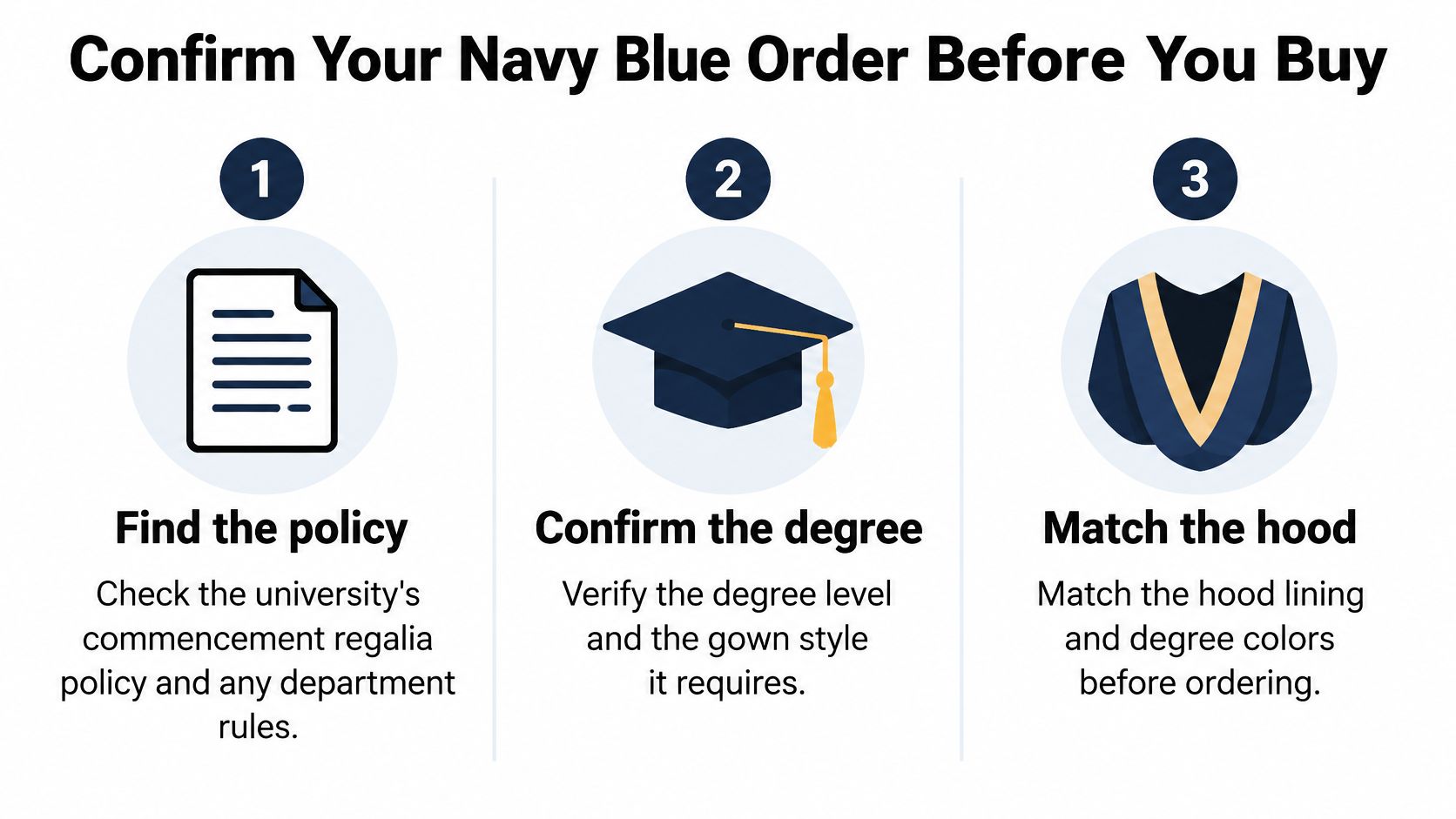
- Find the policy: Save the university's commencement regalia instructions and department rules, including any requirement to use a designated supplier.
- Confirm the degree and gown: If black is required, exclude the navy gown; if navy is required, match the degree-specific sleeves and hood rather than choosing by shade alone.
- Match the hood: Identify the awarding institution and academic field; we can help customers determine the proper velvet and chevron colors once those details are known.
- Check accessories and timing: Confirm tassel color, cord eligibility, and stole approval, and have every required component ready before your ceremony activities begin.
- Measure and test: Use the intended ceremony clothing and shoes, then check sleeve and hem clearance while seated and moving.
- Choose separate pieces or a package: We sell caps and gowns individually as well as in packages, including bachelor's packages that bundle the cap, gown, tassel, and hood in one purchase.
Use this visual checklist while comparing the policy with your proposed order.
Make the order match the written requirements
If the policy calls for black, order a black gown plus only the navy hood trim, lining, tassel, or cord it names. Don't add navy accessories to carry a color through the outfit. A product bundle is convenient only when its contents match the ceremony requirements.
For a navy master's order, identify the construction precisely. A Simmons-style specification calls for full-length square sleeves and crescent-shaped sleeve cloth, whereas UT Tyler's specification calls for elongated sleeves and a 3.5-foot hood. Avoid substituting a generic navy bachelor's gown for either requirement.
At Syracuse, plan to have the cap, gown, and tassel before commencement-week ceremonies. Undergraduate candidates keep the tassel on the right until the degree is conferred. Put that placement instruction with your ceremony notes, not just your shopping list.
Resolve uncertainty before payment
Compare the order confirmation with your saved specification, including gown color, degree level, cap type, hood lining, velvet, tassel, and size. Look closely at similar color names such as navy and royal blue rather than treating them as interchangeable.
If the policy uses unfamiliar terms, send the wording to commencement staff and ask which construction or color selection it means. We can assist with hood velvet and chevron colors, but the university decides what you're authorized to wear.
For a group purchase, collect each graduate's degree and sizing information separately. A shared school color doesn't mean everyone needs identical regalia, particularly when bachelor's, master's, and doctoral candidates participate together.
Keep the final approved specification with your order details. Confirm the school's rules first, then order the matching components.
Graduation Attire offers individual caps and gowns, degree-specific packages, and help selecting academic hood velvet and chevron colors. Once your school has approved the navy blue ensemble or black-gown alternative, visit Graduation Attire to compare options that match your degree and ceremony requirements.