

What if the purple graduation cap you bought for its color is saying something about law, honors, or your university that you didn't intend? That's the gap many families miss. Purple isn't one fixed symbol in academic regalia. Its meaning changes with the item that carries it, the degree you're earning, and the rules your school sets. Once you learn to read each piece separately, you can order with confidence and avoid a cap that looks right but sends the wrong signal on ceremony day.
What Purple Means on Each Part of Your Regalia
A purple graduation cap has no single universal meaning. Under the U.S. academic-costume convention, purple is the disciplinary color associated with law, while a hood's satin lining generally represents the degree-granting institution's official colors, a separation explained in Valdosta State's history of academic regalia. Start with the piece, not the color alone.
| Regalia item | What purple can signal | Where to confirm |
|---|---|---|
| Mortarboard (cap) | Usually no discipline meaning; purple is chosen only where the school permits it | Commencement guide |
| Tassel | Law (Juris Doctor) under the standard US discipline code; some schools use violet for their own degrees, such as NYU for bachelor's and master's graduates | Registrar regalia chart |
| Hood velvet | Field of study; purple velvet indicates law | Institution's regalia chart |
| Hood lining | Colors of the awarding institution, such as LSU's purple-and-gold linings | Institution's official colors |
| Honor cord | An honors designation, such as purple solid cords for magna cum laude at the University of Northern Iowa, or purple-and-gold cords for Latin Honors at LSU | Honors office or registrar |
| Gown trim or panels | Doctoral field, or a full purple gown at Northwestern with black velvet panels | Ceremony guidelines |
How to Read the Table
The tassel and hood usually carry the academic signal, while the mortarboard itself rarely does. If you're comparing hood details, our guide to graduation hood colors and meanings can help you match velvet to field before you talk to your school.
Practical rule: Never interpret a purple cap by color alone. Match each element against your school's own regalia chart first.
Why Purple Has a Place in Academic Regalia
Academic dress began in medieval European universities, where scholars wore robes and hoods influenced by ecclesiastical clothing. By the 14th century, Oxford required faculty members to wear academic dress in public. In the United States, an intercollegiate effort began in 1893 and produced a formal academic costume code at Columbia University in 1895, according to USC Aiken's history of regalia. That code set conventions for gown shapes, materials, hoods, and colors.
The code gave each part of the outfit a job. Gown shape signals degree level. Hood details signal field and institution. Tassel color can signal discipline or school tradition. Each color is an assigned code.

Mortarboards and Tams
The square mortarboard became the recognizable cap for bachelor's and master's graduates. Doctoral candidates commonly wear a tam or other doctoral headwear instead. That split is why the same purple element can look familiar on one graduate and out of place on another.
Purple can carry two different messages across the outfit. A purple gown may be a doctoral tradition at one university, while at another campus purple appears only on an honors cord. The school's regalia chart decides which meaning applies.
Purple Caps for Bachelor, Master, Doctoral and Law Graduates
Purple rarely means one thing across all four degree levels. It attaches to a specific part of the outfit, and that part tells you what the color is doing. A purple tassel, hood lining, or gown can each send a different message at the same ceremony. Your school's regalia policy decides which part may carry it.
Bachelor's Graduates
For a bachelor's graduate, purple usually appears on the tassel or cord, not as a statement about the degree level itself. A purple cord may signal an honors designation, so check whether your school reserves that color for a specific award. Wearing it without earning the honor creates a problem, even if the cord matches your outfit.
Master's Graduates
Master's rules are where school charts matter. One campus may tie tassel color to the student's primary academic college. Another may issue a single institutional color to every master's graduate. Same purple family, different meaning. Find the line for your degree and program, then confirm whether the color belongs to the tassel, the hood, or neither.
Doctoral Graduates
Doctoral regalia gives purple more room to appear. It can show up on the gown, the velvet panels, the hood lining, or the headwear. Treat those pieces as one set. If you confirm the gown color but miss the panel or hood lining rule, the outfit can look right in one photo and wrong beside your cohort on stage.
Law Graduates
Law is one of the clearest examples. The University of North Dakota uses purple tassels for law and purple hood trim for the Juris Doctor. The University of Illinois Urbana-Champaign also lists purple for law and states that master's and doctoral hood velvet indicates the field of study, in Illinois' caps and gowns guidance. At schools like these, purple is a field marker tied to the degree, not a generic celebration color.
If purple marks honors at your school, match the cord to the award you earned. Don't borrow the signal.
Can You Wear a Purple Cap or Add Decorations
For many graduates, personalization isn't just decoration. It's protected expression tied to heritage, faith, or family. Nevada offers a useful example. After Native students used beadwork and other heritage symbols, a district expanded its cap-personalization rules, and Nevada passed AB73, allowing traditional tribal regalia or culturally or religiously significant objects on graduation attire statewide, as reported by The Nevada Independent's coverage of Washoe students.
That protection doesn't erase local rules. Some schools require approval for any decoration, while others explicitly protect tribal or religious items. Campuses can still govern timing, safety, and ceremony uniformity, so a purple graduation cap may carry a beadwork design, flag, or faith symbol at one school and face removal at another.
Questions to Ask Before You Decorate
- Size and placement: How much of the mortarboard can your design cover?
- Prohibited messages: Which words, images, or symbols are banned?
- Adhesive and damage rules: Can you glue items on, or must the cap stay undamaged?
- Approval deadlines: Who reviews the design, and by when?
- Cultural protections: Does state or school policy protect tribal or religious regalia?
- Alternatives: Can you use a stole or cord instead of decorating the cap?
Our overview of cap and gown decorations gives design context, but it can't replace written policy. Ask your commencement office in writing, describe the item plainly, and keep the reply with your regalia.
How to Choose a Purple Cap and Gown Set
A purple set is not one color decision. It is a four-part match: cap, gown, hood, and tassel each carry a school-specific signal, and your school's regalia chart decides which parts may be purple. Begin there, before you fall in love with a shade on a screen.
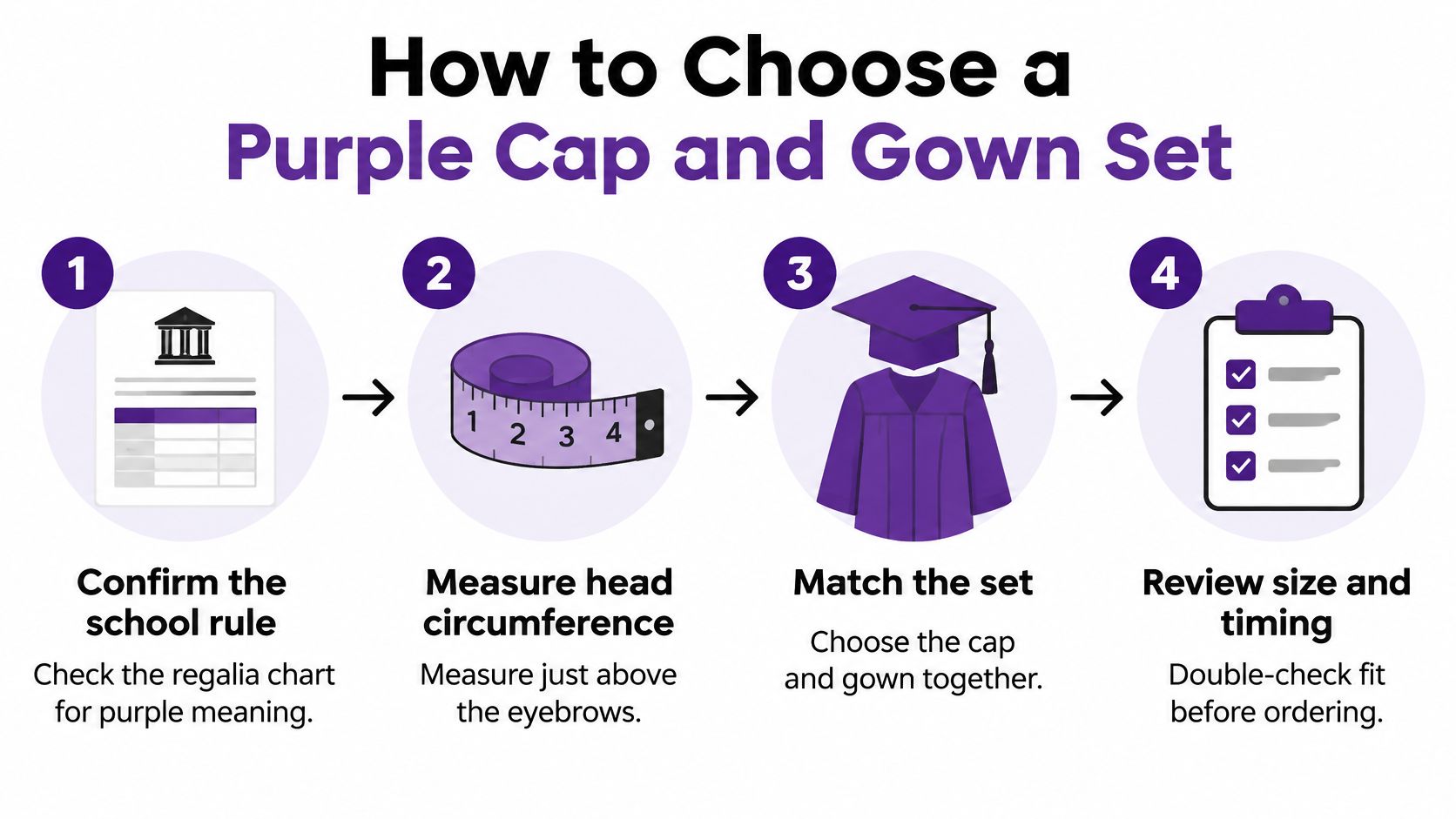
- Confirm the rule first. Read your school's regalia chart for the cap, tassel, hood, and cord. The common mistake is ordering an all-purple set before learning that purple is reserved for a particular degree, honor, or field. If the chart says the gown must be black and only the hood lining may carry color, your purple belongs on the hood, not the cap.
- Measure your head, not your hat size. Wrap a soft tape just above the ears and eyebrows, snug but not tight. Many graduation caps are not adjustable, so a loose measurement leads to a cap that slides. Graduation Attire's caps use an elastic band for a snug fit, but the band does not change the base size.
- Measure height for gown length. Stand straight in the shoes you will wear. Note chest and sleeve measurements if the size chart asks for them. Do not guess from your shirt size. A gown that is too short shows ankles in photos, and one that is too long drags on stage.
- Ask for a physical swatch on bulk orders. A screen preview cannot show satin sheen or velvet pile. Request a swatch or approved color reference so your purple cap and gown are compared as fabric, not as pixels. If you are ordering for a group, make the swatch the shared standard.
- Check two lighting conditions. Hold the cap beside the gown under indoor ceremony lighting and in daylight. Purples that match on a table can separate in photographs. The goal is one purple indoors and outdoors, not a close match under one lamp.
- Compare the complete set. Judge mortarboard, tassel, gown, and hood together. One shiny piece beside matte pieces can break the match even when the color codes agree. Look at the set from a few steps back, the distance a graduation photo usually shows.
- Record your choices. Write down sizes, color names, and codes in one place. Keep that record with your order confirmation so an exchange or a reorder for a friend starts from the same reference.
A Concrete Size Example
The Shiny Purple High School Cap & Tassel - Graduation Caps has a 9" x 9" mortarboard and an elastic band for a snug fit. The cap is not adjustable, so compare the 9" x 9" measurement and the available size with your head measurement instead of assuming one size suits every graduate.
A correct match reads as one purple indoors and outdoors. The cap sits level, the tassel hangs freely from the button, and no single piece looks blue or red beside the others. If one piece does shift, change that piece before you decorate it or order for the full group.
Ordering Purple Regalia Without Missing Deadlines
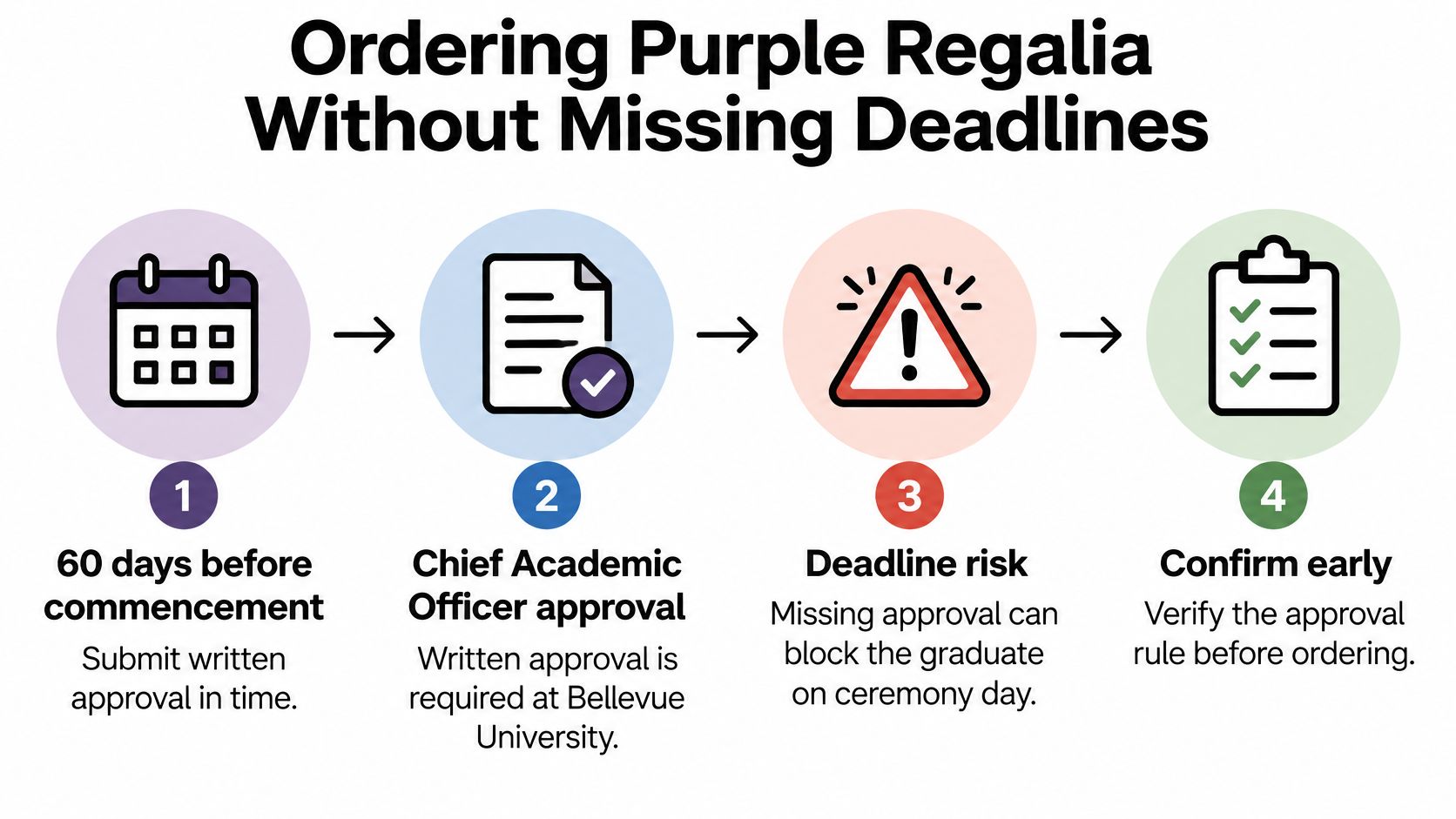
Approval deadlines often matter more than shipping speed. Purple on a tassel, a hood, or a cap can point to different things at different schools, and the ordering calendar is where those differences turn into hard dates. Washington and Lee University prohibits props and unapproved adornment on a graduate's cap or gown, under Washington and Lee's dress and adornment rules. Some schools require written approval from a chief academic officer for items outside approved regalia, and graduates who skip that step may be barred from participating.
A Working Timeline
- Now: Find your school's regalia chart, decoration policy, and approval cutoff.
- By the school's stated deadline, where approval is required: Submit the written request with photos or descriptions of what you plan to wear.
- After approval or standard selection: Order the purple graduation cap and matching pieces.
- On arrival: Try on the full set, compare it with your approval reference, and leave time for an exchange.
Keep the approval letter, order confirmation, and color reference together. Approval windows are fixed. A size exchange is fixable only if you leave time. If you're still deciding on a seller, our guidance on where to buy a graduation cap and gown outlines what to verify. Don't order a customized purple cap before approval, because you may have to replace it.
Confirm Your School's Purple Rule Before You Buy
The school's answer outranks every color chart. Purple on a cap, a gown, an academic hood, or an honor cord can signal different things at different schools, so confirm the rule for each element you plan to wear before you place a customized order. A cap that reads as "school color" in one commencement lineup can read as "unauthorized adornment" in another. That is why the rule comes first and the purchase comes second.
Start with the office that publishes your commencement dress rules. Ask what purple is allowed to signify on the cap, gown, hood, and cords, and whether the answer changes for your degree level. If the response is "follow the regalia chart," get the chart in writing and keep it with your order notes. This matters most for law and doctoral graduates, whose hoods carry velvet and chevron colors that a school may regulate closely. Graduation Attire can help you determine the proper colors for the velvet and chevrons on an academic hood, so you can compare the school's requirement with the hood you plan to order.
Then check the fit before you buy. Graduation Attire's caps are 100% polyester, come in Adult and Child sizes, measure 9" x 9", and are not adjustable, with an elastic band for a snug fit. Because the cap does not adjust, a head measurement matters more than a guess from a photo. The store's school finder helps match regalia to university requirements, and its size and color guides support the measuring step.
For bulk orders, request a sample set through the sample set request form. Graduation Attire sends free samples for potential orders of 100 or more caps, gowns, and tassels after the request is approved. A physical sample lets a coordinator compare purple fabric under the school's lighting before committing a whole class to one color.

For younger graduates, the Child Shiny Purple Graduation Cap & Gown - Preschool & Kindergarten gives families a purple cap and gown option in a shiny finish. Those who prefer less shine can choose the Child Matte Purple Graduation Cap & Gown - Preschool & Kindergarten. In either case, confirm the school's purple rule before ordering, because preschool and kindergarten ceremonies can have their own dress codes.