

Does a purple graduation cap mean the wearer studied law, earned honors, or attended a school whose colors include purple? The cap alone usually can't answer that question. Its meaning comes from the complete regalia set and the institution's commencement rules.
That distinction matters when you're choosing purple graduation caps for yourself, your family, or a graduating class. Start by identifying which garment carries the color, then confirm its meaning, shade, fit, and permission to wear it. A matching outfit isn't necessarily an approved one.
Where Purple Shows Up on Graduation Regalia
A purple cap alone rarely identifies a graduate's field. At most schools, the mortarboard stays black unless the institution specifies another color. Purple may instead appear in a tassel, hood, cord, or stole, and each component has a different job.
The distinction between hood velvet and hood lining causes particular confusion. Velvet borders can identify a discipline, while the lining can display university colors. Looking at both as one purple accessory can lead you to order the wrong combination.
Where purple appears on graduation regalia and what it can signal
| Regalia part | Where purple usually appears | What purple can signal | Check before buying |
|---|---|---|---|
| Mortarboard cap | Usually black; purple only when the school sets it | Institutional identity | Confirm the school's cap color |
| Tassel | Set by degree or faculty at many schools | Field of study, such as purple for law | Match the shade and tassel type the school names |
| Hood velvet or binding | Master's and doctoral hoods | Discipline color, such as purple for law on master's hoods | Check the school's discipline color list |
| Hood lining | Inside the hood | University colors, such as purple and gold on LSU master's hoods | Confirm lining colors with the registrar |
| Honor cords | Draped around the neck | Academic honors; solid purple reserved for top GPA at some schools | Check the honors eligibility rules |
| Stole | Draped over the gown | Identity, affinity, or cultural recognition | Check whether the school permits it |
The University of Illinois Urbana-Champaign's regalia guide lists purple for law in its discipline assignments for master's hood velvet and bachelor's tassels. That doesn't mean the graduate's entire cap and gown must be purple.
Louisiana State University's academic regalia requirements make the distinction especially clear: master's hoods have purple-and-gold lining, while the velvet binding identifies the degree field. Institutional identity and academic discipline can therefore appear on the same hood.
Read the components separately
A product name can help you separate these features. The Deluxe Bachelor/Master Hood -Light Blue Velvet, Purple & White names the velvet color separately from the other colors in the hood. Don't substitute a purple velvet border just because the lining needs purple.
Practical rule: Check every row against your school's commencement page before buying. A shared color doesn't make caps, tassels, hoods, and recognition accessories interchangeable.
Purple Shades and How to Match Them
Purple isn't one reproducible color. A shade name is a starting point, not proof that separately ordered garments will match.
The Intercollegiate Registry's collegiate color classifications distinguish bright purple, including palatinate, pansy, purple, and violet, from medium purple, which includes royal purple. Use those categories to organize your comparison, then approve the actual fabric.
Purple shade terms and what to check before approving them
| Shade term | Category | What to check before approving |
|---|---|---|
| Palatinate | Bright purple | Compare against the school's official swatch |
| Pansy | Bright purple | Check the shade in both indoor and outdoor light |
| Purple | Bright purple | Confirm the exact shade name appears on the order |
| Violet | Bright purple | Check how it renders under camera flash |
| Royal purple | Medium purple | Compare side by side with bright purple before approving |
Approve fabric rather than a screen image
Request a physical swatch or supplier sample before coordinating a group order. Place the cap, tassel, stole, and gown accents together rather than approving each item separately. A matte cap and satin stole can reflect light differently even when their color descriptions sound identical.
Record the approved shade name, material, and finish on the order. Keep the sample available for comparison when the shipment arrives, especially if different components come from different production batches.
Use these checks before authorizing shipment:
- Indoor lighting: Examine the complete combination under auditorium-style lighting, not only beside a window.
- Outdoor sunlight: Look for differences that weren't visible indoors.
- Camera flash: Check whether one fabric becomes noticeably brighter or shifts toward a different purple.
- Batch consistency: Compare the delivered components against the approved physical sample.
Digital screens render purple unevenly, while fabric reflectance and different dye lots can create visible mismatches. A photograph won't replace a physical comparison, but it will show how the combination is likely to appear in ceremony pictures.
Finish with a photo under the lighting your ceremony will use. Reject an off-color batch before distribution, rather than discovering the mismatch when graduates line up.
Why Purple Can Mean Law, Honors or Your School
Purple points to three different things on graduation regalia. It can mark a field of study such as law, signal honors recognition, or show school identity.
School identity gives the clearest examples. A UC Davis account of academic-regalia history records Furman University's adoption of royal purple and white in 1889 and Mount Union's adoption of royal purple as its official color by 1895. Students there wear purple because the institution chose it, not because of any national color code.
Honors create a second use. Millersville University awards purple cords for its University Honors College. The cord marks completion of an honors program.
Discipline color creates the third use. The history of school and academic colors summarizes an 1893 system that linked purple with law, alongside white for arts, yellow for science, green for medicine, and blue for philosophy.
A complete outfit shows why the location of each color matters.

The Burgon Society's academic-dress discussion explains that faculty colors follow the faculty or degree title printed on the diploma, not necessarily the student's major. A buyer should therefore use the school's degree designation rather than translate a course concentration into a color.
One purple hood border can indicate a discipline, while another graduate's purple lining identifies the university. Check the full set against the school's rules before assigning a meaning.
For a visual companion to the academic-dress discussion, use the video below.
Our guide to graduation hood color meanings helps distinguish the different color-bearing parts of a hood.
Read the full outfit through the school's own rules, since a single color can carry more than one meaning.
School Rules That Decide Whether Purple Is Allowed
A purple cap can match the school's colors and still fail its ceremony requirements. Official approval, decoration rules, and recognition eligibility are separate checks.
Use this checklist when reading your institution's policy. The named schools illustrate specific rules, not a universal dress code.
- Confirm official attire requirements. Purdue University's commencement attire policy requires university-approved academic attire and excludes keepsake or non-official gowns from the ceremony. A visually similar replacement isn't automatically acceptable.
- Check whether decorated mortarboards are permitted. Purdue permits decorations only when they aren't offensive and don't obstruct the view of students behind the wearer. Keep the audience and other graduates in mind, not just the appearance of your portrait.
- Verify how the cap must sit. Purdue specifies a horizontal cap with its point centered at the front. Decorations shouldn't force you to tilt the mortarboard to keep it balanced.
- Keep the tassel mechanism clear. The University of North Texas requires decorations to lie completely flat, with the center button accessible and the tassel able to move freely. Build your design around that movement rather than covering the button.
- Remove prohibited decoration types. North Texas bars upward-projecting items, decorations hanging over the sides, and offensive references to weapons, alcohol, or illegal drugs. A lightweight attachment can still break the rules if it extends beyond the permitted surface.
- Check reserved honors colors. The University of Northern Iowa's caps-and-gowns policy prohibits student-organization cords or stoles in solid gold or solid purple and reserves solid purple cords for Magna Cum Laude recipients, defined as the top 4% through top 8% by cumulative GPA within their academic major college or division.
Get permission before attaching anything
Use the cap-and-gown decoration guide to plan a design, then compare that design with your own commencement policy. If the wording is unclear, send the commencement office a photograph or sketch and keep its written response.
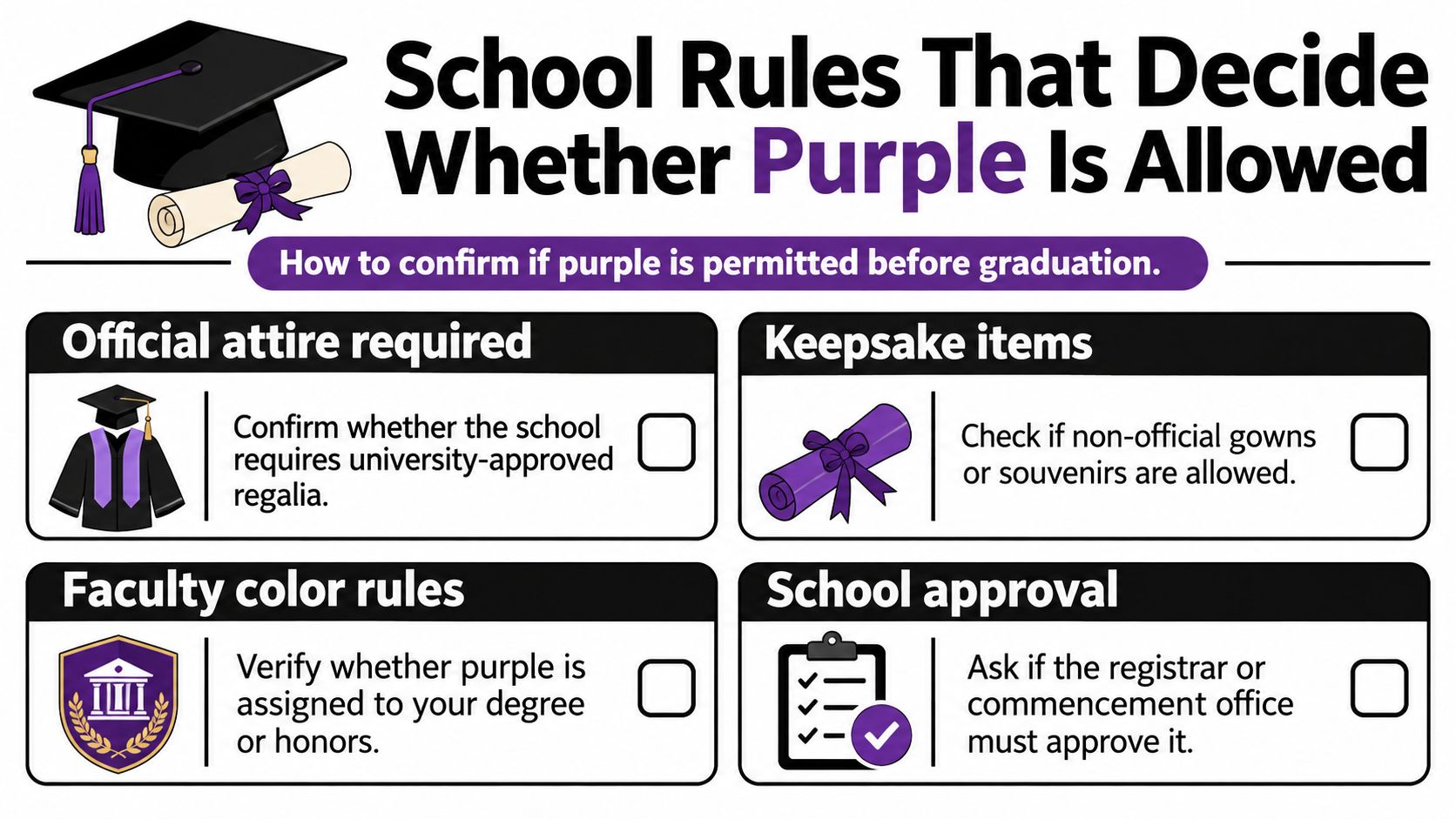
These restrictions apply whether the cap is purple, black, or another color. Color approval doesn't override construction or decoration rules.
Sizing and Styling Your Purple Cap
A purple mortarboard fits like a lid, not like a hat. The stiff square stays level on top while a separate crown grips the head underneath, so the width of the square tells you little about comfort or stability.
Start with a tape measurement taken with your ceremony hairstyle in place. Wrap a flexible tape just above the eyebrows and ears, keep it level, and hold it snug. Braids, twists, an updo, or high volume lift the crown and change the result, so measure the way you will wear it on the day.
Graduation Attire caps are 100% polyester, come in Adult and Child sizes, measure 9 by 9 inches, and are not adjustable. The secure fit comes from an elastic band that gives a snug and comfortable feel without turning the cap into a one size stretch design. Compare your head circumference to the size chart for the exact cap you selected, and pick the larger size when you fall between sizes. Discreet pins help with stability, and a short movement test helps confirm the choice. Walk across the room, look down at your shoes, and turn your head gently to check for sliding, pinching, or riding too high.
styling works best after fit is settled. Wear the cap level with the front point centered, and follow school instructions for which side the tassel starts on and when it moves. Our graduation cap headband guide explains how support and hairstyle placement affect that level position. Keep any support hidden and low so the board keeps its flat line in photos.
Check the full outfit together before the ceremony. Where identity stoles are permitted, the Purple BLACK GRADS MATTER Graduation Stole sits under the gown collar and over any required hood, so confirm the order of layers early. Take a final photograph from the front and side to check that the cap sits even, the tassel hangs clear, and no accessory covers required regalia details.

Buying Purple Responsibly and Planning Reuse
Guides to purple graduation caps often stop at symbolism and styling. What happens after commencement deserves attention before checkout, especially when the cap may otherwise be worn only once.
A purple graduation hat sustainability guide reports UCLA guidance that recommends recycling or donating caps and gowns. The same guide reports San José State University announced its Renew gowns use 100% post-consumer recycled materials. The latter is a gown-specific material claim, not proof that a matching cap is locally recyclable.
Separate material claims from the whole decision
Recycled fiber describes one material attribute. Judge the purchase by usable life, shipping and packaging, and whether someone else can wear the cap afterward.
Borrowing an approved cap may be more practical than buying a new one for a single event. For example, a campus green-graduation closet or departmental loan stock that cleans and reissues donated caps lets a student wear an approved shade without ordering new regalia.
Use a lifecycle checklist:
- Buy only required pieces. Do not add an extra purple accessory solely to complete a color theme if the school does not allow it.
- Check construction. Inspect seams, the crown, and the elastic so the cap can remain usable after the ceremony.
- Keep additions removable. Glued decorations, mixed materials, and metallic finishes can complicate donation or recycling.
- Ask the local textile recycler. Describe the fabric, stiff mortarboard, and attachments rather than assuming the whole cap belongs in a textile collection bin.
- Arrange a recipient. Ask a school, costume drive, or future graduate whether it can use the cap before donating it.
- Consider resale. Keep the shade description and sizing information so the next wearer can assess suitability.
Check who will accept the finished item before counting any recycled-fiber claim as a disposal plan. Name the textile collector, donation closet, or next wearer in writing.
Plan the cap's second life before ordering. A named recipient or confirmed collection route is more useful than a vague intention to recycle it later.
Final Check Before You Order
Make the final decision from a written order specification, not a photograph alone. For an individual purchase, a saved note is enough; for a group order, give one coordinator responsibility for approving the details.
The specification should connect your academic requirements with the exact garments being purchased. That prevents a correct shade from being attached to the wrong degree level or accessory.
Resolve academic and permission questions
- Copy the diploma title accurately. Record the degree level and official degree designation alongside the required faculty color. Don't substitute an informal description of your major.
- Document accessory permission. If solid purple is reserved for honors, obtain written registrar approval before ordering a purple identity stole. A meaningful message doesn't exempt an accessory from the color policy.
- Separate hood instructions. Record velvet, lining, and chevron colors in distinct fields. We can help determine the proper colors for the velvet and chevrons on your academic hood.
For an identity stole, approval should cover both its purpose and its appearance. Send the office the actual item description or image, rather than asking only whether stoles are allowed.
Approve the physical order
For potential orders of 100 or more cap, gown, and tassel sets, we send free product samples after a request is approved through our sample set request form. Submit the request for approval before committing to the full group order.
Use the approved sample to run the ceremony-lighting photo test and confirm that the selected components work together. Keep a record of who approved it, along with the exact shade name and material.
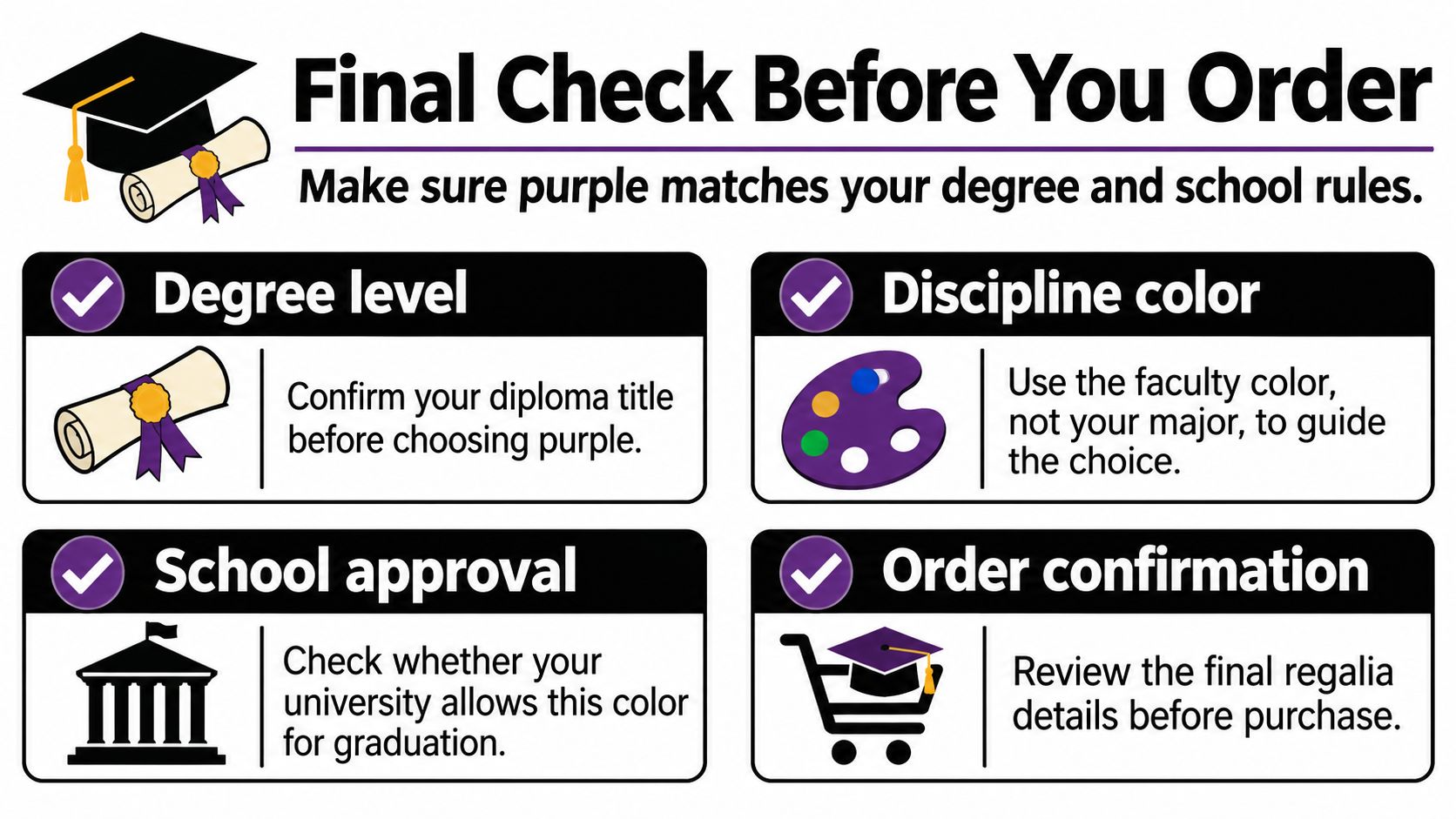
Before checkout, finish the practical details:
- Match measurements to names. For a group, record each wearer's head circumference and selected chart size, not just an estimated age category.
- Save the final specification. Include the cap color, tassel type, hood details, permitted accessories, and any written approvals.
- Assign the second use. Note whether the cap will be kept, passed on, donated, or taken to an accepting recycler.
Order only when the academic requirements, physical sample, and sizing choices align. The goal isn't just a purple outfit; it's regalia that accurately represents the graduate and is ready for the ceremony.
Graduation Attire offers caps, gowns, academic hoods, tassels, and identity accessories, with guidance to help you coordinate the required colors. Visit Graduation Attire with your school's regalia specifications and measurements to choose purple details that fit both the graduate and the ceremony.