

The most common advice about a royal blue graduation gown is also the most misleading: blue doesn't automatically identify your degree, major, or academic field. A striking color can make a group photo look coordinated, but the university's written regalia rules decide whether that gown, hood, and trim belong at the ceremony.
Think of the gown like a team jersey. Its body color is the team color; the hood or velvet trim is closer to a position number, carrying separate information. Before choosing a shade, find out what your school requires and which part of the regalia the color applies to.
What a Royal Blue Graduation Gown Means
A royal blue graduation gown identifies the school's ceremony standard, not the wearer's field of study. The same shade can appear on gown fabric, hood lining, chevron, or velvet trim, and each placement carries different information. Regalia runs on more than one color system at once: the institution picks a signature color for the procession, while hoods and velvet follow a separate scheme tied to degree and discipline. Matching a gown to a campus photo tells you nothing until you know which component the color is supposed to describe.
School colors get fixed long before anyone orders regalia. Rollins College adopted royal blue and gold in the mid-1890s, after students rejected an earlier rose color, according to Harvard Magazine's account of academic costume history. Once a campus locks in a shade, the requirement travels with the regalia even after the original reason is forgotten. A choice that is correct on one campus can be wrong on the next.
Five institutions assign the same blue five different jobs:
| Institution | Who wears blue or royal blue | What stays different | What to verify |
|---|---|---|---|
| Pennsylvania State University | All Ph.D. programs in royal blue regalia | The same blue covers every doctoral field | Whether the requirement names the gown, the hood, or both |
| San José State University | Undergraduate and master's regalia | Sleeve design still splits bachelor's from master's | Gown silhouette plus shade |
| University of Wisconsin–Eau Claire | Bachelor's candidates | Square sleeves are part of the spec | Shade versus navy or light blue |
| Penn State Harrisburg | Undergraduate gown | Master's gown black; doctoral gown black with velvet panels | Degree level before color |
| Hong Kong Baptist University | Ph.D. robes with royal-blue velvet facings and sleeve bars | Hood lining and edges differ for Ph.D., business, and education doctorates | Velvet versus hood colors |
Run the checks in this order before you buy:
Written school rules first. Degree and discipline second. Personal color preference third.
Ask whether royal blue belongs on the gown fabric, the hood lining, the chevron, or only a ceremonial accent. A gown can match the school's branding perfectly and still fail if the university requires black regalia or specifies a different hood. The shade will photograph well either way. Royal blue earns its place only when the published regalia rules call for it.
Sleeve Cuts and Hoods That Change With the Degree
A gown's color works like a jersey: it shows which team the wearer belongs to. The sleeve cut works like the position: it shows what role that person plays. A royal blue graduation gown can read as simple school spirit at one ceremony and signal a completely different rank at another, because degree level changes the garment even when the shade stays the same.
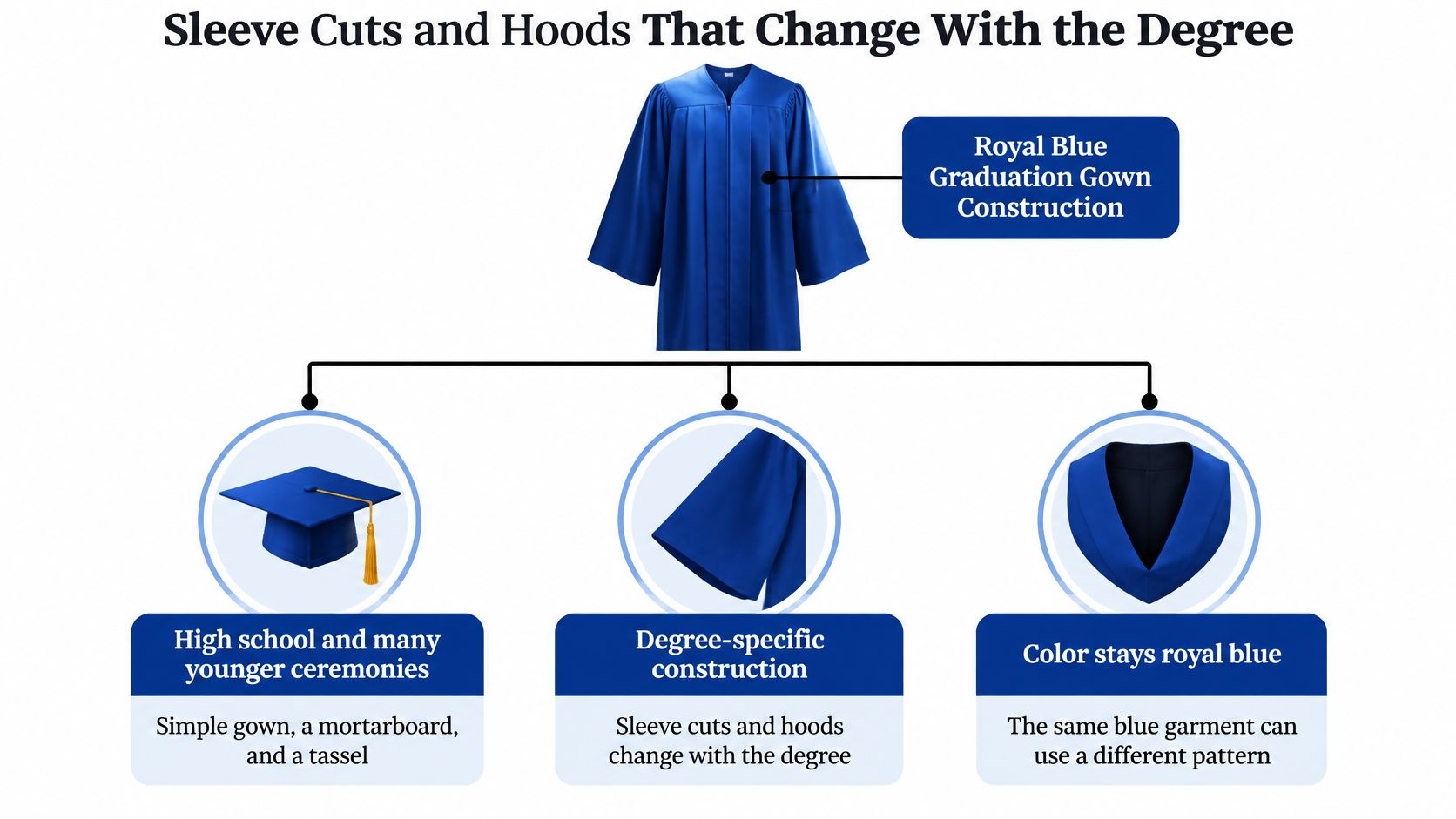
Start at the earliest ceremonies. Pre-K and high school regalia usually means a plain gown in the school color, a mortarboard, and a tassel. Associate and bachelor's gowns typically add pointed sleeves, and a hood shows up only when the school requires one. Master's gowns move to long, closed sleeves with an opening for the arm, and the hood becomes part of the standard outfit.
Each step changes the pattern, not the paint.
Doctoral regalia is fuller, with velvet panels or sleeve bars, and the headwear shifts from mortarboard to tam. Faculty members wear the regalia of the degree they hold, so a row of professors can be dressed in black even while the students beside them wear blue. The hood itself carries its own code: a fabric shell, a school-color lining, sometimes a chevron, and velvet tied to a discipline.
| Level | Usual gown cut | Headwear | Hood |
|---|---|---|---|
| Pre-K and high school | Simple gown in the school color | Mortarboard and tassel | Rarely used |
| Associate and bachelor's | Often pointed sleeves | Cap and tassel | Only if the school requires it |
| Master's | Long sleeves with an arm opening | Cap and tassel | Usually required |
| Doctoral | Fuller sleeves with velvet bars or panels | Tam | Required, with school lining and discipline velvet |
| Faculty | Follows the wearer's degree | Tam or cap | As that degree requires |
Suppliers name hoods by that code. The Deluxe Bachelor/Master Hood - Light Blue Velvet, Royal Blue & Golden Yellow is listed at $37.95 in a single variant, with the velvet and color combination spelled out in the product name itself. Graduation Attire can help customers work out the proper colors for the velvet and chevrons on their academic hood, which matters when the discipline color and the school color are two different things.
Written school rules put these distinctions in plain language. The University of Wisconsin–Eau Claire's commencement guidance, for example, breaks regalia down by degree rather than by shade, so a buyer can check sleeve and headwear requirements before worrying about blue versus navy.
Before settling on a gown shade, write down four things: degree level, sleeve type, headwear, and whether a hood is required. Then match the colors to the school's specifications, because a beautiful blue in the wrong cut is still the wrong gown.
Why Royal Blue Is Not the Same as PhD Blue
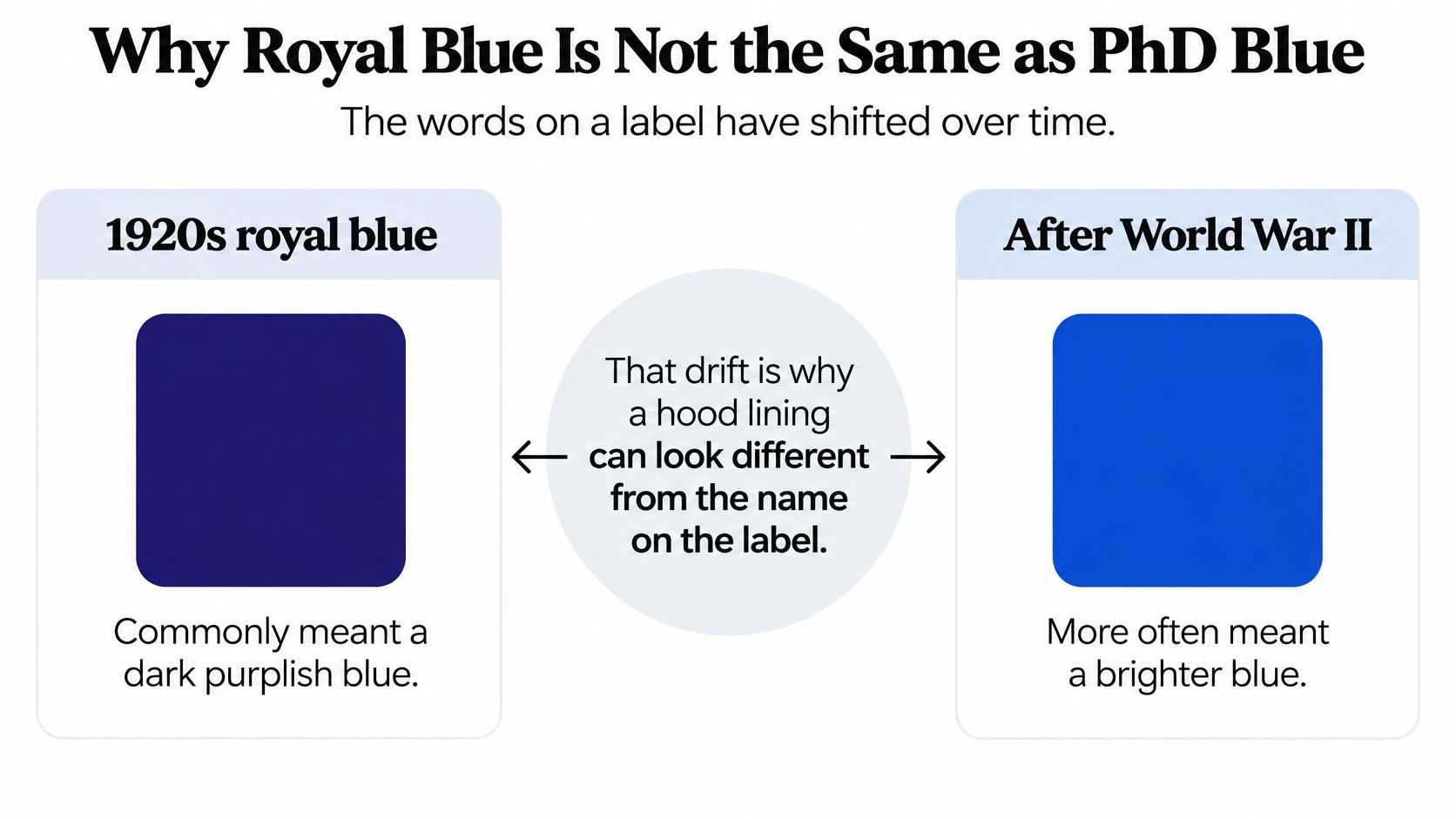
A royal blue gown works like a team jersey: it identifies the school, not the wearer's degree. Even the phrase itself has drifted. In the 1920s, "royal blue" commonly meant a dark, purplish blue; after World War II, it increasingly described a brighter blue, as the academic-color history and guidance describes. That drift can leave a gown, a hood lining, and a school-color reference looking different even when each uses the same label.
| Label or use | What it signals | Why it can be confused |
|---|---|---|
| Royal blue | A shade named in an institution's regalia rules | The intended blue may differ by school or by era |
| Dark blue | The conventional U.S. academic color associated with philosophy and the Ph.D. | A royal-blue school gown may follow a different shade standard |
| School color | An institution's chosen identity or ceremony color | It may apply to the gown, lining, trim, or a different piece |
Universities have revised their official blues over time, and regalia committees have specified shades by precise names that sit apart from the labels shoppers use. That history is why the shade named in an institution's written specification governs the gown order.
Academic discipline colors and school colors do different jobs. Under the U.S. academic-costume system, dark blue is associated with philosophy and conventionally used for the Ph.D., regardless of the candidate's research field. White is used for arts and letters, golden yellow for science, green for medicine, and purple for law. The colors mark the degree earned, so two graduates from different majors can wear the same discipline color on the same stage.
A label can also look inconsistent under different lighting. Royal blue, navy, and light blue may separate visibly under auditorium LEDs, daylight, or flash photography, even if the garments seemed close under store lighting. For a doctoral ceremony, official photography, or a group order, compare the written shade name with a physical swatch and check it in the ceremony's lighting. For more on how hood colors carry their own meaning, see this guide to graduation hood colors and meaning.
Photo check: Approve the shade in the light where the gowns will be photographed, not just where they're unpacked.
Accessories That Sit Cleanly on Royal Blue
A royal blue gown is a loud background. Everything pinned, draped, or hung on it either agrees with that blue or argues with it, and in a group photo the argument is visible from the back row. Plan the outfit as one set: the gown is the jersey, and every accessory is a position marker that has to read correctly at a glance.
The stacking rule that keeps the set readable: the gown carries the school or ceremony color; the hood carries the school's lining and discipline velvet when required; one stole carries a personal or honor story. Cords sit at the neck, while medals and year charms stay small enough not to compete with the gown. Two stoles, three cords, and a medal is not a story. It is a pile.
Because royal blue is usually a school color rather than a degree code, the written regalia rules decide what goes on top of it. Check whether your school limits the number of stoles and cords before buying anything. Some schools reserve stoles for honors programs or specific organizations, and a stole you are not cleared to wear still photographs badly when an usher asks you to take it off.
A royal blue stole can also carry a message the gown cannot. The Royal Blue BLACK GRADS MATTER Graduation Stole sits in the same color family as the gown but reads as a statement, not a match. A stole can mark heritage rather than honors: the Guam Graduation Stole carries the island's flag, which tells a different story than a plain coordinating sash would.
When you layer pieces, aim for one clear focal point: the institutional regalia, an honor, or a personal identity story. If the school's written shade is specific, matching at the gown level beats improvising with accessories; for Deluxe Bachelor and Master gowns, Graduation Attire offers custom colors and embroidery with no minimum order required. If you are unsure how to combine cords and stoles without crowding the gown, this guide to graduation cords and stoles can help you plan.
What Happens to a Bright Blue Gown After Commencement
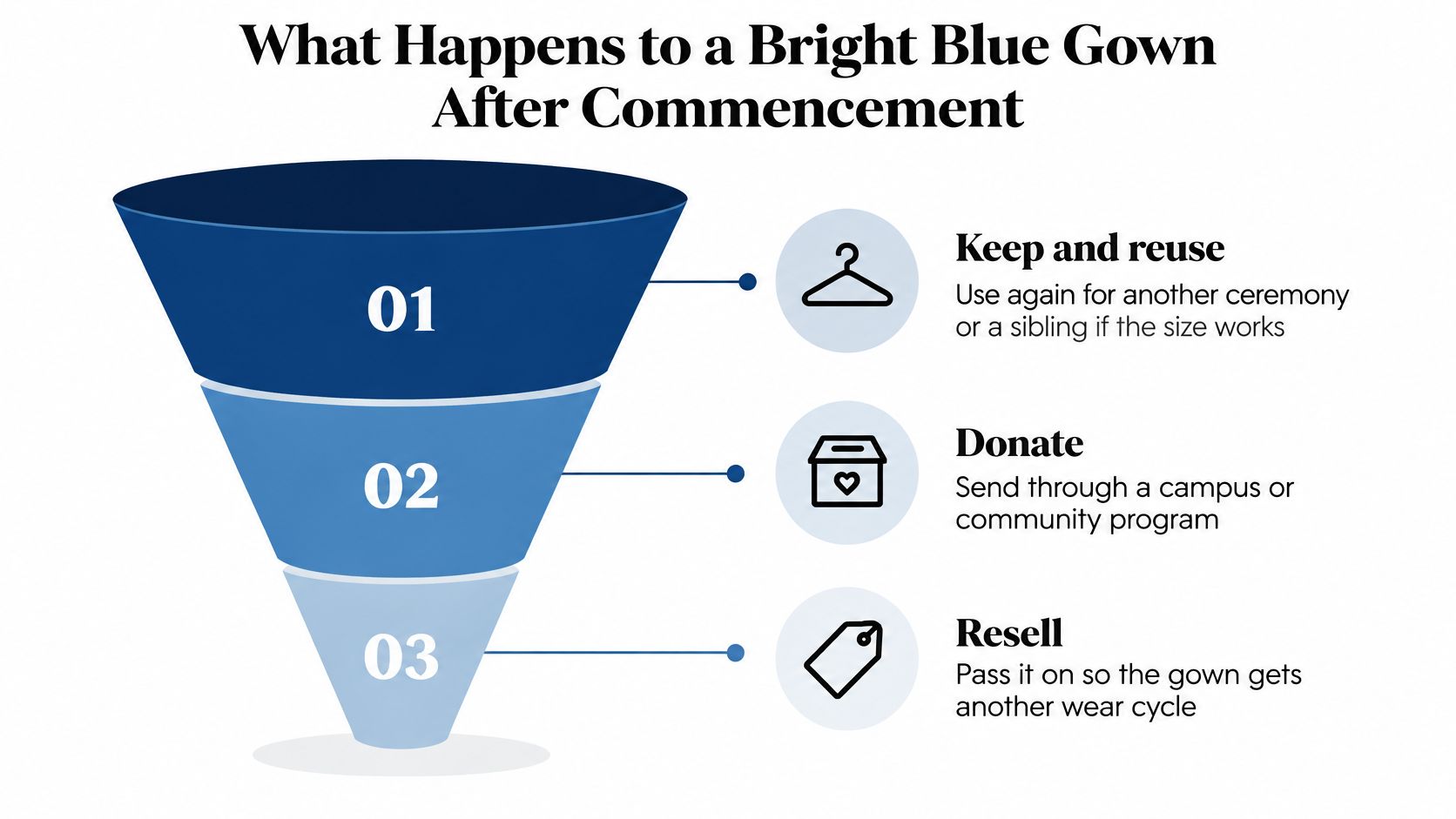
A gown earns its keep one ceremony at a time, and the more graduations it survives, the greener it gets. After yours, work through this order: keep and reuse it if another ceremony or a sibling can use the size; donate it through a campus or community program; resell it locally; recycle it when reuse isn't practical. UCLA's 2025 graduation guidance recommends recycling or donating caps and gowns because graduates may not wear them again, as explained in its green graduation tips. Donation and resale both go smoother when the set is complete and clean; a lone gown with no matching cap or tassel is harder to pass on.
Royal-blue school branding and recycled fabric can coexist. Universities have ordered commencement gowns in their signature blue made from post-consumer recycled material. Recycled content alone still leaves the bigger questions open: whether the gown gets a second wearer, whether a color-specific size run becomes overstock, and whether renting beats buying for a one-day event.
Whether polyester keeps its color comes down to dye chemistry and light exposure, and the color name printed on the label has no vote in the matter. Textile testing exposes dyed material to controlled light and compares it with an unexposed control. In a peer-reviewed test of disperse-dyed polyester, researchers used 35 hours of xenon-light exposure and reported strong resistance to rubbing, washing, perspiration, and light; titanium-dioxide nanoparticle treatment improved light-fastness in the tested formulas, according to this textile color-fastness guidance and study.
Dark, saturated blues can transfer color or fade unevenly where gowns rub against seats, stoles, or garment bags. For reusable stock, inspect the shoulder seams, sleeve edges, and folded panels after storage and transport, and set aside garments with obvious transfer or panel-to-panel variation.
For a bulk order, choose durable seams, standardize sizes where possible, and plan the color across multiple ceremonies. A take-back that collects gowns as graduates exit, culls the damaged pieces, and shelves the rest for the next class keeps usable stock circulating year after year, so the school avoids sitting on a one-year surplus of identical gowns.
Order the Gown Your School Requires
A gown can match the school color perfectly and still be the wrong gown. Royal blue tells you almost nothing about compliance, because the same shade can sit on the gown at one school, on the hood trim at another, and on nothing at all where black is required. The only document that settles the question is the school's written regalia page, so the ordering process below turns those instructions into a purchase specification.
- Read the commencement or regalia page. Copy the required color, degree level, gown type, and pieces. Record whether blue applies to the gown, the hood, the trim, or another item.
- Find the school's regalia listing. Graduation Attire's Find Your University feature helps customers locate their school's regalia instead of searching by color alone.
- Write one complete specification. Include the institution, degree level, gown silhouette, exact color reference, accessory colors, and whether the school has approved the set. For Deluxe Bachelor and Master gowns, Graduation Attire offers custom colors and embroidery with no minimum order, so a spec can note those details before purchase rather than after.
- Resolve hood colors before ordering. If the velvet or chevrons are not clear, Graduation Attire can help determine the proper colors for an academic hood, and its customer service staff can help customers order the correct colors for a gown, hood, and tam.
- Request samples for a large order. For potential orders of 100 or more cap, gown, and tassel sets, Graduation Attire sends free samples after a request is approved through the sample set request form.
- Check the delivered order against the spec. Lay the gown, hood, and accessories out together when they arrive and confirm each piece matches the written specification, including degree level and accessory colors, before the ceremony deadline leaves no room for a swap.
- Confirm sizing and delivery. Check height and build against the school's size guidance or the graduation gown size chart, then confirm how many pieces the school allows. Keep the approved specification, swatch reference, and delivery date together in one order note so you can check the order against the commencement page if the rules change.
Graduation Attire sells regalia for Pre-K and high school through associate, bachelor's, master's, doctoral, and faculty levels, with high school cap-and-gown packages and doctorate packages available in all sizes and colors. Whatever a retailer charges, a lower price on its own cannot confirm that a shade or cut meets your school's rules. Cost answers a budget question. Only the written spec answers the compliance question.
Keep the final order tied to the written spec, not just the phrase "royal blue." A flattering match is nice; a gown that follows the school's requirements is the right one to wear.
Choose your gown, hood, and accessories from the school's written specifications, then use Graduation Attire's university finder and regalia options to match the required pieces. Visit Graduation Attire to find regalia for your degree level and get help confirming the colors for your ceremony.